Scoot will commence flights to Berlin in 2H2018, its second European and third longhaul destination.
The airline intends to launch ticket sales for Berlin in 1Q2018. Subject to regulatory approval, the four-times-weekly Singapore-Berlin flights will be operated with Boeing 787 Dreamliners.
Scoot’s Boeing 787 Dreamliner
Lee Lik Hsin, Scoot’s CEO, said: “Scoot’s merger with Tigerair Singapore earlier this year has greatly strengthened our position, standing us in good stead to launch and sustain our longhaul operations. Athens has lived up to our expectations while bookings for Honolulu have been very promising.”
Scoot’s current route network comprises 62 destinations across 16 countries, with services to Honolulu launching this month, and Kuantan flights commencing in February 2018.
A Taiwanese e-commerce and blockchain company is bringing to the market what it claims is the world’s first blockchain hotel management service.
Darren Wang, founder and CEO of OwlTing, said: “With the launch of OwlNest, our team, already working with hotels and hostels in the US, Taiwan, Japan, Malaysia, will bring OwlNest to over 30,000 hotels by 2019. We expect the advanced blockchain technology behind OwlNest to create huge value for hotels and travellers by solving critical pain points.”
The OwlNest Blockchain Hotel Management Service will be an incorporated accommodations management platform to assist hotels around the world
OwlTing said it is essential for hotels to strike a balance between pricing for visibility on major OTA channels and pricing for profitability on their own websites. Hotels also need to better understand their returning customers and adjust marketing strategies more proactively, which OwlTing said incumbent technology solutions cannot fulfil.
OwlNest Blockchain Hotel Management Service, through a cloud-based and integrated platform, aims to help hotels reduce operating costs and improve customer experience and profitability.
In a statement, the company elaborated that its services could help hotels design customised pricing packages, identify returning customers, collect customer preferences and automatically adjust promotion campaigns for seasonality and customer behaviour more easily.
The platform’s scalable design also enables hotels to earn more revenue by adding on-premise services, local experiences and other travel partners to an integrated dashboard.
OwlNest also supports multiple payment gateways such as credit card, PayPal, WeChat Pay, Alipay, Apple Pay, and other blockchain-based payment services in the future.
Who better to get Amazing Thailand Tourism Year 2018 off to a bright and beautiful start than this bevy of flight attendants from Thai Airways International, Thai Smile, Bangkok Airways, Thai AirAsia and Thai Lion Air?
They joined a parade held by the Tourism Authority of Thailand in collaboration with tourism organisations at the Siam Discovery Center in Bangkok recently.
Location The St Regis Kuala Lumpur is within walking distance to KL Sentral station, a hub for the city’s three different rail lines including the KLIA Express that travels between both international airports (KLIA and klia2) and KL Sentral station. The hotel also offers shuttle services to the station.
The hotel is located close to the city’s largest park, Perdana Botanical Garden, and Islamic Arts Museum. Kuala Lumpur Convention Centre and the retail offerings of Jalan Bukit Bintang are just 10-15 minute drive away.
Caroline Astor Suite
Room The hotel has 208 guestrooms range from 63m2 for rooms to 138m2 suites, some of the largest in the city.
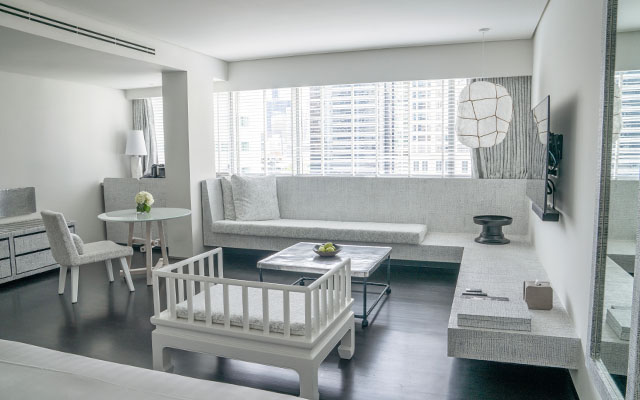
I stayed in a one-bedroom suite, which has a large living room, dining table, lounge area and work space. The bedroom comes with a walk-in wardrobe with ample closet and luggage space.
I was impressed by the detail that went into the suite, such as the safe concealed behind wall panelling. It was so well hidden I would not have noticed if my butler, Wan, hadn’t pointed it out.
St Regis Kuala Lumpur’s lobby
Facilities The hotel has every facility a bleisure client would require – from a gym and fitness instructor who can help create a personalised programme, to a spa, swimming pool and yoga room.
I thoroughly enjoyed my hour-long foot massage at the spa. The Jacuzzi is also memorable as the water was warm and the jets powerful, just the way I love my hot tub dips.
For meetings, the grand ballroom stands out with its digital canvas of 47 LED screens that surround, enabling organisers to have high impact presentations. This is complemented by 16 versatile meeting rooms.
F&B The hotel offers six dining options. I was impressed by the Japanese restaurant, Taka by Sushi Saito, which features creations of three-star Michelin chef Takashi Saito in his only venture outside of Tokyo. I’ve always been hesitant about Japanese cuisine, but the Tako (octopus dish) and Otoro (tuna belly), the best sushi I’ve ever tasted, changed my mind.
The hotel is also known for afternoon tea at The Drawing Room, featuring cakes and entremets.
At Botero, the sommelier hospitality and ornate ambience cresated by Botero’s 3m-high horse sculpture captivated me.
I had breakfast at The Brasserie, and enjoyed local favourites such as Roti Canai and Nasi Lemak. In the evenings, the space transforms into a contemporary French-Mediterranean bistro.
Service As one would expect of a St Regis, the service was excellent with attentive, friendly staff who anticipated my needs before I realised them myself.
I was completely indulged by the 24/7 butler service, a brand signature. Butlers take guests to their rooms and help them settle in – setting up Wi-Fi on all devices, offering complimentary garment pressing, unpacking and packing, and help with making external reservations. I was thoroughly pampered throughout my stay.
Verdict An unforgettable experience with personalised anticipatory attention from butlers.
No of rooms 208 Rates From RM800+ (US$195) per room per night Contact details
Tel: (60)-3-2727-1111
Email: stregis.kualalumpur@stregis.com
It is essential that tourism is sensitively managed if the target of attracting four million visitors to the Mekong River by 2020 is achieved, tourism stakeholders warn.
At 4,350km in length, the Mekong River runs from China to Vietnam, slicing through six countries that offer varying cultures, traditions and experiences. And with many communities living on its banks relying on the waterway for survival, river-based tourism is emerging as a sector that has huge untapped potential.
Tourism stakeholders fear that if river tourism to the Mekong is not managed properly, will lead to negative impacts on the environment and congestion; Mekong River, Vietnam, pictured
The opportunity to develop river-based tourism is growing exponentially, said Jens Thraenhart, executive director of Mekong Tourism. He added: “We want to grow the cruise industry to more than four million passengers on the Mekong by 2020. People are looking for experiences of a lifetime and the Mekong region has the potential to deliver that.”
However, Pierre-Andre Romano, general manager of EXO Cambodia, expressed fears that this volume of visitors may lead to congested waters and have a negative impact on the environment, if managed incorrectly. He added huge investment would need to be ploughed into developing adequate infrastructure, such as docking facilities.
He said: “The boats cannot sail all year round so care needs to be taken that the waters don’t become too crowded.”
Thraenhart said the emphasis needs to be on developing more boutique tours and cruises, in line with community-based tourism models. He said several deluxe offerings have launched in recent months, paving the way for more to follow.
But Christopher Gramsch, Khiri Laos general manager, said developing river-based tourism in Laos is becoming increasingly challenging due to the volume of dams being built in the country’s drive to become the battery of South-east Asia.
It was recently announced boat trips on the Nam Ou are no longer possible between Muang Khua and Muang Ngoi.
He said: “This was one of the last scenic boat cruises we could offer clients. It seems the energy sector is more important than ecology and tourist boat cruises. The dams clearly have impacts on the tourism sector, and are a problem not only for Southern Laos but also for Cambodia and Vietnam.”
Millennium Hotels and Resorts' Lee Richards with M Social's Aura
M Social snagged a double win at the International Data Corporation Asia/Pacific’s inaugural IDC Digital Transformation Awards for its efforts to address manpower shortages with innovative solutions.
The two awards – “DX Leader for Operational Transformation in Singapore” and “DX Leader for Operational Transformation in the Region” – were in recognition of the hotel’s introduction of the region’s first Front-of-House Autonomous Service Delivery Robot, or AURA.
Millennium Hotels and Resorts’ Lee Richards with M Social’s Aura
AURA has been integrated with various subsystems in the hotel, such as networks, elevators, and telephony.
“I believe (such solutions) enables us to stay relevant in the face of manpower crunch and business disruptions,” commented Kwek Leng Beng, chairman of Millennium & Copthorne Hotels (M&C).
“We have been heeding the government’s push for automation. After the success of AURA, M Social (more) recently debuted a second robot AUSCA, the world’s first robot chef that can serve up egg dishes for dining guests,” he added.
“Earlier this year AUSCA, the world’s first Front-of-House Autonomous Service Chef Robot prototype, started work at M Social’s Beast and Butterflies restaurant, making sunny-side up and omelette dishes for guests,” said Lee Richards, vice president of operations Singapore for Millennium Hotels and Resorts.
AURA will be rolled out to other M&C hotels in Singapore hotels next year, according to Richards.
All Blacklane rides are now green, with the company committed to offsetting the carbon footprint of all rides across the 250 cities and 50 countries it operates in.
This is believed to be the first time a ride service is launching a global carbon-neutral programme. Blacklane offsets carbon emissions by funding a wind farm near Pune, India, where 40 wind turbine generators produce electricity with no fossil fuel consumption.
Reduce your carbon footprint with Blacklane
Jens Wohltorf, CEO and co-founder of Blacklane, said: “Quality rides (that do not) compromise the environment benefit travellers, drivers and the world. They also align companies’ business travel needs with their sustainability goals.”
To deliver its promise, Blacklane is partnering Carbon Footprint, the UK government’s provider, to offset ministerial travel carbon dioxide emissions. The company calculates Blacklane’s carbon emissions based on ride distances and vehicles in the fleet.
Amanyangyun, the fourth Aman location in China and the first in Shanghai, will open on January 8, 2018, after a 15-year-long relocation of a Jiangxi forest and reconstruction of a historic village.
Fuzhou-born entrepreneur Ma Dadong and Aman had worked together to oversee the transportation and replanting of 10,000 trees – including the 80-tonne Emperor Tree – and the disassembly and rebuilding of 50 antique houses, which were displaced by a new reservoir project in Fuzhou.
Amanyangyun is the result of a 15-year-long conservation initiative
On the 10ha Amanyangyun 27km southwest of Shanghai, the 50 disassembled antique houses have been restored into 26 guestrooms, 13 of which are four-bedroom Antique Villas measuring 8002 to 1,000m2, and including a private pool and Jacuzzi as well as a courtyard. Amanyangyun will also offer 24 newly created 65m2 Ming Courtyard Suites, with two private courtyards attached to each.
Aman Residences converted from 12 of the historic homes will also be available.
On the grounds of Amangyangyun is Nan Shu Fang, which also made the journey from Fuzhou, a modern-day recreation of a 17th century scholars’ studio. Guests can use this space to practise traditional crafts such as calligraphy, music and painting, or to watch one of Amanyangyun’s Kunqu Opera performances.
Another highlight is the 2,840m2 Aman Spa – one of the largest in the Aman collection – housing eight treatment rooms, two double spa suites, relaxation areas, a sauna, plunge pool, Jacuzzi and two swimming pools; indoor and out.
The spa building will also house the fitness and movement centre, while the Cultural Discovery Centre will welcome children age five to 12, and have a dedicated programme for teenagers. Programmes include wetland visits, classes on Chinese farming techniques, lantern making, paper cutting, pottery moulding and tea ceremonies, as well as Chinese shadow puppet shows.
The property will offer five restaurants and bars – Chinese restaurant Lazhu pays homage to Jiangxi province; Japanese restaurant Nama; the lakeside Arva for Italian farm-to-table style dishes and sharing plates; The Bar and Cigar Lounge; as well as the 200-seat Banqueting Room.
Other facilities include a 200m2 herb garden and 25-seat cinema.
Chinese president Xi Jinping issued a directive last Monday for continued efforts in improving the country’s toilet conditions, in order to encourage greater domestic tourism and international arrivals.
The campaign, termed ‘toilet revolution’, was first launched in April 2015 to upgrade hygiene and living standards in both rural and urban areas, reported Xinhua News Agency.
Public toilets on Tiananmen Square in Beijing
The China National Tourism Administration recently announced plans to build and upgrade 64,000 toilets between 2018 and 2020.
In his recent address, Xi urged the country to maintain its efforts in improving public toilets, announcing: “This work must be a concrete part of advancing our country’s revitalising strategy and we must make great efforts to fill these shortcomings that affect the quality of life of the masses.”
Under the ‘toilet revolution’ campaign, the central government has reportedly pumped more than RMB1 billion (US$150 million) into revamping more than 68,000 public toilets, exceeding its initial three-year goal of 57,000.
An example includes popular Beijing tourist attraction Temple of Heaven, a park whose toilet-paper dispensers are fitted with facial recognition technology that limits each user to 60cm of paper every nine minutes.
Hamersley Gorge in Karijini National Park, Western Australia
Tourism Western Australia (Tourism WA) has teamed up with Travelport to promote Perth and Western Australia to travel agents within Australia.
The targeted trade campaign has been launched since October 16 to stimulate interest among travel agents within Australia, raise awareness of destination experiences and spur more tourist arrivals.
Hamersley Gorge in Karijini National Park, Western Australia
Over the past month, the campaign engaged over 200 agents who have completed a mini-training portal and referred friends and colleagues to participate in the training, according to Tourism WA.
Based on bookings done on Travelport’s platform, there was a 16 per cent growth in October for WA, compared to the same period last year.