TTG Asia
Asia/Singapore Wednesday, 6th May 2026
Page 1540

Next 50 years of ASEAN tourism

2
Raini Hamdi

When I think of the next 50 years of ASEAN tourism, I shudder. Perhaps it’s because I’m writing this at the end of the year, when throngs of tourists are queueing to get through Thai immigration in Bangkok. Thailand’s 34 millionth visitor was decorated on December 22; and the kingdom will, without a doubt, achieve their tourism earnings target – US$50 billion – for 2017.

ASEAN, not just Thailand, is doing extremely well. Just look at WTTC’s report on the world’s 10 fastest-growing tourism cities. Manila, Kuala Lumpur and Jakarta are on the list, with 10 to 11 per cent growth per year over the next 10 years, outpacing Asia-Pacific’s average growth rate of 5.8 per cent and the world’s average of four per cent.

Such exponential growth is what makes me shudder. As ASEAN tourism leaders and industry members meet at ATF 2018 in January in Chiang Mai, I hope they will give some thought as to how ASEAN destinations might look like 10, 20, 50 years from now.

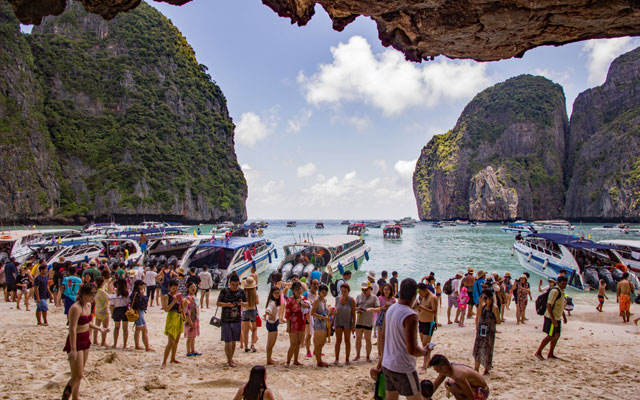
It is no secret that in the last 50 years of ASEAN tourism, progress has come with ill effects: once-pristine resort destinations have turned crappy and cheap; cities immobilised by traffic jams, heritage sites ruined by too many footfalls. How might ASEAN destinations look like in the future if many of them aren’t able to cope with tourism growth now, or are not setting up the infrastructure that will enable them to reap growth without betraying their land, people, values, culture and heritage?

Tourism is easy money, especially with the rise of Asia’s middle income group and the expansion of low-cost carriers. No need to convince governments of tourism’s contribution to the economy. What’s needed is the reverse: convincing governments of the need to protect their country from tourism – specifically ‘over-tourism’ and unsustainable tourism development.

ASEAN turned 50 in 2017 and it’s bittersweet that it also lost its much-admired former secretary-general (2008-2012) and former Thai foreign minister, Surin Pitsuwan, who died of an acute heart attack on November 30. At ATF this January, it will be wonderful if we could take a minute to digest Surin’s last words on tourism which, befittingly, was about sustainability.

The “tapestry of contrasts” of ASEAN’s 10-member countries made it such an attractive destination and, because of this diversity, the regional travel and tourism industry should pay equal attention to the socio-cultural and political-security blueprints of ASEAN, “not just economic, economic, economic all the time”, Surin had said.

“If we are not careful, we will have problems of congestion and environmental impact, which will also impact the cultural resources that we value.

“Tourism is supposed to be one activity that creates opportunity for everyone. Let us make the ASEAN destination attractive, sustainable, accessible and playing the role of equalising that income. Tourism is a goose laying golden eggs. We can’t starve it, nor can we over-feed, nor ignore it, nor take too much advantage of it.”

Philippine associations join forces to reclaim passport processing role

0
Agents in the Philippines lobbying for passport processing roles to be restored

Six Philippine travel agencies associations have joined forces in a bid to restore their passport processing services, which the Department of Foreign Affairs (DFA) temporarily shelved in July last year.

The coalition comprises the Philippine Travel Agencies Association (PTAA), Philippine IATA Agents Travel Association (PIATA), Network of Independent Travel Agencies (NITAS), National Association of Independent Travel Agencies (NAITAS), Central Luzon Association Organization of Accredited Travel Agents (CLOATA) and Pampanga Agents Travel Society.

Agents in the Philippines lobbying for shared passport processing responsibility

The associations said in a press conference Tuesday afternoon that “the solution is to apportion the responsibility and not to block accredited travel agents from assisting the government”, especially as the DFA has acknowledged that it is going to face serious backlogs with the increase in passport applications.

The 1,000 daily passport processing allocation for the 276 DFA-accredited agencies was in 2012 reduced to a cap of 500, and in July last year completely removed with DFA citing the need to weed out unscrupulous individuals selling bogus appointments for passport processing.

But NITAS vice president Angel Ramos Bognot countered that “up to this date, no single travel agency was convicted of a crime against the sanctity of passport processing,” adding that agencies could not engage in such illegal activities given the stringent accreditation rules, US$4,000 surety bond and payment of passport fee prior to processing.

“NITAS, which has more than 300 members nationwide, suffered much from this unfair government action and resulted in the closure of some of its members”, Bognot emphasised.

DFA’s removal of agencies’ passport processing service came at a time when travel was entering its peak season last year, resulting “in loss of business” for many agencies as passport processing services made up 15 per cent of revenue stream for some members, according to PTAA president Marlene Jante.

“Even if agencies are still given the same 1,000 slots daily today, that would only be seven per cent of the total passports being processed by the DFA which is now at 14,000 daily”, added Jante.

PTAA executive vice president Patria Chiong urged the DFA to recognise the role of travel agencies in assisting travellers.

As well, CLOATA president Lerma Quiambao pointed out that outbound tour and corporate clients would usually request agencies to assist with their passport processing.

Bognot further underscored the service value that travel agencies offer to travellers in an archipelagic country, making it difficult for those in the provinces to apply for passports and meet the requirements of DFA, which are subject to change from time to time.

The Travel Corporation launches B2B2C portal for agents

0
Travellers can view itineraries on their mobile device, interact with travel agent and fellow travellers

The Travel Corporation (TTC) has launched an integrated online platform for agents to procure TTC products and provide customer care to their clients.

My Travel Portal (MTP) is a streamlined system on which agents can store and access client emergency contact details and obtain travellers’ personal preferences.

Travellers can view itineraries on their mobile device, interact with travel agent and fellow travellers

Meanwhile, travellers can also create a profile on the portal to view itineraries on their mobile device, interact with their travel agent and fellow travellers, share holiday snaps on social media and record trip notes.

At its initial launch, the platform encompasses Trafalgar, Contiki, Insight Vacations, Luxury Gold and CostSaver. U by Uniworld and Uniworld will be introduced later this year, followed by additional brands from the TTC portfolio.

TTC has also partnered with non-profit organisation One Tree Planted, pledging to plant a tree for every guest who opts out of printed travel documents on the portal.

Agents can access MTP via www.trafalgar.com/agents#SSOTA_LoginAndRegister.

Six Senses’ first city hotels to debut in Singapore

1
Six Senses Duxton will feature 49 guestrooms, each unique

Six Senses has chosen Singapore to launch its first city hotels, set to open later in the year with a heritage focus.

Six Senses Singapore will be split into two buildings – both of which are restored as part of a conservation project – with Six Senses Duxton opening first in April 2018, followed by Six Senses Maxwell three months later.

Six Senses Duxton will feature 49 guestrooms, each unique

Restored under designer Anoushka Hempel of London’s boutique Blakes Hotel acclaim, the building in Duxton will feature 49 guestrooms and suites, a restaurant, as well as a mix of Chinese, Malay and European style elements.

One highlight is the on-site traditional Chinese doctor offering readings, health recommendations and a medicinal herbal dispensary.

Meanwhile, Six Senses Maxwell will boast 138 guestrooms and suites, a Six Senses Spa, outdoor lap pool, champagne bar and lounge, whiskey bar, boardroom and club lounge. A verandah follows the length of the building and will serve as a space for refreshments and alfresco dining.

Guests at the hotels, situated a walking distance apart, can make use of all facilities and service in both properties.

Both properties will be launched bearing recognition from Singapore’s Urban Redevelopment Authority Architectural Heritage Award.

Former Four Seasons exec named CEO of Jumeirah

0

Dubai-based luxury hotel company Jumeirah yesterday appointed Jose Silva as its new CEO.

Silva brings over 35 years’ experience in the hospitality industry, including almost 25 years with Four Seasons Hotels & Resorts. In his last role, he was regional vice president overseeing France, Switzerland, Spain and Portugal as well as general manager of Hotel George V in Paris.

As CEO of Jumeirah, Silva will be responsible for its international expansion, and for elevating the brand and its growing portfolio.

Jumeirah manages 19 properties around the world with 25 properties under development.

What to look forward to at ATF 2018 in Chiang Mai

0
ATF 2018 will take place at the Chiang Mai Exhibition and Convention Centre

As Thailand readies to host the 37th ASEAN Tourism Forum (ATF 2018) in Chiang Mai from January 22 to 26 under the theme of ‘Sustainable Connectivity, Boundless Prosperity’, the Tourism Authority of Thailand (TAT) has unveiled programme activities along with a list of pre- and post-event tours covering local and neighbouring destinations.

Notable activities for this year’s show include the ASEAN MICE Conference hosted by the Thailand Convention and Exhibition Bureau, and the ASEAN Gastronomy Conference by the Ministry of Tourism and Sports.

ATF 2018 will take place at the Chiang Mai Exhibition and Convention Centre

Additionally, a ministerial meeting with China will be held as part of ATF for the first time.

PATA will also host a Destination Marketing Forum 2018, while UNWTO will launch the Open Thailand Tourism Story Book.

As well, the Travex will see 323 booths for 275 organisations, with Thailand making up the biggest seller contingent with 146 booths from 117 organisations, plus 41 booths from Singapore, 40 booths from Malaysia and 31 booths from Indonesia.

ATF 2018 is expected to welcome 240 buyers (hosted 205, non-hosted 35) with 25.8 per cent from around the ASEAN region; 47.1 per cent from the EU; 16.7 per cent from the Americas and the remaining 10.4 per cent from other Asian countries.

Meanwhile, local tours will be conducted on the afternoon of January 23, departing from official ATF hotels. Offered free of charge on a first-come-first-served basis, the six routes consist of nature trails, ‘Follow the King’s Footsteps’ at the Royal Agricultural Station Inthanon and Hmong farmers’ market as well as ‘Earth Experience’ at the Queen Sirikit Botanic Garde.

The remaining four tours are the ‘Art of Thai Ways’ at Ban Celadon, ‘Home Cooking Experience’, ‘Local Recipe Walking Journey’ and ‘The Middle Way in Buddhism’.

Tours that cover neighbouring destinations will run after the show (January 27-29). The 3D2N options are priced at US$300, and include ‘Embrace the Heart of Andaman Blue Sea’ route (Phuket – Phang Nga – Ranong) and ‘The Horizon Heritage’ tour which links Thailand’s Northeastern provinces of Udon Thani and Nong Khai with Vientiane in Laos.

Attendees can also choose from three-night options priced at US$500 – ‘The Memorable Antique Cultures’ that connects Chiang Rai with Myanmar’s Kengtung and the ‘Ancient of the East’ that combines Thailand’s Eastern province of Chanthaburi and Prachin Buri with Cambodia’s Siem Reap.

Air India to be privatised, split into four units for sale

0
Air India to be privatised (photo credit: Joe Ravi/Shutterstock.com)

Uncertainty about the fate of India’s debt-laden flag carrier Air India continues to loom with the government reportedly divesting its stake in the airline by breaking it up into four units and offering at least 51 per cent of each for sale.

Bloomberg reports that as part of the divestment plan, Air India and its LCC arm Air India Express will be offered as one company; and its regional arm, ground handling and engineering operations will be sold separately. The whole process is expected to be completed by year-end.

Air India to be privatised (photo credit: Joe Ravi/Shutterstock.com)

Along with this came the decision that foreign entities will be allowed to own 49 per cent in the airline without need for government approval. Since this was announced, some reports have suggested that Singapore Airlines and the Tata Group are open to bidding. SIA and Tata Son, holding company of Tata Group, are joint owners of Indian domestic airline Vistara.

Meanwhile, the Economic Times of India reported that AirAsia India has ruled out plans to participate in the stake sale.

Aviation roundup: SIA, Hainan Airlines and American Airlines

0
Photo credit: Airbus

SIA to deploy A380s on London, Hong Kong routes
Singapore Airlines (SIA) will soon deploy its new Airbus A380 on its London and Hong Kong routes, after debuting the aircraft on flights to Sydney last December.

Starting February 16, the aircraft will operate as SQ322 (Singapore-London) on Wednesdays, Fridays and Sundays. And on the London-Singapore sector, it will operate as SQ305 from February 17 to April 5; and as SQ317 on Mondays, Thursdays and Saturdays with effect from April 7.

From February 18 to April 6, the new A380s will also be deployed on services to Hong Kong, operating on Tuesdays, Wednesdays, Fridays and Sundays as SQ860 (Singapore-Hong Kong) and SQ863 (Hong Kong-Singapore). With effect from April 8, the aircraft are scheduled to operate on Tuesdays, Wednesdays, Fridays and Sundays as SQ856 (Singapore-Hong Kong) and SQ861 (Hong Kong-Singapore).


Hainan Airlines to begin Shenzhen-Brussels flights
Hainan Airlines will launch twice-weekly services between Shenzhen and Brussels on March 20, 2018. Served by a Boeing 787 aircraft, flight HU759 departs Shenzhen at 12.00 on Tuesdays and Thursdays for arrival in Brussels at 17.30. The return flight (HU760) leaves Brussels at 19.30 and arrives in Shenzhen at 13.50 the next day. From March 25 onwards, flights will arrive at and depart Brussels an hour later (i.e. 18.30 arrival and 20.30 departure).


American Airlines, China Southern enter codeshare deal
American Airlines (AA) and China Southern will today begin their reciprocal codeshare partnership. With the agreement, American Airlines now offers China Southern-operated flights from Beijing to Chinese destinations counting Changchun, Changsha, Chongqing, Dalian, Guangzhou, Harbin, Nanning, Shenyang and Shenzhen. In turn, China Southern passengers will be able to enjoy AA connections from Los Angeles to Charlotte, Chicago O’Hare, Houston, Philadelphia and Phoenix, as well as from San Francisco to Dallas/Fort Worth and Phoenix.

Upcoming election dampens Malaysians’ mood for CNY travel

0

Forward bookings for travel during the Chinese New Year festive period are down significantly this year, revealed outbound agents in Malaysia, citing anticipation of the upcoming general election as the main reason for the slowdown.

While no date has been fixed for the nation’s 14th General Election, there are rumours it will be held soon after the Chinese New Year holidays. The current parliamentary term began on June 24, 2013, with re-election due by June 24.

Travellers at Kuala Lumpur International Airport

Syed Razif Al Yahya, group managing director at Sutra Travel & Tourism Management Group, said: “We see a double-digit shortfall compared with last year. The general election is a business opportunity for people providing services for the general election as well as those who will be directly involved with campaigning and general election duties. For such people, the mood to travel will not be there until after the general election is over.”

However, travel for meetings and incentives are unaffected, he revealed. The company has two incentive groups from the banking industry, each with 200 delegates, travelling to Eastern Europe in late February.

Another outbound agent, Adam Kamal, manager at Aidil Travel & Tours, said forward bookings are down by some 30 per cent.

He said: “There is no point doing promotions to spur demand because people are choosing not to travel during this period in anticipation of the general election and the campaign period prior to the election.

Sharing booking patterns of those who are still travelling, he said: “Beach destinations Phuket, Bali and Boracay are favoured. If it is a city holiday, it is to Bangkok and Siem Reap.”

Raaj Navaratnaa, general manager at New Asia Holiday Tours & Travel, anticipates domestic travel demand will be as strong as last year due to its appeal to price-conscious travellers.

He noticed a growing trend of family travel to experience village lifestyle in lesser-known tourist destinations such as Betong, Kuala Pilah and Endau, a town in Mersing district.

Hostel market booming in SE Asia: C9

0
Established hospitality chains moving into hostel markets

South-east Asia’s hostel market experienced “skyrocketing growth” in 2017, surging 32 per cent in bed inventory, according to the latest Hostel Market Update by C9 Hotelworks.

The surge brings the bed count in the region to 63,632 across 1,766 properties, led by Thailand with a 41 per cent share.

Thailand now has 722 hostels and 25,207 beds, up 28 per cent year-on-year. Other hostel market leaders in the region are Vietnam, with 221 hostels and 7,763 beds, a bed supply increase of 41 per cent year-on-year.

Top five hostel markets in the region

Bill Barnett, managing director of C9, observed “no sign of deceleration as investment is being embraced by an increasing number of hospitality groups and institutional investors”.

Indeed, the report shows conventional hotel companies investing in hostels, highlighted by Lub d, the region’s largest and fastest-growing hostel group.

Despite the influx of capital into branded hostels, independent hostels continue to dominate the regional market, with 1,532 properties representing 87 per cent of total supply.

C9 further reported that year-on-year market-wide ADR per bed (ADRB) declined with bed supply rising sharply. Singapore has the highest ADRB, followed by Myanmar and the Philippines.

Meanwhile, Barnett observed: “In past years, hostel developers maximised profits by developing properties with high bed inventory and no private rooms. However, micro-private rooms in hostels are becoming essential and impactful to rate yields. This can best be seen in the growth of hostels with private rooms in Indonesia, Thailand and Vietnam which now exceed 50 per cent of overall room inventory.

Going forward, C9 expects privacy will become more indispensible for hostels, prompting an exponential growth in private rooms.

C9 also foresees hostels will increasingly come under government scrutiny due to the growth of shared economy products such as Airbnb.

“Despite an elevated growth of supply, one considerable complication to the hostel market is the ambiguous rules and regulations; these have become a major concern in leading destinations such as Thailand, Malaysia and even Japan. While government regulation is starting to evolve, this remain a key sector issue,” Barnett said.