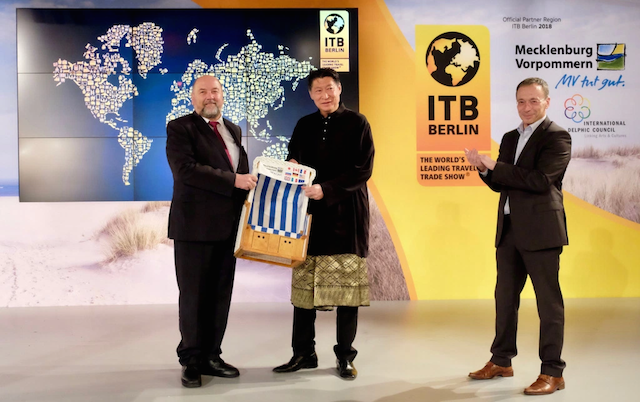
From left: Harry Glawe, economics minister of Mecklenburg-Verpommern hands baton to Siew Ka Wei, chairman of Tourism Malaysia, accompanied by Messe Berlin's Martin Buck
As ITB Berlin came to a close on Sunday, Malaysia picked up the baton as official partner country of ITB Berlin 2019 from 2018 partner Mecklenburg Verpommern during a handover ceremony.
The ITB partner country status in 2019 forms part of Malaysia’s broader “Visit Malaysia 2020″ plan, as the country aims to increase the number and spending of international tourists as well as awareness of its natural and human assets – including highlights such as Kinabalu National Park in Sabah, Gunung Mulu National Park in Sarawak, Malacca and George Town cities and the archaeological heritage of the Lenggong Valley.
From left: Harry Glawe, economics minister of Mecklenburg-Verpommern hands baton to Siew Ka Wei, chairman of Tourism Malaysia, accompanied by Messe Berlin’s Martin Buck
“Being placed on the world stage like this, even more than before, will be an essential part of our government’s strategy in putting Malaysia at the forefront of the minds of international tourists when they consider travel in this part of the world,” said the Siew Ka Wei, chairman of Tourism Malaysia.
As partner country, Malaysia will organise the opening ceremony on March 5, 2019 in the CityCube Berlin.
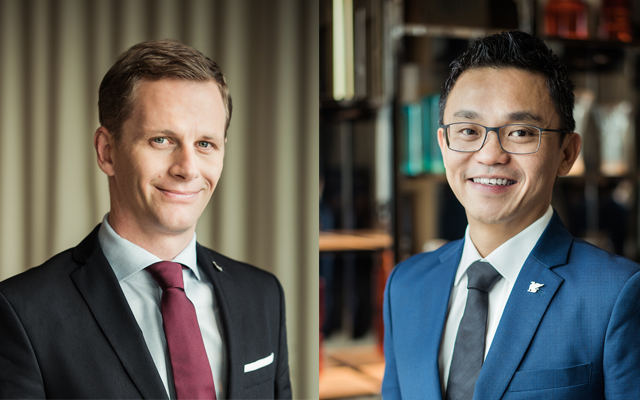
JW Marriott Singapore South Beach has named Oliver Sturmayr as hotel manager and Rex Loh as cluster director of sales & marketing.
In his new role, Sturmayr reports directly to JW Marriott Singapore South Beach’s managing director Stephane Fabregoul for all business- and operations- related matters of the rooms, F&B divisions and the Spa by JW.
Sturmayr (left) and Loh
Sturmayr started his career working in front-of-house roles at established restaurants in Austria and Germany before joining One&Only Resorts in various F&B-related appointments. His then took on the role of resident manager at One&Only The Palm, Dubai, before joining W Retreat & Spa, Bali, just prior to his current role.
Meanwhile, Loh will report to Fabregoul for JW Marriott Singapore South Beach and St Regis Singapore, as well as to Krister Svensson, general manager for W Singapore Sentosa Cove.
Loh boasts experience with the Shangri-La Hotel, Singapore; Ritz-Carlton Singapore and the InterContinental Hotels Group.
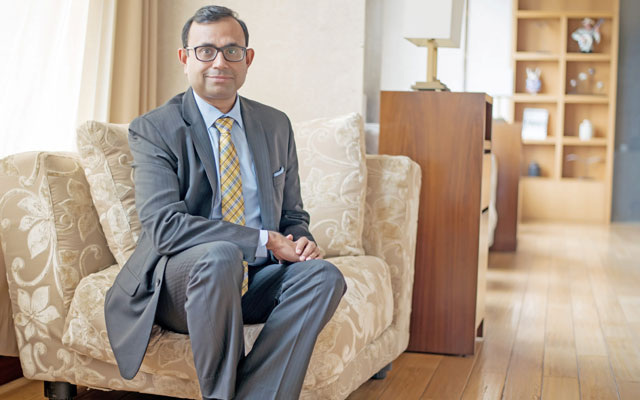
Aditya Shamsher Malla has been appointed general manager of DoubleTree by Hilton Pune – Chinchwad.
In his new role, Aditya will focus his efforts to deliver year-on-year growth, be responsible for staff engagement activities and spearhead corporate social activities.
An industry veteran with more than two decades in the business, Aditya has been a part of global brands such as Marriott International, Hyatt Hotels, Oberoi Hotels and Resorts, Starwood Hotels and Resorts, Shangri-La International, and Taj Hotels Resorts and Palaces.
Marriott International has appointed Brad Mercer as complex general manager of The Westin Brisbane and Four Points by Sheraton Brisbane.
In his new role, Mercer will oversee the opening of the 298-room Westin Brisbane (November 5, 2018), and take helm of all aspects of both hotels’ operation and performance.
Mercer will report to Sean Hunt, Marriott International’s area vice president, Australia, New Zealand and the Pacific.
Mercer steps into the role with 22 years of industry experience. He joined Marriott International in 2007 as executive assistant manager of The Westin Denarau, Fiji, before transferring to the Sheraton on the Park, Sydney in 2010 as hotel manager. In 2013, Mercer was appointed opening general Manager of Four Points by Sheraton Brisbane.
Chan says a third of earnings would go to taxes alone (photo credit: Sunway Lagoon)
A high tax rate on Malaysia’s amusement parks industry is putting the existence of theme parks at peril, said operators, as they struggle with high overheads and stiff competition from regional rivals.
Sunway Group, which operates Sunway Lagoon Theme Park in Sunway City and Lost World of Tambun in Perak, has shelved plans for a new theme park in Johor due to high taxes.
Sunway has been lobbying extensively for the removal of the 25 per cent entertainment duty since it came into effect for the theme park industry in 2014, said HC Chan, CEO of Sunway Malls & Theme Parks.
Chan says a third of earnings would go to taxes alone (photo credit: Sunway Lagoon)
Responding to an email enquiry, Chan commented: “In our view, this ‘killer tax’ is detrimental as it places the industry in a very disadvantageous position and literally kills the industry. Adding to the predicament, the inclusion of the six per cent GST on top of the 25 per cent entertainment duty means a huge 31 per cent in taxes is levied on the industry. This means one third of earnings go to taxes alone – a very unsustainable practice. No other countries imposed this kind of high taxes on the industry.
“The government has heard our views and understands where we are coming from. From a tourism perspective, there is a lot of potential from the development of theme parks as they not only contribute to tourism revenue but creates spinoff of ancillary services and employment which has a positive multiplier effect. We are hopeful the government will remove the entertainment duty imposed on theme parks.”
Jeffrey Hanafiah, chief marketing officer at Movie Animation Park Studios (MAPS), agreed with Chan’s views that the high taxes are harmful to the industry and may discourage tourists from visiting attractions in Malaysia as other ASEAN countries that offer similar attractions at lower costs.
To counter this, he opined: “To command a strong market share despite of a higher pricing, the park offerings have to be very unique and attractive so that people will believe that it is worth spending the money at the park.
That said, Animation Theme Park (ATP), the registered business for MAPS, was granted an exemption from the entertainment tax until December 31, 2017. The entertainment duty for 2018 is capped at five per cent and this is absorbed by ATP and not passed onto visitors, revealed Jeffrey.
MAPS, which opened last year, is developed and managed by ATP, a joint-venture between Perak State Development Corporation subsidiary PCB Development and RSG MAPS.
Tourism Authority of Thailand participating at the pavilion for the first time this year
ITB Berlin’s LGBT pavilion this year has gotten bigger and more diverse, with several Asian exhibitors expressing appreciation for a platform with which to raise awareness about LGBT-friendly destinations in the region.
“We’re trying to promote the whole of Japan as a LGBT-friendly destination, not just Kyoto,” said Shiho Ikeuchi, director, executive guest services/operations, Hotel Granvia Kyoto.
Tourism Authority of Thailand participating at the pavilion for the first time this year
“We have been participating in ITB Berlin for five years. Back then (Japan) only had four members in IGLTA (International Gay & Lesbian Travel Association). We now have 32 Japan members – and the number is growing,” she noted.
Ikeuchi shared that Hotel Granvia Kyoto has registered “a big increase” in the number of LGBT guests since it introduced events, such as weddings, catered to this niche segment.
Taking part at the LGBT pavilion for the first time this year was the Tourism Authority of Thailand, which has long been an active proponent of LGBT travel and is now raising awareness for the “openness and diversity” of the destination, said Chad Intrachooto, marketing executive, project & campaign (New York & Canada).
“I believe that the LGBT travel community knows of Thailand and have probably already travelled there before, but they may not know that we are an active supporter of the industry. Now they know how safe it is to travel to Thailand,” explained Chad.
He expressed confidence that more Asian members joining IGLTA will spur even greater awareness and diversity of LGBT products in the region.
The Indian tourism ministry will continue to have offices in the US, Germany, the UK, Dubai, Russia, China and Singapore
India’s Ministry of Tourism is trimming the number of overseas offices from 14 to just eight, the restructure being part of an integrated marketing plan for the financial year 2018/19.
In an exclusive interview with TTG Asia, Rashmi Verma, secretary, Ministry of Tourism, revealed that a “hub and spoke model” will now be adopted for its overseas operations.
The tourism ministry will keep its offices in the US, Germany, the UK, Dubai, Russia, China and Singapore
She elaborated: “A hub will overlook the operation in the region. We will have eight offices in key and emerging markets, and they will be supported by our marketing representatives and PR agencies. We, in conjunction with Indian missions abroad, are in the process of appointing marketing representatives and PR offices.”
Countries where India tourism offices will remain include the US, Germany, the UK, Dubai, Russia, China and Singapore.
In the past, the viability of some India tourism offices were questioned due to several vacant posts.
The National Institution for Transforming India (NITI Aayog) had in its three-year action agenda for 2017-2020 called for the ministry to focus on digital marketing and social media tools for more efficient destination marketing, and to conduct cost-benefit analysis of its overseas offices. NITI Aayog is the premier policy think tank of the Indian government of India, providing both directional and policy inputs.
“We impressed upon the tourism ministry to (revamp rather than close) the overseas offices as they have been in operation for decades and are instrumental in creating a positive image of our destination. Even if some offices are being shuttered, the ministry should continue its participation in travel trade exhibitions in markets where there are no offices,” remarked Pronab Sarkar, president of the Indian Association of Tour Operators.
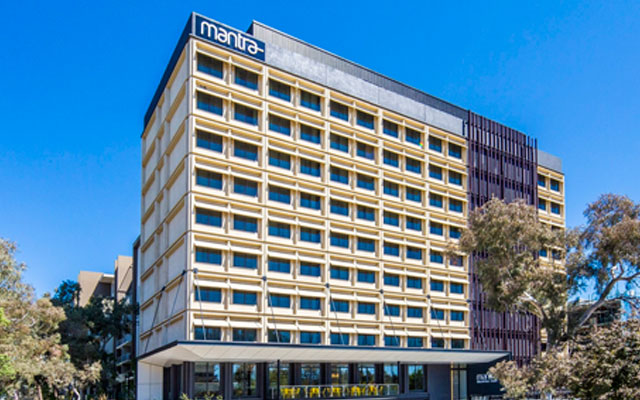
Accor takeover of Mantra on track; exterior of Mantra MacArthur Hotel in Canberra pictured
The Australian Competition and Consumer Commission (ACCC) has given the nod for AccorHotels’ A$1.2 billion acquisition of Mantra Group, after finding that two companies have little overlaps to give rise to anti-competition concerns.
ACCC chairman Rod Sims said: “The combined Accor-Mantra will still compete with other international and national hotel chains, as well as many independent hotels and accommodation providers.
Accor takeover of Mantra on track; exterior of Mantra MacArthur Hotel in Canberra pictured
“The combined Accor-Mantra will have a large number of properties in some areas, particularly in certain holiday destinations in Queensland. However, in each case and after a detailed review the ACCC has found that there are also sufficient other options nearby for visitors which will provide competition to Accor-Mantra,” Sims added.
Accor’s business is mainly focused on hotel-style accommodation and its brands include Sofitel, Novotel, Mercure and ibis. Mantra’s focus is on serviced apartments, which it offers through its Peppers, Art Series, Mantra and Breakfree brands.
The acquisition still requires approval from Mantra shareholders, as well as approvals from the Federal Court and the Foreign Investment Review Board.
Women have been asking for equal labour right and social status since the establishment of International Women’s Day in 1910. It is common sense for a responsible company to provide equal career development and remuneration for women. According to an Economist report, the rate of Chinese women’s participation in the workplace is almost 70 per cent, higher than most of developed economies like the US, Europe and Japan.
We are now in the midst of the Fourth Industrial Revolution, an era characterised by technological fusions and the integration of artificial intelligence, big data and cloud computing. This has catalysed our creativity and bridged the physical gap between individuals. Men and women have equal rights in intelligence and competency.
Sun: growing outbound share
Technology advancement has provided women with more opportunities and broader platform for career development. We have discovered that women also play a crucial role in Internet companies. In Bloomberg’s report, 17 per cent of venture capital companies’ partners are female in China. In the US, this number rests at 10 per cent. While 80 per cent of venture capital companies in China have at least one female partner, in the US, this is only 50 per cent.
Ctrip is a leading Internet travel company in the world and China’s largest. Women represent over more than half of our 30,000 plus employee base. This rate far exceeds the average Internet companies in China and Silicon Valley. Ctrip from day one, 18 years ago, has promoted gender equality. We recruit based on each employee’s competency level and we have a series of policies to encourage workplace growth for women. We adhere firmly to United Nation Women’s Empowerment Principles.
From our experience, women play important roles driving good corporate governance and fostering a culture of teamwork. Decisions made by female leadership are more meticulous and balances risk and reward better. Actions are executed with more communication, consideration and organisation. Fiscal policies are geared towards long-term sustainability.
Our female employees have fostered teamwork and communication, and are more open to different perspectives. This has complemented well with our male employee base that are generally very good at fast execution. Our organisational diversity and the qualities that women bring to the table has helped Ctrip generate large and sustainable investment returns for our stakeholders through the years. I feel it is critically important to encourage and incorporate the female voice. It will also help greatly to have more women leadership devote more time to provide guidance and become role models for aspiring women.
Disconcertedly, figures show workplace gender equality still has a long way to go. Only 10 per cent of Fortune Global 500 Companies have female directors on their boards. And only three per cent of these companies have female CEOs. Internet companies’ female representation is even lower. In many of these companies, it is rare to see any female leadership in key management positions.
Technology companies represent innovation and revolution. I think it is only fitting that we see more and more technology companies take on leading roles in fostering equal rights for women, provide processes for women to grow their careers, and most importantly, shatter any sort of ‘glass ceiling’.
And to further reinforce the point, shattering the ‘glass ceiling’ is not just about recruiting more women. It is about giving women equal opportunities to take on more leadership roles. There are more than 1,000 executives represented in the Top 100 US companies. The large majority of women are in supportive roles such as human resources, public relations and legal advisors. Seldom do we see women taking on key management roles.
We are making some breakthroughs though. In recent years, a quarter of entrepreneurs in China are women. And I am most delighted to learn that 55 per cent of new Internet companies are started by women in China, according to the Chinese government. We are progressing as an industry.
For Ctrip, female leadership, is already well represented, with nine women leaders including myself, forming our key management team. Women also help lead many of the technological developments and innovations at Ctrip. Out of our 7,000 engineers, roughly 30 per cent are female. Ctrip has demonstrated that women can be as good as men in technology development too.
As the Women’s Rights Movement continues, and in light of International Women Day, I hope more and more women can be liberated from traditional family roles and given more opportunities to work alongside their male counterparts in driving growth and innovation. Every company has the responsibility to instil a gender equality foundation to create a fair environment for our future generations.
Ctrip will continue to lead the charge for equal rights for women and provide a broad platform for females to contribute and grow meaningfully in the workforce.
Mövenpick Hotels & Resorts moves forward with its expansion plans to open 11 new properties in nine countries by the end of 2018.
Out of the nine countries, the global hospitality firm will make its debut in five – Bangladesh, Iraq, Kenya, Malaysia and the Maldives. The remaining properties will be located in the UAE, Egypt, Tunisia and Thailand.
Mövenpick Hotels & Resorts announced that it would rebrand and manage a luxury villa and suite resort in Hua Hin last year; the soon-to-reopen Mövenpick Asara Resort & Spa Hua Hin pictured
In Asia-Pacific, Mövenpick’s upcoming hotels this year include Mövenpick Asara Resort & Spa Hua Hin – the brand’s seventh property in Thailand; the 105-unit Mӧvenpick Resort & Spa Kuredhivaru in the Maldives, Mövenpick Hotel & Convention Centre KLIA in Malaysia, and Mövenpick Hotel Sylhet in Bangladesh. The company will also bolster its cluster strategy in Thailand with the opening of Mövenpick Resort Khao Yai.
“In 2018, our global expansion drive really steps up a gear, with the 11 new openings planned, putting us firmly on track to meet our target of 125 properties by 2020 and introducing the Mövenpick brand in some very desirable locations,” confirmed Olivier Chavy, president & CEO, Mövenpick Hotels & Resorts.