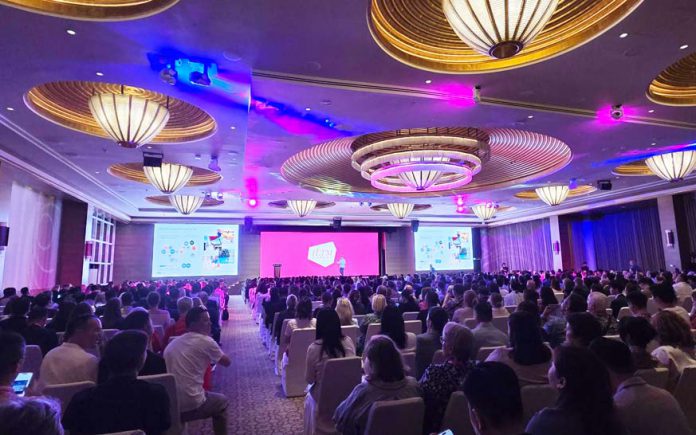
Luxury travel trade show ILTM Asia Pacific 2026 is opening to good news: affluent consumer segments are seeing significant spending increases, and travel is among the top spend item that is attracting incremental new spend from moneyed cardholders between 2023 and 2025.
Sharing data from Visa’ intelligence at ILTM Asia Pacific 2026 Opening Forum on June 29’s evening, Simon Baptist, principal Asia-Pacific economist, noted that Asia’s new luxury consumers are emerging from technology-led wealth hubs.

Spending on affluent cards issued across Asian markets show the highest growth rate in the Philippines, Taiwan and Vietnam: 49 per cent, 41 per cent and 36 per cent respectively, as of April 2026.
Baptist said that while Asian wealth was largely generated by finance, real estate and government-connected conglomerates in the past, the new wealth is coming from technology, semiconductors, and AI or data centre development.
Money in Asia came from finance, it came from real estate, it came from, you know, government-connected conglomerates.
The region’s affluent consumers are spending on a host of things, from travel to entertainment, with ultra-luxury/exotic cars, apparel & accessories, and retail being among the top three categories that are generating the strongest incremental affluent card spend.
Affluent consumers also continue to travel a lot more than their non-affluent peers – most are travelling every two to three months.
In terms of travel motivations, time with family and friends top the list, followed by relaxation, and shopping.
However, Baptist noted that the affluent Gen Z and Millennials are more interested in experiences, sports, and culture when compared to the older Gen X and Boomers. The younger generation is also “more interested in travelling somewhere for social media reasons. They want their luxury experience to look good on TikTok or Instagram”.
Different source markets have different priorities when they travel, added Baptist. Visa observes that affluent Thais, Chinese and Indians splurge the most on retail, while Australians are drawn mostly to recreational offerings. Australians and Singaporeans are also keen on hotel spend.
While travel intentions remain strong among the high-net-worth, the war in Iran and fuel challenge has an impact on travel habit.
“Capacity between Europe, the Middle East, and Asia-Pacific has fallen while jet fuel prices have doubled. Jet fuel accounts for about 30 per cent of the operating costs of a typical airline because it’s a variable cost. It feeds through into the ticket prices very quickly. As such, ticket prices rose by 30 per cent – and more in Asia and Europe where there had also been a reduction in (seat) capacity, resulting in people chasing fewer and fewer seats.”
“So, people cancelled trips and did something else instead,” said Baptist, adding that affluent consumers have also chosen to reconsider their destinations in favour of regional travel within Asia.
Visa intelligence observed that wealthy Chinese are travelling out of China for Japan, Australia, Hong Kong, South Korea, but also farther to Europe and North America. Affluent Taiwanese are heading to Japan, Singapore and South Korea, but also Europe; those from Singapore are preferring Malaysia, Japan and Europe, while Australians are making a beeline for Europe.
And with a bigger portion of travel budget going into airfares, affluent travellers are choosing to cut back on hotels and retail.
In conclusion, Baptist maintains confidence in the spending power of affluent Asians, and urged luxury travel and tourism professionals to identify new wealth hubs in the region, understand where the high growth travel corridors are taking form, and pay attention to how airfares and geopolitics are changing travel destinations.



 From your vantage point at the forefront of medical wellness, what are the most significant developments or shifting traveller demands that are fundamentally redefining Thailand’s wellness tourism landscape this year?