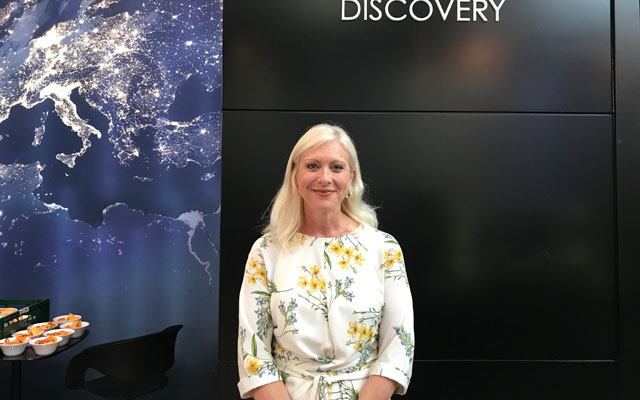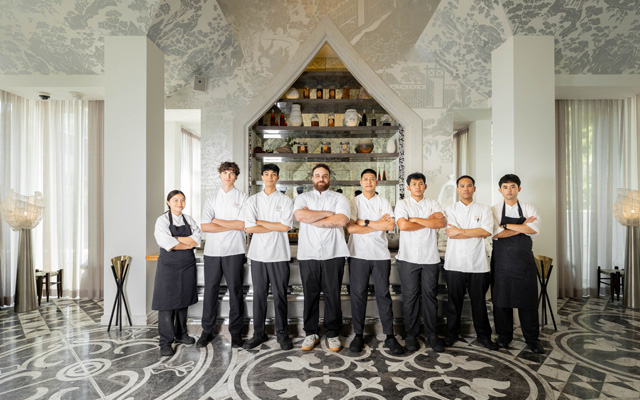
Ship captain Paolo Ravera readies the champagne waterfall while star travel agents pose with Princess' Farriek Tawfik (fifth from left)
Celebrating its fifth anniversary of operations in South-east Asia, Princess Cruises hosted 150 guests comprising travel agents, Captain’s Circle members and travel partners onboard the Sapphire Princess.
Ship captain Paolo Ravera readies the champagne waterfall while star travel agents pose with Princess’ Farriek Tawfik (fifth from left)
As the ship commenced its homeport season at Singapore’s Marina Bay Cruise Centre, travel agents from Singapore, Indonesia and Malaysia were recognised for their top sales performance in the respective markets.
Guests were also treated to a musical performance by the Princess Entertainment Team and a dinner at the fine-dining restaurant onboard.
Radisson Blu Resort Hua Hin has appointed Richard Mehr as general manager.
Prior to joining Radisson, the Swiss national was the general manager of Samujana Koh Samui.
Mehr brings with him 28 years of experience in managing hotels and resorts, golf resorts, wellness and high-end luxury properties, including four years as director of sales for a multi-million US company based in Asia and Europe.
He also previously served as group director of operations for Fusion Resorts & Suites in Vietnam, as well as opened and managed two properties, Putahracsa Hua Hin and Banyan The Resort Hua Hin.
Air safety concerns have led to flight cancellations and airport closures
The Mount Agung alert status has been increased from level three to four (the highest) as of 06.00 local time this morning, with Bali’s Ngurah Rai International Airport declared closed for 18 hours as of 07.17 while Lombok International Airport has been reopened after a brief closure.
The National Disaster Mitigation Agency (BNPB) reported the eruption of the mountain continued increasing from the phreatic to magmatic phases since 21.00 on November 25 with thick ashes spurring up to between 2,000 and 3,400m above the mountain peak.
Air safety concerns have led to flight cancellations and airport closures
“Volcanic ashes have been covering the air above Denpasar, therefore, for safety reasons, I Gusti Ngurah Rai International Airport is temporarily closed,” read an announcement by the directorate general of civil aviation issued this morning on the air situation in Bali.
The authority will continue monitoring the situation and the status is being evaluated every six hours.
“No activities are allowed within the hazard zone of eight kilometres from the crater plus 10km from the crater to the North-Northeast and Southeast-South sectors,” Sutopo Purwo Nugroho, head of Central Data Information and Public Relations of the National Disaster Mitigation Agency (BNPB) said.
He added that the hazard zone could be subject to change at any time.
Since early morning (as at press time) six flights from China bound for Bali have been redirected to Surabaya, Jakarta and Singapore and one domestic flight was redirected to Surabaya.
Some airlines, including Jet Star, Virgin, KLM and AirAsia, have cancelled their flights to and from Bali yesterday on their own safety measures, translating to about 20 affected flights.
The most extensive and ambitious modernisation of BSP (Billing & Settlement Plan) since it was created in 1971 is set to be rolled out.
The resolution for the full implementation of the New Generation of IATA Settlement Systems (NewGen ISS) was adopted by the Passenger Agency Conference, which comprises IATA member airlines.
“Implementation of NewGen ISS is a critical step forward by the global air transport industry in ensuring that BSP continues to serve the industry’s financial settlement requirements for years to come.
“It is the culmination of a multi-year engagement with participants in the air travel value chain, including airlines, travel agents, and IT and system providers,” said Aleks Popovich, IATA’s senior vice president, financial and distribution services.
Popovich: update years in the making
“It will bring greater options and flexibility to our travel agent partners, while providing even more financial security to airlines,” he added.
The NewGen ISS pillars include a three-level travel agent accreditation that allows travel agents to choose the model most applicable to their business, and to convert across models as their business evolves.
Also introduced is IATA EasyPay, a voluntary pay-as-you-go e-wallet solution for issuance of airline tickets in BSP that offers a lower cost per transaction. As a secure form of payment, IATA EasyPay transactions are not part of a travel agent’s cash sales at risk. This allows travel agents a means to lower their financial security amounts held with IATA, and to issue transactions which are not included in their BSP remittance capacity.
The third is Global Default Insurance (GDI), an optional financial security alternative for travel agents that presents a cost-effective and flexible alternative to bank guarantees and other types of security, an IATA statement said.
A newly added pillar, the Remittance Holding Capacity (RHC) risk management framework, is being introduced to enable safer selling and mitigate losses resulting from travel agency defaults.
For the majority of travel agents, the RHC will be calculated based on the average of the three highest reporting periods of the previous 12 months plus 100 per cent. Furthermore, measures will be available, allowing travel agents to manage their RHC, and to continue selling in a secure manner should their RHC ever be reached.
Meanwhile, the resolution text for the initiative also incorporates provisions related to Transparency in Payments (TIP), which reveals the different features and costs associated with each form of payment and agent remittance of airline funds. As it stands today, airlines only see the settlement costs after the fact, if at all.
No form of remittance is barred by TIP, but travel agents can only use those forms to which an airline has previously given consent. TIP allows travel agents to use their own credit cards – previously not supported in the BSP – if an airline consents.
“TIP provides a pro-competitive framework for bilateral arrangements between airlines and travel agents that will facilitate the introduction of new and innovative payment solutions,” said Popovich.
NewGen ISS and TIP will be rolled out progressively from March 2018. Certain NewGen ISS pillars, including IATA EasyPay and GDI are already available in some markets. GDI has been implemented in more than 20 markets worldwide, while IATA EasyPay is being piloted in Norway, Sweden, Finland and Iceland.
Anthony Van Sleeuwen has rejoined Sala Phuket Resort and Spa as its general manager.
He opened the property as executive assistant manager in 2007 and subsequently, became its resident manager.
Van Sleeuwen fills the position left by Jon Ashenden, who is now the group’s vice president hotel operations.
The Australian has also previously held positions such as group director of marketing, as well as cluster general manager for the Sala boutique brand properties in the Sala Bangkok office.
Most recently, Van Sleeuwen was general manager of The Kanda Residence on Koh Samui, and before that, he was leading the sales and marketing team at Fusion Maia Resort in Danang, Vietnam.
Visit California is holding its first-ever California tourism CEO mission to India this month, with the tourism board expecting to see 41 per cent growth in visitors from the market in next five years.
“California already commands 27.5 per cent share of the Indian outbound market to the US, accounting for 319,000 visitors who spent US$706 million in the state. We are projecting US$1 billion in spending from the Indian market by 2021. We also expect numbers from the Indian market to grow with the recent improved airlift from India,” said Caroline Beteta, president & CEO, Visit California.
Visit California will using digital marketing to attract more Indian outbound traffic
Air India commenced flights between San Francisco and New Delhi two years ago and is expected to begin direct flights to Los Angeles in 2018.
To achieve the desired results, the tourism board has increased its investment in the market from US$500,000 to US$800,000 for FY2017/18.
Betata elaborated: “We are developing and strengthening our relationship with the travel trade and adding new promotional layers targeted at consumers. We launched our Facebook page a few weeks back and have already garnered 40,000 followers.”
Visit California was recently in Mumbai, where it did its first global activation of FB Live with a few Indian celebrities and influencers present.
“Digital marketing is going to be our focus. We are working with our industry stakeholders in California to move them along in terms of how do we encourage and incentivise repeat Indian visitations,” she explained.
During the CEO mission, Visit California also signed an MoU with the Producers Guild of India, aiming to bring Indian film shootings to California.
In October, Visit California also launched the California Global Ready India series, which aims to educate travel suppliers on attracting and engaging Indian tourists, the first such undertaking in the US.
“We now see India offering more opportunities than any other market globally. Presently, 35 per cent business in San Diego is meetings and conventions but the Indian market is small. Going forward you will see much more of our promotional and investment in this marketplace to give San Diego and California much more awareness as a destination for all segments,” said Joe Terzi, president & CEO, San Diego Tourism Authority.
The tourism board is leading a delegation of 11 tourism CEOs on the mission, which began in Mumbai before moving to New Delhi.
Japanese hotel company, Tokyu Hotels, is on an expansion drive in the lead up to the 2020 Summer Olympics in Tokyo, with three properties scheduled to open in 2018 and one each in 2019 and 2020.
Sharing details with TTG Asia in an interview, Masato Iizuka, executive vice president of Tokyu Hotels, said next year’s openings will all be in Tokyo.
The 638-key Tokyo Bay Tokyu Hotel will sit close to Tokyo Disney Resort, granting families and large groups easy access to the popular theme park, while the tentatively-named Kawasaki Tonomachi Tokyu REI Hotel will open on the opposite shore of Tokyo International Airport (in Haneda), in King Skyfront where life science research and development facilities are clustered.
Masato shares details on Japan expansion
Commenting on Kawasaki Tonomachi Tokyu REI Hotel, Iizuka said: “(It will be) a lifestyle hotel that meets the demands of researchers and engineers from all around the world.”
The third upcoming property is Shibuya Stream Excel Hotel Tokyu, within a mixed-use development which houses offices, a hall and a shopping complex.
In 2019, Tokyu Hotels will debut its Excel Hotel Tokyu brand in Osaka, with a property located within Nanba Betsuin temple, “making it a unique hotel where one can experience Japanese culture”, said Iizuka.
Rounding off immediate expansion plans is a Tokyu REI branded hotel in Yokohama in 2020.
“We will continue to grow our property portfolio in Japan. Popular travel routes to and from Tokyo, Mount Fuji, Osaka and Kyoto are (places) where we are aggressively trying (to establish a physical presence in),” he said.
Although the Tokyu Hotels brand name is well established across Japan, Iizuka is determined to take its reputation farther in the world and he intends to make it happen through its ongoing partnership with Preferred Hotels & Resorts (PHR).
Currently, Tokyu Hotels has four hotels that are fully branded with PHR – The Capitol Hotel Tokyu (LVX Collection), Kyoto Tokyu Hotel, Nagoya Tokyu Hotel and Cerulean Tower Tokyu Hotel (Lifestyle Collection) – and 15 hotels that are represented by PHR as Travel Partners.
“Tokyu Hotels has developed a high level of brand awareness in Japan. However, we would also like to increase our brand’s reputation in the international marketplace. We believe that our partnership with PHR will help us achieve this goal as they have a large global outreach with more than 30 sales offices worldwide, and a suite of other support services that we can leverage on to enhance our international marketing efforts,” he opined.
But Iizuka’s quest for a stronger brand presence in the marketplace is not only to fight against global brands.
He explained: “Local hotel brands are very strong competitors in our current market (too). And don’t forget there’s also the rise of private accommodations acting as another fierce competitor in the industry.”
Together with PHR, Iizuka’s team has plans to conduct “numerous seminars and receptions in the various markets where PHR offices are located”.
Last Thursday Iizuka led a team of senior management personnel from Tokyu Hotels as well as representatives from 10 Japanese hotels to a roadshow in Singapore, co-hosted by PHR, to meet with travel agents, major incentive planners and corporate bookers based in the city-state.
The agreement will increase IHG’s current system size in India by 34 per cent
InterContinental Hotels Group (IHG) has partnered SAMHI to rebrand more than 1,900 rooms within its India hotel portfolio to Holiday Inn Express hotels.
The portfolio comprises 14 hotels, including 10 open hotels across key cities such as Ahmedabad, Bengaluru, Chennai, Delhi NCR, Hyderabad, Kolkata, and Mumbai. The additional four hotels are under construction.
The agreement will increase IHG’s current system size in India by 34 per cent
All hotels in the portfolio will be closed while they are being refurbished and upgraded with the latest design directives, to ensure the portfolio is fully representative of the Holiday Inn Express brand globally.
Ashish Jakhanwala, managing director & CEO, SAMHI, said: “We look forward to working with IHG to develop the brand further and create an excellent offering for our domestic as well as international guests across Tier 1 cities in India, where there has been a noteworthy increase in demand for quality accommodation in mid-segment.”
“We believe that the re-positioning and rebranding of more than 1,900 rooms to Holiday Inn Express will be the largest such exercise in India’s hospitality sector to-date.”
Sudeep Jain, IHG’s vice president development, South West Asia, said: “This is a significant move towards establishing IHG as a leading player in the midscale hotel segment in India, while we continue to build on our upscale and luxury offering in the country with InterContinental Hotels & Resorts and Crowne Plaza Hotels & Resorts.”
IHG currently has 30 hotels operating across four brands in India, including InterContinental, Crowne Plaza, Holiday Inn and Holiday Inn Express, with a further 33 in the development pipeline.
Compared to other generations, millennial travellers from Europe travel most frequently, but also tend to take the shortest trips, a highlight of an Expedia-commissioned study, released in May, which Expedia Thailand is now flaunting to shed light on travel habits from Thailand’s key European feeder markets.
The study considered French, German and British markets, which make up the most European tourists into Thailand, according to Pimpawee Nopakitgumjorn, director of market management at Expedia group.
Gen Z – adventurous beach bums?
While 72 per cent of Gen Z travellers said taking risks and crossing things off their bucket list are imperative, 60 per cent are interested in trips that offer naps on the beach and all-day relaxation.
This could explain the popularity of lesser known beach destinations. In line with this, Expedia data show that Koh Lipe, Rayong and Trat have seen a surge in demand with nearly 50 per cent year-on-year growth. Expedia pointed out that these three destinations grew faster than the mainstream tourist destinations – Bangkok (+40 per cent), Phuket (+15 per cent), Pattaya (+30 per cent) and Chiang Mai (+25 per cent).
Fun-loving millennials interested in beaches
The European Multi-Generational Travel Trends report further revealed that Gen Z travellers, being one of the most budget-conscious, are more likely to start the research and planning process without a set destination in mind.
Nearly 80 per cent of Gen Z respondents said either they did not have a destination in mind or were deciding between two destinations. Compared to other generations, Gen Z use their smartphones more than other devices when they are looking for travel inspiration (63 per cent) and while on their vacation (76 per cent).
Millennials – many short trips on a good deal
Millennials travelled most frequently among other generations (4.3 trips per year), but had the shortest durations of stay (respondents on average stayed 8.5 days on their last trip).
The study also showed that 90 per cent of millennial respondents said they look for the best deals when booking a trip. Expedia data shows that three out of four bookings from German, UK and French travellers were made via travel deals.
In terms of interests, millennial European travellers look for cultural experiences, exploring the outdoors, family trips and romantic getaways. Majority in this group (70 per cent) indicated they are most likely to opt for ‘off the beaten path’ locations and recommendations from locals (70 per cent).
Gen X – family-oriented and cautious
Expedia said Gen X travellers are family-oriented and more likely than other generations to use reviews and information from brands while researching and booking a trip.
Nearly 70 per cent of Gen X travellers said that every vacation is family-oriented and focused on keeping their family entertained and happy, while more than 65 per cent said they prefer to fill their itinerary with museums, historical sites, and arts and culture.
More than 60 per cent said budget was a primary factor on their last trip, but more so than other generations, they prioritised deals or special offers as important considerations when choosing a holiday.
Almost 85 per cent read reviews of places they want to visit before deciding, the multi-generational report found.
Baby Boomers – price a lesser factor
Baby Boomers are a highly valuable group for hoteliers, Expedia surmised, revealing that they not only take the longest trips at 10.5 days per vacation, but are also the least budget-conscious with only 54 per cent citing budget as a factor when planning their last trip.
Trip activities, cultural experiences and feeling pampered during their vacation topped the priority list for Baby Boomers.
The Jim Thompson Farm in Thailand, closed to visitors for the rest of the year, will open for tours from December 2, 2017 to January 7, 2018.
Located in Nakhon Ratchasima, a few hours northeast of Bangkok by car, the farm will on the opening day host a half marathon (21km), starting at 05.00, a mini marathon (10km), starting at 06.00, and a fun run (5km) and walk-run (1.5km) both at 06.10.
A pumpkin patch at the agro and eco tourist attraction. Photo: Jim Thompson Farm Facebook
Prices are 850 baht (US$26) for the walk-run, fun run or mini marathon and 950 baht for the half marathon. This includes a Jim Thompson admission ticket, running shirt, cloth bag and finisher shirt (exclusive for the half marathon).
Themed Rushing Water – Life Force of Isan, this year’s Jim Thompson Farm Tour aims to help visitors discover the significance of water in the region’s culture and traditions.
Attractions and activities on the farm include the pink cosmos field, the giant pumpkin patch and colourful flower field, ‘Jim Village’ where visitors get a hands-on experience of the silk production processes of the Jim Thompson brand, and ‘Jim Market’ for vegetable, fruit, pot flower and fresh produce shopping.