Harnessing the potential of tourism, which makes up 10 per cent of world GDP, to advance SDGs
UNWTO has launched an online platform to better engage the tourism sector in the advancement towards the UN Sustainable Development Goals (SDGs), with the support of Switzerland’s State Secretariat for Economic Affairs (SECO).
Tourism4SDGs.org is a “co-creation space” that allows users to access a wide range of resources, add their own initiatives, findings and projects, motivate discussion and collaboration, and share content related to tourism and sustainable development.
Harnessing the potential of tourism, which makes up 10 per cent of world GDP, to advance SDGs
“Tourism plays a vital role in many, if not all, of the 17 Goals”, said UNWTO secretary-general Zurab Pololikashvili. “Tourism has come of age as a cross-cutting economic activity with deep social ramifications.”
Ambassador Raymund Furrer of SECO commented: “Switzerland strongly supports this platform as it will allow a focus on the three main components of sustainable tourism: its economic, environmental and social dimensions.”
Learn, Share and Act, the three levels of interaction at Tourism4SDGs.org, aim not only to educate but also to encourage conversation and collaboration towards a sustainable tourism sector.
The platform was launched during the UN High-Level Political Forum on Sustainable Development ‘Transformation towards sustainable and resilient societies’ in New York this month, during an event co-hosted by UNWTO and the One Planet network.
The 17 SDGs constitute a global agenda for people, planet, prosperity and peace through partnerships. The SDGs aim to end poverty, fight inequality and injustice, and solve climate change by 2030.
The 120-key Fairmont Maldives Sirru Fen Fushi has unveiled the world’s first semi-submerged art gallery showcasing a series of sculptural artworks in the skyline.
Created by underwater naturalist and artist Jason deCaires Taylor, the Coralarium pays homage to the abundant sea life and pristine coral house reef surrounding the resort.
Art meets biodiversity
The first coral regeneration project slash underwater art installation in the Maldives aims to showcase the fragile beauty of the Maldives and the world’s oceans and provide visitors a new experience to engage with art and nature.
The artwork creates artificial reefs which will eventually become an integral part of the local ecosystem, with sheltered spaces offering a permanent sanctuary for ocean life such as fish, crustaceans, octopuses and marine invertebrates.
The Coralarium focuses on a stainless steel cube structure at a depth of three meters in the lagoon, raising up six meters from the seafloor. It holds three dimensions of artwork: rooftop sculptures placed at the top of the cube structure; the underwater art pieces and sculptures placed on plinths at various heights to highlight tidal movements; and the semi-submerged architectural cube element, which creates a bridge and fusion between both terrestrial and sub-oceanic worlds.
Guided tours in small groups led by the resort’s resident marine biologists are available several times a day.
Indonesia's Ministry of Tourism is stepping up efforts and has set a tall target of 700,000 arrivals from India this year
Reporting by Mimi Hudoyo and Tiara Maharani
Indonesia is stepping up efforts to boost arrivals from India, a market where it has seen significant growth of late.
India is now among the top five markets to Indonesia, sending 485,000 visitors last year to post a growth rate of 30 per cent, the second highest after China.
In the first two months of 2018, arrivals from India numbered 87,000, surpassing the traditional markets of Japan (74,000) and South Korea (63,000), according to data from the Ministry of Tourism.
Indonesia’s Ministry of Tourism is stepping up efforts and has set a tall target of 700,000 arrivals from India this year
Garuda Indonesia, on the back on strong demand, has increased its Denpasar-Mumbai frequency from twice- to thrice-weekly in June, barely two months after the service was launched.
Within the first two months of operating the new route, Garuda has already seen an average load factor of 87 per cent, the airline’s president and CEO Pahala Mansury told TTG Asia.
Pahala said: “We’ve had fantastic response for Denpasar-Mumbai services, so we felt the time was right to add frequency to three flights per week.”
TTG Asia understands that Garuda has plans to add a fourth frequency by this year-end.
Recognising the growth potential of India, the Ministry of Tourism is stepping up efforts and has set a tall target of 700,000 arrivals from India this year, despite the still-limited direct air links between the two countries.
The ministry has rolled out a strategy making Singapore and Kuala Lumpur as hubs to attract travellers visiting these two countries to extend their stays to Indonesia, according to Nia Niscaya, deputy minister for tourism marketing development II (Asia, Africa, the Americas and Europe).
“We are promoting the Hot Deal packages to Batam-Bintan and Jakarta, as well as culture and heritage to Yogyakarta and beach resorts like Lombok.
“(The ministry) is not only working together with travel companies in Singapore and Malaysia, but also talking to tour operators in India selling Singapore and Malaysia,” Nia said.
To keep the growth momentum of the Indian market, Umberto Cadamuro, COO inbound of Pacto, opined that Garuda should open another destination from India to Indonesia.
“I hope Garuda will open New Delhi-Denpasar or New Delhi-Jakarta anytime soon. The New Delhi market is huge for both business and leisure travel,” Umberto said.
As well, more destinations in Indonesia should be promoted to the Indian market, acknowledged Sigit Witjaksana, director of tourism marketing for Southern and Central Asia, Middle East and Africa at the Ministry of Tourism.
“During our recent visit to India, (major Indian outbound travel companies) told us that Bali sells on its own and asked us to come up with other destinations for promotion, so we plan to meet their needs,” Sigit said.
HotelBeds' partnership with Rezdy could help it grow its presence in Asia-Pacific and allow it to help suppliers meet demand for real-time in-destination bookings
Hotelbeds Group has partnered Rezdy, a Sydney-based software provider specialising in tours and attractions bookings, to expand its portfolio of tours and activities worldwide, particularly in the Asia-Pacific market where growth potential is high.
The partnership will bring over 1,000 additional activities to Hotelbeds Group’s ancillary bank business, with that number increasing progressively over a one-year period.
HotelBeds’ partnership with Rezdy could help it grow its presence in Asia-Pacific and allow it to help suppliers meet demand for real-time in-destination bookings
As a first stage of the integration, the group has already integrated activities from Paris, Copenhagen, Oslo, Stockholm and Barcelona. As the integration progresses, the group will include more destinations in its platform, expanding to include Asia-Pacific.
Director of ancillary bank at Hotelbeds Group, Javier Arévalo, said: “This alliance with Rezdy in particular boosts our presence in the Asia-Pacific region, one of the most important and fastest-growing marketplaces worldwide.
“Rezdy’s real-time booking solutions are transforming the industry at a time when offering mobile booking tools is absolutely critical,” he added.
With the partnership, Hotelbeds will be able to offer clients real-time availability of products, more opportunities for last minute, in-destination bookings and a better guest experience for ticket validation.
This alliance will also enhance the overall sales process and will offer a more scalable contracting model, reducing the time to market for all new products available on Hotelbeds Group’s distribution channels – which includes Hotelbeds, Bedsonline, Tourico Holidays and GTA along with local expert channels.
Rezdy specialises in online booking integration with suppliers, including the ability to handle mobile bookings, resource allocation, customer details and payment gateways.
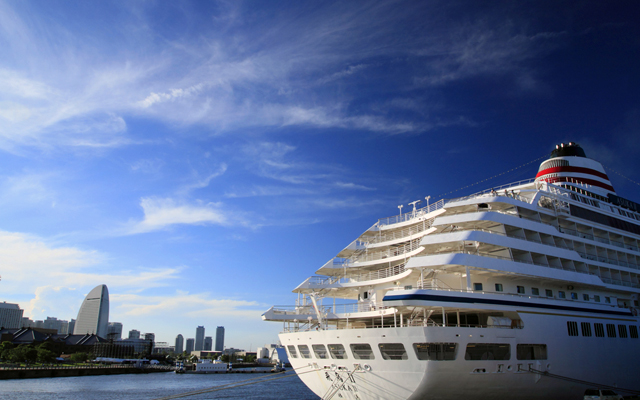
Japan is the Asian destination seeing the most cruise calls; pictured, ship at Japan's Yokohama Osanbashi Pier
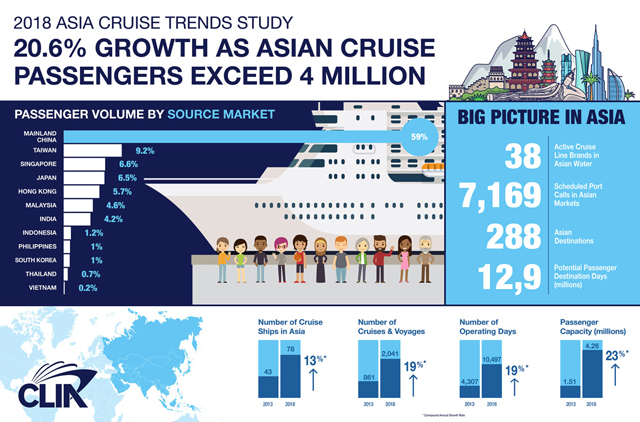
While Asian cruise passenger numbers surged 20.6% to hit another record high of over four million in 2017, overall cruise capacity deployed in the region is expected to decline marginally this year, according to the Asia Cruise Trends 2018 report recently released by Cruise Lines International Association (CLIA).
Between 2012 and 2017, Asian cruise passengers grew from 775,000 to nearly 4.1 million, an estimated 39% compound annual growth rate.
However, China, the main driver of passenger growth in Asia for the last few years, experienced a deceleration last year, adding 286,000 passengers compared to more than one million passengers in 2016.
Japan is the Asian destination seeing the most cruise calls; pictured, ship at Japan’s Yokohama Osanbashi Pier
Still, it maintained its dominance, accounting for 59% of all Asian cruise passengers.
Asia’s other major passenger source markets were Taiwan (374,000), Singapore (267,000), Japan (262,000), Hong Kong (230,000), Malaysia (188,000) and India (172,000).
CLIA observes that the majority (91%) of Asian cruisers sailed within the region in 2017, with intra-regional cruising expected to continue dominating into 2018. For longhaul, inter-regional cruisers, Europe was top choice in 2017 with 25% travelling to the Western Mediterranean, and 9% and 8% respectively traveling to the Eastern Mediterranean and the Baltics.
The Caribbean and Alaska are also popular, accounting for 24% and 11% of Asian cruisers travelling outside Asia.
Shorter sailings were by far the most popular, with the greatest share of passengers sailing four to six nights (66%), followed by two to three nights (26%) and 7 to 13 nights (5%).
In 2018, CLIA estimates overall cruise capacity deployed in Asia will slide 2% versus the planned ship calls in the prior year – although there will be more ships and a broader variety of cruise products in Asian waters.
Most capacity is coming from mega and large ships with six and 19 of them deployed in Asia respectively. As for mid-size ships, 27 are being deployed in 2018.
Small upscale ships will also be active in the region with 21 deployed seasonally, while the expedition niche will have five ships deployed in limited seasons.
In 2018, 7,169 port calls are being made in the region, 27 less than last year. Some 288 different destinations in Asia will receive cruise ships this year, and 24 Asian ports will host 99 or more calls each.
Destination markets seeing the most calls are Japan (2,601), mainland China (1,012), and Thailand (581) in 2018. Top ports with over 300 total calls planned in 2018 include Baoshan/Shanghai (416), Singapore (374) and Keelung/Taipei (322).
In terms of potential for tourist visits, Japan, Mainland China and Singapore are expected to host the most passenger destination days, with their respective capacity for over 4.8 million, 2.4 million and 900,000 passengers.
The volume in South Korea came down from 1.8 million originally scheduled last year to less than 224,000 in 2018.
With the combination of more and larger ships, added cruises and multiple port call visits, the cruise industry will bring 12.9 million passenger destination days to localities across Asia. This will be about 600,000 (or 4%) less than in 2017, according to CLIA.
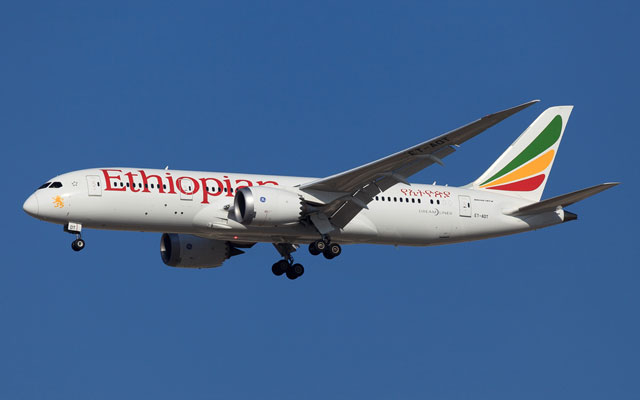
Ethiopian Airlines has launched its Addis Ababa-Jakarta services on July 20 as part of its South-east Asian network expansion strategy, opening up a new feeder market for Indonesia’s tourism.
The thrice-weekly service is an extension of its daily Addis Ababa-Bangkok flights, operated with Boeing 787 Dreamliner. Jakarta is the fifth city in Ethiopian Airlines’s South-east Asia network after Singapore, Kuala Lumpur, Bangkok and Manila.
This new route has a large potential to develop inbound traffic from Africa
Zebiba Miftah, area manager Indonesia Ethiopian Airlines, commented: “We are (determined) to enable Africans or Indonesians to enjoy safe, reliable and economical air connectivity both within the two countries and between the continents (Africa and Asia).”
The service is targeting both business and leisure traffic from both Ethiopia and other African countries to Indonesia and vice versa.
Miftah said that prior to flying directly to Jakarta, the airline had been selling flights to Jakarta via Singapore, in cooperation with Garuda Indonesia for the Singapore-Jakarta leg.
Admasu Tsegaye, Ethiopia’s ambassador extraordinary and plenipotentiary to Indonesia, hopes that the service can boost the trade and tourism potential in both countries.
“This is the first African airline to fly to Jakarta. By this we hope to enhance bilateral relations, both in business, trade and friendship between Indonesians and Africans, especially Ethiopians,” Tsegaye said.
To boost leisure traffic to Indonesia, Ethiopian Airlines has appointed Panorama Destination as its tour operator in the country through their Ethiopian Holiday programmes for the next two years.
Ricky Setiawanto, director of business development Africa, Europe, and Baltic States of Panorama Destination, is optimistic that the Ethiopian-Jakarta route will increase visitor arrivals from Africa.
“The first group tour arrived on July 21 with 50 tourists from Ethiopia. The group will spend a total of eight days in Indonesia, exploring Jakarta and Bali,” Ricky said.
“We believe the potential is quite large. This is the new beginning to develop (inbound) traffic from Africa further,” he added. “Ethiopia is a new market, meaning new business. We are very confident with this.”
According to figures from The Directorate General of Immigration, Indonesia welcomed 17,787 visitors from Africa from January to May 2018, an increase of 30 per cent, compared to last year’s figures of 14,591 African visitors for the same period.
South Africa is currently the largest market from the continent with many regular flights such as Qatar Airways, Emirates, Singapore Airlines connecting the country with Indonesia.
Jean-François Ferret will assume the post of CEO at Small Luxury Hotels of the World (SLH) starting September 2018.
Ferret replaces Filip Boyen who has resigned from his position at SLH after three years.
Based in the company’s London headquarters, Ferret will take responsibility for SLH’s international teams and will lead strategic direction of the brand’s luxury portfolio of over 500 SLH hotels in more than 80 countries.
Ferret was most recently the CEO of the French association Relais & Châteaux. Before that, he was the director general of Hertz France and prior, managing director and president of Manpower France.
In his 30-year career, he has also held travel and hospitality positions as deputy managing director of American Express Travel (France), managing director of Thomas Cook (France), senior vice president of Thomas Cook (West Europe) and CFO of Compass Group (Europe).
Chinese homestay booking provider Tujia has partnered Siteminder to streamline its back-end stock management and pricing system as well as provide a single lodging management platform for overseas hosts.
Beta testing of the platform development is ongoing, and the function is expected to be rolled out to all hosts who use the service outside China starting mid-July. When the service goes live, Tujia is expected to have a real-time inventory of over 50,000 room nights each day.
A screenshot from the Tujia website
Tujia said in a statement that overseas homestays tend to be booked through one of several disparate platforms, so hosts have to adapt to the operation of multiple systems and deal with the associated costs.
With the Siteminder partnership and an update of its ‘Tujia WAKA’ overseas booking platform, the Chinese vacation rental platform hopes to give hosts an improved management experience.
Thousands of lodging listings on Tujia’s platform are already utilising SiteMinder.
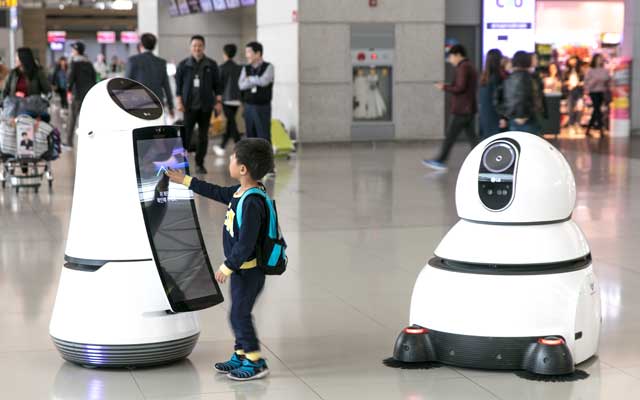
A boy interacts with Incheon International Airport’s Chatbot
SOUTH KOREA
Incheon International Airport’s new Terminal 2 was opened in January in time for the Pyeongchang Winter Olympics the following month, with a key focus on technology and innovation to enhance the passenger experience and stay ahead of the competition in the airport sector.
A boy interacts with Incheon International Airport’s Chatbot
Jo Soo-dong, senior manager of the Smart Airport Team, told TTG Asia: “We believe that by applying new smart technologies throughout the airport, we will be able to enhance passengers’ convenience and make Incheon to be known as a ‘high-tech airport’.”
The latest addition to Incheon’s tech repertoire this month will be the Chatbot, which according to Jo is “a talking robot that interacts with passengers”, featuring a message programme that enables it to communicate information about the airport’s facilities to travellers.
A separate guide robot will be introduced the following month, Jo revealed. “When you ask for directions, the android will first show you the shortest and quickest route – including all the shortcuts that it knows – and guide the traveller to their final destination,” he said.
A portable biometric security system was piloted at Incheon earlier this year, and this is expected to be rolled out throughout the airport by summer 2019, according to Jo.
“We are in the process of completing the research,” he said. “By using these fingerprint scanners, people will no longer need to bring paperwork or physical documents to the airport to check in. We believe this will make checking in quicker, easier and more convenient for passengers,” he added.
Earlier this year, remote check-in facilities at bus and train stations were rolled out in central Seoul and across South Korea. This new system enables passengers to check in their luggage and obtain their travel documents prior to their arrival at the airport, offering “a much simpler journey from home to the departure lounge”, Jo said.
“Passengers have been particularly pleased to be able to hand over their heavy suitcases and no longer worry about them all the way to their (final) destination.” – Julian Ryall
JAPAN
In anticipation of the tourist surge that the Rugby World Cup 2019 and 2020 Tokyo Olympics will bring, cutting-edge technology and innovations will now play critical roles in enabling Tokyo’s Haneda International Airport to cope with increased arrivals while delivering seamless service for passengers.
“IATA is a strong advocate of the ‘fast travel’ concept and we are presently introducing eight fast travel features to provide our passengers with better services. These include the introduction of new technology at the check-in and security gates,” said Fumitake Tsukamoto, head of Tokyo International Air Terminal’s corporate planning division.
Haneda already allows passengers to check in and obtain their boarding passes through automated self-service counters, print and attach their own baggage tags, use dedicated bag-drop options, and self-scan their boarding passes at self-boarding gates, Tsukamoto said.
Meanwhile, robot technology is a firm favourite at Haneda, and a fleet of humanoid Pepper robots was sent out among passengers at the airport in February to cope with the surge of Chinese tourists arriving for the Spring Festival holidays, Tsukamoto said. The Pepper robots were programmed to communicate in English and Chinese, and to provide information on access to gates as well as dining facilities, retail outlets and public toilets.
Earlier, Haneda deployed another robot variant, the humanoid EMIEW3, to reply to questions from travellers as it roves the concourses on wheels. Perhaps most remarkably, it is able to interpret the movements of a human and his or her immediate environment – such as consulting a map of the airport facilities – an autonomously initiate an interaction, enquiring if the traveller requires assistance. – Julian Ryall
HONG KONG
From kerb to gate, innovation and technology are playing greater roles than ever in shaping the passenger travel experience at Hong Kong International Airport (HKIA).
The airport is seeking to “transform the passenger journey into a fully automated and self-serviced process” with the objective of making travel at HKIA “fast, easy and as simple as riding a bus”, said Chris Au Young, general manager for smart airport at Airport Authority Hong Kong.
Automation of processes are now underway at HKIA. The self-bag drop service was first introduced in 2016 to enable passengers to check in baggage by themselves and save on processing time. To date, 120 self-bag drop counters have been installed in the airport.
Since end-2017, HKIA has introduced iCUSS mobile check-in kiosks for travellers to complete their check-in procedures anywhere, from the airport terminals to external locations such as hotels, theme parks and conference centres. Together with the self-bag drop service, the entire check-in process is now more efficient for passengers.
As well, HKIA is set to roll out biometric technology services from late-2018 onwards. By showing their passports and having their faces scanned at check-in, travellers will soon get through security and immigration checkpoints for boarding without having to produce their passports repeatedly.
The HKG My Flight mobile app recently added an augmented reality (AR) navigation function, which guides passengers towards facilities at the airport with instructions overlaid in camera view and terminal signage in users’ own languages.
HKIA has also launched MyTAG, a smart luggage tag that notifies passengers on their smartphones when their checked bags arrive at the baggage reclaim carousel. – Prudence Lui
AUSTRALIA
Melbourne Airport is innovating to speed up the check-in process for frequent international travellers and enhancing security with a less invasive and fully integrated screening system in a first for Australia.
Melbourne Airport’s new self-service check in zone
The airport recently installed 16 customised hybrid desks, 46 new self-service check-in kiosks, six automated bag drops and new digital signage in a bid to shorten check-in time. The hybrid desks, which are a first for international carriers in Australia, mean airlines can switch between using self-service bag drop or full-service traditional counters to change their operations to meet customer demand within minutes.
“(This) gives travellers more control of their airport experience,” said Melbourne Airport chief of aviation, Simon Gandy.
“(We want to) reduce the amount of time spent queueing at the airport. The new technology (also) frees up airline customer service agents to roam in check-in areas, and connect with passengers in a way that you can’t get from behind a conventional check-in desk.”
By September, Melbourne Airport will be the only Australian airport to have a fully integrated international screening point outfitted with Smart Security, a joint security initiative by Airports Council International and IATA. It will include parallel divestment stations to allow multiple passengers to simultaneously prepare and push their trays into the screening queue, allowing passengers with few items to submit for screening and ‘jump the queue’, while those with more items to offload can take their time.
Automated gates will be used for boarding pass verification, extended screening lanes will be added, and automated tray return systems will be introduced. “Further, new body scanners will be much more efficient in processing travellers and will be far less invasive by removing the need for travellers to hold up their hands and circle through,” said Gandy.
Melbourne Airport introduced a chatbot late last year to give travellers access to real-time flight information, links to services like lost property and online carpark booking, and information on dining and retail options.
“Many of our travellers are return users and we believe the function will continue to evolve and play a big part in our traveller experience offering,” said Gandy. The chatbot has more than 19,000 users to date. – Adelaine Ng
MALAYSIA
As part of its ‘Runway to Success 2020’ five-year business strategy, Malaysia Airports Holdings Berhad (MAHB) has embarked on a digital transformation strategy that involves the use of big data analytics and the Internet of Things to improve the passenger experience and operational efficiency at the five international gateways, including Kuala Lumpur International Airport (KLIA), and 16 domestic airports it manages.
MAHB will team up with information management specialist OpenText to innovate KLIA and klia2 operations, including developing intelligent automation, predictive analytics and expanded digital services at both terminals.
In early June, MAHB introduced the MYairports mobile app, an airport travel guide, under its Airports 4.0 digital initiative supported with a RM30 million (US$7.5 million) investment.
MYairports allows passengers to “plan their journey in the palm of their hand”, said MAHB’s managing director Badlisham Ghazali, providing users with real-time flight updates, shopping and dining promotions, while airport services such as self-check-in and self-bag drop facilities and passengers’ authenticity can be verified as well. Furthermore, passengers can shop online through the “click and collect” service and have the products delivered to their boarding gate.
MAHB has also collaborated with the government of Saudi Arabia to introduce the world’s first proof of concept (POC) for pre-clearance of haj pilgrims at KLIA’s departure point. The POC process at KLIA takes around 30 minutes, compared with five to six hours of immigration processing in Saudi Arabia in the past. – S Puvaneswary
SINGAPORE
The opening of Terminal 4 (T4) in October last year marked the latest wave of innovation for Singapore Changi Airport. Most notably, the terminal debuted the airport’s Fast and Seamless Travel (FAST) system that offers end-to-end self-service options for passengers.
This includes automated check-in kiosks, baggage drop using facial recognition and Xbox Kinect-powered 3D modelling technology, as well as immigration and boarding gates that share facial and thumbprint biometric data.
This fully automated process is expected to yield some 20 per cent long-term manpower savings, and the terminal is poised to raise the total annual capacity of Changi Airport by 16 million passengers a year. As of February 8, it has handled more than 1.6 million passengers since its opening.
In April 2018, the airport handled 5.4 million passenger movements; a 5.1 per cent year-on-year increase from 2017.
Following in T4’s footsteps, Terminal 1’s (T1) departure, arrival and baggage claim halls are currently being upgraded to replace check-in counters and implement FAST, among other developments.
T1’s baggage handling system will also become fully automated with sorting capability to support automated check-in and automated bag-drop functions. An automated early baggage storage facility will also be implemented.
These expansion works will increase T1’s handling capacity to 24 million passenger movements per annum. The terminal served some 3.2 million passengers in 1Q2018.
To further enhance the traveller experience, works are also currently underway for lifestyle complex Jewel Changi Airport, which will house a range of play attractions, indoor garden trails and F&B outlets.
Crowning this development is the 14,000m2 Canopy Park that will feature attractions such as sky nets, hedge and mirror mazes, 1,400 trees and palms, as well as dining outlets.
Jewel is scheduled to open in early 2019, and its Level 1 will be directly connected to the T1 Arrival Hall. – Pamela Chow
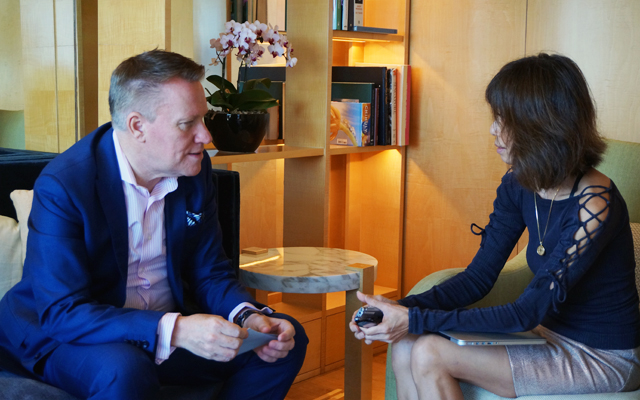
Steve Odell in a May interview with Raini Hamdi was gung-ho about developing China market further for Norwegian Joy
Norwegian Cruise Line Holdings’ (NCLH) announcement to pull out its China-centric ship, Norwegian Joy, from China to the US appears to have taken its Asia-Pacific team off-guard, and raises a question mark about its exclusive partnership with Alibaba.
The cruise company last week announced it would redeploy Norwegian Joy from its homeport in Shanghai to Seattle from April 2019 for Alaskan voyages and to Los Angeles in winter 2019/2020 for Mexican Riviera and Panama Canal voyages.
Instead of homeporting, it will operate in China seasonally with Norwegian Spirit from summer 2020. The ship, which will undergo a Norwegian Edge refurbishment, will serve China in the peak summer months and Australasia in the other season.
Steve Odell in a May interview with Raini Hamdi was gung-ho about developing China market further for Norwegian Joy
NCLH said it was monetising strong global demand and driving higher returns for shareholders. In other words, the rest of the world is bringing greater revenues than China and it is “right-sizing” its capacity based on current market conditions globally.
The domino effect of redeploying Norwegian Joy enables the line to move Norwegian Pearl to Europe, increasing to six the number of ships there; frees Norwegian Jewel to return to Australia/New Zealand for a third season; and sends Norwegian Jade for additional capacity in South-east Asia.
NCLH’s senior vice president & managing director Asia-Pacific (including China), Steve Odell, plays down the impact of a year of hiatus in China, when Norwegian Joy leaves in March 2019 and Norwegian Spirit enters in summer 2020, even though in an interview in May at ILTM Asia Pacific in Singapore he was gung-ho about China directions, including marketing plans to increase yields for Norwegian Joy in China and deepening the partnership with Alibaba.
He even said there was talk of having a second ship, Norwegian Encore, in China, but a decision was made to send it to the Caribbean. “We think we can earn better returns (for Norwegian Encore) in one of the Western markets. Demand is high in North America and the rest of the world,” Odell had said.
Little did he realise that Norwegian Joy would also go, ignoring a question in an email interview yesterday if he was surprised by the announcement.
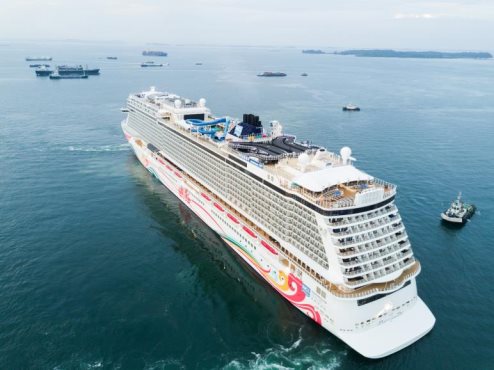
Norwegian Joy
But in the earlier interview, Odell did allude to challenges with the China market. Norwegian Joy, which celebrated its first anniversary in China on June 27, exceeded expectations, with Odell claiming it mostly sailed with 4,300 to 4,400 pax. The problem was the yield.
Norwegian Joy currently is selling at around US$700 to US$1,000 for four days and depends on onboard spending on everything from dining to shopping to spike revenues. But typically in China it has to work with large agents on a ‘commit’ basis of half charters or full charters, which means it has less control over the customers, isn’t able to interact with them, or decide what the discount or promotion should be.
As such, it has been trying hard to widen the distribution and work with smaller agents and go B2C, but the latter is particularly difficult due to rules and regulations.
That hasn’t stopped it from trying. In February, for example, it launched a Joy at Sea programme offering a number of value-adds as part of the fare, the most important being free WeChat if the clients follow the ship.
“So for every cruise, we’re collecting 4,400 WeChat followers. Getting accurate information of the customers in order to re-market, or push sales on board, is critical. It’s been challenging in China but the free WeChat has really helped to grow our database quickly. We have much more of a voice today,” Odell told TTG Asia in the May interview.
Alibaba’s partnership is also critical for NCL’s B2C drive. In turn, Alibaba not only sees opportunities in premium cruise sales per se with NCL, but also pushing online promotions such as shopping on board, dining, entertainment and gambling.
In the first year, the initiatives were more marketing-driven than sales-driven, more about positioning NCL and Alibaba in the cruise market, according to Odell. “We have on-going discussions with them on consumer information and how we can target the right customers through their databases to grow the partnership,” he had said in May. “It’s obviously a brand we would like to be associated with, and they want to be associated with us.”
When asked on Monday what would happen to the partnership given the redeployment, Odell said: “We have a good relationship with Alibaba based on the work we have already done with them and we will re-engage with Alibaba when Norwegian Sprit deploys to the region in 2020.”
At press time, TTG Asia was unable to reach Alibaba for comment.
Odell said NCLH would maintain its current operation in through March 2019, with Alex Xiang continuing as managing director leading its offices in Shanghai and Beijing. “We will naturally reduce manning based on a smaller operation in 2019 and the future, but as we are working through this I cannot share specifics at this stage,” he said.
In the interim, NCLH will expand its activity in “the burgeoning fly-cruise market” in China as well as launch early sales for the 2020 homeport season, he added.