Work is set to start on rebuilding an iconic floating resort in Cambodia that was recently devastated by heavy monsoon rains.
4 Rivers Floating Lodge – a luxury floating resort on Tatai River in Koh Kong province – was damaged last month when unusually heavy monsoon rains combined with excess water released from a nearby dam washed it away.
Repair works on the damaged floating resort have begun
Rising water levels of more than 1.5m caused currents to rip through the resort, with parts of the hotel, along with 40 staff, adults and children, carried eight kilometres downstream on drifting platforms.
No one was reported injured and initial assessments put the damage at several hundreds of thousands of US dollars. All of the resort’s floating platforms including 12 tents were torn, and water and electricity systems completely damaged.
Managing partner Valentin Pawlik said reconstruction work will start this week, with six units expected to reopen on November 1. The new resort will be redesigned to cope with excess flooding.
The resort will also be future-proofed against heavy floods
Pawlik, who built the original structure, said: “When we built the resort nine years ago, there wasn’t this much rainfall and we didn’t think there was this much potential for flooding.”
Several days after 4 Rivers Floating Lodge was destroyed by water, a dam in neighbouring Laos’ Attapeu Province failed, killing an estimated 30 people, with hundreds reported missing and thousands left homeless.
Stefan Scheerer, general manager of Khiri Travel Laos, said the disaster has not impacted the tourism industry, describing the region as “a sleeping beauty in the south” and not yet a well-known tourism destination.
Malacca is expected to welcome a RM200 million (US$49.2 million) water theme park spanning 4.6ha, the largest in the Malaysian UNESCO World Heritage city.
A collaboration between Singapore’s Hatten Land, Samsung C&T Corporation – which also operates South Korea’s Everland Resort – and water slides designer Polin Waterparks, Splash World @ Harbour City is due for completion by end-2019 and expected to be opened to the public in 1H2020.
Hatten Land’s Colin Tan; Hatten Group’s Eric Tan; chief minister of Melaka Adly Bin Zahari; Hatten Land’s Edwin Tan; Everland Resort’s Tommy Byungsuk Jeong; and Polin Waterparks’ Emre Büyükgüngör
The partners said in a joint statement that the water park, located 14 floors above ground, will be “the world’s first ‘sky’ theme park”. Nestled between two 30-storey towers on the 14th floor deck of Harbour City @ Melaka, a mixed development shaped like a ship, the four-storey park will offer indoor and outdoor areas and more than one kilometre of water slides.
A man-made river will meander over two floors to intertwine more than 50 attractions, including 11 extreme slides for thrill-seekers, a Sky Beach and a dedicated children’s water play park. After dark, the Cosmic Waters light show will illuminate the park, accompanied by a water circus, trapeze stunts and other entertainment in an amphitheatre.
Splash World @ Harbour City hopes to attract 850,000 to one million visitors annually after the first year of operation. Malacca hosts nearly 17 million visitors a year.
Melaka chief minister Adly Bin Zahari commented: “Splash World @ Harbour City will bring a transformational new dimension to our travel and leisure landscape, and make Melaka an even more compelling international attraction.”
Both WeGoGo and KeyoCoin will use Ethereum-based tokens
A fresh cryptocurrency-based rewards model is emerging in the travel industry, touting potentials to shift the power from distribution giants to smaller travel providers.
In May, WeGoGo launched an initial coin offering of WeGold, a digital token that users can earn through performing various actions, from making travel recommendations to travel do-gooding such as participating in beach cleaning on their trips or providing eco-tips to fellow users on the platform.
Both WeGoGo and KeyoCoin will use Ethereum-based tokens
By incentivising users to raise the visibility of longtail providers such as local surf and dive schools and integrating these providers into the travel rewards ecosystem, WeGoGo says it promotes a “fair share” model where smaller players are adequately rewarded rather than marginalised as in the case of traditional distribution systems.
Another rewards model has emerged as US-based KeyoCoin announces plans to launch what it says is “the world’s first universal travel rewards programme built on the blockchain”.
Similar to WeGogo, it says it is “on a mission to shift power from the few big players” and put it in the hands of travellers and travel providers.
KeyoCoin says its technology will give hospitality, tour and local experience providers and any merchant the means to offer customers cryptocurrency rewards for either making purchases, or completing location-based travel challenges (e.g. in the style of Pokémon Go, Amazing Race).
Travellers will be able to redeem KeyoCoins for accommodation, tours and activities, tip staff or gift to friends and family heading off on trips of their own.
The platform is already supported by an app that features over 12,000 tours and activities products in four US markets and six Latin American countries, with hotels to be added soon.
The startup’s advisory team includes head of social media at Apple, Rick Savage; Ethereum investor, Federico Pistono; vice president at Oracle, Layla Revis; former vice president at Live Nation, Tamara Camp; SEO director at IGN, Marat Gaziev; and Les Clefs d’Or Concierge of the Year, Sarah Dandashy.
Matt Baer, CEO and founder of KeyoCoin, commented: “The travel industry is no stranger to loyalty programmes, but only airlines and large hotel chains have had the resources and reach to actually make them work for customers that are on the move. Even then, these programs are shackled by restrictions that make the rewards uninspiring to earn, a pain to manage, and frustrating to share or redeem.”
Sarah Dandashy, head of travel and hospitality for KeyoCoin, added: “The hospitality and tourism industry, now more than ever, is overflowing with innovative and unique travel experiences. These hidden gems are the exact experiences that today’s travellers so eagerly want to have, and yet there has always been a gap in connecting local experience providers with travellers. Eighty per cent of this exciting market has yet to make it online, and those that have are largely at the mercy of OTAs that charge high commission.”
LOCATION
The hotel’s convenient location between Cotton Tree Drive and Garden Road is a hard one to beat. This building situated in the CBD is a stone’s throw from key tourism attractions like Hong Kong Park, Peak Tram Station and St John Cathedral.
The premises was converted from a government office block under a revitalisation project.
The Murray, Hong Kong
ROOMS
My N2 Grand room affords ample space at 50m2. I also appreciated the extra touches of luxury like in-room check-in rather than just a cold towel upon arrival.
I was also surprised by the turn-down amenities – a hydrating face mask made by the hotel. This will be changed regularly to items such as a chocolate bar and face mist.
Moreover, 75 per cent of rooms are 50m2 or bigger. All oversized accommodation features uniquely recessed windows allowing abundant daylight without direct heat from the morning sun.
F&B
While four outlets (The Tai Pan, Garden Lounge, Murray Lane and Popinjays) are managed by the Hotel, the 90-seat Cantonese restaurant Guo Fu Lou is a partnership with Fook Lam Moon Restaurant.
In July, Popinjays opened on the hotel’s topmost 26th floor, offering panoramic and spectacular views. The 355m2, 120-seat entertainment space includes an indoor dining area, a private dining room and a bar.
For an exclusive experience, The Aviary, a private dining room with a glass facade, will be available for intimate events for up to 14 guests.
FACILITIES
There are ample choices of indoor and outdoor venues for events. For instance, a dedicated MICE floor – Murray Room on 25th floor – provides 425m2 space for small to mid-scale events. Though there are no windows on this floor, the space benefits from great lighting equipment and event-friendly set-ups.
The Arches is a semi al-fresco venue, and there are seven boardrooms on level two to suit different needs.
While the hotel pool will only be ready this month, the spa already has two couples rooms and three treatment rooms in operation. Half or full day customised spa rituals are available.
SERVICES
The hotel provides an in-house guide of hand-drawn maps to help you explore the district.
Or simply ask the concierge for recommendations of the city’s best-kept secrets. I tested a concierge’s knowledge on private clubs and temples. He demonstrated his expertise and patience, giving a rare insider’s view rather than just mentioning off-the-mill touristy spots.
VERDICT
It was with mixed feelings revisiting what I once knew as an office block and place of work – now as a hotel guest. Still, a thumbs up to the architect who gave the historical building new life without stripping it of its timeless features.
No. of rooms 336 Rates From HK$4,800++ (US$612++) Contact details
Email: themurray@nicolohotels.com
Tel: (852) 3141 8888
One Farrer Hotel has appointed Freddy See as director of sales & marketing.
Prior to joining One Farrer Hotel, See successfully helped to open the flagship property of Sofitel Singapore City Centre where he oversaw room sales, reservations, catering and conference services, as well as marketing strategies.
See has more than 24 years of hospitality under his belt, having worked as director of sales & marketing at Grand Copthorne Waterfront and hospitality companies like the InterContinental Hotels Group and Fairmont Raffles Hotels International.
Disaster mitigation agency says 'hundreds of smaller quakes to come', but Lombok and Gilis are 'safe'
Following the powerful earthquake that hit Lombok last Sunday, industry stakeholders in Indonesia are taking swift steps to facilitate the return of travellers home.
Sutopo Purwo Nugroho, a spokesman for Indonesia’s disaster mitigation agency (BNPB), said: “Gili and Lombok are safe, and people are not required to leave. The seven-magnitude earthquake was the main shock. There will be hundreds of smaller quakes to come.”
He added that further big earthquakes in the near term are unlikely.
Disaster mitigation agency says ‘hundreds of smaller quakes to come’, but Lombok and Gilis are ‘safe’
The joint Search and Rescue Agency team managed to evacuate between 2,000-2,700 domestic and foreign tourists.
Muhammad Faozal, head of the West Nusa Tenggara Culture and Tourism Office, said: “At press time, there are at least 600-700 people who have not been transported (out of Lombok). The number (is) still increasing as many more want to go home.”
Visitors from the Gili Islands were being evacuated through three ports in the Lombok region and transported to Mataram, the capital of West Nusa Tenggara.
There remains limits to ship capacity, Faozal pointed out, adding that transfers to Bali by sea was also not optimal due to the high waves.
Additional ships, including two navy ships, were deployed to facilitate evacuation. At press time, there remained around 200 tourists waiting to be transported, he said.
In the meantime, local tourism stakeholders have stepped in to shelter visitors awaiting evacuation and facilitate their transportation.
“For those who’ve left the Gili Islands but have to stay in Mataram because they cannot fly out yet, we provide free lodging at the tourism office. Meanwhile, for those who want to continue the journey to the airport, we will also facilitate free airport transfers,” said Faozal.
From Lombok, the Ministry of Tourism is providing free bus transportation for tourists to the port or directly to the airport, while the Association of The Indonesian Tours and Travel Agencies (ASITA) and Indonesia Hotel and Restaurant Association (PHRI) were also providing food and stay facilities free of charge.
On the Gili Islands, Dewantoro Umbu Joka, chairman of ASITA West Nusa Tenggara, added: “The West Nusa Tenggara Culture and Tourism Office immediately set up an (emergency) post in the office and provided shelter for visitors who do not have a place to stay. All facilities were provided free of charge.”
Austin Gusman, manager of Gili Amor Boutique Resort in Gili Trawangan, revealed that some local residents have jumped in to house stranded tourists in tents.
In anticipation of the movement of passengers in the wake of the disaster, Garuda Indonesia on Monday operated three extra flights on the Lombok-Denpasar route. More flights are expected to be added today.
The national disaster mitigation agency has stated that it is not necessary to leave the affected islands. DMCs Khiri Travel Indonesia and Asian Trails have also issued statements saying that changes to travel programmes were unnecessary.
But Khiri Travel is giving travellers the option to do so, or move guests scheduled to visit Gili Islands to alternative accommodations.
“Without any further incidents, Khiri Travel believes it will be possible to resume normal travel to Lombok in a few weeks’ time, especially the largely unaffected south and eastern areas of the island,” the DMC stated.
Hotel Nikko Thonglor among the handful of confirmed properties to rise in the neighbourhood
The serviced residence scene in Bangkok’s trendy Thonglor neighbourhood is transforming along with a marked shift away from the traditional Japanese long-stay segment, according to C9 Hotelworks.
The demand for serviced apartments in Thonglor is being driven by expatriates, the majority of whom are Asian.
Hotel Nikko Bangkok among the handful of confirmed properties to rise in the neighbourhood
Today, Thonglor continues to be the preferred location for the expatriate community in the Thai capital. However, where Japanese residents once accounted for 90% of the serviced residence market, today the number has reduced to 65%, C9’s market research shows.
In 2017, the number of Japanese expatriates grew marginally at 0.3%, in contrast to the 8% increase in Indian expatriates.
As well, the proportion of long-stay business “dropped dramatically” to 38%, while the short-stay ratio now dominates at 62%.
“Many serviced apartments, therefore, have adjusted their business model and designs to short/leisure-stay and transient focused guests versus the traditional Japanese long-stay business client,”said Bill Barnett, managing director, C9 Hotelworks.
Besides Japan, other key long-stay sources are Europe and Singapore, while many short-stay guests are from South Korea and China.
Meanwhile, C9 also notes that despite a 2.2% drop in occupancy, serviced apartment average rates bumped up 3.8% in 2017 and rose another 1.2% in 1Q2018.
There are three confirmed properties or 1053 keys in Thonglor’s pipeline, including Ascott Thonglor Bangkok, Hotel Nikko Bangkok and StayBridge Suites Bangkok Thonglor.
French master chef Joel Robuchon, who built up a global restaurant empire and elevated mashed potato into an art form, has passed away on Monday in Geneva. He was 73.
The French government announced his death. He died of cancer, according to French newspaper Le Figaro.
Often dubbed the greatest French master chef of his era, he was widely regarded for recasting French haute cuisine in a personal and inventive style.
Born in Poitiers, western France, in 1945, Robuchon rose up through apprenticeships and came into his own in the 1980s and 1990s. His first Paris restaurant, Jamin, dazzled the French culinary and earned three Michelin stars a mere three years after opening in 1981.
He ran many restaurants worldwide, including Las Vegas, New York, Bangkok, Hong Kong and Macau, becoming the world’s most Michelin-starred chef with a record 32 Michelin stars in 2016.
In June, it was announced that his two restaurants at Singapore’s Resorts World Sentosa were closing down.
Iris scans are being tested at the Woodlands checkpoint, bordering Johor Bahru in Malaysia
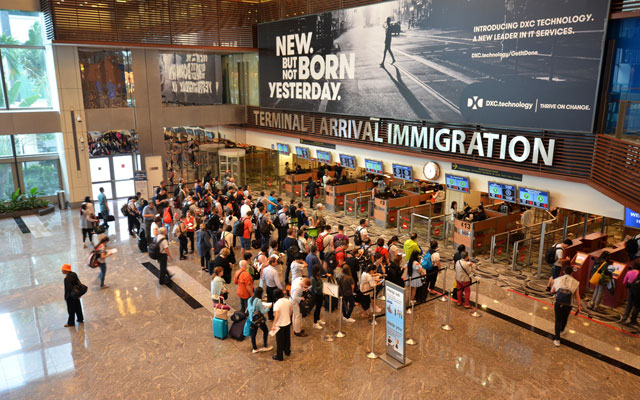
Eye scans for Singaporeans and permanent residents are being piloted at select counters at the Woodlands and Tuas checkpoints, as well as Tanah Merah Ferry Terminal.
The trials involve officers scanning travellers’ iris in addition to fingerprint verification at select counters, reported Singapore’s The Straits Times, quoting an Immigration and Checkpoints Authority spokesman.
With iris patterns harder to replicate than fingerprints, eye scans represent a more effective biometric identity verification tool that could eventually replace thumbprint checks at Singapore checkpoints, the article stated.