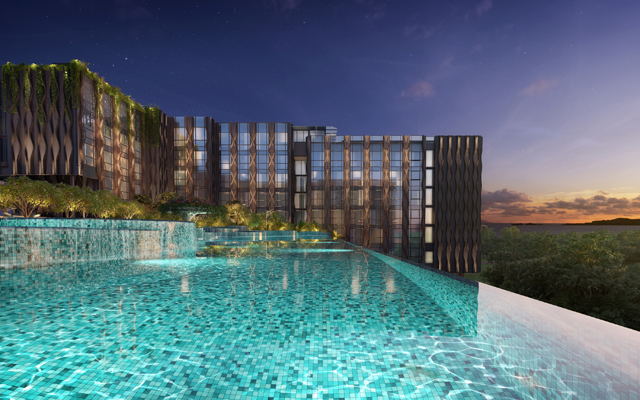
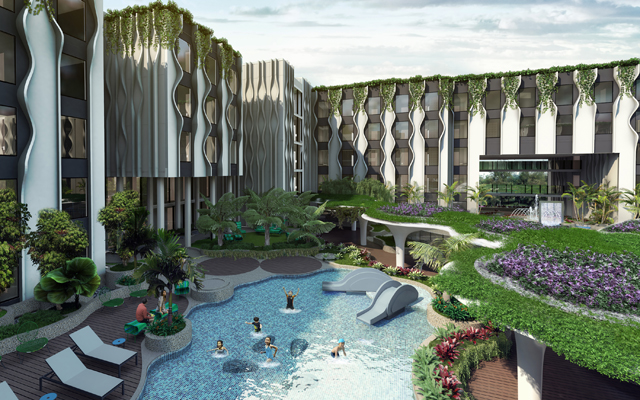
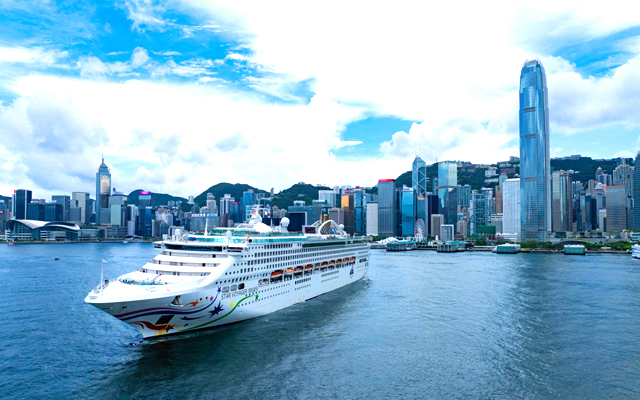
Hotel Nikko Thonglor among the handful of confirmed properties to rise in the neighbourhood
The serviced residence scene in Bangkok’s trendy Thonglor neighbourhood is transforming along with a marked shift away from the traditional Japanese long-stay segment, according to C9 Hotelworks.
The demand for serviced apartments in Thonglor is being driven by expatriates, the majority of whom are Asian.
Hotel Nikko Bangkok among the handful of confirmed properties to rise in the neighbourhood
Today, Thonglor continues to be the preferred location for the expatriate community in the Thai capital. However, where Japanese residents once accounted for 90% of the serviced residence market, today the number has reduced to 65%, C9’s market research shows.
In 2017, the number of Japanese expatriates grew marginally at 0.3%, in contrast to the 8% increase in Indian expatriates.
As well, the proportion of long-stay business “dropped dramatically” to 38%, while the short-stay ratio now dominates at 62%.
“Many serviced apartments, therefore, have adjusted their business model and designs to short/leisure-stay and transient focused guests versus the traditional Japanese long-stay business client,”said Bill Barnett, managing director, C9 Hotelworks.
Besides Japan, other key long-stay sources are Europe and Singapore, while many short-stay guests are from South Korea and China.
Meanwhile, C9 also notes that despite a 2.2% drop in occupancy, serviced apartment average rates bumped up 3.8% in 2017 and rose another 1.2% in 1Q2018.
There are three confirmed properties or 1053 keys in Thonglor’s pipeline, including Ascott Thonglor Bangkok, Hotel Nikko Bangkok and StayBridge Suites Bangkok Thonglor.
French master chef Joel Robuchon, who built up a global restaurant empire and elevated mashed potato into an art form, has passed away on Monday in Geneva. He was 73.
The French government announced his death. He died of cancer, according to French newspaper Le Figaro.
Often dubbed the greatest French master chef of his era, he was widely regarded for recasting French haute cuisine in a personal and inventive style.
Born in Poitiers, western France, in 1945, Robuchon rose up through apprenticeships and came into his own in the 1980s and 1990s. His first Paris restaurant, Jamin, dazzled the French culinary and earned three Michelin stars a mere three years after opening in 1981.
He ran many restaurants worldwide, including Las Vegas, New York, Bangkok, Hong Kong and Macau, becoming the world’s most Michelin-starred chef with a record 32 Michelin stars in 2016.
In June, it was announced that his two restaurants at Singapore’s Resorts World Sentosa were closing down.
Iris scans are being tested at the Woodlands checkpoint, bordering Johor Bahru in Malaysia
Eye scans for Singaporeans and permanent residents are being piloted at select counters at the Woodlands and Tuas checkpoints, as well as Tanah Merah Ferry Terminal.
The trials involve officers scanning travellers’ iris in addition to fingerprint verification at select counters, reported Singapore’s The Straits Times, quoting an Immigration and Checkpoints Authority spokesman.
With iris patterns harder to replicate than fingerprints, eye scans represent a more effective biometric identity verification tool that could eventually replace thumbprint checks at Singapore checkpoints, the article stated.
Chinese airlines allowed to set price on significantly more routes now
As the Chinese authorities further loosen controls on airfares, travel industry players are expecting greater fluctuations on popular domestic routes as early as this summer.
Last December, the Civil Aviation Administration of China and the National Development and Reform Commission allowed Chinese carriers to set their own prices on a significantly larger number of routes.
According to BCD Travel, only 31 China air routes operated without price control in 2013. After the new ruling kicked in, the number jumped to 724 in 2017 and 1,030 this year.
Chinese airlines allowed to set price on significantly more routes now
More than giving airlines pricing control, a greater implication of the reform is that prices become subject to free market forces, BCD Greater China, managing director, Jonathan Kao, stressed.
Changes in airfares are “the result of many different factors including competition between different carriers flying the route, competition with high speed rail, and behavior changes – travellers booking earlier, choosing cheaper flights”, Kao explained.
Yet, Kao expects that airfare in China will continue to increase modestly in the near future, “consistent with the rise in prices in most categories of products/services in China”.
Kao noted that TMCs will play a role in procuring options most beneficial for his corporate travellers. “There is no evidence so far that the price reform will affect the demand for business and leisure travel. However, we do feel that forward-planning and travel policy controls will become more important.”
On the leisure front, Century Holiday International Travel Group, Shanghai branch, vice general manager, Frank Kao said the market has already been regulating itself by supply and demand without much government control.
While pricing varies between low and peak travel seasons, Kao said he has never encountered airlines charging above the ceiling of published rates.
“It’s hard to tell whether airfare will rise as it relates greatly to China’s economy. Based on big data and online websites (however), it seems economic prospects are not optimistic so there will be downward trend.”
A leisure travel agent in Beijing who spoke to TTG Asia on the condition of anonymity also expected lower airfares from Chinese carriers in the future as high-speed trains are increasingly seen as alternatives to flying.
The source remarked: “If one takes the train between Xi’an and Chengdu or through Guangxi area, the view from the window will be super nice. While if taking a flight, you worry about the airflow bumps all the time.”
Mary Li has taken up the role of co-CEO at B2B airfare marketplace Mystifly, joining founder and CEO Rajeev Kumar to lead the company through its next phase of innovation and growth.
Li will direct the company’s leadership in optimising product, technology, operations and the human resource efforts while also bringing her expertise to drive growth.
Before joining Mystifly, Li founded and served as the COO of Aslan, a data-driven travel technology company which was acquired by Alitrip (Alibaba’s online travel market). She went on to serve as the head of air tickets, where she and her team rolled out the first mobile app platform for air ticketing in China.
The Guam Visitors Bureau (GVB) is soliciting proposals from marketing companies to act as its destination marketing representation in South Korea.
The chosen agency will play a role in promoting Guam tourism and achieving visitor arrival goals, as well as act as GVB’s liaison office in South Korea on matters pertaining to the destination.
Inarajan Natural Pool in Guam
Request for proposal packages can either be downloaded via GVB’s website or obtained (in USB format) at a fee of US$25 at the GVB Office, located on 401 Pale San Vitores Road, Tumon, Guam.
GVB said in a statement that any questions should be made in writing to the president and CEO, and be dropped off at the GVB office; emailed to procurement@visitguam.org; or sent by fax to 671-646-886.
The deadline for submission is September 14, 17.00 (Chamorro Standard Time).
Best Western Hotels & Resorts has unveiled a new Double Points promotion for its loyalty programme members.
Valid for stays between now and October 31, Best Western Rewards members booking directly with any participating hotel across Asia or via Best Western’s website can earn double the points.
Best Western’s Asia portfolio includes hotels in Bali, Tokyo and Yangon.
Graham Perry has been appointed managing director of Best Western Hotels & Resorts, Australasia.
The appointment follows Best Western International (BWI) taking management control of the brand on June 1 from the Motel Federation of Australia.
His first few weeks have been spent bedding down the operational transition as BWI moves to a property direct relationship with hotels and resorts in Australia and New Zealand.
Perry’s immediate goals are to boost the level of services Best Western provides properties such as increasing revenue management capabilities and growing Best Western Rewards.
He was most recently CEO of inland NSW, while previous roles include CEO See Australia, CEO Traveland, managing director classifieds at Fairfax Media, and managing director Utell International.
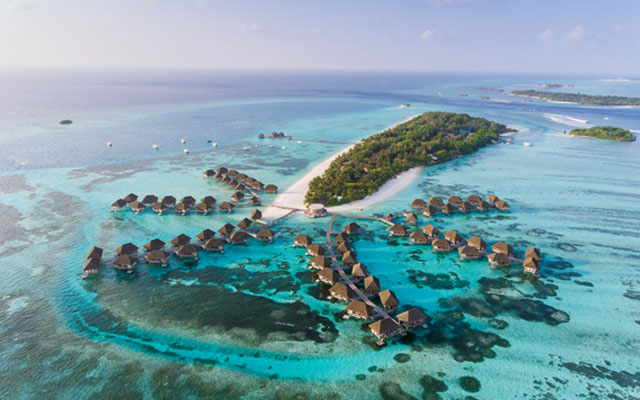
Singapore-based luxury hotel group Como Hotels and Resorts has appointed Fadzlon Bakar as cluster director of sales and marketing for the Maldives – Como Cocoa Island and Como Maalifushi.
Bakar’s experience in the luxury travel industry includes three years with Shangri-La Hotels and Resorts, 16 years with Four Seasons and most recently with Alila Villas Soori, where she played an instrumental role to rebrand the property to become The Soori Bali.
Let’s go back to the beginning. Why did Associated Luxury Hotels buy WorldHotels 18 months ago?
We compete with the bigger chains, but we were a one-legged stool doing only meetings and incentives (the parent owns Associated Luxury Hotels International or ALHI, an independent global sales organisation serving the North American MICE market). We should also be doing corporate travel and leisure. Either we build or we buy. So we bought WorldHotels.
Tom Santora
Why WorldHotels?
We have the same ethos, i.e. to prop up independent hotels for success. The portfolios were almost opposite, so there wasn’t an overlap from a distribution perspective. ALHI at the time had over 170 hotels in North America and 50-60 hotels internationally, while most of the 350 members of WorldHotels are predominantly in Europe and Asia, with only over 30 hotels or so in the US.
From the sales perspective, no one does MICE like ALHI, while WorldHotels is the ALHI of corporate travel. So we have two portfolios covering the globe. We’re now a full-service soft brand, not just a MICE global sales organisation.
ALHI has existed over 30 years. Why is it important to be a full-service soft brand today? How do ALHI members react to your being global, from US-centric previously?
It is a delicate but important subject in that in both groups, I don’t think members always want to see you grow. They want all the attention, so as we keep growing the organisation, sometimes they may feel they won’t be getting as much revenue as they used to get.
But if, say, our sales person talks to a customer and the customer says, ‘We need to have a meeting in Shanghai, what do you have there?’ If we don’t have anything there, well guess what? They are going to call Marriott or Hilton or someone else.
If you join ALHI, you probably don’t want the sales person running around selling 600 hotels (the combined number of hotels, roughly), but remember, the 600 hotels are not all MICE hotels, only a portion.
Do you see a day when the two portfolios will combine?
What we might see is the ALHI collection and the WorldHotels collection coming under one name. In some cases members might be in both (depending on the product). A lot of WorldHotels’ members in Asia are upper upscale hotels that need MICE, while the ones in Europe and the US typically have 150 rooms with three meeting rooms. There are already 35-40 WorldHotels members that have also become part of ALHI.
Give me an example how the purchase has benefited ALHI.
It gave us literally overnight an infrastructure to put more MICE people on the ground.
On our own, to hire someone to work for ALHI in Singapore would mean us knowing who the experts are, setting up an office, understanding the requirements such as medical benefits, etc. Now, they can start working in Shanghai or Beijing (WorldHotels has over 30 sales offices globally) and that’s the plan.
We’re going to put more MICE people on the ground globally. If you rewind to 18 months ago, everybody was in the US; today, we’ve already opened offices in London and Frankfurt, and Paris next, with offices in Asia and South America following.
Back to the two portfolios, how are you growing them going forward?
Our CEO (Josh Lesnick) stands behind the mantra that we’re not in the membership business; we’re in the revenue-generation business. We have always been a sales-focused organisation that highly incentivises our sales people to perform (http://bit.ly/2KhCrie). We’re not about the plaque; we want to be behind the scenes driving revenue and helping guide our hotels be successful.
So our combined portfolio moving forward is to have the right quality hotels in locations our customers want be, and to make sure we have the sales support to make those hotels successful.
That means saying no to hotels (that are not the right fit). In the past year, we have turned away over 10,000 rooms inventory from people who came to us (for WorldHotels membership). When we did the background, we didn’t think we could support them, so we didn’t want to take their money, or we felt their quality wasn’t where we’re going.
Apart from shifting WorldHotels’ culture towards more revenue-generation and sharper membership fit as you’ve just described, how else are you strengthening the new child?
We’re investing over US$10 million in WorldHotels alone this year on technology and people.
One of the big initiatives we’re taking is relaunching the loyalty programme. We’ve sunsetted Peak Points (the previous WorldHotels loyalty programme) and are launching an entirely new one, TheList, this fall.
There’s a focus among independent chains on loyalty programmes, as the big chains launch soft brands and other new threats such as home-sharing emerge. What gives your new loyalty programme an edge?
Our CEO Josh is the gentleman that came up with no blackout dates. He’s either launched or redefined maybe five different loyalty programmes from major chains like Hyatt, Starwood, Wyndham, plus he launched a loyalty coalition on Broadway, addressing issues such as how to get members to go to the different theatres’ shows – in short he’s Mr Loyalty, he gets it.
I redefined Omni’s programme (Santora was Omni Hotels & Resorts’ CMO and SVP of sales) but I also launched Global Hotels Alliance (GHA) which brought together 35 brands and 600 hotels around the world. Omni was a shareholder in that, so I had the chance to work with the CEOs of GHA to develop (the alliance).
And now we have a chance to launch a loyalty programme from the ground up, without being handcuffed by old technology or legacy programme.
How does one go about launching a new loyalty programme?
Understanding what our customers want is one of the first steps. In 4Q2017, we did a quantitative study of 100,000 independent travellers across the globe.
And here’s a really interesting finding: they feel they get inconsistent recognition at independent hotels. Say, when they arrive, they’re asked ‘is this your first stay with us?’ when it’s their third.
Then we went to the GMs and owners and did a similar survey. Guess what, the first thing they said was they needed to improve recognition for their guests – they know they don’t know their own customers.
So tied to our loyalty programme is a new CRM that will create extremely valuable profiles of every guest. This will provide them with better service when they travel and stay with our members.
We’re going to go back to the hotel, take three years of the customer history, and dedupe it. So instead of five times Santora (record), it becomes one, and that profile would say everything about me, not just where I’ve stayed – and that it’s not my first time at the hotel but third – but what my preferences are. We’re providing our members with technology that on their own, as independent hotels, will be expensive to have.
We’re still fine-tuning the programme and will roll it out in the fall, after the new WorldHotels website is launched this summer. There, too, the change won’t just be the skin of the website but an entirely different architecture. It will be fantastic from the functionality perspective, communications perspective and so on.