Wyndham Hotels & Resorts will launch a 593-key resort in the western Pacific island destination of Palau, said to give the country’s Aimeliik region its first upscale international hotel.
Commenting on the group’s Palau debut, Joon Aun Ooi, president and managing director, South-east Asia and Pacific Rim, Wyndham Hotels & Resorts, said: “International visitor arrivals to Palau have jumped 50 per cent since 2010, and the country remains an intriguing and appealing destination for many Asian travellers. With direct air links from key source markets such as Seoul and Taipei, the prospects for Palau’s tourism industry – including the MICE sector – remain bright.”
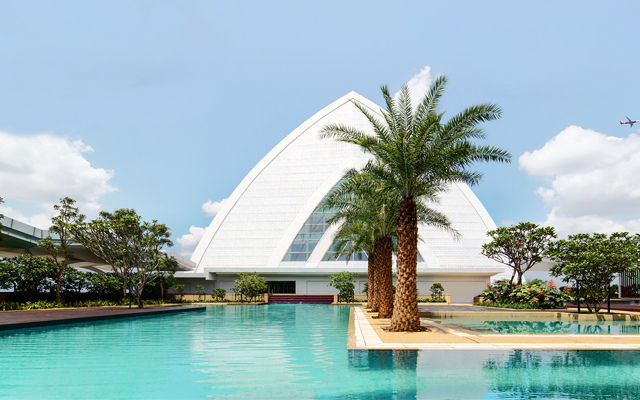
A rendering of the resort
Developed by the Sea Sky International Development Group, the resort will offer 132 guestrooms and over 400 villas, including over-water and hillside options.
It will also feature an executive lounge, two free-form pools, a children’s pool, a kids’ club and a wellness centre. The resort also includes a purpose-built conference centre with a variety of options for event planners, including a ballroom seating up to 140 guests and four meeting rooms for up to 60 people.
For F&B, guests can choose from a lobby lounge, beach bar and terrace, pool bar, an all-day dining poolside restaurant serving Asian and international cuisine, as well as a specialty Chinese restaurant.
A rendering of the docking platform
Palau comprises more than 200 jungle-clad islands in the western Pacific Ocean, about 1,500km east of the Philippines. It is a choice destination for divers and snorkellers, with its healthy and protected reefs housing marine life including approximately 1,500 species of fish, sharks, rays, turtles and more.
Wyndham Palau will be located 20 minutes’ drive from the Palau International Airport and a short boat transfer from Koror, the country’s main commercial centre.
One of the biggest advantages of cruise companies that struck me the other day – like ships passing in the night – is that their assets are moveable. I was reminded of this convenient truth for these companies when Norwegian Cruise Line Holdings (NCLH) decided to redeploy its China-centric ship, Norwegian Joy, from its homeport in Shanghai to the US.
The move created for it a domino effect of positioning its ships around the world where revenues would be highest. NCLH is a listed company; it minced no words that it was monetising strong global demand and driving higher shareholder returns.
Ican practically hear hotels moaning how they, too, wish they could move their property elsewhere each time RevPAR was down; alas, they have to stick their neck out in the market. That not sticking-it-out come rain or shine, which other tourism sectors do, is what bothers me about NCLH’s decision, no matter how logical you may say it is.
This is particularly so when the Norwegian Joy has been profitable since entering the China market – and only for just a little more than a year at that. It received the highest satisfaction level of all Norwegian Cruise Line fleet (NCLH also operates Oceania and Regent cruise lines), according to guest feedback surveys across all the line’s ships.
A lot of effort and progress have been made by the line to understand the Chinese consumers (even little things like shifting dining hours to 17.00 onwards than 18.00); increase their spending onboard through WeChat marketing; educate smaller agents to sell cruises; plus there’s the exclusive partnership between NCLH with Alibaba which has not even scratched its potential.
The ship itself was purpose-built for Chinese and its entry into China last year created a stir for cruising among Chinese travellers who love bells and whistles all the time.
The Norwegian Joy will be moved from Shanghai to Seattle in April 2019
There are no fewer than 28 F&B outlets – the widest array of dining experiences yet on any new ship that has been purpose-built for China – accommodation offerings that make it attractive for multi-generational travel which is popular for Chinese, great facilities for gamblers and gamers alike, among others. Its hull artwork was painted by renowned Chinese artist Tan Ping, who picked the phoenix to symbolise supremacy over all birds of the world. Its godfather is Mandopop star Wang Leehom. Now imagine this ship homeporting in Seattle then Los Angeles. No wonder NCLH has to spend another US$50 million to rejig the vessel to suit a different customer set.
What’s the point of the rigmarole of building a China-centric ship, of saying the company is bullish about China, as NCLH’s president & CEO Frank Del Rio did just last February, only to sink the plan all too soon even when the toddler is profitable?
Granted, with only 26 ships, NCLH feels it is underserving many markets of the world. But that only means it has made a huge miscalculation of building a China-centric ship in the first place.
Clearly, NCLH now sees that the opportunity cost of being in China today is high, considering other parts of the world can bring higher returns than the wholesale ship charter style that is still predominant in China.
But there is also an opportunity cost of leaving a fast-growing and fast-changing market like China for a whole year. As to which is the larger opportunity cost, only time will tell.
There’s also something to be said of real commitment in helping develop a market – not just approaching it like ships passing in the night.
Grab is eager to grow in Indonesia, where Gojek is its main competitor
As it consolidates market share in South-east Asia on the back of a takeover of Uber’s operations in the region, Grab has raised US$2 billion from its current financing round, “a significant portion” of which is expected to be invested in Indonesia.
The funding round saw investor Toyota Motor Corporation (Toyota) joined by global financial institutions, including OppenheimerFunds, Ping An Capital, Mirae Asset – Naver Asia Growth Fund, Cinda Sino-Rock Investment Management Company, All-Stars Investment, Vulcan Capital, Lightspeed Venture Partners, Macquarie Capital and others.
Grab is eager to grow in Indonesia, where Gojek is its main competitor
In a statement, Grab said it would use the funds to expand services in South-east Asia. On top of ride hailing for a range of transport modes, its services today include GrabPay, GrabFood for on-demand food delivery and GrabExpress for parcels.
Most recently in July, it entered the on-demand grocery delivery space by launching GrabFresh in Jakarta, with other cities to follow later in 2018.
The company intends to use a significant portion of the proceeds to continue investing in Indonesia.
Grab said it has over 7.1 million “micro-entrepreneurs” on its platform, more than half of whom reside in Indonesia. Through Grab’s partnership with local wallet and rewards programme, OVO, Grab said it has formed the country’s most widely accepted mobile payments ecosystem, with more than 60 million downloads.
According to Grab, this has been a year of exponential growth in Indonesia accompanied by a significant increase in market share.
GrabFood this year expanded beyond Jakarta to serve 28 cities and towns across Indonesia. Its Gross Merchandise Value (GMV) in the country almost quadrupled in the first half of 2018, while GrabExpress’ GMV has more than doubled in the first half of 2018.
Sharp rises in fuel prices have prompted major North American airlines to warn of flight cuts and fare hikes, and that direction appears to be rippling into Asia with Singapore Airlines Group’s LCC Scoot firing the salvo to increase airfares by an average of five per cent.
In a statement released yesterday, Scoot said that effective September, its fares will increase by between S$5 (US$3.70) and S$30 per sector, depending on flight duration.
Scoot fares will increase by up to S$30 per sector
Jet fuel price has surged almost 40 per cent year-on-year and now stands at nearly US$90 per barrel on average, according to the LCC.
With fuel comprising 32 per cent of Scoot’s total operating costs, the rise in jet fuel prices has pushed up Scoot’s fuel expenditure by 31 per cent year on year, it said.
Singapore Airlines reported RPK declines across the group in the April-June quarter, as well as a 57 per cent plunge in net profit on the back of rising fuel prices.
Besides increasing fares, Scoot is also looking at containing costs. Some initiatives being considered include exploring ways to reduce fuel burn, review suppliers’ contracts, improve productivity and keep manpower resources lean, among others.
Amid speculation that Scoot’s fare hike may be the start of increases across Asia’s airline sector, travel agents in Singapore are not jumping the gun.
Albatross World Travel & Tours’ president and CEO, Crystal Sim, told TTG Asia: “Any increase in fuel charge has no direct nexus with airline charges. It does not mean ipso facto that airline prices automatically go up… We expect it, but not automatically. In time, it will come.”
Meanwhile in the Philippines, airlines such as Philippine Airlines and budget carrier Cebu Pacific are petitioning to impose a fuel surcharge to cope with rising costs, according to local reports.
The country’s Civil Aviation Board is also in discussion with local carriers on a fare matrix scheme for the fuel surcharges, the Philippines’ GMA News reported.
A strong line-up of speakers at the first Asian MICE Cruise Conference panel
IT&CMA 2018 will debut the region’s first-ever Asian MICE Cruise Conference on September 18 as part of the show’s three-day business, education and networking programme.
Confirmed opinion leaders taking the stage include Dream Cruises’ president and Crystal Cruises Asia’s managing director, Thatcher Brown; Royal Caribbean Cruises’ managing director Angie Stephen; Worldwide Cruise Associates’ co-founder and president, Steve Bloss; Genting Cruise Lines’ senior vice president – international sales, Michael Goh; Silversea Cruises’ vice president, corporate & incentive sales, Freddy Muller; and Princess Cruises’ Southeast Asia director, Farriek Tawfik.
A strong line-up of speakers at the first Asian MICE Cruise Conference panel
Said Karen Yue, editor of TTGmice and group editor of TTG Travel Trade Publishing: “The cruise industry is booming and MICE is undoubtedly the next big thing for the sector. Market leaders are already capitalising on the potential, while many are still coming into the game. TTGmice is proud to put forth this first and only platform of its kind in the region – an open conversation with the world’s leading cruise executives.”
Kicking off IT&CMA’s education highlights on its first day, this half-day event at the Bangkok Convention Centre at CentralWorld will feature an intense panel discussion led by cruise CEOs and an experts’ exchange on making the case for MICE cruises, among other sessions, as well as networking opportunities at its hosted breakfast, coffee break and luncheon.
On the motivation behind this conference, Darren Ng, managing director of TTG Asia Media said: “As a pioneer in the business events industry, TTG is always at the pulse of key developments impacting the profession. Cruise offers a huge playing field for its many stakeholders, where its potential rests on the immense collaboration between the private and public sector across verticals and geographies to ensure that the right policies, infrastructure, facilities, producs and services are in place.”
Organisers therefore expect 400 regional MICE stakeholders relevant to the cruise sector to attend, with at least half of attendees comprising of buyers covering corporate incentive, meetings and events, incentive trips, luxury travel, associations and academics. Hotels, resorts, airlines, destination management companies, government representatives from national tourism organisations, convention visitor bureaus and ports, and media professionals will form the remaining audience profile.
According to the Cruise Lines International Association (CLIA) 2017 Asia Cruise Trends, cruise capacity across all metrics (number of ships, voyages, operating days and passengers) has increased significantly since 2013 with greater uptrend expected in the foreseeable future. Asia remains at the heart of this growth with passengers from this region quadrupling over 5 years. Last year, passenger capacity was estimated at 4.24 million.
While leisure cruise demand has seen a revival, the concept of cruises as an appealing and viable option for business events is still relatively new. Shared panelist Tawfik of Princess Cruises: “Today, there is low awareness among organisers and companies that MICE events can be organised easily and held successfully onboard cruise ships. As a possible budget-saving, all-inclusive alternative to hosting a meeting at a luxury resort, cruises also offer plenty of interaction and teambuilding opportunities, as well as a unique experience to give delegates that “wow” factor, such as waking up in a new country every day while only needing to pack and unpack once. The advantages of a MICE event at sea are endless.”
Bloss of Worldwide Cruise Associates echoes the perspective that greater exposure is needed for MICE cruises. He said: “As a collective, we strive to foster understanding of what a modern cruise ship is, and make purchasers aware of how to buy cruises while embracing cruises’ different terms and requirements. Today, there are over 55 cruise lines, some 400 ships plus 100 new ships in the pipeline. It is possible to have an unbiased all-in-one cruise shopping experience with options that extend globally.”
In addition to being part of the inaugural conference’s panel, the organisation is also exhibiting under IT&CMA’s cruise cluster.
IT&CMA 2018 will be held from September 18 – 20, 2018 at the Bangkok Convention Centre at CentralWorld. It is co-located with the CTW Asia-Pacific – The Leading Corporate Travel Management Conference for the Asia-Pacific.
Matthew Smith has been appointed general manager of Destination Asia in Singapore, succeeding Bob Guy who retires after eight years as managing director of the DMC in the Lion City.
Smith brings with him 18 years of experience in the travel industry and a developed network in meeting & events and DMC activities.
From left: Matthew Smith and Bob Guy
Alongside the management of daily operations, he will also drive forward new initiatives to further develop key sectors of meeting and events, luxury FIT travel and cruise.
Guy had set up the Singapore office in October 2010 alongside James Reed and Gill Guy, growing the company from an initial five staff to 34 travel specialists.
He will continue in his role as managing director of Destination Asia in Malaysia until the end of the 2018.
Kota Kinabalu Marriott, Malaysia
Located along Jalan Tun Fuad Stephens on Sabah’s waterfront, the new hotel offers 332 guestrooms and suites decked out in a design that pays homage to the rich heritage of Borneo’s Kadazandusun tribe. Recreational facilities include an outdoor infinity pool with views of the South China Sea, a 24-hour gym and a spa. There are also five F&B options, ranging from the Japanese teppanyaki dining room to the rooftop bar. For events, there is 1,300m2 of versatile space available across five function rooms and a Grand Ballroom that can accommodate up to 650 guests.
Adina Apartment Hotel Brisbane, Australia
TFE Hotels has opened the doors to its latest property, a 220-key hotel housed in a restored heritage-listed building that was completed in 1922 to accommodate the Queensland Government Savings Bank. Each apartment boasts TFE Hotels’ new signature Dreamcatcher bed, and has its own kitchen, laundry and living room with the ease of full hotel services including a restaurant, bar, 24-hour reception, room service and meeting facilities.
Standing on the corner of George and Elizabeth streets in the city centre, the hotel is located close to the Brisbane Convention & Exhibition Centre and Queensland Performing Arts Centre in Southbank.
Mövenpick Asara Resort & Spa Hua Hin, Thailand
The Asara Villa & Suite Hua Hin has undergone a complete rebranding and refurbishment by Mövenpick Hotels & Resorts. The upscale resort now features 96 private suites and pool villas. The 120m2 suites offer large balconies or terraces featuring day beds, as well as bathrooms with indoor and outdoor rainshowers and bathtubs. Meanwhile, the one- and two-bedroom villas span 150m2 and 200m2 respectively, and include luxurious indoor living areas, outdoor decks and private plunge pools.
Also available is a 400m2 two-bedroom beachfront villa with three separate pavilions, its own private beach area, large outdoor decks and a plunge pool overlooking the sea. Facilities on-site include the Asara Spa, a gym, outdoor infinity swimming pool, two restaurants and a bar.
Libre Resorts opens in Lijiang, China
The second upscale hotel in Libre Resorts’ portfolio, Libre Resorts Lijiang has opened in China’s Yunnan province. The resort features 455 premium deluxe rooms and 86 luxurious villas. Amenities include an all-day dining restaurant, a tea house and lounge, family club, spa, fitness centre and a Japanese hot spring. Meanwhile, events can be held at the neighbouring Lijiang International Convention Center.
Spaces on the ground floor to facilitate play and social interaction
Capri by Fraser is debuting in Japan with an opening in the Ginza district of Tokyo.
In line with the brand’s design centricity and millennial focus, Frasers Hospitality has partnered Japanese architect Kengo Kuma – whose work includes the upcoming Tokyo 2020 Olympic National Stadium – for the development of the property.
Spaces on the ground floor to facilitate play and social interaction
According to a statement from Frasers Hospitality, Kuma will channel his vision of challenging traditional urban spaces towards reinventing the concept of a hotel lobby, which will include social spaces on the street level connected to the pool, bar and Spin & Play, the brand’s innovative launderette offering.
Another highlight of Kuma’s design will be an origami roof at the entrance which regulates light entering the building.
Wardrobe space in the guestroom
The 190-room Capri by Fraser, Ginza / Tokyo will also feature meeting and conference facilities, as well as model after the digital core offering of Capri by Fraser, China Square / Singapore, which serves as a testbed for brand experiences.
Since its launch in 2012, Capri by Fraser has grown to become Frasers Hospitality’s fastest-growing brand with 16 properties in 14 cities with over 3,500 rooms, owing to rising demand from millennial travellers.
Capri by Fraser, Ginza / Tokyo will join Fraser Suites Akasaka, which is due to open in 2020 and Fraser Residence Nankai, Osaka, which opened in 2010 as the hospitality company’s debuting property in the country.
Village in Hainan's Qiongzhong Li and Miao Autonomous County
Hainan Tourism Development Commission has teamed up with Xiaozhu.com to leverage the rise of homesharing and develop rural tourism, including through establishing a Hainan Tourism B&B Association.
Wang Liantao, co-founder and COO of Xiaozhu.com, has been named president of the new association, while the commission will play a supervisory role. The association aims to regulate the development of the B&B industry in Hainan, establish a mechanism for police-citizen interaction, solve problems in B&B operations, improve the industry’s service level and drive competition.
Village in Hainan’s Qiongzhong Li and Miao Autonomous County
The agreement will also see the partners jointly promote villages in Hainan, build village B&B accommodation for poverty alleviation, and establish a B&B industry association.
The development comes as village homesharing becomes increasingly seen as a driver of village rejuvenation. According to a data report Xiaozhu released earlier this month, the platform now has over 30,000 village B&Bs. Each village B&B creates six local jobs on average, it said.
Stressing the importance of developing village tourism, Ao Liyong, deputy director of Hainan Provincial Tourism Development Commission, shared that there are about 516 rural tourist sites across the island, bringing about 1.75 billion yuan (US$256.7 million) in revenue in the first half of this year, up 14.2 per cent year-on-year.
Zhang Xinhong, chief information officer of the State Information Center, added that the sharing economy has created a historic opportunity for China’s economic development, breaking geographical boundaries to connect resources in villages and cities.
In 2018, Chinese sharing economy companies markedly increased their competitiveness globally, and both central and local policies provided unprecedented support to the sharing economy, playing a positive role in leading innovation and poverty alleviation, according to a statement.
Meanwhile, Xiaozhu plans to build a hands-on classroom for homesharing entrepreneurship in Hainan’s villages, providing better solutions for B&B entrepreneurs and operators.
The Chinese homesharing platform has over 420,000 house listings in 652 cities across the world and over 35 million active users. In the first half of 2018, Xiaozhu reached strategic collaboration with Fliggy, the tourism brand of Alibaba Group, and agoda.
After cutting 600 jobs in Hong Kong last year, Cathay Pacific Airways is looking at restructuring its overseas operations to further ward off competition from budget carriers and mainland China airlines.
The South China Morning Post (SCMP) reported Cathay would consolidate overseas sales, marketing, cargo and airport operations functions in some cities, with an unspecified number of jobs lost, citing an unnamed source.
Cathay Pacific is planning to restructure overseas operations; the company has about 7,600 employees based in 100 locations outside Hong Kong
The airline posted a net loss of HK$1.26 billion (US$160.5 million) in 2017. As part of its restructuring, Cathay is seeking to trim costs by more than HK$4 billion over three years.
Overseas operations include North-east Asia, comprising Japan, Taiwan and South Korea.
The restructuring process has yet to be finalised, Cathay Japan said, in the statement to Bloomberg. A spokeswoman at Cathay’s South Korean office said it was undergoing structural changes in line with what had been done at the Hong Kong headquarters and declined to specify whether there would be job losses, added the Bloomberg report. Taiwan operations would follow the structure set by the head office, Cathay’s Taipei office said.
The company has about 7,600 employees based in 100 locations outside Hong Kong, according to SCMP.
Cathay is reorganising other teams to enable quicker and better informed decisions to be made, following the redesign of its head office structure, the carrier’s Hong Kong office.