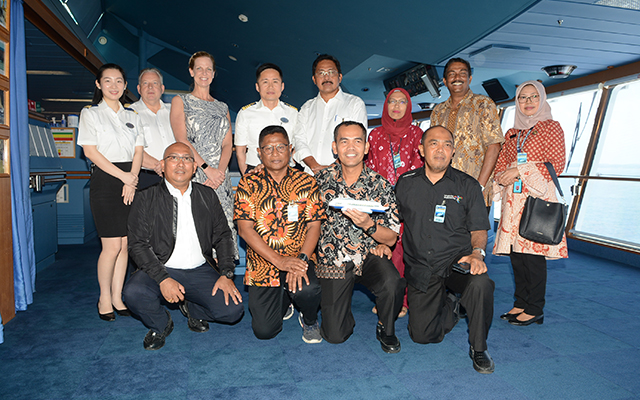
The Indonesian port and government delegation with the Royal Caribbean team onboard Voyager of the Seas in Bintan
Royal Caribbean International’s Voyager of the Seas on May 2 made her maiden call at Bintan Island, carrying around 3,800 guests on a three-night cruise from Singapore which also called at Kuala Lumpur (Port Klang).
The Indonesian port and government delegation with the Royal Caribbean team onboard Voyager of the Seas in Bintan
To celebrate the ship’s maiden call, a traditional plaque and key ceremony was held onboard, whereby Voyager of the Seas’ captain Wu Huimin exchanged plaques with Nurdin Basirun, governor of Riau Island and Frans Gunara, vice president director of Bintan Resort Cakrawala. Angie Stephen, managing director, Asia-Pacific of Royal Caribbean Cruises was also present at the ceremony.
Voyager of the Seas will call at Bintan Island on three more dates, i.e. May 5, 12 and 19.
The 15-deck ship will continue her South-east Asia season out from Singapore until late June, which includes itineraries such as the three-night cruise to Penang, four-night cruise to Penang and Phuket, and a five-night Spice of Southeast Asia cruise to Penang, Langkawi and Phuket.
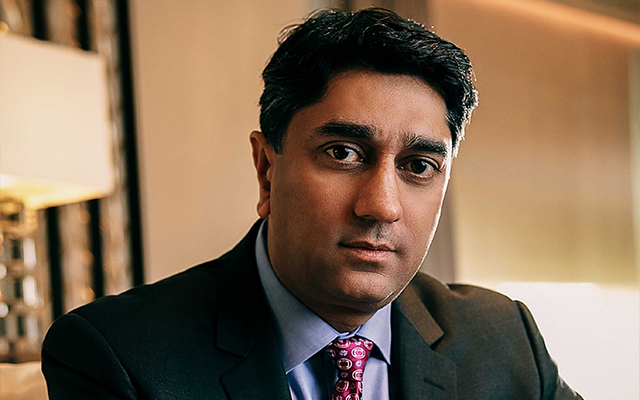
Karan Berry has been appointed general manager of Mandarin Oriental, Taipei.
Born in New Delhi, Berry possesses more than 22 years of experience in the hospitality industry and hotel operations.
He previously served as general manager at The Ritz-Carlton Pacific Place, Jakarta before joining Mandarin Oriental, Taipei. Prior to that, he was general manager of JW Marriott Hotel Jakarta, and has also spent time at several Oberoi Group hotels.
Thailand is starting to court LGBT tourists from Latin America, seeing huge opportunities particularly from Brazil, Argentina, Chile, Mexico and Columbia.
Jefferson Santos, representative to South America for the Tourism Authority of Thailand (TAT), said Brazil alone has a 25 million-strong LGBT community, making it the top priority market for Thailand.
Pride parade returned to Chiang Mai this year
“We will start developing the LGBT market from Latin America markets,” Santos said, although TAT has yet to open a new office in South America as originally planned.
To cash in on this segment, TAT will join the LGBT Forum, scheduled to take place in Sao Paolo in June this year, as well as the LGBT Symposium in Bangkok this September.
In 2018, over 200,000 tourists from Latin America markets travelled to Thailand, mostly to Bangkok, Phuket, Phi Phi Island and other beach resorts in the south.
Jorge Rocha, representative of Mexico-based International Travel Group (ITG), one of operators joining a fam trip to Thailand last week, said many tourists including those in the LGBT segment are interested in holidaying in Thailand. Despite the long distance, travel to Thailand costs about the same as to the Caribbean.
Not only does Thailand welcome LGBT travellers, the country offers unique culture that people in South America are looking for, said Rocha.
Marcia Tenroller of Trip and Travel Tour in Brazil said Thailand could become a new destination for tourists from longhaul markets.
Sichaphat Aukkapreechapat, cluster assistant director of sales leisure at Holiday Inn Express in Krabi province, added that travel to Thailand is not too expensive compared to some other destinations like Japan or Hong Kong.
On top of family and FIT guests, the property is also expecting to welcome more LGBT visitors from Latin American markets in the near future.
Meanwhile, Tarn Panita, director of sales and marketing at the Siam Hotel in Bangkok, said the exemption of visa-on-arrival fee for many nationals including in Latin America would help boost tourism to Thailand.
With the Philippines recently refreshing its destination campaign, tourism players who attended Messe Berlin’s Travel Meet Asia show in Manila are reiterating the importance of promoting the destination’s USP, targeted marketing and social media, among other priority areas.
Queenspoint Travel and Tours Corp president, Marlene Dado Jante, said that while there are a number of interesting activities that the Philippines can offer, including agritourism and tours focused on heritage and World War II, they need to be introduced to foreign clients and marketed actively.
Better marketing is required to promote lesser-known attractions like the Taal Volcano(pictured) in Calabarzon
She added that the Philippines has rural richness that are not yet well known.
Kristoffer Li, consultant at business consulting Frost & Sullivan, said that in a 2016 study for the Philippine Tourism Promotions Board (TPB), they recommended “diversifying away from beach destinations” and creating more targeted campaigns including for diving, culinary, nature or heritage.
At the same time, another key finding in the Frost & Sullivan 2016 study points to the lack of awareness about the Philippines – tourists cannot find basic information like where to go, what to see and what to eat.
As for the top channels of information, Li noted that the Department of Tourism website was “so old” and compared unfavourably with the websites of other NTOs that are mobile-friendly, and have itineraries for various number of days and types of activities like those that can be seen on travel blogs.
Much of these recommendations, including the importance of user-generated content, were taken on by the Philippines’ recently refreshed destination campaign.
But social media is just one part of marketing the destination, said Blessy Townes, Discovery Hospitality’s head of digital & CRM. Townes advised taking advantage of big data, and search engines. “If your business is not in Google, it doesn’t exist.”
Gerhard Doll, general manager of The Crimson Hotel Filinvest City Manila, added that other important areas include fixing and investing in tourism infrastructure, going for sustainable tourism, and innovation.
On the heels of Grab declaring its super app ambitions covering the travel vertical, Go-Jek has partnered Indonesian OTA Tiket.com to launch Go-Travel.
Go-Jek will be able to book hotel rooms ton Go-Travel, but not flights or train tickets.
Gojek users will be able to make hotel bookings
Currently, Go-Pay isn’t available as a payment option on Go-Travel.
Considered to be Traveloka’s immediate competition in Indonesia, Tiket.com reemerged as a travel booking frontrunner after being acquired by GDP Venture through e-commerce platform Blibli in 2017. Blibli and Tiket.com are both owned by Indonesia’s Djarum Group.
Aside from Go-Travel, recent news also said that Go-Jek is developing a Go-Mall feature on its apps, likely to include Blibli as one of its merchants.
Imam al-Bukhari Mausoleum is one of the major places of pilgrimage in Uzbekistan
Uzbekistan Airways has started flying between Tashkent and Jakarta on May 1, and this new route is expected to boost tourism between the two countries.
Operated with a Boeing 767 Dreamliner with 264 seats in two classes, the new flight is available twice-weekly on Wednesdays and Thursdays. It is hoped that the frequency will be bumped up to thrice-weekly, according to Azimkhon Khodjaev, head of marketing and networking planning of Uzbekistan Airways.
Imam al-Bukhari Mausoleum is one of the major places of pilgrimage in Uzbekistan
In addition to improving bilateral relations, Uzbekistan ambassador to Indonesia Ulugbek Rozukulov is upbeat that the direct flight between the two countries will have an impact on the tourism sector.
Rozukulov expects the new route will double the number of tourists from Indonesia to Uzbekistan and vice versa. He believes the target is possible because, among other reasons, Indonesians already enjoys visa free travel to Uzbekistan, he said.
“We also find a lot of interest among Indonesians because (of the many) Islamic attractions in our country,” Rozukulov shared.
Similarly, Rusmiati, chairman of the Association of the Indonesian Tours and Travel Agencies (ASITA), observed for Indonesians, a majority of whom are Muslims, Uzbekistan was an attractive destination because it was home to historical Islamic sites.
Another segment of Indonesians who travel to Uzbekistan are those travelling for umrah, with a direct flight connecting the country to Jeddah. She added that Indonesians usually visit Uzbekistan largely for leisure, not business.
For Rudiana, director of sales of Jakarta-based WITA Tour, the launch of Tashkent-Jakarta flight is a breakthrough.
Prior to that, Indonesians wanting to visit Uzbekistan usually had to go through Singapore or Malaysia to catch a connecting flight to Tashkent airport.
Rudiana pointed out that while not many Indonesians have been to Uzbekistan, the interest in the destination is growing.
“If we take a look at Uzbekistan today, it is largely like Jakarta in the 1970s. However, it is rich in tourist destinations appealing to Indonesian people who are mostly Muslims. One of them is the memorial complex of Imam al-Bukhari,” he said.
Like Rusmiati, he foresees demand for Uzbekistan coming mostly from the leisure segment.
On Wednesdays, the flight takes off from Islam Karimov Tashkent International Airport at 06.45 and arrives at Soekarno Hatta International Airport at 09.00, transiting in Kuala Lumpur. The return flight leaves Jakarta 22.30, and flies direct to Taskent, arriving the next day at 07.00.
The Thursday flight goes to Jakarta direct, leaving Tashkent at 09.25 and arriving in Jakarta the next day at 09.25. The return flight leaves Jakarta at 10.50 with a transit in Kuala Lumpur and arrives at Tashkent at 21.35.
Thomas Cook (India) to craft Sentosa-only packages, going beyond offering the island as part of Singapore tours
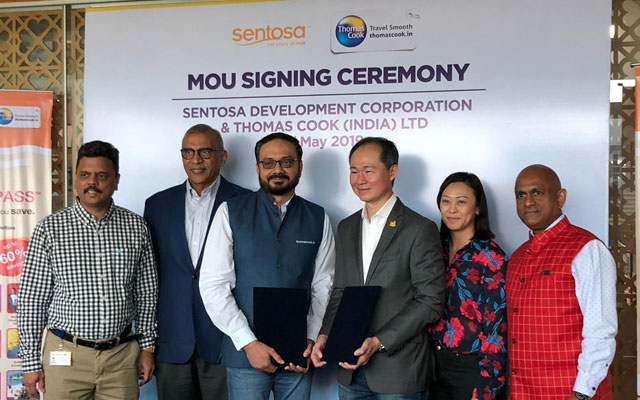
Thomas Cook (India) and Sentosa Development Corporation (SDC) have entered into a three-year MoU with the aim of driving tourism from India to the Singapore island attraction.
Both parties will collaborate on a multi-pronged effort comprising activities such as product development, joint consumer promotions, as well as publicity to raise Sentosa’s profile in the India market.
Thomas Cook (India) to craft Sentosa-only packages, going beyond offering the island as part of Singapore tours
The overall aim is to strengthen Sentosa’s position as a top-of-mind destination for all Indian tourists visiting Singapore, increase Sentosa’s capture rates of the India market particularly in Tier 2 and 3 cities, and grow visitorship to and spend on the island.
While Sentosa has previously featured as part of Thomas Cook India’s Singapore portfolio, the company is now focussed on curating exclusive Sentosa packages as well. Additionally, as part of the partnership, Thomas Cook India will offer enhanced access to multiple Sentosa attractions, coupled with promotions and special offers on accommodation and attractions.
Commenting on the MoU, Quek Swee Kuan, CEO of SDC, said: “With India being Sentosa’s top inbound market for the last three years, we look forward to collaborating with Thomas Cook India to tap on this growth potential and welcome more tourists to Singapore and Sentosa.”
Myanmar-based Memories Group has bought a US$3.2 million minority share in Strand Hotel International.
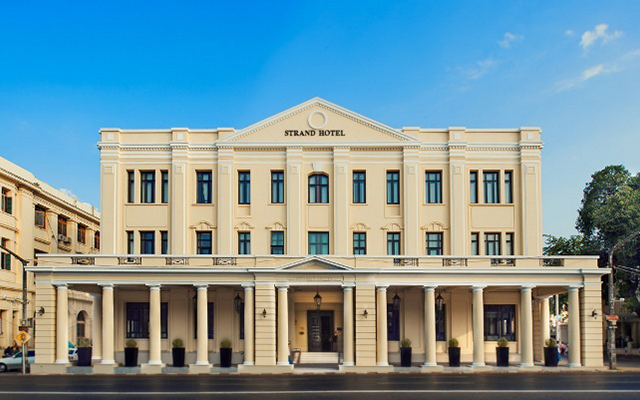
The investment gives the Singapore listed company stakes in the Strand Cruise, a 61m-long 25-cabin luxury ship operating on the Ayeyarwady River; and a trio of hotels including the landmark The Strand Yangon, the four-star Inya Lake Hotel in northern Yangon; and the modern Hotel G Yangon in Yangon’s city centre.
The Strand Yangon is a national landmark in Myanmar
“The acquisition is in line with our plans to own, develop and/or operate more hotels and lodges so as to expand our hotel business segment,” said Memories Group CEO Cyrus Pun, adding that he remains convinced in Myanmar’s “enormous tourism potential”.
According to the country’s hotel and tourism ministry, Myanmar attracted some 3.6 million foreign visitors last year, a far cry from the 38.3 million tourists that neighbouring Thailand recorded.
Memories Group’s portfolio include sail operator Burma Boating; hot-air balloon flight company Balloons Over Bagan; and three recently-opened hotels in the country: four-star Awei Metta, Hotel Suggati, and Awei Pila in the Mergui Archipelago.
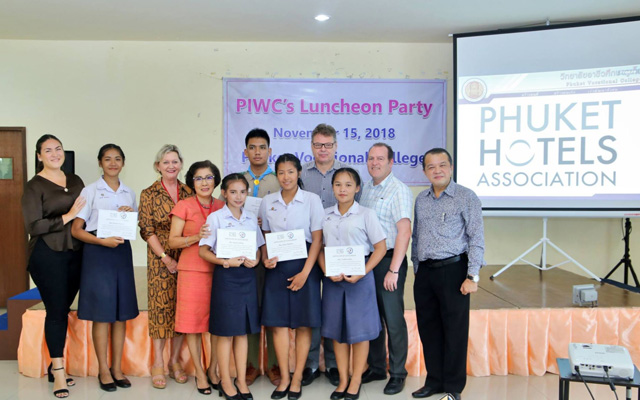
Scholarship Recipients from last year's fundraiser
Non-profit organisation The Phuket Hotels Association is inviting the public to bid in an online auction to raise funds for scholarships as part of its PHAB 2019 campaign, which included a charity gala dinner at Latitude Laguna Marquee last Friday.
Bidding is open until midnight May 31, 2019, and prizes include five-star stays and experiences donated by an array of sponsors from London, New York, Dubai, the Maldives and Sydney, plus Bangkok, Chiang Mai, Krabi and Koh Samui – all available with discounts for the highest bidder.
Scholarship Recipients from last year’s fundraiser
In addition to hotel stays, the online auction includes a range of activities such as yacht charters, golf, tennis, surfing classes and gym memberships.
The PHAB 003 silent online auction is continually being updated with bids and new prizes are being added. Bidders can check back on how they are doing and see what other are coming up.
Proceeds from the auction will sponsor at least 20 hospitality scholarships and traineeships, exclusively for the benefit of young Phuket residents who would be otherwise unable to fund their education. To date, the association has successfully sponsored over 30 students studying hospitality and tourism in Phuket.
For more information, please visit https://phab.phukethotelsassociation.com/silent-auction/.
Diethelm Travel Group has appointed Adam Szymanski as its new North America representative.
Based in the US for his new role, Szymanski has been tasked with further establishing the company’s reach throughout the US and Canada.
Szymanski joins Diethelm with nearly a decade of experience in travel representation, sales and brand management. Beginning by creating African safari itineraries, he soon moved over to the supplier side of the industry representing more than 37 hotels, camps and DMCs across Africa with Travel Marketing Worldwide. From there, he became the North American representative for Singita through JG Black Book of Travel.
Prior to joining Diethelm, Szymanski most recently represented a collection of 26 hotels and six DMCs as the director of sales and marketing at Passages of Distinction.