Capella Ubud, a luxury camp in Bali, is offering the Dream Now, Travel Later package, a pay-now, stay-later package without the need to lock down dates.
Guests can make advanced payment for a stay at attractive rates and select their vacation dates only at a later time, eliminating the hassle of date changes or trip cancellations.
Capella Ubud boasts luxurious tented camps in place of hotel rooms
Under the package, guests can book up to 14 nights. Breakfast will be provided. Guests staying for two consecutive nights will receive a free round-trip airport transfer, while those staying for three or more consecutive nights will be served a complimentary private dinner in their tent.
Featuring 22 one-bedroom tents and a two-bedroom lodge, the Capella Ubud comprises a gym, a spa offering nomadic treatments, as well as three dining establishments, including open-air Asian street food outlet Api Jiwa.
Each tent focuses on a unique theme and comes with a 24m2 private salt water pool. The Translator’s Tent, for instance, features Balinese lontar palm-leaf manuscripts on topics such as astronomy and healing.
Designed by Bill Bensley, the Capella Ubud sits on sloping terrain amid a dense rainforest about a 20-minute drive from the heart of Ubud. Care has been taken to preserve the flora and fauna native to the area.
Capella Ubud, a luxury camp in Bali, is offering the Dream Now, Travel Later package, a pay-now, stay-later package without the need to lock down dates.
Guests can make advanced payment for a stay at attractive rates and select their vacation dates only at a later time, eliminating the hassle of date changes or trip cancellations.
Capella Ubud boasts luxurious tented camps in place of hotel rooms
Under the package, guests can book up to 14 nights. Breakfast will be provided. Guests staying for two consecutive nights will receive a free round-trip airport transfer, while those staying for three or more consecutive nights will be served a complimentary private dinner in their tent.
Featuring 22 one-bedroom tents and a two-bedroom lodge, the Capella Ubud comprises a gym, a spa offering nomadic treatments, as well as three dining establishments, including open-air Asian street food outlet Api Jiwa.
Each tent focuses on a unique theme and comes with a 24m2 private salt water pool. The Translator’s Tent, for instance, features Balinese lontar palm-leaf manuscripts on topics such as astronomy and healing.
Designed by Bill Bensley, the Capella Ubud sits on sloping terrain amid a dense rainforest about a 20-minute drive from the heart of Ubud. Care has been taken to preserve the flora and fauna native to the area.
Capella Ubud, a luxury camp in Bali, is offering the Dream Now, Travel Later package, a pay-now, stay-later package without the need to lock down dates.
Guests can make advanced payment for a stay at attractive rates and select their vacation dates only at a later time, eliminating the hassle of date changes or trip cancellations.
Capella Ubud boasts luxurious tented camps in place of hotel rooms
Under the package, guests can book up to 14 nights. Breakfast will be provided. Guests staying for two consecutive nights will receive a free round-trip airport transfer, while those staying for three or more consecutive nights will be served a complimentary private dinner in their tent.
Featuring 22 one-bedroom tents and a two-bedroom lodge, the Capella Ubud comprises a gym, a spa offering nomadic treatments, as well as three dining establishments, including open-air Asian street food outlet Api Jiwa.
Each tent focuses on a unique theme and comes with a 24m2 private salt water pool. The Translator’s Tent, for instance, features Balinese lontar palm-leaf manuscripts on topics such as astronomy and healing.
Designed by Bill Bensley, the Capella Ubud sits on sloping terrain amid a dense rainforest about a 20-minute drive from the heart of Ubud. Care has been taken to preserve the flora and fauna native to the area.
The Mekong Tourism Coordinating Office (MTCO) and the Ministry of Hotels and Tourism, Myanmar have decided to push back the dates of the annual Mekong Tourism Forum, from August 25-26, 2020, to February 15-16, 2021.
Both parties made the decision in light of current travel restrictions and concerns that delegates would not be comfortable convening with more than 300 others in a closed venue amid the pandemic.
Bagan will remain host destination in 2021, while Vietnam will take the 2022 baton; Htilominlo Temple in Bagan pictured
Bagan, a town awarded UNESCO World Heritage site last July, will remain as the host destination. The theme ‘Achieving Balanced Tourism’ will be retained, with emphasis given to rebuilding the region’s tourism industry.
Vietnam, originally the host of the 2021 Mekong Tourism Forum, will host the event in 2022.
Jens Thraenhart, executive director, MTCO, shared that the theme ‘Achieving Balanced Tourism’ was “more important than ever”, given that the region has the chance to “reset tourism and become more sustainable”.
He added that the industry can do so by leveraging innovative insights — such as Doughnut Economics. Meanwhile, the Greater Mekong Sub-region (GMS) nations can draw up travel bubbles to speed up tourism recovery.
Nevertheless, Thraenhart acknowledged that there was still an element of uncertainty despite the postponement. “While nobody can predict if travel will actually be possible in February and people will be comfortable in being together at a conference with hundreds of delegates, we are now setting the new dates, and (hoping) for the best,” he said.
In the meantime, MTCO will work alongside the Ministry of Hotels and Tourism, Myanmar and other public and private industry stakeholders, to ensure safety and hygiene measures are put in place at the event.
The office will also host a half-day Virtual Mekong Tourism Forum on the afternoon of August 25, focusing on tourism resilience and recovery in the GMS.
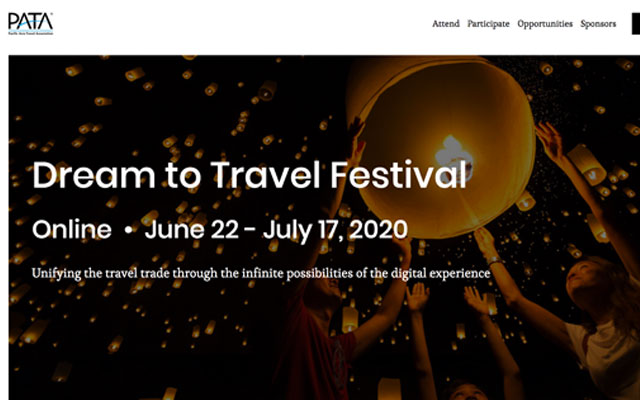
A four-week virtual festival that promises to unify the travel trade through free learning and networking opportunities will be held by PATA from June 22 to July 17, 2020.
Dream to Travel will not be “just another virtual event”, remarked PATA CEO Mario Hardy.
Participants can look forward to virtual hangouts and games alongside learning opportunities
Besides interaction with experts and peers, the festival will also provide a platform for industry players to introduce and browse regional and global travel products, and network in fun and innovative ways such as virtual hangouts, he elaborated.
PATA envisioned that the festival will spur the “industry to come together and work towards a more responsible and stronger travel and tourism industry”, Hardy said.
Dream to Travel will feature three key elements, the first being the Dream to Travel forums, where speakers from public and private tourism organisations share latest insights on the industry.
Meanwhile, the Digital Showroom and Community Hub element will provide a platform for tourism players worldwide to interact, and exhibit and browse travel products. Festival recordings and links will be made available.
The third element, Live Experiences, Virtual Hangouts and Giveaways, will challenge players to consider how meet-ups and cultural exchanges can be reworked in a time of safe distancing, where technology is more pertinent than ever.
Games and activities will be incorporated into the festival calendar.
PATA has partnered the Macao Government Tourism Office (MGTO), the Tourism Authority of Thailand (TAT) and Tourism Malaysia, to feature the respective destinations during the festival. Each will be highlighted for a week.
A fourth partner destination will be announced at a later date.
Interested industry players can register for an Attendee Pass with PATA, and download the event app to receive further updates. A free webinar will be conducted on June 9, 15.00 ICT to provide more details on the Dream to Travel festival.
Destination NSW, the government agency that leads the tourism and events industry for Australia’s New South Wales, has rolled out its 213 Ways to Reboot 2020 campaign to reignite global wanderlust for Sydney and other destinations in the state.
The campaign, which is part of the state government’s wider tourism recovery effort, Now’s The Time to Love NSW, depicts an array of diverse and unique experiences across the state that travellers can enjoy in the 213 days that remain in the year 2020.
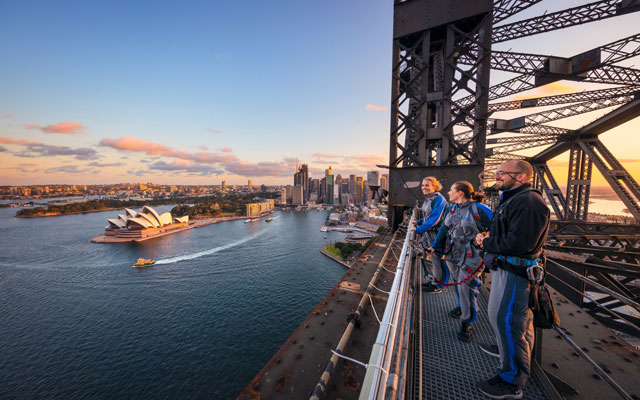
BridgeClimb Sydney is among the 213 ways to enjoy Australia’s New South Wales
More than 102 state destinations, 131 operators, 37 hotels and other accommodations, 28 national parks, 19 animal encounters and more, are featured in the line-up.
To drive attention to 213 Ways to Reboot 2020 on VisitNSW.com, Destination NSW will be executing a social media campaign targeted at the international markets of the US, the UK, New Zealand and India.
“We hope that this list of NSW travel experiences encourages global visitors to love NSW once again, and start planning to visit as many of the incredible towns, sights and experiences that the state offers,” said Steve Cox, CEO, Destination NSW.
“Whether it is sailing on Sydney Harbour, hiking through the Blue Mountains, surfing in Byron Bay, diving with marine life on the South Coast, or drinking an award-winning drop from one of our 14 wine regions, people come to NSW from all over the world in search of the awe-inspiring adventures that are available to us right now in NSW.
“Now’s the time to start dreaming and planning to make up for lost time once you are able to visit Sydney and NSW again,” added Cox.
The International Skal Council has established a committee to formulate post-Covid-19 strategies to protect and guide the travel, tourism and hospitality industry it represents, with special attention paid to improved airline refund processes.
The committee was a result of several meetings since early May, conducted with internal members as well as with other global travel association to identify issues within the industry amid the pandemic.
Skal International Council committee will advocate governments and authorities to restructure policies to protect both airlines and airline customers
In a press statement, Skal noted that it was particularly concerned with the lack of transparency around refunds practiced by some airlines, and hoped to protect travel agencies and airline passengers across the globe.
Of Skal’s 14,000 industry membership, 35 per cent is made up of travel agents and tour operators.
Leaders of the Skal International Council pointed out that “the industry is facing serious challenges due to the inconsistent refund procedures enforced by the airlines worldwide. The consumers and agencies who booked their travels with the anticipation of service have been put into misery going through the refund process with airlines and this has been damaging…the industry”.
The Skal International Council has agreed that the committee will focus on ensuring consumer protection while formulating future policies, and will do so by advocating governments and authorities to restructure policies to protect both airlines and airline customers. It will also draw up plans to redesign distribution channels with trained and credible stakeholders.
“This is an historic day for our Skal International Council, to decide to ensure that the traveling public is better protected,” said Peter Morrison, president of Skal International.
“We, our committee within the International Skal Council, will be working on a road map to optimise commercial and service relationship between airlines, IATA, travel agencies and the hospitality industry worldwide to the full satisfaction of customers. (We will) share (that plan) with our global partners and industry in general,” added Constantine Panoussi, International Skal Councillor for Monaco and the leading councillor on the initiative.
Indonesian tour agents are urging local attractions to stimulate a rebound in tourism business with discounts and special deals, as the country moves to reopen selected tourism sites this month.
Borobudur, Prambanan and Ratu Boko temples in Central Java are planning to welcome visitors from June 8, after nearly three months of closure, as part of trial operations to exercise the new protocol. Taman Safari Park in Bogor, West Java rolled out on May 26 an early bird promotion for its tickets, even though a reopening date has yet to be set. The discounted ticket, priced 23 per cent lower than usual, is valid until May 10, 2021 and must be purchased by June 8 this year.
With the reopening of Indonesia’s tourist magnets such as the Prambanan temple (above), which is set to welcome guests again this month, trade players are urging destinations to dole out discounts to stir up demand
Pranoto Hadi Prayitno, owner of Citra Gilang Tour, expressed during a webinar that discounts offered by major tourist attractions would stimulate domestic demand and allow tourism businesses to gauge consumers’ purchasing power.
While he is aware that discounts will add to the burden of attractions that are struggling to stay afloat during the crisis, he suggested that the promotions can be phased out gradually once domestic tourists are ready to accept the usual fares.
Pranoto opined that a 10 to 25 per cent discount should be bearable for attractions and sufficient to whet domestic travellers’ appetite.
Udhi Sudiyanto, chairman of the Association of Indonesian Tours and Travel Agencies (ASITA) Yogyakarta chapter agreed that discounts were needed to give locals a reason to resume their holidays when purchasing power has been reduced.
Udhi expects the government to subsidise at least half the entrance fee to state-owned attractions like the Borobudur and Prambanan temples as well as Watu Goyang hill and Tebing Breksi cliff in Yogyakarta.
Profit-making would need to take a back seat in attraction management, he said, adding that the government should focus on restarting the economic engine of domestic tourism so that employees in the industry can make a living again.
With no way of attracting international travellers immediately, the domestic market is now critical for the survival of Indonesian tourism businesses, according to Arief Gunawan, chairman of the International Luxury Travel & Hospitality Alliance.
“It is impossible that (Indonesians) will be interested in (domestic travel) if we do not offer discounts,” he said.
Arief hoped Indonesia would learn from Vietnam, where travel trade players have been enticing the locals with attractively priced tour packages. He noted that while the Vietnamese were initially apprehensive about heading outdoors during the Covid-19 outbreak, they changed their minds after seeing good tourism deals.
When asked if Taman Wisata Candi would be heeding the industry’s call for attractive offers, Hetty Herawaty, marketing director of the state-owned company that manages Borobudur, Prambanan and Ratu Boko temples, simply said in a webinar that her team was still reviewing the decision.
Other local tourism companies, like Jatim Park Group and Perisai Group, are also mulling the possibility of promotions to initiate early demand.
“We are now struggling to not dismiss (our staff). We currently employ over 1,000 people. Our cashflow is drained (due to a lack of income)…and we have to be very careful (not) to contribute to the increasing rate of unemployment (which) can add to the problems faced by the government,” Hetty said.
Hetty shared that the temples would likely target middle- and upper-class domestic travellers in the first three months of reopening, as this segment would be less financially-strained.
“We will engage them to work together in restarting business in tourist destinations. We want them to understand that traveling is not just (satisfying) a need, but also a way to help the locals who are working at the sites,” she said, adding that the initial recovery may be supported by a rising emphatic society – people who are willing to spend and lift the tourism industry.
Expedia Group has committed US$275 million to help supply partners, destinations and the wider travel industry weather the Covid-19 impact, as well as fuel industry-wide recovery efforts.
The company’s recovery programme comprises a number of global initiatives to support industry recovery and property-level relief designed to help independent partners and small chains rebuild their business, attract high-value guests, and optimise cash flow.
Expedia Group commits US$275 million to to help partners rebound from the impact of Covid-19
Relief initiatives for partners include US$250 million in marketing credits and financial relief. For each participating property, the company will reinvest 25 per cent of the compensation earned in 2019 from the property into marketing credits for use with Expedia Group.
The company is also reducing its compensation on all new bookings made within the three-month programme period, regardless of the actual stay dates. As well, the group is extending payment terms for Hotel Collect bookings to 90 days to provide additional financial relief.
The marketing credits and financial relief measures will become available to partners based on recovery signals, including demand trends, from their specific markets, so as to provide them with timely support.
In addition, Expedia Group is providing proprietary data, through a new analytics tool called Market Insights, to track trends on website traffic, stay dates, and demand source markets. The tool is live now and is complimentary to all partners utilising Partner Central.
To support chains and owner groups, the online travel giant has released a streamlined version of its optimised distribution solution that allows lodging suppliers to more effectively manage the distribution of wholesale rates among third party travel providers.
To restore destinations, Expedia Group Media Solutions, the advertising arm of Expedia Group, is opening a US$25 million fund for destinations. The group will also roll out a series of global brand campaigns.
Furthermore, to lift furloughed and displaced workers, Expedia Group has created a complimentary training and education programme, Expedia Group Academy, which offers skill development through online learning modules and live content led by the company’s subject matter experts and travel industry leaders. Participants will receive recruitment opportunities upon completion.
The group has also created a new feature for lodging partners to highlight the health and hygiene measures at their properties, to bolster consumer confidence. Additionally, Expedia Group is introducing a new filter to search flights by flexible fares on the company’s sites globally.
Tourist destinations across the globe are taking the first tentative steps towards easing Covid-19-related travel restrictions, new research by UNWTO has shown.
Amid the UN agency releasing its global guidelines for reopening tourism, three per cent of all global destinations have now taken steps to ease travel restrictions.
Travel restrictions starting to ease, but caution remains, says UNWTO
The recently-released fourth edition of UNWTO’s COVID-19 Related Travel Restrictions: A Global Review for Tourism report, looked at the measures of 217 destinations worldwide as of May 18, 2020.
Seven destinations have eased travel restrictions for international tourism purposes, while several other destinations are engaged in significant discussions about the reopening of borders, showed its research.
Still, caution remains, with the report noting that 100 per cent of all destinations worldwide continue to have some form of Covid-19-related travel restrictions in place.
Furthermore, as of May 18, 75 per cent continued to have their borders completely closed for international tourism. In 37 per cent of all cases, travel restrictions have been in place for 10 weeks, while 24 per cent of global destinations have had restrictions in place for 14 weeks or more.
UNWTO secretary-general Zurab Pololikashvili said: “The timely and responsible easing of travel restrictions will help ensure the many social and economic benefits that tourism guarantees will return in a sustainable way. This will contribute to the livelihoods of many millions of people around the world. The sector is a driver of sustainable development and a pillar of economies. UNWTO stresses the need for vigilance, responsibility and international cooperation as the world slowly opens up again.”
Pololikashvili also welcomed the growing confidence in the global tourism sector, noting it stands ready to return to growth.
Zooming in on global travel restrictions, the UNWTO research showed that the more important tourism is to the economies of individual destinations, the more likely they are to have introduced complete border closures.
In the case of SIDS destinations (Small Island Developing States), 85 per cent continue to have their borders completely closed for tourism purposes.
All UNWTO regions have more than 65 per cent of their destinations completely closed to tourism: Africa (74 per cent), Americas (86 per cent), Asia and the Pacific (67 per cent), Europe (74 per cent) and the Middle East (69 per cent), found the report.