

Emerging recovery across travel, tourism and hospitality businesses has facilitated improvements in employee sentiments and hiring confidence in the Asia-Pacific region, found the ACI Report 2022 which was released on January 31 this year.
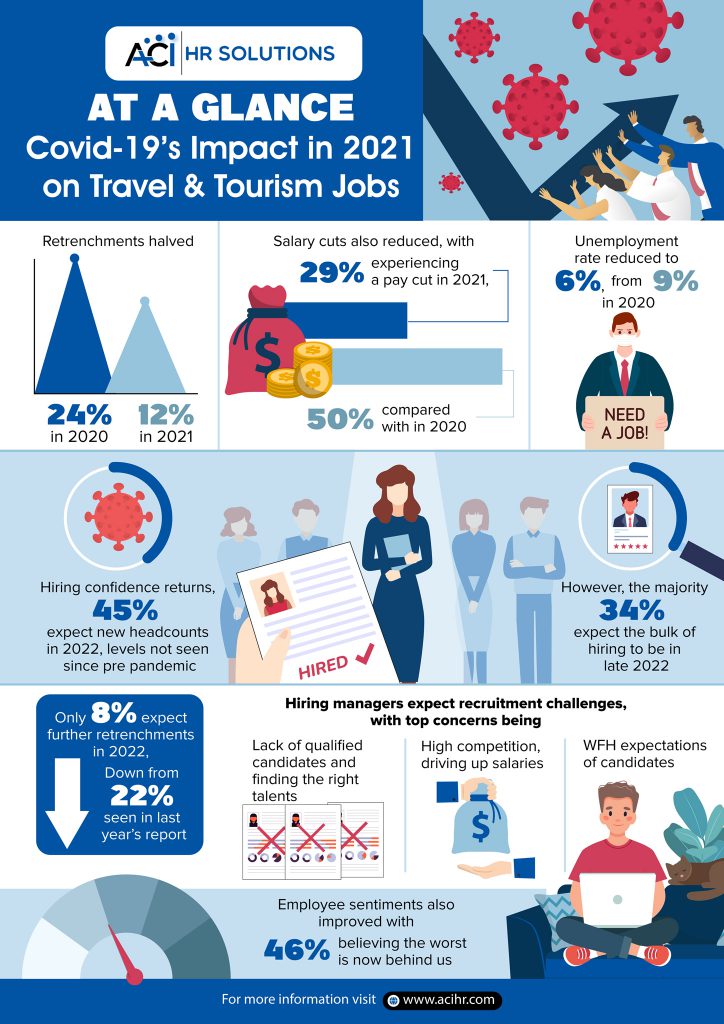
The annual report, conducted with 820 travel, tourism, hospitality and lifestyle personnel across the region, has identified a reduction in retrenchments in 2021 – 12 per cent compared to 24 per cent in 2020. Employee sentiments have also improved, with 46 per cent believing the worst is now behind them.
 Similar optimism is seen among HR and hiring managers, with 45 per cent of such respondents expecting new headcount in 2022 – levels not seen since pre-pandemic.
However, hiring managers expect a tougher time when they eventually recruit. They are most concerned with a lack of qualified candidates and challenges in finding the right talents; high competition for talents, thus driving up salaries and increasing their budgets; and work-from-home expectations of candidates that may not align with their company’s return-to-office policies.
In terms of salary satisfaction, only 26 per cent of respondents received a pay increment in 2021 – a slight drop from 2020’s 28 per cent and far behind pre-pandemic levels of 65 per cent. Thirty-seven per cent enjoyed a bonus in 2021, similar to 2020’s 39 per cent, although the majority (36 per cent) was given less than one-month’s bonus while 35 per cent received one to two months’ bonus.
Career development continues to be valued by respondents, with 68 per cent indicating that this was either “extremely important” or “very important” to them. Thirty-five per cent of respondents say that their current employer offered “excellent” or “good” opportunities for career progression, slightly higher than 2020’s 32 per cent.
At the same time, 38 per cent said career prospects with their current employer were “poor” or “zero”, up from 34 per cent.
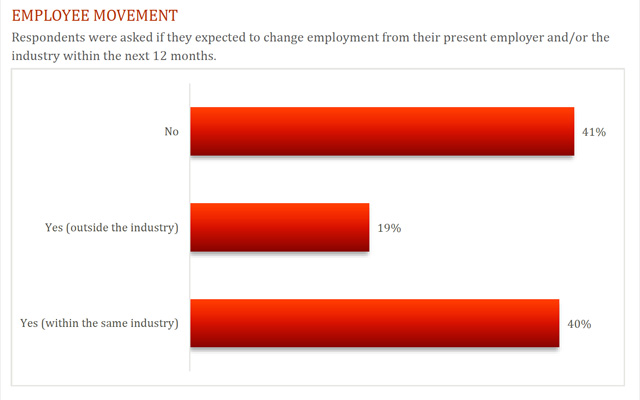
Respondents’ desire to exit their current job or industry appears less intense compared to last year’s findings. Fifty-nine per cent of respondents expressed plans to change employers and/or industry over the next 12 months, with 19 per cent of them keen to explore opportunities in other industries. In the ACI Report 2021 report, the exit desire was stronger – 68 per cent wanted to leave their jobs, with 27 per cent of them looking to switch industries.
While salaries fluctuated across different surveyed countries, there was a noticeable drop in salary for certain positions, particularly senior leadership positions such as the CEO. The UAE recorded the highest average salaries (US$146,142) and which also rose sharply from the previous year with a 34 per cent jump – signifying that the region is well into recovery phase.
Hong Kong (US$104,921), Thailand (US$94,649) and Singapore (US$91,895) were the next highest averages from the survey. Indonesia (US$42,512) again posted the survey’s lowest average salary and an additional 10 per cent slide against last year’s figures, highlighting the country’s dire tourism situation.
 A detailed copy of the ACI Report 2022 can be downloaded here. It includes a special Covid-19 supplement to help both employers and employees alike of travel, tourism and hospitality industries make sense of such challenging times.

 Forget the coveted five-star rating – possessing the hidden star is now the new gold standard in delivering service excellence. Here are five factors that will give hotels the edge to deliver the ultimate memorable guest experience and secure that extra star of excellence:


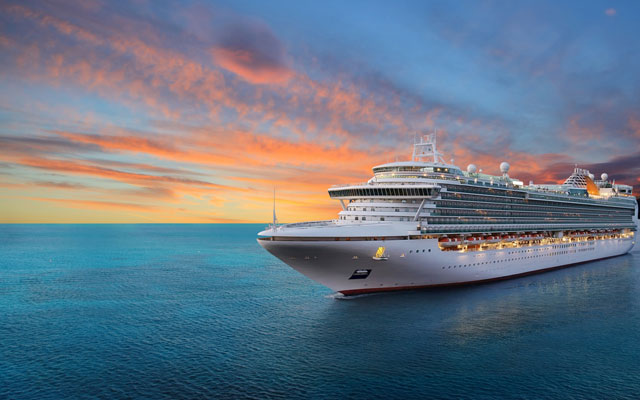













Cruise Lines International Association (CLIA) has released the 2022 State of the Cruise Industry Outlook report, which highlights how the industry has continued to resume responsibly with proven protocols, underscores the value of cruise tourism to local communities and national economies, and charts the industry’s progress towards achieving carbon neutrality.
The report “provides an opportunity to reflect on how far our industry has come as CLIA ocean-going cruise lines have welcomed more than six million guests onboard since resuming operations in July 2020,” said Kelly Craighead, president and CEO of CLIA.
“While our focus on health and safety remains absolute, our industry is also leading the way in environmental sustainability and destination stewardship,” she added.
“Coastal and maritime tourism is an important economic driver, and we continue to work in partnership with cruise destinations so that communities thrive from responsible tourism. Our members are also investing in new technologies and new ships and pursuing the goal of net carbon neutral cruising by 2050.”
The 2022 outlook report also features reflections from cruise industry partners and community members around the world.
The report highlights that by 2027, the CLIA ocean-going cruise line member fleet will reflect significant advancements in the cruise industry’s pursuit of a cleaner, more efficient future. It also presents 2020 economic data that illustrates the pandemic’s impact on the wider cruise community and underscores the importance of cruise tourism to global economies.
In addition, it shows how industry-leading protocols are facilitating the resumption of cruise tourism around the world, with more than 75 per cent of ocean-going member capacity having returned to service and nearly 100 per cent projected to be in operation by August 2022.
The report also details how continued collaboration with local communities in the destinations cruise ships visit remains a critical focus for the cruise industry, including in Dubrovnik, Croatia, the Greek destinations of Corfu and Heraklion, and the City of Palma in the Balearic Islands.
Read the full 2022 State of the Cruise Industry Outlook report here.