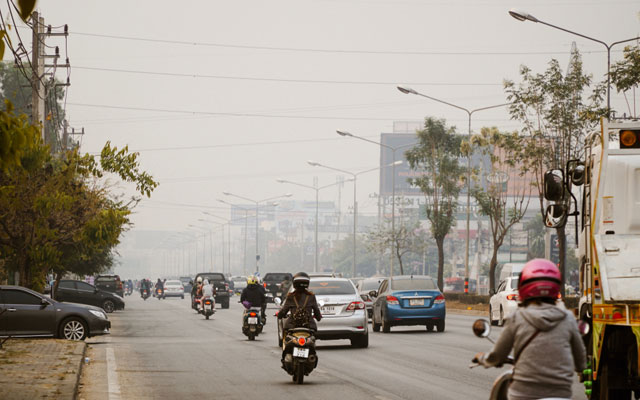
Air pollution at dangerous levels; Chiang Mai streets pictured
The Tourism Authority of Thailand (TAT) has issued a statement saying the air quality in parts of the country’s north has been at unhealthy levels for the past weeks.
It is advising tourists visiting Chiang Mai, Chiang Rai and the surrounding provinces to monitor air quality index (AQI) reports and take necessary precautions.
Air quality in Thailand’s north at ‘unhealthy levels’; Chiang Mai streets pictured
The Pollution Control Department under the Ministry of Public Health is providing ongoing reports of air quality, and tourists can keep abreast of these via the Air4Thai website or by downloading the mobile application “Air4Thai” on App Store or Google Play.
The haze may also affect flight operations and cause delays. Passengers may check the flight status from the airline that they are travelling on or get the latest updates from the airport authority.
TAT also suggests that individuals take precautionary steps such as wearing an N95-rated face mask whenever going outside, and advises those with respiratory problems or other suspected effects of the haze to see a doctor or pharmacist immediately.
Tourists who experience “any unfortunate incidents” are encouraged to immediately contact the Tourist Police Hotline on 1155.
The NTO has also stated its readiness to support the government and other public or private sector efforts to tackle the haze, which is blamed mostly on forest fires, open scrub burning and vehicle emissions.
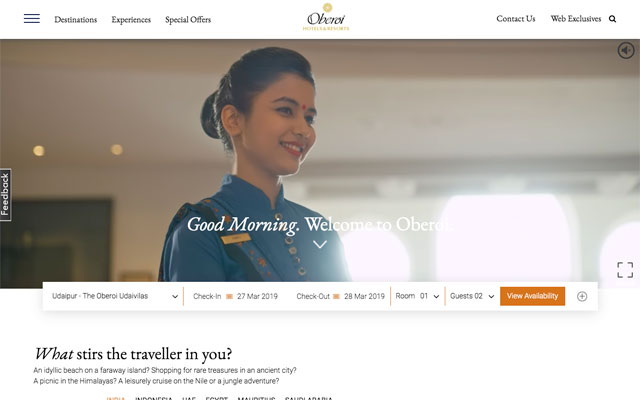
The Oberoi Hotels & Resorts has announced a “rebrand”, which includes a change in logo, website and names of three hotels in Asia-Pacific.
The group presents its new logo, the Oberoi Sun, which it says represents the brand promise of bringing warmth, energy and a sense of well-being to guests.
A screenshot from the revamped Oberoi website
The Oberoi Mauritius, Bali and Lombok have been renamed as The Oberoi Beach Resort, Mauritius; The Oberoi Beach Resort, Bali; and The Oberoi Beach Resort, Lombok.
As part of the brand initiative, the group also unveiled a new website design and brand video.
Bedsonline has appointed Elif Esen as regional sales manager for the Indonesia and Singapore markets.
Based in Singapore, she will lead a team of eight across Singapore and Indonesia to expand and diversify the number of travel agent subscribers in both markets.
Prior to this new posting, Esen was Bedsonline Asia head of sales, having joined Hotelbeds destination offices in Turkey in 1997. She has been with Hotelbeds for over 22 years.
Trip customisation is key whether the adventure activity is casual or extreme
Adventure travel is still at an early stage in the Chinese market, but interest is growing rapidly across the “casual” and “advanced” segments, underscoring the importance for travel providers to personalise their services to meet different needs and provide safety assurance, according to the ITB China Travel Trends Report.
Over 52% of the 300 China outbound agents surveyed believe Chinese travellers are willing to spend more than RMB10,000 (US$1,491) on each adventure trip. In a poll of members in ITB China’s Buyers’ Circle, 80% agree that adventure travel is a category that appeals most strongly to young Chinese born in the 1980s and 1990s. The trends report was created in collaboration with the international consulting and research company Kairos Future and will be presented at ITB China, set to take place from the May 15-17, 2019 in Shanghai.
Trip customisation is key whether the adventure activity is casual or extreme
According to travel industry experts interviewed, it is no coincidence that entrepreneurs and company leaders love adventure: expedition and entrepreneurship have similarities, such as extraordinary courage and dedication, not being afraid of difficulties and challenging oneself.
Adventure travel can take many forms, and the meaning of “adventure” differs widely from traveller to traveller. For some, the ultimate adventure can be found in high adrenaline activities such as skydiving or paragliding. For others, adventure requires embarking on an expedition into the wilderness to engage in activities such as hiking or rock climbing. The interest in adventure among Chinese travellers runs parallel to the strong entrepreneurial ideals present in today’s Chinese society.
Whatever the choice of activity is, trip customisation is key. Among the surveyed travel companies, almost three quarters considered customised and personalised travel experiences to be in high demand or absolutely necessary when it comes to adventure trips – a much higher share then for the other travel themes focussed on in the ITB China Travel Trends Report.
Safety tends to be a central consideration when it comes to adventure travel. This, the report said, highlights the importance of service providers who can assure that everything is under control.
The most important three aspects that Chinese travellers care for in adventure travel are safety (30%), local activities (26%) and scenery (17%).
Safety concerns are more common in China than internationally, as travellers are far less experienced in adventure travel, the ITB China report claims. Topics include safety risks of activities such as bungee jumping as well as the risk of getting lost in the wilderness, and the dangers stemming from not carrying the right equipment. Providers of adventure travel products targeting the outbound Chinese market need to tailor products to traveller segments with different expectations on difficulty, safety and comfort.
Early 2019 performance levels and profitability fundamentals are foreshadowing an unfavourable short- to mid-term for Kuala Lumpur’s hotel industry, according to data and analysis from STR.
During the first two months of 2019, Kuala Lumpur reported noticeable year-over-year declines across the three key performance metrics: occupancy (-7.4% to 63.4%), ADR (-3.9% to MYR330.85) and RevPAR (-11.1% to MYR209.63). Performance was down in 2018 as well (RevPAR: -6.6% to 232.37).
Key hotel performance metrics all declined in first two months of the year
“The market got off to a rough start to the year with a 2.2% decline in demand and an absolute ADR level that was 5% points below the recent five-year average,” said Jesper Palmqvist, STR’s area director for Asia-Pacific.
“Overall 1Q performance should be a strong indicator of whether this current slump lasts or not, because March is historically a strong performance month in Kuala Lumpur.”
Another indicator of the overall health of the market is the Lunar New Year, which typically lifts occupancy during the extended holiday in the market. The holiday week this year, however, produced an occupancy level (66.9%) that was 20.7% lower than the holiday week in 2018, STR said.
Additionally, supply was up 5.6% through February, and Kuala Lumpur’s current development pipeline shows 25 hotels and 6,900 rooms. New inventory will likely add performance pressure in certain areas of the market, especially high-end hotels, as half of the rooms in the pipeline will be in the upper upscale and luxury segments. The impact from these news rooms is not urgent, however, as only 20% are projected to come online in 2019.
“The direction that performance moves will be partially dictated by whether or not the market can continue to increase international arrivals and diversify the mix of arrivals and length of stay,” Palmqvist said. “Ultimately, something needs to change if Kuala Lumpur is going to produce better performance for brands and owners.”
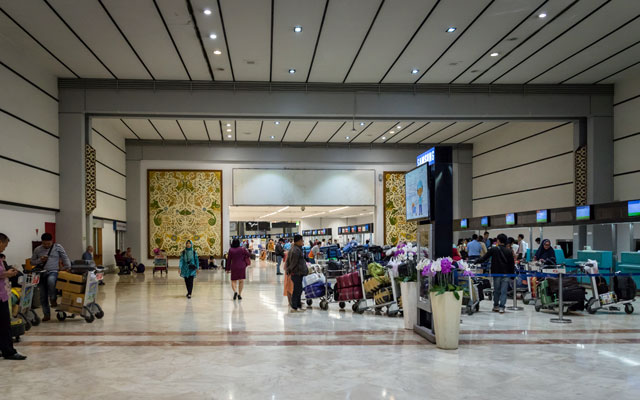
Terminal 2F of Jakarta’s Soekarno-Hatta International Airport will operate as an LCC terminal as of May 1.
Muhammad Awaluddin, president director of airport authority Angkasa Pura II, said in a statement that the move is in accordance with a directive from president Joko Widodo.
Soekarno-Hatta Terminal 2
Awaluddin shared: “The strategy is to have different terminals serving different segments, especially at Soekarno-Hatta, which has Terminals 1, 2 and 3, and is developing Terminal 4. We are also building a dedicated terminal for Umrah.
“We are expecting an increase in inbound traffic with the potential growth of passengers travelling on LCCs.”
Awaluddin said that service at the Terminal 2F is expected to be simple and uninterrupted with a ground time of up to one hour.
In the meantime, Febri Toga Simatupang, senior manager of branch communications and legal services of Soekarno-Hatta International Airport, said that the movement of LCCs were under preparation, including with the establishment of immigration counters, ground handling office, aviation security and customs facilities.
“Terminal 2 has three sub terminals. Terminal 2D is for domestic flights, Terminal 2F will be a fully LCC terminal while Terminal 2E will be partly for LCCs,” he said.
Ten LCCs will operate from Terminal 2F and two more – Indigo from India and Zandong from China – are expected to join, according to tourism minister Arief Yahya, who welcomed the operation of the terminal.
He said: “Data of 2017 showed that 55 per cent (arrived in) Indonesia on full-service carriers (FSCs) and the rest LCCs. However, the growth of passengers on FSCs (in the world) is only 12 per cent while on LCCs is 21 per cent… Indonesia needs to have (more) LCC terminals to boost arrivals to the country.”
Sbe, a lifestyle hospitality company that AccorHotels recently invested in, has launched a new luxury hotel brand, The House of Originals.
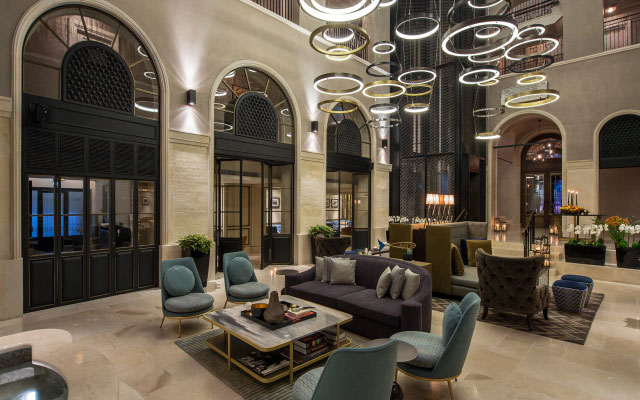
Existing properties in the collection include Sanderson and S Martins Lane in London, 10 Karakoy in Istanbul, and the Shore Club in Miami Beach. There are five House of Originals hotels in the pipeline in key gateway cities such as Dubai, London and Paris.
House of Originals property in Karakoy, Istanbul
The brand will be “predicated on luxury experiences and centred around sbe’s culinary and mixology offerings”, according to a joint statement from the partners.
On its part, Accor will offer sbe’s customers and partners access to an global distribution and procurement infrastructure.
Sam Nazarian, founder & CEO of sbe, stated: “The House of Originals will include our existing destinations, the Sanderson, St Martins Lane, Shore Club and 10 Karaköy and create a community and network of unique global properties.”
Gaurav Bhushan, chief development officer Accor, stated: “The lifestyle market continues to grow rapidly and has one of fastest growth rates in the industry. Accor has had very strong acceleration in the lifestyle sector and now offers the widest portfolio, with 10 brands to be developed internationally from economy to luxury.
“The House of Originals is the perfect combination of sbe’s knowhow in entertainment and F&B, and will benefit from Accor’s global platform, particularly in terms of distribution, loyalty and network development.”
Website in China the first to leverage the Agoda-Peakwork partnership
Peakwork’s latest partnership with Agoda is set to significantly boost its Leisure Travel Network and see the first launch of a dynamic packaging portfolio in China.
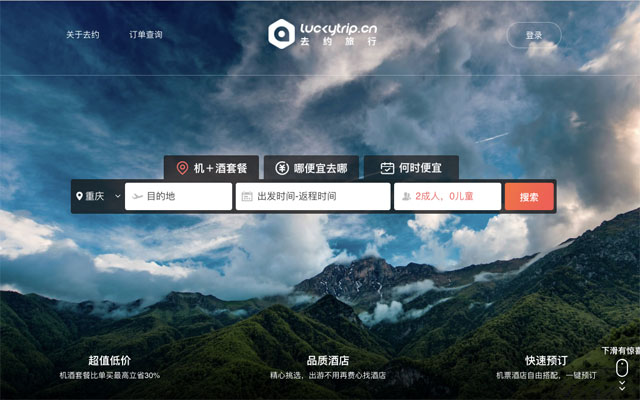
The first platform leveraging this partnership is now live at www.luckytrip.cn. With access to Agoda’s inventory of two million properties, travellers in China are able to search for a wide range of competitive “hotel+flight packages”, while Agoda’s accommodation partners are able to connect with a wider clientele, according to Peakwork.
Website in China the first to leverage the Agoda-Peakwork partnership
Jan Gerlach, CEO of Peakwork, added: “The partners in the Peakwork network benefit from the widely diversified hotel and flight content. All tour operators working with our technology have the option to create competitive and country specific product portfolios and to sell in new markets easily.”
Peakwork is the dynamic packaging and distribution connectivity specialist for the travel industry. With its Player Hub Technology, Peakwork has created a marketplace and leisure travel network that brings together global supply and distribution of travel products.
Sojern, a provider of digital marketing solutions for the travel industry, has appointed Masahiro Ueno as vice president of Asia-Pacific, based in Singapore.
Ueno joins Sojern from BuzzFeed Japan, a joint venture set up by BuzzFeed and Yahoo Japan, where he was CEO. Bringing more than 20 years of leadership experience to the role, Ueno will oversee growth across the wider Asia-Pacific region including Singapore, Hong Kong, Australia and New Zealand.
This announcement follows on the heels of a US$120 million financing round by TCV in Sojern, with Ueno’s appointment expected to “further accelerate growth and build on the current momentum Sojern has in the region”, the company said in a statement.
Ueno also held CEO and president positions at companies in Japan including Criteo, Become, Overture and DoubleClick. Ueno grew the Criteo’s Asia-Pacific business from four employees to over 250 across six regional offices representing over 20 per cent of Criteo’s global revenue.
Bangkok-based SpiceRoads Cycling has launched women-only trips as well as solo departures open to both genders.
These departures respond to the needs of an increasing number of travellers who choose cycling adventures not only to explore a new destination, but also for the social experience.
SpiceRoads is promoting cycling tours with like-minded travellers
The company’s women-only departures feature some of SpiceRoads’ most popular tours, led by an expert female cycling guide. These departures will be open to female riders booking individually or as a group.
“We are very excited to launch the new Women Only departures”, said SpiceRoads product manager Sally Phipps. “These are all about great riding, authentic cultural immersion and a memorable, shared challenge with other strong women, whether they be your mother, daughter, sister, best friend or partner.”
Alongside Women Only trips, SpiceRoads has developed new Solo Only departures designed for cyclists who want to explore exotic destinations while getting to know other like-minded riders on their trip.
“As one of the few specialist cycle touring operators in the world, we know the potential of our trips to bring together individuals who all share the same passion for exploring the world by bicycle. SpiceRoads riders value the ability to connect with others on our tours, and we want to provide an inclusive environment that doesn’t just make it possible, but encourages it,” said SpiceRoads managing director Daniel Moylan, speaking on the new Solo Only departures.
“Nowadays, solo travel is no longer an ambitious undertaking, but a part of travelling culture for many. These departures speak to that trend, and our belief that cycling solo doesn’t necessarily mean being alone.”