TTG Asia
Asia/Singapore Thursday, 2nd April 2026
Page 1267

Accor brings its most premium brand, Raffles, to India

0
XXXXX

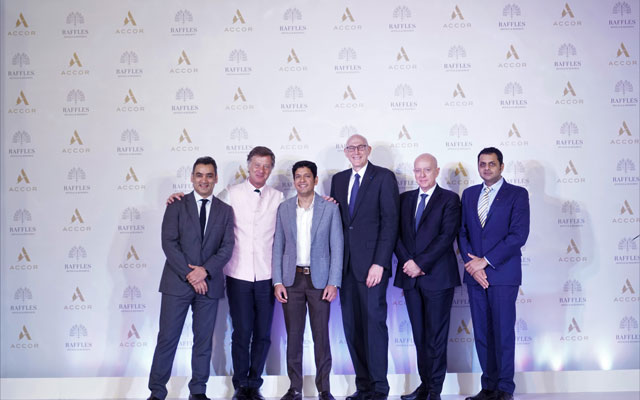
French hospitality giant Accor is expanding its foothold in India’s luxury segment by launching two new hotels under its most premium brand Raffles in Jaipur and Udaipur, announced chairman and CEO Sébastien Bazin at a signing of both hotels earlier this week.

“It is with immense pride that we announce the arrival of the Raffles brand in India, a hallmark of luxury and sublime service in a country that is famous for delivering luxury at the highest level,” Bazin declared.

AccorHotels’ Sébastien Bazin (second from left); Indian businessman and hotel owner Ratankant Sharma (third from left)

Jean-Michel Cassé, Accor’s COO – India and South Asia, said: “We are seeing increasing demand for luxury travel in India and are looking forward to expanding Accor’s globally renowned portfolio of luxury brands in this incredible country. The addition of the iconic Raffles brand signals a new era for our group.”

Since its acquisition by Accor in 2015, the iconic Raffles brand has undergone a renaissance and now boasts a strong pipeline that will see the portfolio double in the next few years.

The Raffles Udaipur will be located in the historic Udaipur, set on a 8.5ha private island in the midst of Udai Sagar Lake. The 101 lake-facing rooms are surrounded by spectacular hill scenery with views of the 400-year -old temple in the background, and suites will feature their own private pools. Expected to open by mid-2020, the Raffles Udaipur will be reached after a short 15-20 minutes’ drive from the Udaipur Maharana Pratap Airport, followed by a short boat ride.

The Raffles Jaipur is being built at Kukas in the city of Jaipur as a set of secluded private residences and courtyards adjacent to the larger hotel complex that presently houses the Fairmont Jaipur. The development is planned as a discreet destination for guests to “be themselves”. The hotel is anticipated to commence operations in 2022 and is located close to key tourist destinations in Jaipur including the Amer Fort, Jaigarh Fort, Nahargarh Fort and Jal Mahal palace.

OTAs build up customer loyalty through hyper-personalisation

0
Online players leverage tech to cast hook in customers

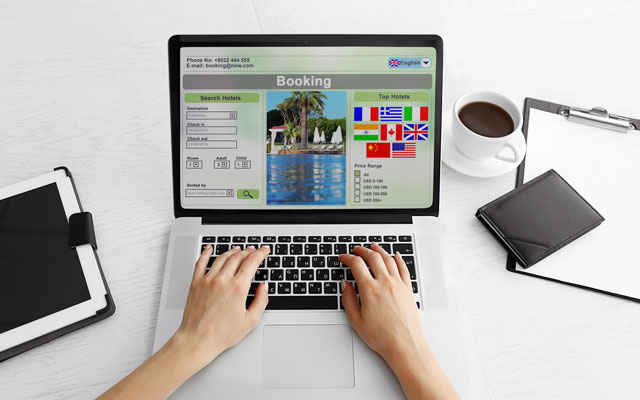
To increase customer acquisition and effectively connect with target audiences, OTAs are employing unique digital solutions that elevate personalised content to the next level.

For example, India-based QuaQua employs highly interactive and dynamic video content to “engage and inspire” travellers, shared Purav Shah, its founder & CEO, at Digital Travel APAC 2019 in Singapore earlier this week.

Online players leverage tech to reel in existing customers

Using data from customers’ viewing history and booking preferences on the website, the OTA recommends and dynamically curates videos and stories for its users; and when building a personal itinerary of tours and activities, it filters out products that the traveller has previously booked, and instead recommends destinations similar to where they have already visited.

“Millennials are our target audience and they flock to our site with a zest for more information. So we need to keep innovating with the type of content we provide – it has to have lots of personalisation and AI content,” explained Shah.

Meanwhile, tour booking platform KKday translates online data into real-life customer service. Liu Weichun, its co-founder & executive vice president, shared that the team has a database that can predict what services or products each customer is most likely to purchase, and these predictions are distributed to tour guides on ground for recommendation to guests.

Liu said: “We do our best to bridge our online knowledge with the on-site experience. Our guide serves the role of something like a hotel concierge, as they can recommend dinner reservations and upsell products that complement the experience, designed based on data we’ve collected online. This way, we can easily convert users.”

Global positioning system (GPS) data is also used to make recommendations, as in the case of Line Travel jp. Using geolocation data from the mobile app, the OTA has set itself apart from competitors by presenting personalised offers and merchant promotions to a user based on their travel itinerary or pattern of commute.

Line Travel jp is also building an ecosystem around loyalty points, which can be interchanged with Line’s main payment solution, Line Pay. With the points under Line Travel jp’s loyalty programme, users can convert them to cash, make in-app purchases and more.

Yoshihiro Sakurai, head of accommodation business, Line Travel jp, Venture Republic, said: “We’re trying to create an ecosystem within the platform, and the use of GPS-based data is one of our unique selling points. We currently have 14 million users; we plan to expand to 20 million by June and 25 million by the end of this year.”

New hotels: Rosewood Bangkok, Village Hotel at Sentosa and more

0

Rosewood Bangkok, Thailand
Thailand’s second Rosewood has risen on Bangkok’s Ploenchit Road as a 30-storey standalone building, featuring 159 rooms including 34 suites and studios, as well as three signature “houses” which also boast their own private pools and terraces.

Four F&B options are available at this ultra-luxury hotel, including all-day dining venue Lakorn European Brasserie, Chinese restaurant Nan Bei; Lennon’s, a speakeasy-style bar; and upscale organic cafe G&O (green and organic).

Recreational facilities include Sense, A Rosewood Spa with five treatment rooms, an indoor-outdoor saltwater lap pool, and a fitness studio. Event planners may avail The Pavilion, a 320m2 residential-style venue with show kitchen that can seat up to 200 pax, or the 100m2 Ploenchit Boardroom on the 28th floor.

Village Hotel at Sentosa, Singapore
Village Hotel at Sentosa has officially opened its doors in Sentosa with 606 rooms, some of which are connected and can act as family rooms. The Pool Deck is the piece de resistance of the property, offering several pools such as the Children’s Play Pool, Lazy River Pool, Adventure Pool and the Pamukkale Pool. There are numerous activities and entertainment options for both kids and adults, such as pool games, movie nights and cycling trails around Sentosa. Other facilities include the Native Kitchen restaurant, as well as a half-hourly shuttle service that connects guests with Vivocity.

citizenM Shanghai Hongqiao, China
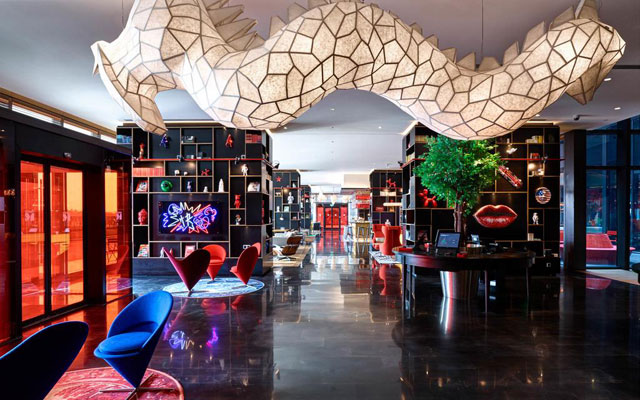
CitizenM’s second Asian outpost is located in Shanghai’s Hongqiao, a seven-storey hotel with 303 rooms. Check-in reportedly only takes a minute via kiosks. What sets the brand apart are its striking “living rooms” or lobbies, which feature specially-curated art pieces from both international and local artists. Amenities on-site include a retail shop; canteenM, the first-floor eatery with a 24/7 noodle bar; and wildy-coloured eight societyM meeting spaces.

Best Western Hotel Metro Clark, Philippines
The brand’s latest opening in the country is situated in downtown Angeles City, part of Saver’s Mall. The hotel offers 85 keys, 77 of which are deluxe rooms while the remaining are suites. Guests can cool off in the outdoor infinity pool which overlooks the city, or work out in the fitness centre. There’s also an all-day restaurant within the hotel. For corporate events, Best Western Hotel Metro Clark offers a conference room that can hold up to 30 guests, as well as the 405m2 Simon & Stanley Hall that can accommodate 360 guests reception-style.

InterContinental Jakarta Pondok Indah, Indonesia
The 311-room InterContinental Jakarta Pondok Indah has opened in the heart of South Jakarta, as part of a high-end commercial complex that includes a shopping mall, office tower and golf course. There are three F&B options, plus recreational facilities such as the Fitness & Movement Studio, Inaria Spa and a swimming pool. Events and function spaces are in abundance at the InterContinental Jakarta Pondok Indah, ranging from the Grand Ballroom that can hold up to 1,100 pax banquet-style to The Studios, Jakarta’s first club-inspired meeting space that can hold 120 pax and comes complete with show kitchens.

Paul Rombeek helms Jetstar’s sales and commercial department

0

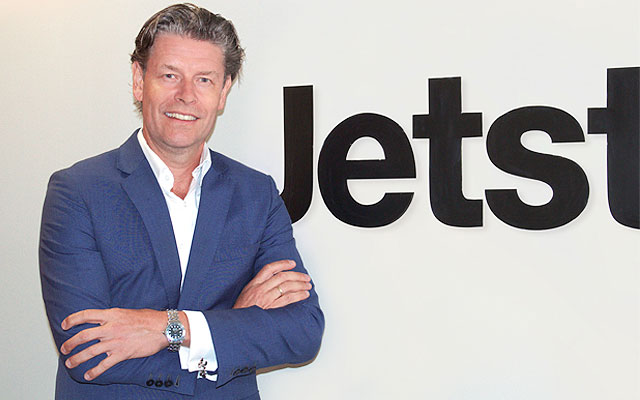
Jetstar Group has promoted Paul Rombeek to global head of sales and commercial lead Jetstar Asia.

Rombeek is responsible for worldwide sales and business development, overseeing sales, distribution and business development across for all four of Jetstar’s branded LCCs. He will also be the commercial lead for Jetstar Asia, and is responsible for the coordination and optimisation of commercial results.

The experienced aviation expert first joined Jetstar in September 2014 as head of sales for Jetstar Group. His previous roles include CEO of Tigerair Mandala (a joint venture between Tiger Airways Holdings and Saratoga Capital Asia), KLM’s general manager for South-east Asia and Pacific, and positions in Air France.

Letting go to let it grow

0
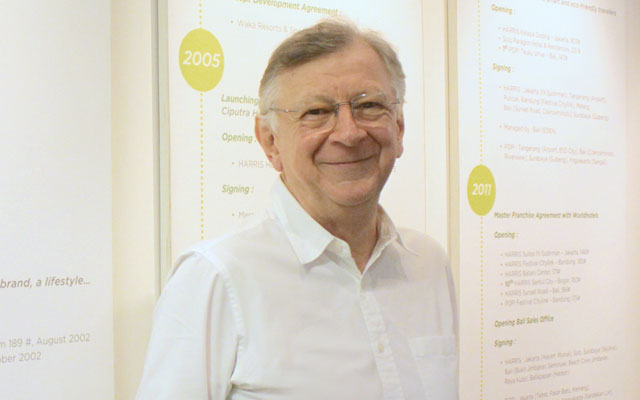
Marc Steinmeyer

Why do you want to expand beyond Indonesia when the country still offers so many opportunities?
One, because as Indonesians travel more outside of Indonesia and see a Harris, Yello or Pop! hotel, I am sure they will take to these (homegrown) brands. Two, the Harris Hotels brand is a success story in Indonesia. If I have Harris properties in Bangkok, Manila or elsewhere in the region, the brand will indirectly become more successful in Indonesia, as it will gain more credibility in the eyes of travellers. We will not be perceived as a local but an international brand.

Marc Steinmeyer

You have been mulling to go regional for some time, so why is now the right time?
Actually, I have the vision to expand outside the country since 2012, but going out by myself as an operator will take a lot of time to build up relations in other countries. (When entering) a new destination, there is a risk of not getting the right partner and owner, and that may impact the brand. It can even kill a brand that I have been building for so many years.

These concerns had not stopped me from developing outside Indonesia but I needed a different strategy. I started to look for a strategic partner with three objectives: one, to complement (Tauzia Hotels); two, the company should have a strong base in Asia; and three, someone with a long-term vision.

How did it lead you to Ascott, and not some global hotel company with presence in Asia?
My objective is that the partner must complement us. What is the point of partnering another big world player? Cash wise, it may be good for me, but they will kill a brand that we have invested in over the years. My partners, hotel owners and employees believe in the brand. If I should merge with a partner who will dilute or rebrand with theirs, it will be a pity, so I need a partner who needs and believes in the future of (Tauzia’s) brands.

What do you mean by long-term vision?
Because in today’s financial market, private equity and banking (firms) have short-term interests. When they like it they buy it, raise the value and then quickly sell it. I don’t want that. It will be out of my control, and I want to remain in control of the company.

How do you eventually find Ascott as a partner?
I have got people knocking on my doors while I also knocked on others’ doors. Over the years, I found two candidates that I had fallen in love with. One was not an Asian brand but they were based in Asia. All criteria were met, but the negotiation process was not easy and the deal fell through.

The other candidate is Ascott and it fits all three objectives I have been seeking. They are in the para-hospitality business, in the residential market, their guests are long-stay and they have no F&B operations.

We, on the other hand, are in the hotel business, our guests are short-stay, we have F&B services, and our properties range from budget to luxury. Our square metres are smaller while their residential (units) are much bigger.

Both are hospitality companies with totally different markets. We have bigger F&B components because our hotels have meetings and conventions (services), which is something they don’t (offer). Their structure and management system is simpler, and their gross operating profit is different from us.

We share a similar vision in running a long-term business. This is not two companies merged into one; it is Ascott taking shares in Tauzia to grow the company.

You are passionate about your brands, but you also let Ascott hold two-third shares. Why?
My number one objective is development. They will bring me a network of developers, so that we can move fast. Two, (Ascott has) financial credibility in the region which sometimes can offer a back-up. Three,  the hospitality business has changed a lot in the last 10 to 15 years, and we are depending more on technology. We require more means in term of technology to invest in mobile applications and access to many other tools. We need more technological muscle to follow the (changing market needs).

But aren’t you concerned that with a majority stake they will have a bigger say?
The idea of getting a partner is to make sure that Tauzia’s inventory grows in the next few years, and that growth will most probably be generated by their resources.

On the other hand, for the interest of the company’s growth and expansion, having a 30 per cent stake of a big plate for my family’s future is better than owning 100 per cent of a small plate. Some of the investment will be to grow the company.

On their side, they also do not want me to run away. My stake, though minor, is still 30 per cent, not 10 per cent or five per cent. It is fair.

Both sides have made this (partnership) a long-term decision. They agreed to a 70 per cent stake because they want to grow Tauzia beyond Indonesia.

I am committed to run the company in the next five years as CEO. Moreover, we have an executive committee (with representatives from both companies) to make decisions.

Why did Tauzia set up a regional office in Singapore?
The Green Oak, the holding company of Tauzia Hotel Management, is based in Singapore. Communication wise, we call it Tauzia Singapore Regional Office.

You need to be in Indonesia to grab the Indonesian market. If I want to grab the worldwide market, I need to be based in Singapore as it is a financial hub in the region. As soon as you are present in Singapore, immediately your visibility is international, even if your property development is outside the country.

Having a regional office in Singapore will help me with marketing the (Tauzia) brands in the big countries like Thailand, the Philippines and Vietnam. Once I get three or more hotels in Manila or Bangkok, for example, I will need to have an anchor in these countries and I will open Tauzia Thailand and Tauzia Philippines. Like Indonesia, Asians are very nationalistic. Once we have a number of our brands in a country, we need to become a domestic network in the destination.

Correction: This article earlier referred to CapitaLand as Tauzia’s partner. It should be Ascott, which is a wholly owned serviced residence business unit of CapitaLand. The story has since been updated to reflect that. 

Travelling with multi-gen tribes: bring the kids – and grandparents

0

Multi-generational travel is a strong and fast-growing trend that shows no sign of abating. According to the 2019 Virtuoso Luxe Report on the global travel industry, multigenerational travel is this year’s top vacation trend – among the top travel trends since 2011.

Key findings from Agoda Family Travel Trends 2018 also revealed that in Asia, travellers are more inclined to engage in multi-generational and extended family trips than their Western counterparts.

Multi-generational travel is clearly a hot trend in the Asian tourism sector. Among the key trends Steve Odell, Norwegian Cruise Lines’ senior vice president and managing director of Asia-Pacific, has observed is the rise of multi-generational travel, and “a lot of times in Asia it’s grandparents hosting the family”. Big extended family groups are coming out from most Asian markets, namely Singapore, the Philippines, Hong Kong and Thailand.

In the serviced residence sector, multigenerational travel is also singled out by Richard Tan, vice-president, serviced suites at Pan Pacific Hotels Group. “Millennials, who have become parents, are bringing their parents – active, healthy Baby Boomers – along on trips as the grandparents play a large part in (grand) parenting the children. This is true of the Chinese market, as outbound family travel are often accompanied by grandparents,” he noted.

Cruises, theme parks and beach resorts are natural choices for multi-generational travel, but with a new generation of travel-savvy parents, grandparents and kids who are no longer content to be visiting sites but collecting memories, a custom itinerary focussing on the desires of each family member may just be the ticket for travel advisors to  showcase their planning expertise and increase sales.

While multi-generational travel has been on the rise for years, the family travel market continues to be dominated by picture-perfect images focussing on nuclear families. Savvy travel marketeers should refine their marketing approaches to extended families.

Who’s the best person to target for multi-generational travel? The grandparents. In many cases, they are usually the decision-makers and instigators for a family vacation, having more time, money and motivation.

I can personally testify to this – my mother, now a grandmother of four, is often looking out for new travel destinations and opportunities for everyone to come together for an extended family vacation.

Meanwhile, an emerging subset within the multi-generational travel market is skip-gen travel, i.e. grandparents travelling with grandkids, leaving mom and dad behind. Now, I can’t wait for my mother to suggest a grandtravel trip…

Navigating Brexit chaos

0

The March 29 Brexit deadline came and went, but the UK – and everyone else – is none the wiser about what to expect in coming weeks and months as uncertainties continue to surround Britain’s departure from the EU.

At press time, British lawmakers still failed to coalesce around a single proposal in indicative votes on the process of leaving the EU, with the UK now on course to leave the bloc on April 12 or May 22, depending on the agreement terms ratified.

What frustrates many in the travel and tourism business is the lack of a clear Brexit outcome – hard, soft, on hold or no deal – as the country continues to be paralysed by political division since the UK public voted to clear the EU in June 2016.

Travel industry members are cautious in speculating what this may mean for business coming into Asia, although the current uncertainty about Brexit and weakening pound appear to make Brits think twice – and longer – about booking longhaul holidays.

“Brexit opens up two levels of uncertainties. On the consumer level, travellers are not sure what’s going on and how it would affect them personally; on the trade level there will be more uncertainty over currency issues, with the pound already hit really hard a bit ago, will there be even further impacts?” asked Willem Niemeijer, CEO & co-founder, Khiri Travel.

“The UK is our largest market at Exo Travel so we are watching the situation carefully,” said Hamish Keith, CEO of Exo Travel.

“Clarity is the key component for successful business planning and unfortunately nothing is clear at the moment so it is very difficult to know what will happen and of course how to plan effectively.”

Keith added: “In the meantime we are in constant communication with our key agents and working hard to assess potential direct and indirect impacts from all scenarios, particularly any possible changes in regulations and likely responses to those changes from customers, competitors and service providers. Like everyone else, we are waiting for a clear outcome so we can move on.”

Greg Young of Destination Asia’s international sales office, UK & Ireland, said: “The British are still spending and travelling, though it is more price-led than ever before. We are seeing bookings made in the same month as departure or now for 2020 and a much slower pace in the middle area. A decision made in regards to Brexit one way or the other would help.”

In January, IATA warned that up to five million flights would be at risk if the UK leaves the EU without a deal. A no-deal Brexit was feared to see airlines capping flights at 2018 level, although tickets for 2019 routes were already on sale. Late last month, the EU reportedly stated its intentions to lift this cap.

Research by Oxford Economics projected that a no-deal Brexit would cause a five per drop in UK outbound travel and tourism trips in 2020, as a result of the stifled economic backdrop and impact of a weaker pound. On the other hand, the weaker pound could mean that UK tourism inflows are four per cent higher in a no-deal scenario, provided there is no travel disruption.

Frank Wiegand, director of team sales Europe at Focus Asia, said: “There could be some legal problems for a short while, leading to certain Europe flights (operated by UK airlines) being unable to continue – but these will be solved.”

Paul Gorman, senior manager – owner engagement, of Luxury Escapes, which is plotting its move into the European outbound market, said: “Whether Brexit will have an impact depends on what the result is. At the same time, (a great deal of) airline capacity is coming out of Europe into Asia and vice versa. The barrier to getting to places now is so much less, you can fly between Singapore and Berlin (on an LCC, for example). Ultimately it’s about (the desire to travel). I don’t think Brexit will slow that down.”

For intra-Europe travel, he said: “Nobody knows how it’ll be in terms of operating licences. Guys who have UK or Irish operating licences like Ryanair and EasyJet may have to reapply for landing rights. I suspect that will be worked out before (the deal is final), (but it is still) a big risk to a lot of companies.”

On whether these uncertainties could translate to speculative buying of Asian holidays in the short term, trade opinions are spilt.

Said Keith: “We believe some of the strong demand to Asia from the UK is driven by British travellers choosing not to go to Europe, so there is a silver lining for Asian destinations there. In addition Asian destinations such as Thailand and Vietnam are well positioned as offering quality without being as expense as other parts of the world so in times of economic uncertainty become the go-to destinations for British travellers.”

But a more doubtful Wiegand commented: “Asia is more expensive (than an European holiday). I don’t think a family in Birmingham originally intending to visit Spain will decide on Thailand instead. (Those choosing Asia and Europe holidays) are different markets.”

Particular segments of Brits may even choose to travel closer to home. Said David Kevan of Chic Locations in the UK: “I think the concern about being close to home is valid, particularly in the months immediately after Brexit. Our clients tend to be decision-makers within their business, and they want to feel they can react quickly to any crisis (as Brexit unfolds). They like the idea of a three, four hour flight rather than a 16-hour flight.”

Meanwhile, a potential slump in the UK economy and currency are larger concerns. “Nobody knows yet what the result of Brexit might be. Does it happen in March, June, or ever? Will they hold another referendum? The only risk I see is there might be less Brits travelling at all, whether to Europe or to Asia,” said Wiegand.

If or when the pound takes a hit, “travel everywhere will get more expensive”, Wiegand explained. “It happened in Russia years ago, and there could be a similar crisis ahead of the UK.”

With travellers’ spending power affected, Kevan suggested that the UK’s travelling demography may shift towards those above 60. “Like with everything, a door closes and another opens. There will be problems and opportunities in equal measure.”

Kevan suggests that senior travellers are likely winners, as they are free from concerns of job security and dependents, and have a bigger travel window that is not tied to specific dates and can be enticed with longer stays with better value.

Losers, in his opinion, are likely to be those in the 25-55 age group, as they will be hit by job concerns and uncertainties, less disposable income, and any increase in bank interest rate.

But Keith is positive that the UK market will continue to do well in the longer term when a greater level of clarity is achieved.

“Holidays and travel are still a priority for the British and some recent surveys are indicating that longhaul travel are still experiencing strong growth driven by increased availability of cheaper longhaul flights and a desire to travel outside the Eurozone, particularly to Asian destinations where there is still good value to be found.

“The bottom line is that Brits will continue to travel no matter what happens with Brexit,” he surmised.

As the clock ticks down, the travel trade has one common desire: a clear Brexit outcome, come what may. – Additional reporting by Yixin Ng


Sabre rolls out first set of NDC APIs

0
New direct flights expected to spark demand

Sabre Corporation has released its first set of New Distribution Capability (NDC) APIs with launch carrier, United Airlines, enabling the airline to offer customers new fare options and additional flight amenities for a more comprehensive shopping experience.

Sabre’s Beyond NDC Agency Partners can now use the capabilities of its advanced shopping API to integrate and normalise air content from all sources, including traditional, low-cost carrier and NDC offers.

United using Sabre’s first set of NDC API

The travel technology company says this development is “a significant step forward for the travel industry”, as the pan-industry vision moves NDC closer to becoming an everyday reality for travellers, carriers, agencies, corporations and more.

Sabre will continue to work with all its Beyond NDC airline partners to integrate their NDC content this year, and will also release additional capabilities throughout 2019, including integration into its agent desktop workspace, Sabre Red 360.

Sabre has been granted a NDC Level 3 Capable (Offer and Order Management) IT provider by IATA.

Resorts World Sentosa, Marina Bay Sands set for multi-billion-dollar transformation

0
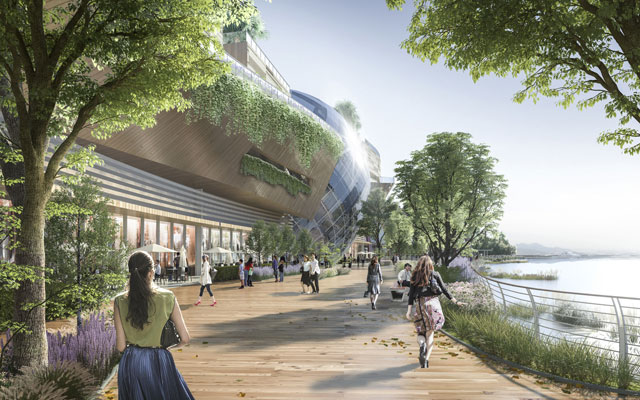
Artist impression of the enhanced aquarium

The two IRs in Singapore, Resorts World Sentosa (RWS) and Marina Bay Sands (MBS), have unveiled massive expansion plans, each at an estimated investment of S$4.5 billion (US$3.3 billion).

The RWS expansion will boost its gross floor area by about 50 per cent, adding 164,000m2 of new attractions, entertainment and lifestyle offerings. Set to integrate with the transformation of the future Greater Southern Waterfront, the expansion will be delivered in phases with new experiences opening every year from 2020 to a projected completion around 2025.

Both RWS’ major attractions, Universal Studios Singapore and S.E.A. Aquarium, will see substantial increase in size. Universal Studios Singapore will get two new, themed and immersive environments based on Minion Park and Super Nintendo World.

The S.E.A. Aquarium will be expanded to more than thrice its present size, and proposed to be rebranded as Singapore Oceanarium. RWS says there will be additional exhibits centred on prehistoric marine life and deep sea creatures.

In addition, a new Waterfront Lifestyle Complex helmed by two new destination hotels, together with the expansion of Central Zone, will add up to 1,100 more keys.

MICE capacity at RWS will also get a boost. The entire waterfront promenade will be renewed, anchored by a public attraction that will set the scene for seafront activities that include dining and lifestyle activities.

The Resorts World Theatre will make way for a new Adventure Dining Playhouse, and a new Driverless Transport System will provide last-mile connectivity between the mainland and Sentosa with better efficiency and capacity, which the group hopes would encourage more to visit RWS and the rest of Sentosa Island.

Meanwhile, Las Vegas Sands has entered into an agreement with the Singapore government to expand MBS. Located immediately adjacent to the existing MBS, the key elements of the development will be a 15,000-seat show arena, a luxury hotel tower and additional MICE space.

The 1,000-suite hotel will include a sky roof with a swimming pool and a signature restaurant. The tower will also feature an atrium and terraces along with F&B offerings and a combination of meeting rooms, ballrooms and exhibition halls.

Since opening in 2010, MBS has attracted more than 330 million visitors, and brought over 700 new MICE events to Singapore. In 2018 alone, it hosted 3,680 events at the Sands Expo and Convention Centre.

“New luxury hotel accommodations and a world-class entertainment venue are the catalysts we need to drive additional visitation to Singapore, and specifically to Marina Bay Sands,” said Rob Goldstein, the company’s president and COO. “The expansion of our Singapore IR is a key component of our company’s growth plan and also reflects the strong tourism and business potential in Singapore.

“The additional hotel rooms are extremely important to us in addressing the demand created by our leisure and business tourists and our premium gaming customers.”

Tourism’s ‘the best partner for governments’ to drive economy and job growth: WTTC

0
As tourism becomes a stronger force globally, WTTC says there should be available best practice rather than unnecessarily reinvent the wheel

The growing importance of tourism’s role in the global economy was once again underscored by WTTC president & CEO Gloria Guevara yesterday at the opening of the WTTC’s Global Summit in Seville, Spain.

“Travel & tourism is truly the best partner for governments to generate economic growth, create jobs and reduce poverty,” said Guevara, addressing over 1,500 global leaders including former US president Barack Obama at WTTC’s annual key event that is themed ‘Changemakers’ this year.

Guevara opened: “We are living in an era of rapid change, the pace of which, I predict, will only increase. Within the past decade alone we have witnessed advancements that have propelled the travel & tourism sector to new heights, fundamentally changing the way we live, the way we do business, the way we communicate with each other, and the way millions and millions of people travel every day.”

As tourism becomes a stronger force, WTTC says there should be readily available sets of best practice, such as Colombia’s investments in rebranding its image, so governments do not have to unnecessarily reinvent the wheel

Surging tourism figures in 2018 – with 1.4 billion international arrivals and 4.4 billion people flying around the world, and domestic tourism chalking up seven trips – are “just the beginning” of tourism’s exponential growth globally, the WTTC chief stated.

Industry stakeholders “need to make sure that we stay ahead of the curve by considering what the future of travel looks like, who the consumers of tomorrow will be and what they will expect”, she added.

Emphasising the global economic powerhouse that is travel & tourism sector, which is projected to generate an addition 100 million jobs, or one in four new jobs, over the next decade, she said: “Our sector is truly the best partner for governments to generate economic growth, create jobs and reduce poverty. But we cannot take historical strong performance and positive forecasts as a given.

“The reality is that the world is confronted by significant challenges that require coordinated global action, changemaking behaviour and more collaboration. If we don’t work on our future, the growth predictions could fail to materialise, impacting millions of jobs and progress towards the SDGs.”

At the summit, WTTC also launched the Global Best Practices Recognition Initiative as toolkit for public and private sectors worldwide to develop, review and implement proven policies in the sector.

Despite the travel & tourism’s ability to be a force for good, best practices across the sector are not readily available for both the public and private sectors, often compelling governments to unnecessarily reinvent the wheel, researching solutions to problems that have already been successfully innovated on elsewhere in the world, WTTC said in a statement.

WTTC’s Global Best Practices Recognition Initiative will be an ongoing drive, continually updated by integrating the most recent quantifiable success stories into a new online repository to ensure that the most innovative policies are shared among travel & tourism networks.

The initiative’s immediate focus will be on ‘quick win’ policies and ‘game changers’ in the areas of securing & facilitating travel, prioritising the sector, and planning for sustainable & inclusive growth. This will extend to policies related to infrastructure, workforce, technology, regulation, innovations, entrepreneurship, resilience and crisis planning in the future.

Among the policies identified in the initiative’s initial phase are the USA’s Global Entry programme, which provides expedited clearance for pre-approved, low-risk travellers upon arrival; Colombia’s significant investments and rebranding that have rebuilt the country as a safe and desirable destination; and Palau’s ‘Pledge’, which permits entry to the island upon the visitor signing a pledge asking them to respect the island’s ecology and support local business.

Tiffany Misrahi, Director of Policy, WTTC added, “As we launch the initial phase of our grand efforts in cross-pollinating government and private sector networks with best practice case studies, we call upon those same leaders to share with us the results of their own excellent work so that we may continue to amplify our online repository with the very best initiatives from across the globe.”

All of the best practices can be found at www.wttc.org/agenda/best-practices.