Travel and tourism businesses looking to begin or advance their technology transformation will now gain updated forms of assistance from the Singapore Tourism Board (STB).
STB’s familiar Tcube innovation platform, created in 2021 to accelerate the digital transformation of tourism businesses, will now move into its next chapter as Tcube Centre of Excellence (CoE). CoE functions as a one-stop resource hub where tourism businesses can access practical tools, data resources, and industry knowledge needed for digital transformation towards improved productivity and enhanced visitor experience.
CoE is also different from Tcube in its approach towards digital transformation. While Tcube abided by a Learn-Test-Build approach, CoE now takes a Learn-Test-Scale user journey that is focused on helping businesses adopt and deepen usage of technologies that have already been proven to work.
Addressing Singapore travel and tourism professionals at the Tourism Industry Conference at Resorts World Sentosa on May 8, STB chief executive Melissa Ow said the next phase of Tcube “will focus on scaling up technology solutions for the industry in three key areas: Unlocking new growth opportunities through data analytics; improving productivity and staying competitive through innovation, and enabling a seamless visitor journey across Singapore through understanding traveller behaviours and needs”.
Jordan Tan, chief technology officer, told TTG Asia that the evolution of Tcube was necessitated by external forces – changing traveller needs and search-and-book behaviours, intensifying competition within and beyond Singapore, and growing attention on destination experiences as a differentiating factor.
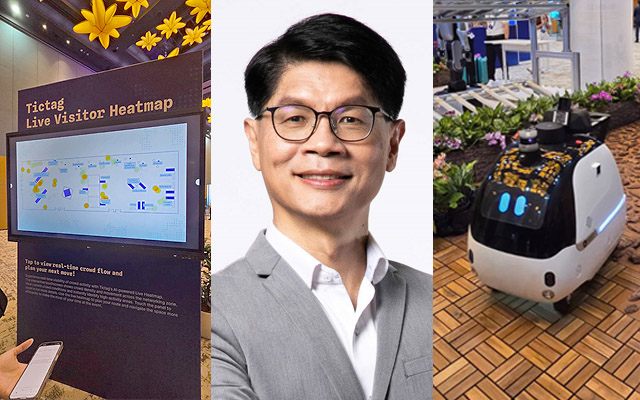
To demonstrate tech applications that can immediately be deployed in tourism, STB brought 10 tech companies to the annual Tourism Industry Conference on May 8. The exhibition included Tictag’s AI crowd analytics that help event organisers, retailers and attraction managers generate real-time crowd insights; dConstruct Robotics, which presented its robotics-enabled surveillance solutions to enhance manpower needed for surveillance and security operations; and TwinMatrix Technologies’ web-app wayfinding capabilities to help venue visitors better navigate and interact with large and complex spaces.
Along with the introduction of CoE, STB has initiated its first AI Playbook for Tourism. It features a roadmap that defines four key phases for tourism businesses to get started on their AI journey: Nascent stage, for businesses to get started with easy-to-adopt AI technologies; Optimised stage, where businesses will use GenAI or Agentic AI to streamline back-end processes; Connected stage, where AI technologies are integrated to coordinate services in various industries, so that multiple AI agents across different businesses interact together; and Transformational stage, where AI agents are able to plan, execute, and optimise end-to-end operations without human initiation.
Through the AI Playbook for Tourism, businesses can also access a list of support measures to accelerate adoption, spanning capability development and manpower training programmes, innovation programmes, and grants to de-risk digital investment.
Additionally, in 2H2026, STB will continue building industry capabilities through curated workshops with leading industry partners to cover topics such as prompt engineering and generative engine optimisation.
Tan said the AI Playbook for Tourism takes into account the different levels of maturity in AI deployment across tourism businesses in Singapore – and because AI is just one part of digital transformation, CoE’s Learn-Test-Scale approach is also embedded in the AI Playbook for Tourism.
While Singapore tourism businesses have access to innovation tools, insightful deployment case studies, and reliable tech supplier contacts through STB’s transformation initiatives, Tan said it is also crucial that business owners pay attention to guardrails and safety for data privacy protection.
Tan hopes that with the combined efforts of CoE and the AI Playbook for Tourism, along with various funding available to help Singapore tourism businesses transform for productivity and competitiveness, the whole tourism industry could “move forward together”.