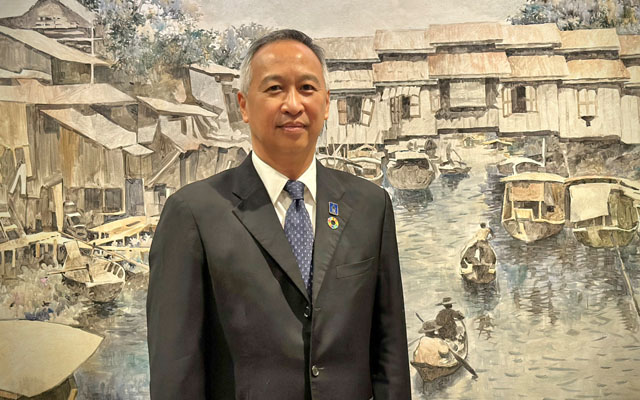
As Thailand’s hotel sector stabilises after the pandemic, Thienprasit Chaiyapatranun, president of the 62-year-old Thai Hotels Association (THA), discusses the industry’s push for higher standards, sustainability, and policy reform, while reflecting on the rise of FIT markets and efforts to maintain Thailand’s competitive edge
 How large is the THA membership base now, and how is it structured?
We currently have between 1,000 and 1,100 active members; the number fluctuates as properties join or leave.
The association is divided into 10 regional chapters, covering Bangkok, the Central, Eastern, and Western regions, as well as the Upper and Lower North, Upper and Lower North-east, and the South-western and South-eastern zones representing the Andaman coast and the Gulf of Thailand, respectively.
The THA was established in 1963; we celebrated our 60th anniversary under Marisa Sukosol Nunbhakdi’s presidency.
You’ve been part of the THA for decades. Can you share your background as a hotelier? What has your journey been like leading up to your presidency?
I began as a real estate developer, building condominiums. The Grand Diamond Hotel, which I own, was my third or fourth project. Because of the land size, we planned two towers and decided to make the first one, along the roadside, a serviced apartment.
But just as construction was finishing, the Tom Yum Goong crisis hit. Many expats left Thailand, so the serviced apartment plan was no longer viable. We decided to pivot and convert it into a hotel targeting tourists instead. Even during the economic crisis, tourism was still active while other industries, like manufacturing, slowed down. That was the turning point that led me into hospitality.
After three or four years, someone invited me to join the THA. I’ve now been a board member for almost 20 years and was elected president in March 2024.
Each presidency term lasts two years, with a maximum of two consecutive terms. That’s important, because the association doesn’t belong to one person; it belongs to all of us. We all help each other to develop, and new people bring fresh ideas to help develop the industry.
What is THA’s role in supporting its members?
Our mission is to raise the standards and competitiveness of the Thai hotel industry. That includes training and knowledge sharing on topics ranging from taxes to human resources and legal frameworks, and technology updates.
For example, through our annual Thailand Techspace event, we help small and mid-sized hotels understand what tools and solutions exist in the market. Many smaller operators don’t know what technology is available or how to apply it effectively. We connect them with providers and practical solutions suited to their scale.
We also act as a collective voice to the government on policy advocacy.
At times, the government will reach out to us directly to ask for our feedback on new programmes and campaigns – but often, we must also be proactive in voicing our concerns and representing the hotel industry’s needs.
We believe open communication from the start is essential, so new policies or campaigns that involve the hotel industry can be designed realistically, reflecting how operations work on the ground.
What are your top priorities as president?
Right now, two areas stand out. First, we recently submitted a petition opposing a blanket increase of minimum wages across the country. We believe it should vary by province, based on local cost of living and business realities.
But our main direction is sustainability. Many hotels, especially small and medium-sized ones, want to go green but don’t know how. So we are focusing on education and practical tools.
We’re working with the Ministry of Natural Resources and Environment (MNRE) on the Green Hotel Plus programme, which has been recognised by the Global Sustainable Tourism Council (GSTC) in Scotland. This is very important because, in the near future, OTAs like Booking.com will only give green badges to hotels certified by GSTC-recognised schemes.
That means hotels without certification might lose visibility online. Corporate buyers will also start filtering based on sustainability – many European companies already require proof that their business travel supports green-certified hotels. So we need to help our members get ready for this.
How is the THA helping hotels become more sustainable?
We’ve launched a project called Hotels Love the Earth, in collaboration with the Thai Chamber of Commerce (TCC).
Trainers from the TCC visit hotels directly and teach staff how to manage and separate waste, reduce consumption, and calculate carbon output.
The system tracks results – how much waste is reduced, how much can be recycled. Paper and plastic are collected and sold to suppliers. It’s not a large income, but it creates a circular system and shows that sustainability can be practical and profitable.
Large international chains already have global sustainability systems in place. Our focus is to help local and independent hotels catch up. The project will begin by targeting properties in Bangkok and nearby provinces.
Phuket is aiming to become Thailand’s first GSTC-certified destination. What is the THA’s role there?
Yes, Phuket is our pilot. The goal is to certify around 600 hotels by 2026, when the GSTC World Congress will take place on the island. Phuket has over a thousand hotels, but if 600 become certified, that would be enough to qualify as a Green Destination.
How do you view the current market conditions for Thai hotels?
The market is uneven. With the Thai baht strengthening by around seven per cent, travellers are actually getting fewer baht for their foreign currency, and as many travellers arrive with fixed travel budgets, some may feel their spending power drop.
Even if official figures show higher spending per head (in baht), that doesn’t mean tourists are actually purchasing more. The stronger baht means they could spend more local currency while getting less value for their money.
Investment in hotels continues, but it’s concentrated in the luxury segment, where yields are strongest.
What are the most promising key source markets right now?
The trend has clearly shifted toward FIT travel. Group tours are shrinking.
In the past, Thai travellers used to join group tours to Japan because we didn’t speak the language.
Today, travellers can book everything online on their own and use translation apps to communicate.
Europeans still prefer guided tours for longer trips, especially in Northern Thailand, but many Asian travellers – particularly from China and South-east Asia – prefer to travel independently.
Therefore, we need to make it easy to travel around Thailand, and safe.
Thailand is struggling with credibility due to perceptions of being “unsafe”. Can campaigns like Trusted Thailand help?
Safety is not really the problem; perception is. Crime exists everywhere, but Thailand’s petty crime rates are low. I’ve personally heard more first-hand anecdotes of Thai tourists being robbed in European cities, than tourists being robbed here – yet people still see Thailand as risky.
We’ve supported and given input on the development of the Trusted Thailand initiative by the Tourism Authority of Thailand, which certifies hotels and tourism operators that meet service and safety standards. It’s a step in a positive direction.
With rising competition from regional destinations, how can Thailand maintain its edge as a preferred global destination?
We need to get back to the basics. Thai hospitality has always been about warmth, kindness, and the human touch. That’s what sets us apart and keeps guests coming back.
At the same time, we can’t stand still. Vietnam is an emerging market; it’s like when a new restaurant opens nearby and everyone wants to try it. But in the restaurant business, repeat guests are what really matter. Thailand is strong in that area; we already have loyalty.
However, Vietnam is building many man-made attractions that draw new visitors. So, why not Thailand? We can also create new destination areas.
The key is to attract both Thai and foreign investors to take part. If the government can provide suitable land or allow it to be leased at low cost, it would make new developments more feasible.
That way, we could build exciting new destinations for travellers to explore.
We don’t need casinos. We just need creative projects and strong government support to bring them to life.