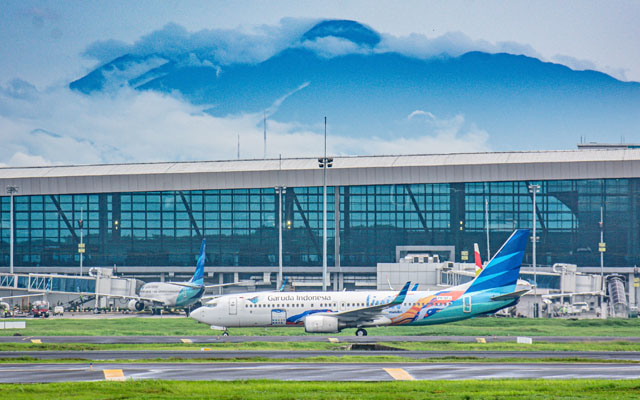
Indonesia’s government has allowed airlines to raise domestic ticket prices by nine to 13 per cent, and increased the fuel surcharge ceiling, as global fuel costs continue to climb.
At the same time, the government is introducing fiscal measures to keep fares within a manageable range.
Speaking at a recent press conference in Jakarta, Airlangga Hartarto, coordinating minister for economic affairs, said that the government was preparing mitigation measures to ensure airfares remain affordable for travellers.
“The government has also allocated 1.3 trillion rupiah (US$76.4 million) in monthly subsidies for the exemptions. The programme will run for two months, bringing the total allocation to 2.6 trillion rupiah,” he said.
In addition, the government has set the fuel surcharge ceiling at 38 per cent for all types of aircraft, including both jet and propeller planes. Previously, the fuel surcharge cap was set at 10 per cent for jet aircraft and 25 per cent for propeller aircraft.
Airlangga added that the additional support includes the removal of import duties on aircraft spare parts, aimed at reducing maintenance costs and helping airlines sustain operations across domestic routes.
“This way, we can minimise the impact on our airline industry while keeping fares within reach for travellers, so people should still be able to afford the tickets,” he said.
Responding to the measures, Denon Prawiraatmadja, chairman of the Indonesia National Air Carriers Association, said the policy came at a time when the airline industry needed support.
“We hope this policy can be immediately implemented in the field so that it can help airline operations in maintaining flight safety and comfort, as well as supporting air transport connectivity,” said Denon in a statement.
Travel agents, however, are more cautious in their perspective. Pauline Suharno, chairman of the Association of Indonesian Travel Agents, noted that even a modest rise could quickly affect demand, particularly as consumer spending has not yet fully recovered.
The effects are already beginning to surface, particularly among operators in secondary cities. “They are likely to face the greatest pressure, especially those outside the Java-Bali island,” Pauline added.
Budijanto Ardiansjah, secretary general of the Association of the Indonesian Tours and Travel Agencies, projected that demand and sales could fall by as much as 40 per cent over the next two months.
“This is a very challenging situation, as domestic conditions are slowing economically. Combined with global uncertainty, people are now choosing to hold back and prioritise essential spending such as food and education,” he said.
Both Pauline and Budijanto hope that conditions will improve within the next couple of months, particularly if geopolitical tensions ease and fuel prices stabilise.