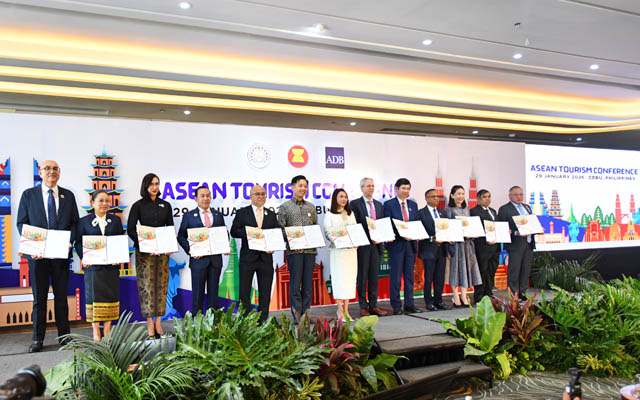
The Declaration on the Implementation of the ASEAN Tourism Sectoral Plan 2026-2030 was unveiled on January 29, 2026 at the ASEAN Tourism Conference in Cebu, Philippines, marking a decisive move from post-lockdown recovery towards long-term transformation of the region’s tourism sector.
The declaration aligns with the ASEAN Vision 2045, the bloc’s long-term development blueprint endorsed by ASEAN leaders in May last year, which sets out a 20-year trajectory for the region’s economic, social, and institutional growth.
Under Vision 2045, tourism is positioned as a key driver of quality growth, resilience, and meaningful employment.
In 2024, tourism generated close to US$400 billion in 2024, accounting for almost 10 per cent of South-east Asia’s GDP and supporting about 42.5 million jobs, shared ASEAN deputy secretary-general, Satvinder Singh in his opening address.
In 2025, South-east Asia welcomed 144 million international visitors, a 13.4 per cent year-on-year increase, with nearly 48 million travellers coming from within the region.
He noted that South-east Asian tourism faces mounting pressures from climate change, digital disruption, geopolitical uncertainty, and intensifying global competition.
He shared that the ASEAN Tourism Sectoral Plan and the ASEAN Tourism Marketing Strategy for 2026-2030 is an opportunity for the region to move decisively from recovery to transformation.
The five-year sectoral plan is built around five interlinked priorities: resilient tourism, empowerment of the tourism workforce, accessible and seamless travel, digital tourism and product diversification, and sustainable tourism.
As host country and lead country coordinator for the ASEAN Tourism Sectoral Plan, the Philippines highlighted how national policies are already aligned with the plan’s five priorities.
Department of Tourism secretary, Christina Garcia Frasco said the Philippines’ experience, particularly in climate resilience, had helped to shape the plan’s direction.
She underscored the importance of resilience today, citing recent floods, earthquakes, and extreme weather events affecting Cebu and other destinations in the country.
She pointed to government initiatives that are currently underway, including large-scale skills training, emergency cash assistance for displaced tourism workers, visa liberalisation, as well as improved air connectivity.
Frasco shared that Cebu alone had gained 12 new international routes in 2025, thus strengthening its role as a regional gateway.
She also highlighted the Philippines’ digital nomad visa, expanded visa-free system for major markets, partnerships with global payment platforms, and the Philippine Experience Program, which is designed to promote culture, heritage, gastronomy and emerging destinations to ease pressure on overcrowded sites and raise visitor spending.
Asian Development Bank (ADB) vice-president for East and South-east Asia, and the Pacific, Scott Morris said South-east Asia’s tourism rebound has been driven by strong intra-regional travel and renewed long-haul demand.
“Countries are transitioning away from volume-led models towards higher-value and more diversified forms of tourism,” Morris said, adding that ADB has committed more than US$4 billion to tourism-related projects and has a US$3 billion investment pipeline through 2030.
An ASEAN Dialogue Partner, Igor Maksimov, deputy director general Department of Multilateral Economic Cooperation and Special Projects at the Ministry of Economic Development of the Russian Federation, said Russia is prepared to support ASEAN member states through technical cooperation and capacity building, including smart city management systems, large-scale tourism investment projects, and workforce training programmes.