TTG Asia
Asia/Singapore Wednesday, 8th April 2026
Page 638

Radisson Hotel Group expands Middle East portfolio

0

Radisson Hotel Group (RHG) has announced expansion plans in the Middle East as it sets to add over 5,000 keys over the next five years, further cementing its presence in the region with a growing portfolio of 77 hotels in operation and under development.

Currently operating 52 properties in the Middle East with more than 11,000 keys, RHG continues to focus on the region, with the Kingdom of Saudi Arabia (KSA) and United Arab Emirates (UAE) remaining its core markets, and plans to sign at least five hotels and open more than 1,000 keys within the next 12 months.

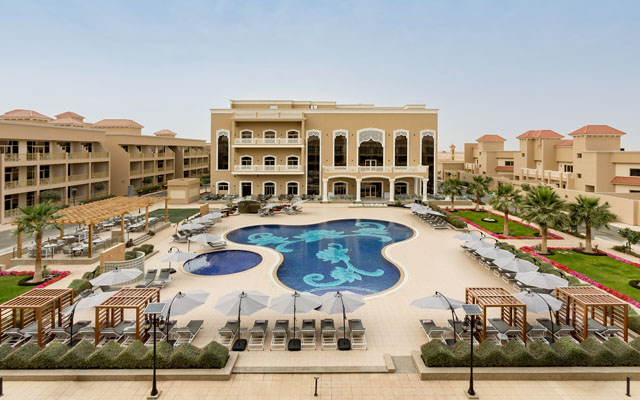
Radisson Hotel Riyadh Airport is the first Radisson-branded property in Riyadh, Kingdom of Saudi Arabia

The recent opening of Radisson Hotel Riyadh Airport marked RHG’s first Radisson-branded property in Riyadh, KSA, while Mansard Riyadh, A Radisson Collection Hotel is the brand’s second hotel in the city.

Radisson Beach Resort Palm Jumeirah will open later this year in the UAE.

RHG has over 25 hotels and serviced apartments in operation and under development in the Kingdom, including the upcoming openings of Radisson Blu Hotel, Riyadh Convention and Exhibition Center, and Park Inn by Radisson hotels in Makkah’s Thakher City Development.

Elie Milky, vice president development for the Middle East, Pakistan, Cyprus and Greece, RHG said: “We will be announcing more hotels with plans to open another 400 keys before the end of the year, closing the year with almost 1,000 keys signed and almost 1,500 keys opened across the GCC and Levant sub-regions.

“We also look forward to capitalising on our expanding development team across the Middle East and to the opening of our office in Riyadh, reaffirming our strategic shift on the Kingdom.”

Other signings include Radisson Blu Hotel, Amman Galleria Mall in Jordan and Park Inn by Radisson Kuwait Hotel & Apartments in Kuwait, scheduled to open in 2023, as well as Park Inn by Radisson Muscat Airport in Oman.

“We remain committed to unlocking (Middle East) potential with a solid and immediate pipeline to double our hotels in this area by 2026,” adds Elie Younes, executive vice president and global chief development officer, RHG.

Welcome the new year at Star Island Singapore Countdown 2022-2023

0

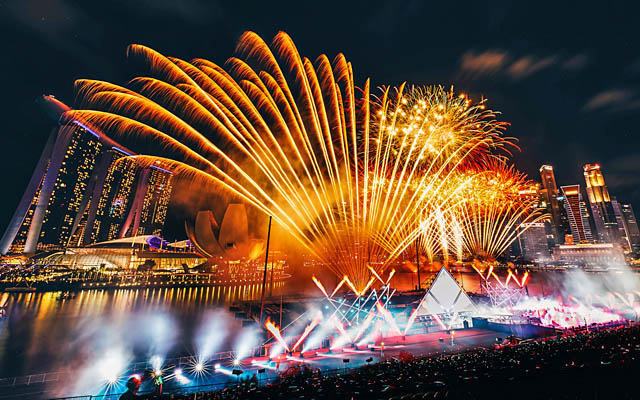
Fireworks are set to illuminate the sky against Singapore’s Marina Bay city skyline on New Year’s Eve this year. After a two-year hiatus, STAR ISLAND Singapore Countdown 2022-2023 is back with artisanal Japanese fireworks that have never been featured anywhere in South-east Asia.

With a 22,000-seating capacity, this 70-minute fireworks musical extravaganza features larger-than-life pyrotechnics and dazzling lights, immersive sound and world-class entertainment, and is refreshed with a brand-new storyline this year.

STAR ISLAND Singapore Countdown 2022-2023 is a fireworks musical extravaganza not to be missed

Expect Live DJ performances, family-friendly entertainment zones and gastronomic offerings at the food village as part of the STAR ISLAND experience.

This year’s show includes artisanal “Ghost Effect Shell” fireworks which have been designed to bloom in Singapore’s stunning colours, a red-to-white gradation across the sky. Ten bursts of fireworks bestowed with the “Prime Minister Award” earlier this year at Japan’s Omagari Fireworks Competition will also paint the night skies of Marina Bay for the very first time. Come nightfall, ticket holders will experience a futuristic twist on the traditional Japanese hanabi entertainment show.

There will also be a free admission event preview, “Prequel to STAR ISLAND”, at the Marina Bay Sands Event Plaza from Decemeber 25 to 30, where visitors will be able to get a sneak peek of the show.

Tickets will go on sale on October 20 and start from S$88 (US$62), and S$318 for VIP experience with exclusive entitlements. Each ticket permits entry to the seated gallery at The Float at Marina Bay and access to the food village.

Limited SUITES packages for parties looking to celebrate in luxury start from S$10,888, and comes with a bird’s eye view of the show, sofa seats, table service, and exclusive lounge access.

Waitlist for tickets is available here.

Cape Panwa Hotel selects new GM

0

Voytek Klasicki has been appointed general manager of Cape Panwa Hotel, Phuket.

Klasicki is no stranger to Phuket, having been the general manager at Cape Panwa Hotel 24 years ago. Most recently, he spent the last 15 years working for Centara Hotels and Resorts.

A seasoned hotelier with more than 40 years’ experience, Klasicki has worked in countries such as the UK, Australia, New Zealand, India, The Maldives and Thailand.

Thailand sets US$46.2 billion tourism revenue target for 2023

0
A couple taking a selfie at Wat Arun, Bangkok

The Thai government has set the tourism revenue target for 2023 at 1.73 billion baht (US$46.2 billion) – 80 per cent of what the Kingdom achieved in 2019, reported The Bangkok Post.

Government spokesman Anucha Burapachaisri said on September 19 that the bulk would come from international visitors.

The bulk of the Thai government’s tourism revenue target will come from international visitors

In the best case scenario, total revenue from tourism in 2023 could reach 2.38 trillion baht – 1.5 trillion baht from foreign arrivals and 880 billion baht from domestic travellers.

International arrivals to Thailand has been on the mend, aided by the country’s removal of travel barriers. More than five million foreign tourists have arrived in Thailand between January and September this year, according to Anucha.

One million international travellers are expected in September alone, while 10 million are expected by the time the year closes.

The Tourism Authority of Thailand (TAT) has forecasted that arrivals in 4Q2023 would be around 1.5 million per month, and it would work with airlines on marketing to help restore inbound tourism.

Asia-Pacific likely to lose its position as top civil aviation market: ACI

0

China’s tougher border measures and Japan’s cautious approach toward the relaxation of inbound travel restrictions could displace Asia-Pacific as the world’s largest air passenger market for the year 2022.

Asia-Pacific, which has dominated the civil aviation market for several years prior to the pandemic, is estimated to finish second, behind Europe in terms of passenger share, and at a comparable level with North America.

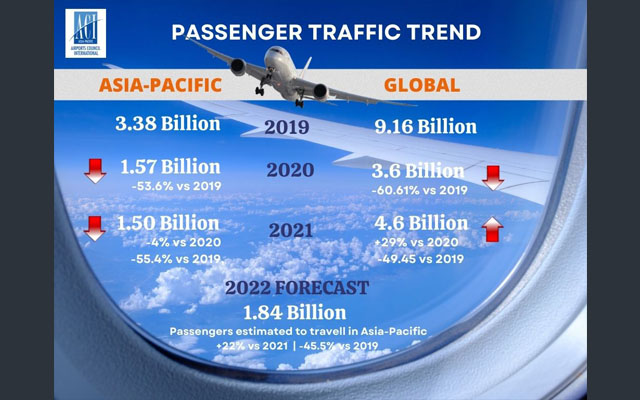
The ACI Asia-Pacific forecast indicates that passenger traffic will only recover by about 55% by end-2022

The latest Airports Council International (ACI) Asia-Pacific forecast indicates that by the end of 2022, passenger traffic will only recover by about 55% as compared to pre-pandemic levels. This is in stark contrast to other regions where recovery is substantially higher, and indeed estimated to be approximately between 70% and 80%, respectively. In 2019, 3.4 billion passengers travelled by air in Asia-Pacific, representing 37% of the global volume of 9.2 billion. Following a phenomenal growth, 2020 was a watershed year for aviation as the Covid-19 pandemic crippled the industry.

In 2020, the region witnessed only 1.6 billion passengers, an unprecedented 53% crash in traffic owing to pandemic-induced restrictions across the globe. However, Asia-Pacific dominated the traffic share by contributing 1.6 billion pax or 44% to the global traffic of 3.6 billion. Home to several large domestic markets, the region demonstrated sensible resilience in air traffic.

In 2021, 1.5 billion people travelled by air in Asia-Pacific, experiencing a slight decline by -4% versus 2020, but was still the leading region accounting for 33% of 4.6 billion global passengers.

Although the latest ACI forecast predicts 22% growth for the year 2022 over 2021, the share of passenger traffic in Asia-Pacific is likely to drop to second globally, with an estimated traffic of 1.8 billion passengers – a decline of -45% compared to 2019.

Stefano Baronci, director general, ACI Asia-Pacific said: “The traffic in the region will not be able to fully recover to 2019 levels unless all countries keep their borders open to facilitate freedom of movement. China and Japan – one of the largest contributors to the region’s overall traffic – have been slow in lifting travel and Covid restrictions.

“We are urging states to take a measured approach to facilitate the recovery in a more sustainable manner and without causing significant impact on their healthcare system. Accelerating the recovery will need a whole of industry and government support, especially in view of an increasingly challenging macroeconomic scenario.”

ACI Asia-Pacific has written a letter, co-signed by ACI World and World Travel & Tourism Council (WTTC), to the prime minister of Japan, urging the government to remove all restrictions and restore the travel privileges to enable smooth recovery of the industry in the region.

Appreciating the Japan government’s efforts for providing a safe environment for its citizens amid the pandemic and easing of restrictions on international air travel in a phased manner, the three organisations urged the Government to take necessary actions to bolster the recovery of the industry, including the resumption of visa exemptions to countries that had such an agreement with Japan.

This reform is considered particularly urgent in view of economies still battling strong headwinds, including geopolitical instability in eastern Europe and its subsequent impact on global macroeconomics, including high inflation and rising energy prices. All these external factors too are causing disruptions in supply chains, negatively hampering the recovery of the industry.

Baronci added: “There are positive signs emerging from Japan where the Government is considering on lifting of daily arrival caps to spur tourism to revive their economy, and it will benefit the industry to a greater extent. We hope to see a positive outcome in the very near future.”

Resorts World Cruises introduces thematic cruises on Genting Dream

0

Resorts World Cruises (RWC) is launching a series of monthly thematic cruises on the Genting Dream that includes a variety of enrichment programs and activities for guests to experience while at sea.

Also to commence are the Sail-Away Celebration Parties available at the start of each week for Genting Dream’s Sunday departures, which are filled with performances, music, dance, good vibes and amazing hospitality from the Captain and crew.

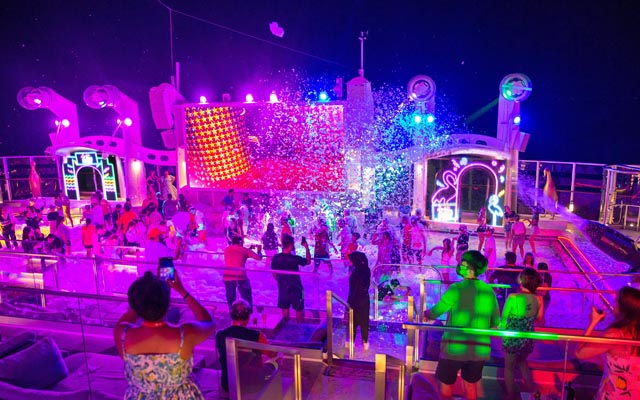
Kick-starting in September is Genting Dream’s Light Meets Night thematic cruise

Resorts World Cruises’ president Michael Goh said: “At Resorts World Cruises, we are taking the celebration up a notch and onto the ship, introducing unique themes that will be refreshed every month for our guests’ pleasure. Each thematic cruise promises to be different; and guests can look forward to a one-of-a-kind experience at sea, complementing the extensive onboard offerings, cuisines and shore excursions that are readily available.”

From now until October 16, guests can discover a new world of bright colours and neon lights with the Light Meets Night thematic sailing. The ship’s Zouk Beach Club transforms into a magical outdoor wonderland under the stars with colourful displays and projectors. There is a Glow-in-the-Dark Bouncy Playground just for kids, dance and light performances by some of Singapore’s renowned street musicians and buskers, as well as Arts and Crafts workshops to create glow-in-the-dark paintings, and more.

Celebrate Halloween at sea with the Clowning Around thematic cruise from October 16 to November 2, where the ship turns into a house of horror with special Halloween-themed rooms and activities.

Wellness-seekers can join the Sensational Voyage thematic cruise from November 2-13, where they can participate in numerous exercises and meditation classes under the supervision of professionals, and indulge in healthy meals under the guidance of onboard nutritionists.

For the year-end holidays, celebrate Jelilo Christmas at sea with one of Singapore’s famous homegrown art and toy designers from gagatree. The ship will be decked up in Christmas decorations, with Christmas markets, a Christmas feast, and workshops for guests to creating personalised gifts.

For more information, visit Resorts World Cruises.

New Paradox Singapore builds an identity on its heritage edge

0

The newly-rebranded Paradox Singapore Merchant Court at Clarke Quay will leverage the hotel’s heritage credentials to stand out in Singapore’s competitive accommodation landscape.

The hotel was conceived following the April 2022 partnership between Canadian-born boutique hospitality brand, Paradox Hotel Group and leading property developer in Malaysia, TA Global to rebrand the former Swissotel Merchant Court.

Khoo-Gan: to reinvent, find new things to entice people to want to come to Singapore

Jessie Khoo-Gan, the hotel’s general manager, told TTG Asia: “One of the key values that the owners wanted to present is to be on the chic, playful side and yet offering an authentically local taste.”

The hotel showcases distinctive décor reminiscent of historical elements. For example, its Ellenborough Market Café spotlights Peranakan (Straits Chinese) dishes and setting, while the name pays homage to the former popular market and street in the area.

The 476-key hotel enjoys a prime location, with the bustling entertainment and dining river district of Clarke Quay at its doorstep as well as tourist spots such as Chinatown and Little India within a short train ride away.

Moving forward, Khoo-Gan wants to build on its unique branding, capitalising on the interesting background of the Merchant Court area where samsui women and coolies used to congregate in the olden days.

Her team is exploring a locally-made, tailored-by-Paradox package for guests that involves a heritage trail in Clarke Quay and nearby Fort Canning.

She told TTG Asia that ideas for the future include bringing local delights, such as bak kut teh (pork rib soup) and sweet potato porridge, to the hotel’s F&B offerings and creating a special massage that is reimagined from treatments offered in the past. The latter is expected to appeal to a rising traveller trend for wellness, and can take advantage of the hotel’s ability to function as a quiet sanctuary to relax and unwind, complete with scenic riverside views.

She said: “We (Singapore) are so small, so we always need to reinvent, find new things to entice people to want to come to Singapore.”

The power of traveller-centric technology

0

The current power of planning travel online puts choice in the hands of the traveller in ways that would have been inconceivable 25 years ago.

With a simple search, millions of travellers can be connected to their choice of brands and experiences. Travellers can select how they want to travel by sharing preferences, instantly enabling them to compare options for where they might want to stay. Powerful back-end and user interface development, paired with supply from partners, has put the power firmly in the fingertips of the traveller.

While this clearly benefits the traveller, it’s clear that the online travel market has become too price conscious rather than the right product at a fair price.

Fortunately, this is now changing. What we are currently seeing is a realignment of the online travel booking experience, with technology putting the traveller’s considerations at its core – with the aim of providing an exceptional guest experience.

In order to deliver better results for travellers, and for hoteliers looking to improve their business, there are a series of ways in which hoteliers can adapt to better suit the traveller’s needs. The reasons to focus on guest experience are clear: better guest experiences lead to higher rates of rebooking, greater brand loyalty, and better reviews which lead to additional bookings. By using technology and marketplaces which put the traveller experience at the centre, hoteliers can drive better traveller experiences and better outcomes for all.

Understanding travellers’ experience better
The ability to accurately gauge a traveller’s perception of different aspects of their trip or experience is important for understanding where they can improve, and to hear about the elements of a trip that travellers particularly value. Technology which enables hoteliers to listen for signals that indicate a great guest experience is crucial.

The need to be attuned to the traveller’s needs is underlined by findings that 53 per cent of consumers are likely to spend with companies if they trust they’ll get what they were promised. Using technology that tracks and analyses key touchpoints – from guest reviews, cancellations, and in-stay feedback, to call propensity and relocations – can all help to build an accurate picture of the overall experience. Knowing where a hotel is overpromising and underdelivering is important to understand how to make improvements, eliminating the guessing game and helping to inform actions to improve traveller satisfaction.

A marketplace in step with guest experience
While this feedback helps to improve a hotelier’s offering, this information is also helping to improve online marketplaces for hoteliers and travellers alike. For example, Expedia Group is reimagining its marketplace by rewarding partners that deliver great traveller experiences with more visibility. Historically, offer strength, which reflects factors related to a property listing – factors like content, images, and price availability – have been a significant component to our marketplace. Expedia Group is introducing changes to our marketplace where a hoteliers’ visibility will reflect two types of signals: offer strength and guest experience.

The intent behind the guest experience signals is to give travellers an accurate and clear picture of what they can expect when they book their accommodations by meaningfully elevating the importance of the guest experience. Some of the signals impacting this score will include staff and service ratings, cleanliness ratings, relocation rates, amenity ratings and more.

This traveller-centric shift will reward accommodation providers that have delivered positive guest experiences with increased visibility and performance, and more opportunities to create connections with guests. Using a marketplace which takes into account price consideration and availability alongside how a hotel has performed for guests in the past, delivers an equally positive experience for the hotel and traveller. After all, many hoteliers consider providing a great experience the core value that they offer to travellers. Indeed, across Asia-Pacific, the industry takes pride in our ability to provide exceptionally high levels of customer service and hospitality – as evidenced by the importance of omotenashi in places like Japan.

When the traveller wins, we all win
Previous iterations of the overly commodified online travel experience don’t best serve the traveller’s needs, and don’t offer the best value to hotels. Traveller-centric technology, such as a marketplace that rewards partners and displays rooms and experiences which take into account previous guest experiences, much better reflects travellers’ preferences.

Without adopting technology that puts travellers at its core, hoteliers risk being left behind as travellers seek an online travel booking experience that best serve their holistic interests – not just price. By adopting the right technology, hoteliers can expect a richer suite of tools to better understand and serve travellers and better businesses because of it.


Cebu Pacific to resume Manila-Kota Kinabalu flights

0

Cebu Pacific (CEB) will resume its flights to Kota Kinabalu from October 31, bringing the number of its international destinations to 19.

The Manila-Kota Kinabalu service will operate on every Monday and Friday; return flights will fly every Tuesday and Saturday.

Cebu Pacific will resume its Manila-Kota Kinabalu service from October 31

The flight will depart from Manila at 23.25 and arrive at Kota Kinabalu at 01.50 the next day; while the return flight will depart Kota Kinabalu at 02.35 and arrive in Manila at 04.40.

All guests bound for Kota Kinabalu must download and register for the MySejahtera mobile app to indicate their Covid-19 risk status.

Digitalising travel: Dreaming of a streamlined travel future

0

I was recently invited on an excursion – a journey into SITA’s tech lab where many of its systems and programmes for travellers, airport operators, airlines and pilots are showcased.

I finally got to see how SITA Flex works. In layman’s terms, SITA Flex allows airports and airlines to process their passengers beyond the confines of traditional check-in counters, by using smart devices – tablets for the airport/airline staff and personal smart devices for passengers. SITA Flex could be deployed in cafes or sitting zones around the departure hall, allowing passengers to complete the process themselves, or implemented by roving airport/airline service officers who will provide assistance when needed.

The benefit for airports and airlines is that the former can spread out check-in crowds while freeing up valuable facility space for commercial usage, while the latter can process more passengers without needing more counters or staff.

As a traveller, I am excited by SITA Flex. While many major airports in Asia have self-check-in kiosks at their departure halls, crowding in a single area is still a reality. I relish the prospect of being able to avoid crowds by choosing alternative check-in zones, and perhaps queue for my latte while getting my baggage tags printed out at the same time.

Together with digitalised pre-trip processes like electronic visa and electronic travel authorisation, biometrics implementation throughout the pre-boarding and boarding process, technology can further improve the accuracy of passenger clearance, reduce physical touchpoints and minimise waiting times.

Even more promising is the idea that similar technology applications and the traveller’s electronic identity can be utilised beyond the airport, so that the traveller who was cleared for flight can also waltz through the cruise terminal for his ocean getaway without undergoing repeat checks, into his pre-booked hotel room without the need for a keycard, and into the exhibition hall or conference centre without a physical badge. Wouldn’t it be great if he could also pick up his pre-booked rental car or pocket Wi-Fi just by scanning his face and not having to input the same personal particulars for every different vendor?

I dream of the day I can travel anywhere without a physical passport, where my official travel document is available as a secure app – just as my Singapore identity card is – and my face or my palm is my access key.

Of course, discussions about such a streamlined future of travel isn’t new and the common gripe continues to be the slowness in getting government agencies and commercial organisations worldwide to agree on a data-sharing system. But, at least, technology transformation is happening faster at airports, catalysed by combined pressure on operators to better manage processes with a smaller pool of workers post-lockdown as well as greater public expectation for safe distancing and contactless everything.