TTG Asia
Asia/Singapore Thursday, 23rd April 2026
Page 2063

Holiday Inn Singapore Atrium relaunched after 9-month facelift

0

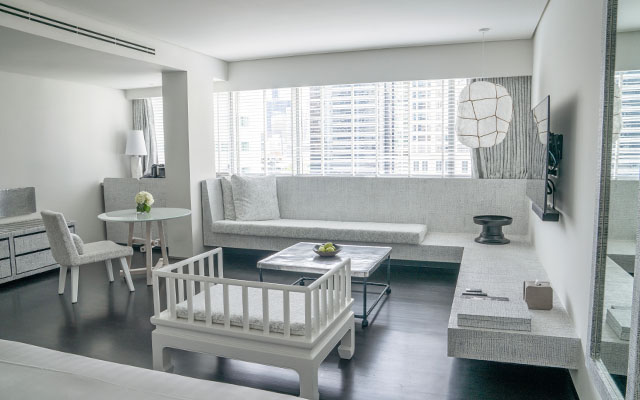
THE 512-room Holiday Inn Singapore Atrium has officially relaunched after completing an extensive multi-million dollar refurbishment.

With its revamped lobby, guestrooms, dining outlets and meeting facilities, this is the building’s first major facelift in its 30-year history.

The new vibrant looks of the hotel lobby and guestrooms are inspired by the iconic Singapore River and the colourful rows of shophouses along its banks.

Additions to the dining scene include all-day dining venue Atrium Restaurant, and Atrium Bar 317, which overlooks the hotel’s lobby atrium.

To maintain its popularity among business travellers, the hotel also upgraded its Atrium Ballroom and 12 meeting rooms, fitting them with improved equipment, including new live recording, sound and lighting facilities.

During the nine-month refurbishment process, business continued as normal at the hotel. “We have been very careful with the way we went through the (renovation) process,” Charles Godot, Holiday Inn Singapore Atrium’s executive assistant manager, told TTG Asia e-Daily.

“As hoteliers, we understand that guests come first, so we chose certain periods of the month or day to do certain parts of the renovation to limit (guests’) exposure to the renovation,” he said.

The hotel’s facelift was timed to coincide with its 10th year anniversary, while doubling as a way to stay competitive amid Singapore’s recent falling visitor arrivals.

“In a way we went through a difficult time, but most of our guests were understanding of the situation and very supportive – they were even giving advice on how we should’ve carried it out!” quipped Godot.

By Jerlene Ng

Sri Lanka banks on Chinese and Western markets for 2015

0

INDIA is likely Sri Lanka’s largest tourism source market this year but the country is investing a substantial part of its budget in the markets of China, UK, Germany and France.

The Sri Lanka Tourism Promotion Bureau (SLTPB) announced last week that it had secured a Rs3.4 billion (US$26 million) promotions budget for 2015.

The budget will cover roadshows, trade fairs, advertising, as well as the 280 travel consultants and 280 journalists to be invited on fam tours this year. China will receive the lion’s share of promotions money at Rs176 million.

The campaign, running from January to December, is targeting 2.5 million arrivals in 2016 and positions Sri Lanka as a ‘peaceful destination’ as well as increase awareness of the country among travellers, according to SLTPB Chairman Rohantha Athukorala.

This year, the NTO wants two million arrivals, up from last year’s 1.5 million actual visitors.

Amal Goonetileka, regional director-sales for Taj Samudra Hotels, Sri Lanka and the Maldives, said 2015’s marketing plan was done in consultation with the Tourist Hotels Association of Sri Lanka, whose representatives sit on the SLPTB board.

“This plan will be reviewed from time to time and new initiatives…will be added where necessary going forward.”

Mahen Kariyawasam, president of the Sri Lanka Inbound Tour Operators Association, said the new budget was welcome news “given the limited resources available at the SLTPB”, adding that his association was also consulted.

India’s proposed national tourism policy draws ire of hospitality sector

0

AFTER a 13-year gap, the Ministry of Tourism is setting a new national tourism policy in motion, though some quarters have found it disappointing.

Released on May 1, the initial draft of the new national tourism policy outlines the establishment of new tourism bodies, including the National Tourism Advisory Board, the Inter-Ministerial Coordination Committee on Tourism, a Medical Tourism Promotion Board and a MICE Promotion Bureau.

The tourism ministry also invited feedback from various sectors of the industry. Suman Billa, joint secretary for tourism, said: “We have received many suggestions…After due consideration with various ministries, the draft of the National Tourism Policy of 2015 may undergo a few changes.

“The final draft will again be sent to the cabinet for approvals and only after seeking the ministries’ acceptance will the policy be made public.”

However, the present draft is drawing flak from the hospitality sector that alleges the new policy is neglecting its needs, especially its longstanding demand that it be given industry status.

Speaking to TTG Asia e-Daily, Beni Agarwal, business consultant, GK Hospitality Services, said: “Industry status helps hoteliers and investors by narrowing down on licences and bringing in a single-window clearance system. Secondly, it helps industry stakeholders borrow cheaper loans from financial institutions with repayment period of 15 to 20 years. Also, certain projects in special zones are given tax holidays for five years.”

The Hotel & Restaurant Association of Western India last week sent a letter to the Prime Minister’s Office calling for a revisit of the policy to ensure that hospitality gets “deserved attention”.

Association president, Bharat Malkani, said: “If hospitality as a sector is ignored then service levels will definitely take a plunge, leading to a bad experience for the tourist.”

The initial new tourism policy draft declares that all hospitality projects will be classified as industrial when it comes to utility charges, property taxes and levy of industrial rates.

Japan preps tourist evacuation plans as volcanic activity rumbles on

0

JAPAN is drawing up legislation that will require operators of hotels and other tourist facilities close to the nation’s volcanoes to have emergency evacuation plans in place.

Revisions to the existing Active Volcanoes Countermeasures Law will force such companies to devise emergency measures, while tourism departments of local governments will be charged with monitoring visitors’ locations.

The government’s action has been prompted by the eruption of Mount Ontake last October, which killed over 60 hikers, and the ongoing volcanic activity in the Owakudani hot spring district.

Roads and paths into the Owakudani district, normally busy with day-trippers from Tokyo, have been shut.

“We are informing all our clients and the media about the situation, but it is important to point out that only a very small part of the area is affected,” Motohisa Tachikawa, a JTB spokesperson, told TTG Asia e-Daily.

“There has been a very small number of cancellations so far, but we are a little concerned if this unsure situation continues into the summer holiday season.”

He added that hotels and tourist attractions in nearby towns like Gora and Tonosawa are operating normally.

HIS Japan is also reporting a limited impact on business with only “a few” cancellations, confirmed spokesman Yasuhiko Hoshi. “It’s a relatively small area that has been affected and not one of the most popular spots for tourists. Overseas visitors rarely go to that area anyway, so that segment of the business has hardly been affected.”

The company is nevertheless monitoring the situation carefully, he added.

Osaka to become Scoot’s next Japanese destination

0

SCOOT is set to start a new service from Singapore to Osaka from July 8.

The LCC will connect Osaka and Singapore six times weekly, with three via Bangkok and three via Kaohsiung in Taiwan.

The Bangkok-Don Mueang route is scheduled to run on Wednesdays, Fridays and Sundays, while travellers bound for Osaka via Kaohsiung will need to travel on Tuesdays, Thursdays or Saturdays.

Campbell Wilson, CEO of Scoot, commented: “Osaka has long been on our radar, and we’re excited to add it to our network.”

“Besides Osaka’s many attractions, such as Dotonbori food district, its castle and Universal Studios Japan, it is also the gateway to the stunning historic capital of Kyoto with its many temples and sights. When combined with our existing service to Tokyo, Scoot’s guests can now complete the Golden Triangle of Tokyo, Kyoto and Osaka without backtracking.”

To commemorate the launch of this new route, Scoot is offering one-way Economy Fly fares from Singapore to Osaka starting at S$99 (US$74). On sale from now until May 24, fares exclude taxes and surcharges and are valid for travel between July 8 and October 25.

Orchard Hotel Singapore names new GM

0

RICHARD Ong has been picked to lead Orchard Hotel Singapore as its new general manager, and will take charge of the hotel’s business operations in this role.

Bringing over 30 years of local and international hospitality experience to the job, Ong joined Millennium & Copthorne last year as general manager, operations, Asia.

The Singapore-born hospitality veteran has held several key leadership roles in Singapore, the US, Cambodia, Australia, China and Japan.

New CEO for Sunway International Hotels & Resorts

0

SUNWAY International Hotels & Resorts has appointed Albert Cheong as CEO.

Cheong will oversee and manage all Sunway hotels, both local and overseas, while continuing to hold the position of group general manager for Sunway Resort Hotel & Spa.

Prior to joining the company in 2014, the 30-year hospitality veteran was area general manager for Landmark Lancaster Hotel Group.

Malaysian travel consultants lament sorry state of rate parity

0

WHILE local tour operators have long complained that hotels offer them contract rates that are higher or similar to the dynamic rates offered to OTAs, the gap has widened in recent months to place traditional travel consultants at the losing end.

Arokia Das, senior manager at Luxury Tours Malaysia, shared: “A year ago, OTAs were offered rooms without breakfast at slightly higher rates. This year, they get rooms with breakfast at rates that are lower than what we get.”

The average contract rate for a four-star hotel ranges from RM220 (US$61) to RM250 for local travel consultants, but OTAs get rates as low as RM190, including breakfast, he said. “This is happening because hotels need business and there is an oversupply of rooms.”

As a result, “local players lose out to OTAs who make money and are not even based here”, he opined.

Agreeing, Ally Bhoonee, executive director of World Avenues, said this is unfair to travel consultants who have invested in destination promotion. “It also makes the destination look ‘desperate’ to overseas outbound tour operators, who will take full advantage and squeeze the local travel consultants for further discounts.

“The industry – Malaysian Association of Hotels (MAH), Malaysian Association of Tour & Travel Agents and the Ministry of Tourism and Culture – must come together to find a solution to this issue,” he said.

However, MAH president, Cheah Swee Hee, told TTG Asia e-Daily the association does not regulate rates as “This is a free market”.

Asked whether there is a solution to rate parity, he said: “If travel consultants want good rates they must also be able to commit a certain number of room nights to the hotel.”

Meanwhile, Alex Lee, CEO of Ping Anchorage Travel & Tours, has found a way out of competing against OTAs by diversifying into the hospitality industry with the 22-room boutique hotel, Terrapuri Heritage Village, in Penarik, Terengganu.

He said: “We sell rooms to OTAs and traditional travel consultants, and we have also diversified to offer services to small inbound MICE and bespoke programmes to high-end clients.”

South-east Asia the centerpiece of Mövenpick’s Asian growth

0

MÖVENPICK Hotels & Resorts will open seven hotels in Asia over the next three years as part of the company’s plan to focus on South-east Asia as a key growth area.

This will see the Swiss hotelier expand its footprint from eight to 15 properties, six of which will be in Thailand.

Jens Reichert, the management company’s vice president of development, said South-east Asia will become an increasingly important market for Mövenpick, which has another 10 properties in the regional pipeline.

“We believe there’s a lot of opportunity within South-east Asia’s existing destinations; it has good ingredients for hospitality and the right kind of entrepreneurs that we can work with (as investors in hotels).”

The company will open seven properties across the region in the next three years: two in Thailand, two in Malaysia and one each in China, Indonesia and Vietnam.

Even though markets such as Bangkok are fiercely competitive and have some of the cheapest five-star hotels in the region, Reichert said Mövenpick believes there is still ample room to build new business within the upscale market.

Beyond South-east Asia, Mövenpick recognises China’s strong development potential but has no plans to significantly expand its footprint there.

Beijing’s current crackdown on graft and profligate spending among public officials has resulted in a notable reduction in the number of luxury hotel licences issued. Said Reichert: “We will only go into China when (a project) ticks all the boxes.”

That said, the hotelier will target Chinese tourists travelling within the region.

“There are about 100 million middle-class Chinese who travel outside of the country each year. South-east Asia is a key destination for them. (While they initially may travel on group tours), by their second or third trip a large chunk of those 100 million tourists will stay at an upscale hotel,” opined Reichert.

South Korea welcomes first Holiday Inn Express

0

INTERCONTINENTAL Hotels Group has opened Holiday Inn Express Seoul Euljiro, South Korea’s first Holiday Inn Express hotel.

Located in the heart of Seoul, the 224-room hotel is just a minute’s walk from the Euljiro 3-ga subway station and an hour from Incheon International Airport.

Holiday Inn Express Seoul Euljiro offers a choice of twin- and double-bed rooms, free on-site parking, Wi-Fi and breakfast.

Travellers can visit the nearby Bukchon Hanok Village, a preserved traditional village, the famous N Seoul Tower atop Namsan Mountain, or shop at Dongdaemun Fashion Town, a designated tourist zone.

The hotel is promoting an opening rate of 137,500 won (US$126) per night for bookings made until August 31.