TTG Asia
Asia/Singapore Saturday, 28th March 2026
Page 1849

Western Australia reinstates funding for Perth Convention Bureau

0

The government of Western Australia has decided to retract the proposed cuts in state funding for the Perth Convention Bureau (PCB).

The move comes on the back of lobbying efforts by business events stakeholders in opposition to tightened funding announced in the state budget, which would have seen funding for PCB slashed by up to 30 per cent over the next three years (2017-19).

In addition, opposition party Western Australian Labor Party had in March jumped in to pledge an investment for the conventions promotion body, which works out to an estimated 60 per cent increase in funds.

Welcoming the state government’s decision, PCB CEO, Paul Beeson, said: “We are grateful to
the premier and state government for the reinstatement of this funding, particularly given the fiscally tight environment in which the government currently sits.

“It’s an important acknowledgement of the high return on investment PCB offers and recognition of the role of business tourism in the economy and fabric of our state.”

Elaborating on the “high ROI”, PCB estimated that it generates a return of over 30 times the amount invested by the state, far exceeding that seen in competing destinations such as Bureaux in the east coast.

Further entrenching the importance of the business events sector to Perth, PCB stated that conference delegates spend over five times more than leisure tourists.

Beeson concluded: “In the context of our state’s increasing reliance on the visitor economy and the expanding venue and accommodation stock, any cuts to such a successful organisation and industry are illogical.”

InterContinental Wellington introduces 360-degree virtual site inspection

0

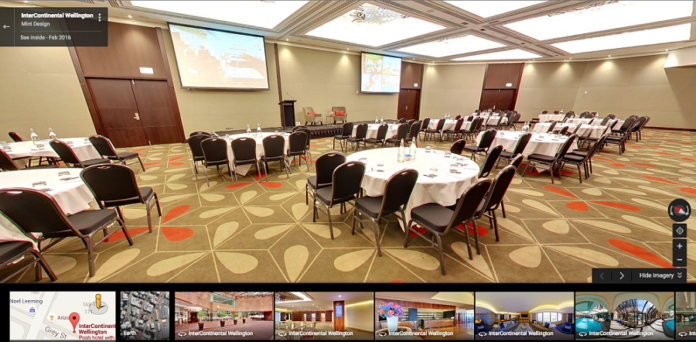
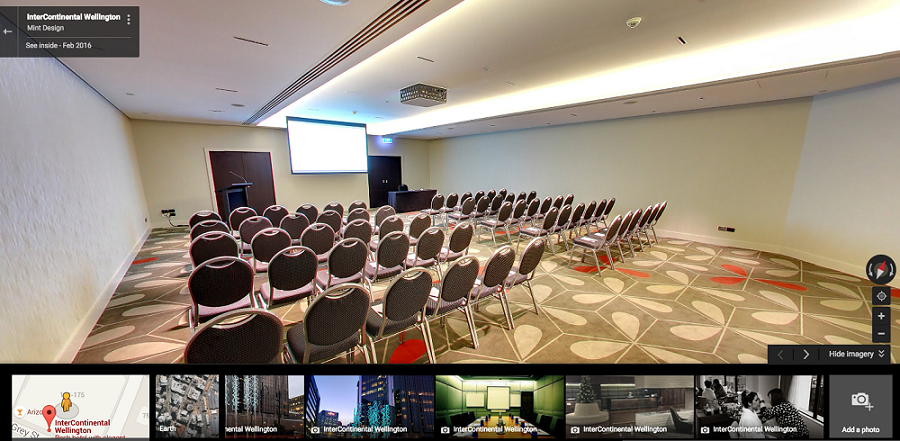
intercon-wellscreen_shot_2016-05-11_at_6_14_14_pmintercon-well-screen_shot_2016-05-11_at_6_16_16_pm

EVENT planners can now go on a site inspection of the InterContinental Wellington conference floor without taking a single step, thanks to a new Google Maps feature.

Instead of seeing static pictures, clients can now take a 360-degree view of the hotel’s six function rooms and pre-function lounge.

The hotel’s business development manager, Julien Albrecht, said that while the ability to show a 360-degree view is not new technology, using it as a room-space sales tool that can stand in for physically visiting a property appears to be relatively new for the MICE market.

Albrecht added: “Time constraints and geographical distance means a lot of decisions have to be made by the event planner remotely, with the client unable to visit a space before the day of the event. Rather than seeing static pictures, taking a virtual tour around the floor can give the client the reassurance that this (the function space) is the right fit for them.”

[PERSPECTIVES] Lowest Available Hotel Rates: A Friend or Foe?

0

OWING to increased Internet penetration and the booming sharing economy, which has an impact on the lodging sector, the online travel market in Asia-Pacific has grown in recent years. Technology has made the travel search and booking process easier, spurring travellers to manage their travels on-the-go at the very last minute.

Arguably, the chief benefit of online travel agents (OTAs) – both generalists like Booking.com and Expedia, as well as specialists like Hostelword – is the convenience of choice that they bring to the table. Travellers are easily able to compare hotel rates and then select the lodging that best suit their preferences.

For corporates, this transparency and access to knowledge presents the opportunity to benchmark their negotiated rates. Other value propositions include boosting demand during periods of low hotel occupancy, and connecting hotels to travellers that did not initially have them in mind.

While OTAs can bring benefits, there are also several challenges in terms of value and flexibility. The cost of OTA commission for hotels has had significant impact on the cost of sale for hotels in this distribution channel; which – if the hotel is heavily reliant on OTA business – can influence rate levels. This means that buyers are not getting the best value for their money, and hotel guests are paying more for their room regardless of whether they use the online platform or not. It is no wonder that hotels like Hilton Worldwide and Marriott International are educating consumers on the benefits of booking direct, via global campaigns and awareness of loyalty benefits.

At the most fundamental level, a hotel’s objective is to fill its rooms with guests through a booking channel that does not significantly reduce its margins. But how does this go hand-in-hand with the priorities of corporates, which includes ensuring that hotels are of appropriate quality, are available at the lowest possible price and can be booked through the preferred channels?

At HRS, our contention is that the challenge lies not in finding the lowest hotel rate, but finding the best accommodation option, at the lowest acceptable price taking into account all the key criteria within any corporate travel policy.

Demand-based pricing by its nature is dynamic, and ever-changing, and it means that price does not necessarily equate to quality. It does not always follow that a better quality hotel costs more, and conversely, that the lowest-cost hotels are of lower quality. Additionally, the lowest rate may not be the most cost-effective rate, as negotiated rates often include corporate-specific criteria, such as airport or local transportation, breakfast, Internet, parking and other amenities.

Another key consideration is the flexibility in booking conditions required by the corporate. Generally speaking, the buying power and procurement expertise of larger corporates will demand the flexibility of Last Room Availability (LRA) to ensure access to availability when needed. This essentially means that corporates (or anyone) with an LRA clause has a right to buy any room at their contracted terms and prices – even if the hotel has only one matching room to sell.

In my opinion, a clear definition of LRA clauses must be agreed upon because it could include a higher category of room type, such as a suite – for which a premium is typically charged given that it displaces higher-paying businesses. To extract the best value, however, buyers can consider negotiating for LRA at no additional charge.

For corporate travellers, finding the lowest rate on a one-off basis, too does not leverage on the volume generated by their colleagues and the negotiation power that their companies possess. Having established earlier that OTAs have fuelled misunderstanding of rate mechanisms, corporate travellers should not be wasting their time in search of online ‘bargains’ and making bookings outside the corporate travel policy.

Turn your knowledge into savings.
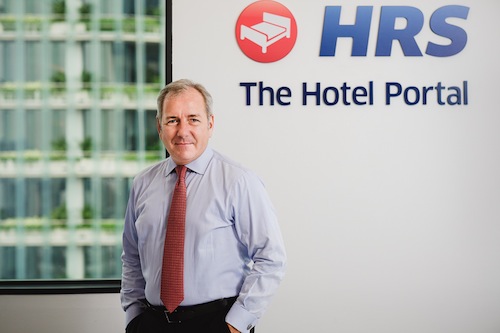
todd_arthur_13
Todd Arthur is the managing director, Asia-Pacific of Hotel Reservation Service (HRS). HRS is a global hotel solutions provider and serves more than 40,000 corporate customers worldwide through its inventory of more than 300,000 hotels in 190 countries.
Arthur’s core responsibilities include setting the business direction, driving organic growth with new and existing customers across Asia-Pacific markets, establishing strategic partnerships and talent development.

Article by Todd Arthur

Pullman Bangkok Hotel G reels Singapore groups in with special meeting deal

0

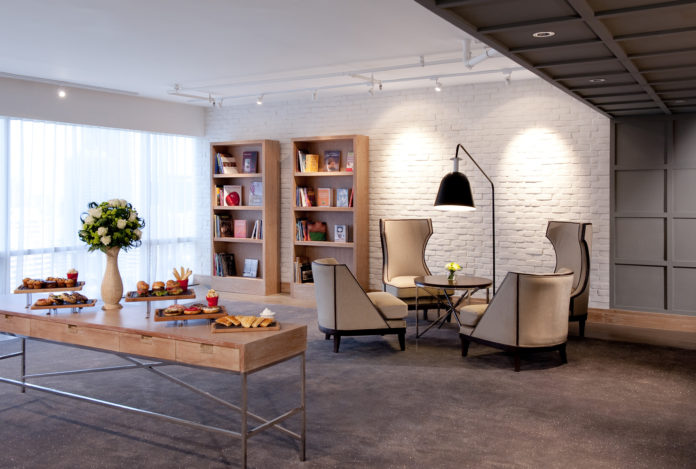
the-library-foyer
The foyer of The Library, a collection of four meeting rooms designed to resemble an architect’s studio

A FULL-DAY and half-day meeting package, priced at S$50 (US$37) and S$40 per person respectively, are being offered to Singapore groups hosting their gatherings at the Pullman Bangkok Hotel G in Thailand.

The hotel, which had unveiled a slew of updated event spaces late last year, is throwing in various complimentary perks such as one room upgrade to an Executive Room with Executive Lounge benefits for every 20 confirmed rooms per night, accommodation for the organiser during the event, group photo service, Wi-Fi access in the meeting room, and 10 per cent discount on hotel limousine service with a choice of BMW or Toyota Camry.

Meeting groups can also enjoy the hotel’s newly renovated G Deluxe Room at approximately S$160 per room night (non-commissionable), which comes with two free soft drinks from the mini bar each day and a welcome drink at Playground Bubble and Mixology Bar.

The offer is valid for bookings and stays made by September 30, 2016.

Other terms apply.

Call (662) 238-1991 for more information.

Sabre touts ability to find lowest fares globally

0

flight-search

ACCORDING to Sabre, its air shopping platform returned the lowest fares globally when compared to other leading GDSs.

The finding was the result of research by Fried & Partner, a German marketing and management consulting company, in partnership with Sabre.

Results of the Low Fare Study showed that Sabre found the lowest fare 12 per cent more often than Amadeus and 9 per cent more often than Travelport.

This also led to substantial discounts, with Sabre fares saving travel buyers on average US$20.50 and US$11.40 compared to Amadeus and Travelport respectively.

Explaining why this was an important finding, Sean Menke, president, Sabre Travel Network, said: “Travellers want to know that no matter which airline, itinerary and services they choose, they are getting a good value for their money and the experience that is right for them.”

He added: “For travel agents especially, the ability to consistently find the lowest fare is foundational to improving their service quality and generating savings for the traveller at the same time.”

When contacted for comment, an Amadeus spokesperson said: “This study was commissioned by Sabre and does not reflect a neutral or objective view of Amadeus’ search results.

“We believe that search requires an understanding of the business practises of online travel players and airlines, and most importantly that search is about content. In comparison to other GDSs, Amadeus has more airlines with content agreements.”

Travelport similarly finds flaws in the study, noting that it was funded by Sabre, thus skewing results in their favour. “For example, the study compares fares in certain key markets such as the US, based on a Travelport pricing engine which is not even used there,” said a Travelport spokesperson.

“The data produced by Sabre’s marketing study is not in line with our data, or the feedback we receive from our customers who also monitor their performance very closely.”

More consolidation expected in China’s package tour market

0

chinese-travellers

Chinese travellers pose for a photo in Brussels, Belgium

CHINA’s packaged tours industry will continue to consolidate, according to a study by Morgan Stanley Research, recognising the massive growth potential for vertical integrators in the highly-fragmented market.

The report showed that the packaged tours industry is seeing strong demand in the outbound segment, owing to language barriers, visa requirements and other complications in planning trips outside of China.

The industry saw a total transaction value of 500 billion yuan (US$76.7 billion) in 2015, up 19 per cent year-on-year, with the number projected to grow to about 700 billion yuan by end-2018.

OTAs are expected to be a chief beneficiary of this trend as online penetration for packaged tours are estimated to have only reached 13 per cent, compared to more than 50 per cent for air ticketing and about 20 per cent for hotel bookings.

The report cites leading Chinese OTA Ctrip as an example, which has been integrating the value chain since 2006 by investing in an airline, hotels, wholesalers and an offline retailer.

“Eventually 
we could expect a few vertically integrated travel 
companies to control a significant share of the
 mass market, and we expect upside in margins and
 market share, similar to what TUI and Thomas Cook 
have experienced historically,” stated the study’s authors.

Even smaller OTAs such as Utour, which accounts for less than two per cent of
 the market with a total revenue of
 8.4 billion yuan in 2015, could see its revenue increase by 60 per cent with just a one per cent expansion in the market.

It further added that the highly-fragmented online packaged tours market makes the segment ripe for consolidation.

The offline packaged tours market is even more fragmented, stated the report, with travel services revenue of China’s leading traditional travel agencies – CITS, CYTS and CTS – accounting for a combined market share of only 4.4 per cent in 2014.

This provides even greater opportunity for OTAs to integrate the value chain by acquiring its offline counterparts.

While both OTAs and offline travel agencies are trying to expand into each other’s areas, mainly by buying shares or via strategic collaboration, the stronger position held by OTAs, such as Ctrip’s more than 70 per cent market share, makes it difficult for traditional agencies to find an alternative collaboration partner.

Philippine visitors to Guam surge after LCC enters market

0
Cebu Pacific Airlines' service between Manila and Guam begins with an inaugural flight at the A.B. Won Pat International Airport on March 15.

Cebu Pacific Airlines' service between Manila and Guam begins with an inaugural flight at the A.B. Won Pat International Airport on March 15.

Guests aboard CEB’s maiden flight to Guam being welcomed at the airport

This was the second busiest March in Guam’s tourism history, with 133,335 visitor arrivals, just behind March 2013 when 136,728 visitors were recorded.

“By making air travel more affordable, we help boost tourism into the destinations we fly to,” commented Alex Reyes, general manager long haul division at CEB.

CEB’s service operates every Tuesday, Thursday, Saturday, and Sunday, utilising the airline’s Airbus A320 fleet. The non-stop service departs Manila at 04.15, arriving in Guam at 10.05, with the return flight departing from Guam at 12.20, arriving in Manila at 14.05.

One-way, all-in fares on the route start from 7,212 pesos (US$153.9).

MATTA president refutes claims Kuala Lumpur is unsafe

0

hj_hamzah_rahmat

Hj Hamzah Rahmat

THE Malaysian Association of Tour and Travel Agents (MATTA) president Hj Hamzah Rahmat has refuted suggestions that crime and a conservative image are hurting Malaysian tourism, according to a MATTA statement released yesterday.

The points were levied by Bert van Walbeek, a speaker at the Global Tourism Cities Conference 2016 organised by the Kuala Lumpur Tourism Association.

Hamzah said: “The Bangkok-based expatriate is experienced in the hotel and MICE business but was quoting from a website which sourced an article from another website ranking the most dangerous cities in Asia based on input by visitors to the website and software to crunch numbers. It was not produced from official statistics or comprehensive studies.”

Walbeek, who is managing director of consultancy The Winning Edge, was reported to have said: “I don’t see you, as tourism destinations, answer that perception and try to change that perception. Most of you have not even noticed these websites.”

Hamzah insists that “isolated cases of a few tourists falling victims to crime does not make a city among the most dangerous in Asia”.

He said that safety is “relative to the measures taken by individuals as no place on earth can be totally safe”.

“In any city, (being) dressed to the hilt and standing by the roadside for a long time will run the risk of being mugged or rolled over by a passing vehicle,” added Hamzah.

Regarding Malaysia’s perceived conservative image, he pointed out that a licence is not required to sell beer in Malaysia, and is readily available at sundry and coffee shops.

“Those fancying swanky establishments can head to TREC Lifestyle and Entertainment Hub at Jalan Tun Razak in Kuala Lumpur, which is a designated entertainment zone boasting 77 units of lifestyle and food and beverage outlets, including the largest club in Asia, Zouk,” said Hamzah.

He concludes: “The fact is Kuala Lumpur is one of the most popular and safest cities. Thanks to common knowledge and word-of-mouth, 12 million foreign visitors are expected to visit the city this year.

“The last thing we need is to adopt a siege mentality and go on a defensive to counter perceived threats. Such self-fulfilling prophecies would pose a greater danger.”

Marwood deal faces legal dispute from hotel owners

0

westin-nyc-times-square

The Westin New York at Times Square

THE ink has barely dried on the shareholder approval agreement for Marriott International to acquire Starwood Hotels & Resorts Worldwide and already a wrench has been thrown into the works.

According to a Bloomberg report, the acquisition is facing legal challenges from Cityfront Hotel Associates Limited Partners and Dream Team Hotel Associates LLC, the owners of Sheraton Grand Chicago and The Westin New York at Times Square respectively.

They are arguing that the merger would violate exclusivity agreements and unfairly eat into their businesses.

The plaintiffs are thus calling for an injunction on the deal with the civil suit currently being handled by the New York State Supreme Court.

Marriott and Starwood had just last month been given the green light by their respective shareholders to go ahead with the merger, an important development that ended anintense bidding war sparked by the involvement of a third conglomerate led by China’s Anbang Insurance Group.

The Marriott-Starwood deal was last expected to close by mid-2016, according to a joint statement by the two companies in April.

Lion Air gets slapped with suspension of new route permits

0

lion-air-1

INDONESIA will stop issuing new route licences to Lion Air, a sanction imposed on the airline for its numerous flight delays.

“We have warned (the airline) and will not issue (permits for) new routes in the next six months, (as of May 11),” said Suprasetyo, director general of air transportation at Indonesia’s Ministry of Transportation.

Thousands of passengers were stranded at various airports last Tuesday as some 300 Lion Air pilots went on strike in Jakarta, demanding payment for delayed transportation allowances.

While the cause of the strike was an internal issue between the pilots and the company’s management, the licensing suspension was a result of the airline’s poor management of the situation, added Suprasetyo.

Edward Sirait, general affairs director for Lion Air, said in a statement that the company had since managed to overcome administrative problems faced by a number of crew members and operations are now back to normal.

He added however, that more flight delays should be expected in the coming days and that the management is still working on reducing those delays.

Still, ticket sales continue to be healthy despite the airline’s repeated failure to operate according to schedule.

Edwin Ismadi Himna, chairman, Association of the Indonesian Tours and Travel Agencies Jogjakarta Chapter, said: “Travellers keep getting angry with the airline when things go wrong, but they will still fly (with them). This is because the airline has extensive routes and frequencies around the country, some (exclusively by them). The airline is also known for its cheap fares.

“This, however, does not give the airline the right to take customers for granted and it is up to the government to impose rules and regulations to assure that service standards are being met.”

Calling for sterner sanctions, Pauline Suharno, deputy secretary general of the Association of the Air Ticketing Companies in Indonesia, said: “Instead of halting new route permits, the government should force the airline to improve its operational performance by cutting existing routes and frequencies.

“The airline has too many routes and frequencies, too much for the company to manage.”