TTG Asia
Asia/Singapore Wednesday, 8th April 2026
Page 1560

M’sian trade upbeat over SME, medical tourism allotment in Budget

0
Funds set aside for infrastructure development, SME loans, medical tourism promotion give trade many reasons to cheer

Malaysian prime minister Mohd Najib Abdul Razak last Friday presented the national budget for 2018, unveiling a RM2 billion (US$471.5 million) component for the SME Tourism Fund, which provides soft loans to eligible tour operators with an interest subsidy of two per cent, among other tourism sector allocations.

Apart from the SME Tourism Fund, RM500 million has been set aside for the development and promotion of tourism through infrastructure upgrades, as well as marketing for homestay and eco-tourism programmes.
Funds set aside for infrastructure development, SME loans, medical tourism promotion give trade many reasons to cheer

Other highlights include expanding eVisa regional hub by facilitating visa application worldwide, especially for expatriates, foreign students and the Malaysia My Second Home programme; and allocating RM250 million to the Eastern Sabah Security Command (ESSCOM) to enhance security controls at Sabah and Sarawak borders, including RM50 million for coastal surveillance radar.

Notably, the government has also allocated RM30 million to the Malaysian Healthcare Travel Council. Among other purposes, funds will go towards promoting Malaysia as the Asian Hub for Fertility Treatment and introducing the Flagship Medical Tourism Hospital programme, which offers special incentives for private hospitals to attract medical tourists.

Malaysia Healthcare Travel Council (MHTC), CEO, Sherene Azli, commented: “We welcome the allocation and are excited with the budget announcement to spur further growth of the medical tourism industry. Since 2011, the industry has shown tremendous potential recording a double-digit annual growth, ranging between 16-17 per cent every year. In 2016, the healthcare travel industry grew by 23 per cent from 2015, compared to the average growth rate of 15 per cent from 2011-2015.”

Malaysian Association of Tour and Travel Agents’ (MATTA) president, KL Tan, said the tourism allocations answer MATTA’s calls for continued incentives for inbound and domestic tour operators to help new and small players, many of which are Bumiputera companies.

“MATTA had proposed for funding for capacity building in the travel sector and RM2 billion was allocated to SMEs for training programmes, grants and soft loans under SME Corporation Malaysia. (Also), the allocation for infrastructure development will strengthen rural tourism and homestay, including eco-tourism facilities like jetties, toilets and signages.”

He further expressed optimism that the expansion of the eVisa regional hub, Malaysia “is certain to attract more visitors from countries with access to this facility”, and that airport expansion would bring greater comfort and convenience to travellers.

“As safety and security are paramount, allocating RM250 million to ESSCOM is essential for the safety and security of tourism and economic activities in the East Coast of Sabah, which is currently experiencing an influx of China tourists, especially to Semporna,” he added.
Fiji Airways rolls out off-airport check-in at Denarau resort

0
http://www.accorhotels.com/5706

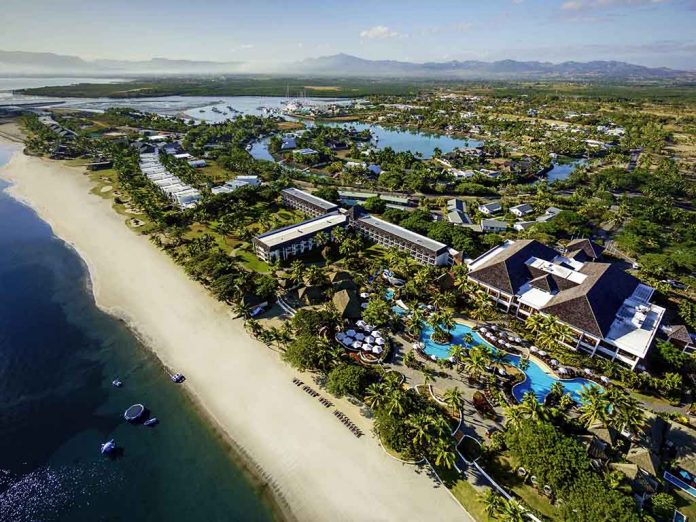
Fiji Airways is introducing a flight check-in feature at the Sofitel Fiji Resort and Spa on Denarau Island, believed to be a first for the Pacific.

Speaking at the official launch yesterday morning, Fiji Airways’ managing director and CEO, Andre Viljoen shared: “We’ve designed this experience so guests simply get to the resort lobby and check themselves and their bags in for their Fiji Airways flights. We issue the boarding passes, tag and take bags off guests, leaving them free to enjoy Fiji for a few more hours.”

Guests can complete check-in at the resort, including for baggage; photo credit: AccorHotels

All bags are transferred to Nadi International Airports and loaded onto guests’ respective flights.

Viljoen said this frees guests up for meals, recreation, and shopping before making their way to the airport. At the airport, guests can then bypass the check-in process and head straight to security.

Fiji Airways had earlier piloted the resort check-in feature and received “overwhelmingly positive response” from guests during the trial phase, according to a statement from the airline. The feature was also activated during the Fiji International Golf tournament at Natadola and the Pre-COP 23 convention at the Sheraton Fiji Resort earlier in October.

The airline anticipates that more resorts in Fiji would get on board to offer the complimentary service to guests.

[Sponsored Post] Leading Companies Better At Collaborating To Reach Their Simplification Goals

0

With new technology proliferating and business traveller needs and expectations evolving, travel managers are struggling to manage complex, multi-layered travel programmes. According to new research from the Association of Corporate Travel Executives (ACTE), underwritten by HRS, travel managers recognize this challenge and understand that simplifying their programmes could yield benefits—but simplification initiatives face competing priorities.

The new study, Simplifying Managed Travel, finds that traveller safety trumps the agenda: Most buyers (94 per cent) say duty of care is a key priority; 82 per cent say it is their top priority. With 72 per cent rating it a key priority for their managed travel program, simplification follows behind cost reduction (88 per cent), data security (84 per cent) and improving traveller satisfaction (75 per cent).

However, travel managers recognize that simplification initiatives can support their other strategic priorities. For example, 47 per cent of travel managers say that simplification will improve duty of care, and 39 per cent believe it will reduce the overall cost of their travel policy.

Travel Managers Struggle to Translate Priority into Action

Despite recognizing the importance of simplification, travel managers see a gap between intention and execution. Reflecting the strategic importance placed on traveller safety, duty of care is the travel buyer’s top priority for simplification: A majority (83 per cent) say duty of care requires immediate action (62 per cent).  Data security appears second on buyers’ list of simplification targets.

Disconnects between buyers’ simplification priorities and their actual behaviour, however, indicate barriers to pursuing strategic goals. The execution gaps for duty of care and data security are large relative to other priorities, with more than one-in-five buyers saying they are not currently translating their traveller safety (23 per cent) and data security (24 per cent) concerns into action.

Suppliers and Internal Stakeholders Must Become Partners in Simplification

Today’s complex travel programmes encompass multiple partners and stakeholders—internally and externally. To be effective, simplification initiatives often require support from these parties. While nearly one-in-five buyers do not get support from peers in other departments, most report that internal stakeholders are on board with simplification initiatives:

  • Procurement is most often regarded as a partner in simplification (57 per cent);
  • Internal risk/security and communications staff follow (40 per cent);
  • IT support (36 per cent) and human resources (28 per cent) lag other departments.

Third parties can supply relevant tools and expertise, providing support to travel buyers’ simplification initiatives. Buyers welcome this assistance: More than half of buyers not currently receiving help from travel providers say they want it. Internally and externally, the data suggests that the travel buyers who say simplification is a top strategic priority are better at collaborating to reach their simplification goals.

“The value travel management provides to a company is increasingly measured in optimised processes and cross-department collaboration,” explained HRS CEO Tobias Ragge. “The study shows this close collaboration is vital and that leading companies build on their internal stakeholder network, but they also rely on the data, advice and support of external partners to reach their strategic goals.”

Driving Effective Simplification

Simplification is a key route for travel managers to achieve their business objectives. However, facing the hurdles of limited resources and differing levels of support from internal and external stakeholders, buyers must ramp up communication with suppliers, other departments within the organization and with the travellers themselves.

The study can be downloaded https://corporate.hrs.com/int/simplify.

Blacklane makes inroads in airport transfers

0
From inside a Blacklane vehicle, Wohltorf shared updates on the company’s latest acquisition, headway made in airport services, democratising the chauffeur-driven experience and constructive disruption

Blacklane’s recent acquisition of US-based Solve, which offers VIP concierge services, will strengthen its foothold in the market, where it already has the potential to displace one of the major income streams of inbound tour operators – airport transfers.

Solve is an 18-month firm that offers services such as curbside and airside passenger meet-and-greet, fast-track security, expedited customs and immigration, and lounge access, which ties in neatly with Blacklane’s business model of offering high-quality rides at fair, fixed and all-inclusive rates bookable on its website, mobile app or via distribution and channel partners, in real-time with instant confirmation.

Blacklane’s co-founder & CEO Jens Wohltorf told TTG Asia at the recent ITB Asia 2017 that he is rebuilding Solve and relaunching it by year-end using the same principles that have driven Blacklane to be a trusted brand with a smart booking technology and global scalability.

From inside a Blacklane vehicle, Wohltorf shared updates on the company’s latest acquisition, headway made in airport services, democratising the chauffeur-driven experience and constructive disruption

Blacklane is able to offer, say, an airport transfer at prices which are a third of those charged by legacy operators because it has been able to consolidate fragmented local service providers and retrain them to offer professional chauffeur-driven service.

The company now operates in more than 50 countries, 250 cities and 500 airports. In Asia-Pacific, business has expanded rapidly under the charge of regional director Lo Li-Wen based in Singapore. In 1.5 years, Blacklane has increased its footprint in the region from 20 to 80 cities.

From December 1, travellers will be able to book Blacklane’s airport services, with or without airport transfers. Just as Blacklane has made professional chauffeur-driven service accessible and affordable to more travellers, Wohltorf said the new service would no longer be the reserve of the famous and beautiful.

He believes in “constructive” disruption, pointing out that what Blacklane has done is to put existing infrastructure to better use – for example aggregating mom-and-pop players onto the Blacklane platform, resolving their biggest issue that only 20 per cent of their vehicles are utilised.

“With low utilisation, they have to charge high prices in order to survive. But with 70 or 80 per cent utilisation, they are able to charge lower prices,” he said.

He admitted however airport transfers, long been a high profit margin and revenue centre for inbound tour operators, may be a thing of the past for them. But he said tour operators should work with Blacklane and focus on their core area of providing personalised itineraries and service delivery to clients.

Even legacies like Hertz are working with Blacklane. Since March this year, Hertz Europe has been providing Hertz Driver Services powered by Blacklane, where Hertz customers in Belgium, Czech Republic, France, Germany, Italy,

Luxembourg, Netherlands, Spain and the UK can book airport transfers, limousines and chauffeur services through Hertz website or customer service telephone number.

As the old saying goes, if you can’t beat them, join them.

– Full report, View From the Top, TTG Asia March 2018

Hilton picks Kuala Lumpur for Canopy’s SEA debut

0

South-east Asia will get its first Canopy by Hilton property when Canopy by Hilton Kuala Lumpur, Bukit Bintang opens in 4Q2021.

Set along Pudu Road within the Bukit Bintang neighbourhood, the 456-key hotel will feature complimentary Wi-Fi, Canopy Central café and bar, a fitness centre, as well as a rooftop swimming pool and F&B outlet on the 28th floor.

The hotel will form part of Bukit Bintang City Centre, a mixed-use development that includes office towers, residential apartments, a lifestyle shopping mall, a modern Malaysian heritage-inspired bazaar, an entertainment hub as well as a transit hub.

The science of keeping children happy on flights

0
Nope, the "electronic babysitter" is not enough to keep children occupied, the Child Boredom Quotient suggests

Young flyers take just 49 minutes and 47 seconds to ask the dreaded, ‘’are we there yet?’’, according to Emirates. With parents battling the boredom threshold, the airline teamed up with Sandi Mann, a psychologist and boredom specialist at the University of Central Lancashire, to develop the Child Boredom Quotient to help parents plan activities to catch boredom before it sets in.

The study also revealed that 64 per cent of parents worry about entertaining their children while 43 per cent expressed concerns about their children disturbing other passengers.

Nope, the “electronic babysitter” is not enough to keep children occupied, the Child Boredom Quotient suggests

Bribery techniques such as giving out snacks (41 per cent) in exchange for good behaviour were often used to keep the peace. Other methods of distraction include employing electronic devices (33 per cent) even if they are not allowed at home, handing out new toys (27 per cent) or trying to tire out their children by running around the airport before boarding (16 per cent).

However, the quotient suggests that keeping children entertained is a way more precise science. Mann said: “Parents of children aged three to four will start to find that this is when their children are physically very active, gaining independence and when they need more sophisticated things to entertain them than they did when they were younger.

“For instance, the ‘electronic babysitter’ while popular for a flight may not work for all age groups and parents of younger children will find that they have less attention span for this than older ones. Breaking up this passive activity for active or creative ones will stop children becoming bored, restless and disruptive.’’

When engaging in an activity on board, films are the most popular for keeping children occupied from around 40 minutes for the youngest age group (0-2) to 1 hour 45 minutes for the oldest (11-12). This is followed by games either on a smart device or on the inflight entertainment system (keeping kids occupied from 30 minutes for the youngest to 1.5 hours for the oldest).

Sleep is the next most time consuming activity after electronic activity. Surprisingly, there is very little difference across the ages with parents reckoning that all children from 0-12 sleep for around 80 minutes on a plane.

Meanwhile, creative pursuits such as drawing was the most popular until age nine when quizzes and puzzles become more engaging. Colouring and sticker books have most appeal to the younger ones.

Amount of time (in minutes) children can be occupied by an activity before getting bored; credit: Emirates and Sandi Mann
The expert’s recommended way to divide flying time by activity

Surf’s up in Sri Lanka with new Cantaloupe Hotels tie-up

0
Cantaloupe Levels

Cantaloupe Hotels Group has teamed up with The Perfect Wave, said to be the world’s largest surf travel network, to offer a series of Sri Lankan surfing packages.

The hotel group is also in the process of creating a new Surf School at “Lazy Left” in Midigama, the spiritual home of Sri Lankan surfing on the island’s south coast. This will also be the location of Cantaloupe’s new seafront hotel, Cantaloupe Veralu Verala, which is expected to open in 2018 and be the only upscale hotel in Sri Lanka focused primarily on the surfing market.

Cantaloupe Levels (pictured) and Cantaloupe Aqua in Galle will offer surf packages for the coming winter surfing season

As an island nation with beaches lapped by the waves of the Indian Ocean, Sri Lanka has the natural attributes needed to become a surfing hotspot, the hotel group said in a statement, but this potential has been largely untapped.

The group expects its partnership with Perfect Wave and the surf packages to help boost visitor arrivals from key markets such as Australia, while positioning Sri Lanka as an attractive alternative to traditional surfing destinations such as Bali.

Cantaloupe Hotels Group will offer Surf Experience packages at its two hotels in Galle for the 2017-18 winter surfing season, which runs until April 2018. Guests can enjoy 5D4N or 8D7N packages at Cantaloupe Levels and Cantaloupe Aqua, including sea-facing accommodation, lessons for inexperienced surfers or professional guide services for those seeking the best breaks, shuttle services to Sri Lanka’s top surf spots, airport transfers and free Wi-Fi.

Prices start from US$950 nett (based on double occupancy) for the 5D4N package at Cantaloupe Aqua or US$1,200 nett for the same duration at Cantaloupe Levels. The 8D7N packages start from US$1,500 nett at Cantaloupe Aqua or US$1,950 nett at Cantaloupe Levels.

Bintan Lagoon Resort has a new GM

0

Gerald Hendrick has been appointed senior vice president of Resort Venture and general manager of Bintan Lagoon Resort.

As senior vice president and general manager, Hendrick is responsible for the administration and operations of Bintan Lagoon Resort, which has a staff strength of 500, the resort’s ferry operations and the Singapore corporate office.

Previously vice-president – business development & hotel operations, Hendrick has been with the resort since September 2014. A Malaysian national and seasoned hotelier, Hendrick brings with him 25 years of experience in the hospitality industry.

He has worked with various hospitality management organisations within Asia and the Middle East, such as Hilton International, Shangri-La Hotels & Resorts, Raffles International, Mandarin Oriental Hotel Group, Pan Pacific, Madinat Jumeirah and St Regis Hotel Singapore.

Meet Frozen Lime Asia, a young hospitality services outsourcee

0
Team Frozen Lime Asia (from left): Pow Zhi Hoe, Aileene Thangaveloo, Serene Lam, Jagdish Sandhu, Adelina Pillai, Kenji Chen

Singapore-based Frozen Lime Asia is touting its one-stop, outsourced services that synergise revenue, distribution and sales & marketing functions for Asia’s tourism and hospitality clients.

Formed in October 2016, the company now works with clients to evaluate market demand and optimise revenues, build awareness, generate demand with marketing campaigns and communications and drive sales, as well as help ensure clients are getting the right mix to achieve business goals.

Team Frozen Lime Asia (from left) Pow Zhi Hoe, Aileene Thangaveloo, Serene Lam, Jagdish Sandhu, Adelina Pillai, Kenji Chen

Jagdish Sandhu, CEO and co-founder, said: “I believe we are one of the first independent companies in Asia to offer such a service to hospitality clients where they can totally outsource these functions to us, without having to maintain a large internal team.”

In the dynamic travel industry landscape of today, Jagdish said Frozen Lime Asia’s value proposition is in industry and functional leads who stay on top of trends across all channels. In addition, their experience in large and mid-size brands means they are equipped with knowledge of best practices and processes covering hotels, resorts, golf, food & beverage, pre-opening and launches.

Malaysia’s north to soar on Qatar’s wings

0
Kurz expects interest from UK senior market looking to visit Penang

Qatar Airways’ new thrice-weekly flights between Doha and Penang, commencing February 6, 2018, are spurring hopes among Malaysian inbound agents of stronger European traffic to the northern region of the country.

The new service will be the first longhaul flight to Penang, an island destination that gets mostly air connections with regional destinations in South-east Asia and North Asia.

Kurz expects interest from UK senior market looking to visit Penang

Diethelm Travel Malaysia’s managing director, Manfred Kurz, believes that the new flights are “perfect” for promoting the northern region of Malaysia, where Penang is, to the Europeans. Popular destinations in the north include Langkawi, Kedah, and the Belum Temenggor Forest Reserve in Perak state.

Speaking to TTG Asia at the recent ITB Asia 2017, Kur said: “I foresee the UK senior market will be interested in these flights due to the country’s historical links with Penang.”

As the “Germans like to move around more and tend to end their holiday with a beach stay”, Kurz predicts that an open jaw arrangement would appeal to the travellers, where they start off in Kuala Lumpur before proceeding overland to Perak (state) and onward to Penang, and leaving for Doha on the new Qatar Airways flight.

The new flights are a boon to Malaysia’s business events specialists too, opined Yap Sook Ling, managing director, Asian Overland Services Tours & Travel.

She told TTG Asia that the flights will “provide an opportunity to promote Penang for business events and to attract more international conferences”.

Arokia Das, senior manager at Luxury Tours Malaysia, agreed: “Penang is relatively new to the business events scene. Corporates and associations intending to have their event in South-east Asia will see Penang as a fresh option (due to the improved access).”

And because “Qatar Airways has a solid reputation and airfares are reasonable”, Arokia thinks it will be easier now to sell Penang to the European market.

He added: “For the leisure segment, we are looking at selling just Penang or combining Penang with East Malaysia, which has rich eco-tourism and cultural offerings.”
Longhaul buyers at ITB Asia 2017 are equally upbeat about the new air link.

Jesko Krengel, senior product manager, Indonesia, Malaysia, Singapore at TUI Deutschland based in Hannover, said: “Our (best selling) tours combine Singapore and Langkawi. The new flights to Penang will provide us with options in creating new itineraries for the northern region of Malaysia. Qatar Airways is known for its good service and affordability, so promoting the airlines and the new route will not be too hard.”

A new buyer to ITB Asia, Joe Calstas, director general, board member at the Institute of Journalism and Communication based in Geneva, Switzerland, said: “We are considering holding seminars related to journalism in Penang, and improved longhaul connectivity will certainly help.

“We will be meeting with the Penang Convention & Exhibition Bureau at ITB Asia to know more about the offerings in the state.”

Calstas shared that most of those attending his association’s events in Asia are Europeans.
But when asked if the new flights would boost Malaysia’s Middle Eastern footfalls, Ally Bhoonee, executive director at World Avenues, said he didn’t think so.

“Most Middle Eastern visitors to Malaysia are from Saudi Arabia, and in the past, many from Saudi Arabia used Qatar Airways. With the ongoing sanctions (placed on Qatar by Saudi Arabia), the new flights will only benefit Qataris and the expatriates living in Qatar,” he explained.