TTG Asia
Asia/Singapore Thursday, 25th December 2025
Page 1487

China overtakes US as Philippines’ second largest arrivals source

0
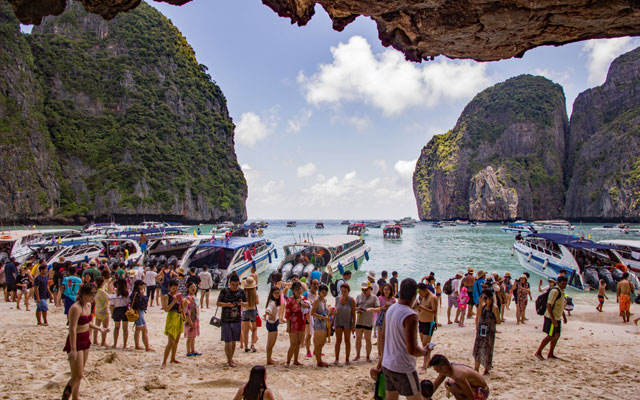
Tourists going on the Underground River boat tour in Palawan, Philippines

China has overtaken US as second top feeder for the Philippines with 810,807 arrivals, comprising a 14.8 per cent market share.

South Korea remains the country’s top visitor market with 1.3 million arrivals, representing 24.3 per cent of the total arrivals, while the US is in third place with 785,269 (14.3 per cent) arrivals, Japan with 490,857 (nine per cent), and Australia with 206,443 (3.8 per cent).

Tourists going on the Underground River boat tour in Palawan, Philippines

Data released by the Department of Tourism (DoT) indicate there were a total of 5.5 million international arrivals for from January to October this year, an increase of 11.5 per cent when compared to the same period last year.

Compared to last year’s figures for the same period, Chinese arrivals jumped 39.3 per cent, while India visitors rose 20.3 per cent.

Total international visitor arrivals to the Philippines are on track to reach at least 6.5 million this year, the target set by the National Tourism Development Plan for 2017-2022.

In terms of revenue, visitor receipts recorded a double-digit gain of 36.3 per cent to 243.23 billion pesos (US$4.8 billion) for the period of January to September, a significant rise from the 178 billion pesos for the same period in 2016.

DoT secretary Wanda Corazon Tulfo-Teo said: “The department will continue an aggressive marketing efforts, including through social media. We will promote emerging or developing destinations to entice more visitors from across the globe.”

As well, the DoT has launched the It’s More Fun in the Philippine Farms campaign, and revived the Bring Home A Friend programme as part of its strategy to hit 12 million tourists by 2022.

Epicurean cruise line Oceania Cruises releases 2018 Asian itineraries

0
Nautica

Oceania Cruises, the cruise line dedicated to epicurean enthusiasts, is offering a season of voyages – starting January – dedicated to exploring Asia’s culinary cities.

Oceania Cruises’ ships Nautica and Insignia will be calling on more than 50 ports in the region starting next month.

Nautica

Itineraries include the 15-day Pagodas and Shrines cruise aboard Nautica from Singapore to Hong Kong. Beginning January 20, destinations along the way include Koh Samui, Bangkok, Sihanoukville, Ho Chi Minh and Hanoi before ending in Hong Kong.

There is also the 15-day Eastern Escapade cruise, beginning February 4, aboard Nautica from Hong Kong to Bangkok. Guests will cruise through Ha Long Bay in Hanoi, before stopping at coastal city Nha Trang and the historic Ho Chi Minh City. Singapore and Koh Samui will be the next ports- of-call before the ship concludes its journey in Bangkok.

Meanwhile, Insignia’s cruises include a 20-day sojourn from Singapore to Beijing beginning March 15, and a 25-day journey from Tokyo to Singapore starting on March 31.

Both Nautica and Insignia field 342 suites and staterooms and are able to carry 684 guests and 400 staff. Facilities onboard include four restaurants, fitness centres, spas, lounges, bars and a casino.

Kwek Leng Beng receives award from Malaysian prime minister

0

Malaysian prime minister Najib Tun Razak presented Kwek Leng Beng, executive chairman of Hong Leong Group Singapore and chairman of Millennium & Copthorne Hotels, with the Global Blue Ocean Shift Award at the Global Entrepreneurship Community Summit held in Kuala Lumpur held on December 13.

Centred on the philosophy of global bestsellers, Blue Ocean Strategy and Blue Ocean Shift, the award was given to Kwek in recognition of his efforts in opening up new frontiers of opportunity and growth, and creating a new pipeline for economic expansion.

Najib Tun Razak (left) presenting the award to Kwek Leng Beng (right). Photo credit: Bernama

The Blue Ocean Shift ideology focuses on identifying untapped growth opportunities by moving from “red oceans” crowded with competition to “blue oceans” of uncontested market space and explosive growth.

M&C’s hotels have taken steps to implement various activities to support Kwek’s Blue Ocean vision. Activities include a monthly staff recognition programme where the most innovative idea wins S$100 (US$74). M&C’s hotels in Singapore include Grand Copthorne Waterfront, M Hotel, Orchard Hotel, Copthorne King’s and Studio M.

Time off for us to recharge

0

TTG Asia will be taking a break from December 18 after a wonderfully-hectic (read: crazy) year which has given us a bumper crop of highlights to remember, including a revamp of this online channel, two awards from the Media Publishers Association of Singapore and a slew of special projects, especially the special edition commemorating the 50th anniversary of ASEAN.

Do continue to visit our website to read us – keep discovering the new-look TTG Asia Online with many web-only articles.

We look forward to coming back stronger on January 8 and to continue bringing you the most interesting news in the travel trade.

Won’t miss you and we think you shouldn’t miss us too! Take it from us dear readers: Have a break from news, ditch the desktop and mobile, take time to ‘be present’ with family and friends, whether at home or someplace great.

From all of us at TTG Asia Media, happy holidays and here’s to a sane 2018!

Fairmont Hotel Vancouver

0

Location
‘Location, location, location‘ is what hotels swear by. In this case, however, Fairmont Hotel Vancouver defines the location, not the other way round. An imposing building with a distinct green copper castle-shape roof, the hotel brings glamour and reverence to the heart of Vancouver’s shopping and entertainment district.

Ambience
The lobby is artistic and stylish, giving a great sense of arrival. There’s a feeling of lightness, spaciousness and joy, the modern design appealing to me more than the classic interiors of grand old dames.

What’s more the renovation of the lobby, which also includes a new restaurant, Notch8, hasn’t robbed the hotel’s history. White walls are adorned with framed architectural drawings of the property, which was originally opened in May 1939 by King George VI and Queen Elizabeth.

Notch8 itself pays homage to the hotel’s role with the Canadian Pacific Rail, its decor reflecting the romance of rail travel, while its name refers to the ultimate running capacity only attained by engineers after years of experience. And that’s how the word ‘top-notch’ is derived. There is so much to learn from this hotel!

I love its idea of having canine ambassadors at the lobby to welcome guests – you should see how our faces ‘pawsitively’ lit up when lovable Ella, a two-year-old Labrador/Golden retriever mix, is around.

Rooms
My room is a Deluxe King Non Smoking room, it too newly-renovated and continues the modern, residential theme, with touches of Victorian elegance. The room is highly comfortable. But the bathroom can hardly fit two people, however I do recognise this is not unusual in old structures.

My partner is a member of Fairmont President’s Club and we arrive at this hotel from a stay at Fairmont Chateau Lake Louise. But the data isn’t captured. There’s no turndown service, a privilege accorded to members, despite my asking for it. There are no bathroom slippers and no drinking water.

Coming from Asia, it’s a bit of a cultural shift: Turndown in luxury hotels is not a privilege, it is a given. It’s also funny there’s a bucket of ice in the room, but no water, let alone champagne.

Facilities
The fitness centre is just great, with technogym machines and kinesis wall. Other facilities include an indoor pool, the Absolute Spa and 5,110m of flexible meeting space. And lovers of luxury brands, rejoice – Lobby level boutiques include Canada’s flagship Dior while Hermes is just opposite the hotel.

Service
Friendly.

Verdict
A must-visit when in Vancouver, even if it’s just for a drink or meal – for a dash of style to the trip.

No. of rooms 557
Rates From $299 CAD (US$233)
Contact details
Tel: 1 (604) 684-3131
Email: hvc.concierge@fairmont.com
Website: http://www.fairmont.com/hotel-vancouver/

What luxury buyers are watching out for in 2018

0


Amit Kalsi, founder & CEO, Experiential Travel Journeys, India

1. Describe 2017 in three words
Unpredictable, adaptive, evolving

2. How does this impact you?
The world has become unpredictable. When I say this I am referring to unexpected natural or man-made incidents, which continued to dominate the travel landscape in 2017 (natural calamities, acts of terror, political tensions, etc). This has led to a growing need of adaptive approach in our handling, planning and forecasting strategies (destinations, trips, experiences) for our discerning clients.

Such incidents are sure deterrents and can have short or longterm affects. We need to work around them or offer alternatives, and bounce back when the situation improves, and this can happen with a continuous source of reliable information on destinations we promote and sell and with help/support of our DMC and hotel partners.

The world of travel is also changing rapidly with new entrants in luxury travel, for which we need to adapt our strategies and offerings: Examples, luxury home stays, luxury villa rentals, Uber and the likes, hotel concierge revamped teams becoming effective DMCs, credit card concierges, rise of travel networks and communities, etc.

3. What’s the most outlandish piece of business you had in 2017?
Discerning clients in India are exploring the world, from established destinations to remote corners. This is very satisfying to me as a travel designer since this authenticates the fact that the Indian outbound market is maturing, tourists are becoming travellers, they are travelling deeper, they are exploring destinations and discovering experiences outside their comfort zones. They are moving away from being typecasts and willing to discover what can be achieved in complete safety, reliability and accessibility.

I have not yet come across a request which cannot be executed, or something which is outlandish enough to be mentioned.

4. What’s the biggest lesson for you about luxury travel in 2017?
The biggest lesson is that luxury travel is always evolving, always redefining itself, never settled or stagnant in its appeal or reach.

With new products, new destinations, news ways of explorations and discoveries, it’s all new every year. I have been selling luxury travel for many years, but with every client, destination, product and experience, I get a new perspective on the market. This excites me to a great extent. Authenticity, uniqueness, time and space, attention to detail, experiences, privacy, flexibility have all become synonyms to luxury travel.

5. Your assessment of business in 2018?
Business will continue to grow. But we need to keep a close watch on global and travel industry developments, and continue to alter/amend our offerings strategically. Discerning luxury clients are more sensitive to destination news and developments, as compared to mass-market package tourists.

Clients will continue to travel, but we need to feed them with inspirations, alternatives and newer experiences. Fortunately as outbound travel designers we can do this, but it’s surely a challenge for inbound operators who face deeper challenges in case their destination gets affected.

I am also very positive due to new investments, new openings in remote locations which were earlier deprived of, to name a few: Bisate Lodge, and One & Only (2018) in Rwanda; Miavana in Madagascar, Jabali Ridge in Ruaha National Park Tanzania; Wild Coast Lodge Yala in Sri Lanka, Gran Hotel Manzana Kempinski La Habana in Cuba, and a long list of new openings listed in 2017 and beyond. Such developments give us growing options to offer inspirations and revive growth to destinations.

6. What are the pros and cons of ILTM having three Asian offshoots, Japan, Asia-Pacific and China?
Moving to Singapore will offer a more Asia-wide perspective among exhibitors and I think a wider Asian buyer database. Singapore as a venue is also more neutral, accessible and have fewer hurdles (cannot survive without VPN override).

ILTM China can focus more on China (worldwide exhibitors seeking best of Chinese luxury travel buyers), since in terms of numbers, China surely surpasses all other markets including India, and hence demands a luxury show of its own.

The biggest lesson is that luxury travel is always evolving, always redefining itself, never settled or stagnant in its appeal or reach.


Eldi Lau, head of sales – travel, Quintessentially Travel Group, Hong Kong

1. Describe 2017 in three words
Transformational, celebratory, personal

2. Kindly elaborate why
TTransformational 2016 was the year of experiential travel which saw vacationers looking for ways to tap into native cultures, meaningfully interacting with locals and becoming more than ‘just a tourist’. This year, transformational travel has emerged as a key motivator, building on the idea of experiential travel but with vacationers seeking experiences that are motivated and defined by a shift in perspective, self-reflection and development, as well as a deeper connection with nature and culture.

Celebratory Whether a 60th birthday celebration in Marrakech (complete with exclusive use of Villa Des Orangers, a desert camp dinner, snake charmers and fire eaters), an eight-week trip following the sale of a business, or even reliving a honeymoon 30 years later, more clients are marking special occasions or lifetime milestones by experiencing new or much-loved destinations with family and friends.

Personal Travel has never been more personal; it empowers travellers to achieve what they want during their trip. Discerning travellers are now seeking trips that are tailored to their interests and abilities, and are venturing all over the globe to find them. What might be ordinary for one client, may be extraordinary to another, so by understanding our clients’ likes, dislikes, and how to anticipate their needs allows us to make their journeys special and unique to them.

3. What’s the most outlandish piece of business you had in 2017?
To celebrate a joint 50th birthday, one of our clients wanted to travel the world by the alphabet. Abu Dhabi, Brazil and Chile have been completed so far (at press time), and family and friends will be joining the couple in various destinations over the next 12 months.

4. What’s the biggest lesson for you about luxury travel in 2017?
Luxury is such a broad term, and means different things to different people. But across all its definitions, the moments people treasure tend to be those unexpected personal touches or rare experiences that hold emotional value. Luxury is becoming redefined, with its focus being on the creation of unforgettable memories over just property aesthetics.

5. What is your assessment of business in 2018?
Leisure travel will be motivated more by the need for rest and relaxation, spending time or reconnecting with loved ones, exploring new destinations and seeking authentic experiences.

Business and incentive travel will become more popular than ever, with more companies creating travel experiences to reward staff and loyal customers to increase their return on investment.

Geopolitical issues (threat of terrorism, Brexit, etc) will impact travel decisions.

‘Last-chance tourism’ will rise, due to those destinations that are rapidly changing or even disappearing (Cuba, the Arctic, Lanai, Venice). This sense of urgency may also encourage more conscientious travel, so sustainable tourism and eco-friendly travel choices may become more popular.

Demand for international trips will increase both in popularity and length of travel.
Upscale trips will thrive and sell out earlier than in previous years.

More requests for business and first-class travel, as well as non-stop flights.

6. What are the pros and cons of ILTM having three Asian offshoots, Japan, Asia-Pacific and China?
Pro: ILTM becomes more specific and dedicated as an event, which is great for opening up new business opportunities as more international sellers will want to participate.

Con: Some sellers might only be able to join one event due to a limited budget.

To celebrate a joint 50th birthday, one of our clients wanted to travel the world by the alphabet. Abu Dhabi, Brazil and Chile have been completed so far (at press time), and family and friends will be joining the couple in various destinations over the next 12 months.


L.Hammond, independent incentive travel consultant, Singapore

1. Describe 2017 in three words
Connected, redefined, simplified

2. Kindly elaborate why
In this digital age, travel planning and customer interactions need to be available on a mobile basis, anytime, anywhere, as speed of response, immediacy is crucial for staying ahead.

Redefined in terms of what it means today to be luxury by the totality of rich exclusive experiences and how these experiences need to be redefined and personalised. Luxury does not mean one thing to everyone.

Simplified in that luxury travel is going back to the core values of simple luxury living, i.e. eating simple clean, farm-to-table food, nothing overdone. Just good in
its core.

3. What’s the most outlandish piece of business you had in 2017?
Sorry, nothing outlandish…

4. What’s the biggest lesson for you about luxury travel in 2017?
Personalisation

5. What is your assessment of business in 2018?
Pros: More travel opportunities for consumers than ever before; including more creative offers from luxury hotels.

Cons: Diluted definition of luxury, safety of travel in terms of terrorism.

6. What are the pros and cons of ILTM having three Asian offshoots, Japan, Asia-Pacific and China?
Pro: The biggest advantage of the multiple shows is the opportunity to deep dive into the opportunities of that culture, giving focus for planners and suppliers to more effectively explore possibilities for that region.

Con: More time away for travel planners and suppliers.


Alison Gilmore, director, ILTM Collection, based in London

1. How is the luxury market evolving and what’s the impact on providers?
Since the birth of ILTM 16 years ago, we have seen customers grow more demanding and standards becoming higher and higher. Even outside the luxury sector, consumers are looking for added value in whatever form it takes. Brands are having to evolve, think smarter and anticipate future consumer demand. We live ‘virtual’ lives where we all think our next travel goal is to reach Everest Base Camp or to float in a hot air balloon over the Nullarbor Desert because that is what we have seen in incredible Instagram posts or YouTube videos. Our expectations are high, and not only travel suppliers but travel advisors know that they not only have to meet these expectations but exceed them.

The fact that the industry has anticipated this demand is the reason that luxury travel is continuing to grow and grow – we are groundbreakers, instigators and as long as we continue to raise the travel experience bar higher and higher, our industry will continue to evolve.

2. Will ‘luxury’ travel become more mainstream?
We actually believe the upper end of mainstream will become more luxury.

3. Will there be a lot more luxury travel agencies as a result?
We are now in a world where everyone has the potential to be a luxury travel planner but relationships will still be key.

Trust is still the word we hear most often so, as the world of luxury consumer travel is diversifying, so is the world of luxury travel agencies, inbound and outbound.

4. What is your take on luxury travel in Asia-Pacific for 2018 and beyond?It is clear that travellers from each sub-region and country have their own preferences and unique demands when they travel. This is the thinking behind launching an event targeted at the Chinese HNW traveller (ILTM China, Shanghai (October 31 to November 2, 2018) as well as relocating ILTM Asia to Singapore (May 21-24, 2018, see Gasp!) to widen the reach of this event.

The recent earthquake in Mexico City just a week before ILTM Americas came at a time where it was right to bring the world of travel not only together but to Mexico: the event was defined by a strong feeling that more travel not less is vital to transforming the world we live in.

We actually believe the upper end of mainstream will become more luxury.

Who TTG Asia reporters want to have a good chat with, Part 1

0

Raini Hamdi, senior editor

Hardest assignment in 2017
The hardest assignment is creating one, conceptualising, say, this or the upcoming January/February issue from a blank piece of paper, under time and space constraints, then assigning the reports out. This year, we’ve had more than our usual share of assignments; I’m proudest the most of our 50th anniversary of ASEAN special edition in January. Increasingly, it’s harder to find original ideas and angles in our fast-changing industry. But we must keep up – find the time to read up, meet CEOs, visit companies, attend conferences, to grasp changes fully.

One industry expert you’d love to chat with in 2018
I’d like to have a good lunch/chat with Adrian Zecha. I’d talk about winning and losing, why it’s hard to give up (after Aman, he’s still at it with Azerai Hotels and Maha Yacht Club), the chutzpah of hotel companies today, their brilliance, about personalised service in a world of chatbots and spoilt customers, the future of the industry – make that a long, long lunch please!


Karen Yue, group editor

Hardest assignment in 2017
I cannot recall any. The bulk of my time goes to shaping editorial direction for TTGmice, TTGassociations and the TTG Show Dailies, and the rest of it attending critical business and association events-related conferences to get content for my publications – and I love doing them all and learning from industry veterans. Perhaps work isn’t hard when it is enjoyable!

One industry expert you’d love to chat with in 2018
I’ve just heard that Maritz Global Events, a company with 120 years of history, has a Behavioral Sciences and Innovation division that takes a scientific approach to understanding event delegates, using neuroscience and human behaviour research. This enables Maritz to craft effective events for its clients. I would love to sit with the lead researchers and hear about the division’s findings.


Xinyi Liang-Pholsena, editor, TTG Asia

Hardest assignment in 2017
Visiting the Airbus base in Toulouse with Thai Airways  to take delivery of its third A350-900 aircraft when I was four-plus months pregnant. Although I didn’t suffer from morning sickness, flying longhaul and jumping straight into work upon arrival despite the time difference was still quite tiring.

However, what I got to experience, learn and see during this trip more than made up for my lethargy. I was awestruck by the scale of Airbus’ assembly line for its various aircraft models – including the A380 and the upcoming A350-1000 – and how a strong global tourism sector has workers beavering away round the clock to meet the demand for commercial airplanes. It didn’t hurt that both Airbus and Thai Airways were extremely good hosts – there was plenty of wine, scrumptious food and business class seats. This trip turned me into an aviation buff wannabe.

One industry expert you’d love to chat with in 2018
I’d love to sit down for a chat with Dara Khosrowshahi, the former chief of Expedia and now CEO of Uber. He has turned Expedia into one of the most powerful OTAs during his 12-year tenure, but the talented leader chose to move out of his comfort zone by accepting the job offer to lead Uber, one of Silicon Valley’s most valuable startups that has had its fair share of growing pains worldwide and internal problems. And in regions like South-east Asia, Uber is also facing stiff competition from rivals like Grab, so it would be interesting to hear from this travel industry veteran turned tech mogul’s take on ride-hailing. Will this experienced leader be able to head Uber and change its fortunes?


S Puvaneswary, editor, Malaysia

Hardest assignment in 2017
It was a report on Chiang Mai for TTG Asia, which was assigned to me last minute – on the day I was travelling to Macau for PATA Travel Mart (PTM) in September (yes, those crazy editors!). With just one exhibitor from Chiang Mai at PTM, it was a task, but I got around the problem by securing more Chiang Mai exhibitors at IT&CM Asia in Bangkok the following week. But of course, that’s only the beginning, and soon after came the task of juggling the report amid other deadlines.

One industry expert you’d love to chat with in 2018
I would like to find out from Malaysia’s Tourism & Culture Minister, Mohamed Nazri Abdul Aziz, what checks and balances are in place to ensure funds collected from the tourism tax are not misused.

I would also like to find out why no dialogue took place with hotel associations prior to the implementation of this tax. Is this the new norm, where the government bulldozes through things despite loud protests from stakeholders, such as the hoteliers who are made to collect the tourism tax for the government?


Mimi Hudoyo, editor, Indonesia

Hardest assignment in 2017
The hardest assignment for me, ironically, was getting a simple quote from an airline chief. It seems to me that some airline PRs (the policy is to go through PR) are only interested in sending out press releases but are not interested in entertaining queries from the media, even when there is no controversial issue.

One industry expert you’d love to chat with in 2018
President Joko Widodo. He has no tourism background but he must be an expert of sorts considering his tourism vision. I am curious to know how he came up with the vision of tourism becoming an important focus during his administration. What makes him so confident about the sector that he remains true to his vision and is willing to “walk his talk”, as shown in the allocation of budget for tourism marketing and development, and the support of other government departments in pro-tourism policies.

I would also like to learn if there was anything he would change for the betterment of tourism if he is elected for a second term in 2019.


Pamela Chow, reporter, Singapore

Hardest assignment in 2017
A month after joining the team, I was tasked to deliver an analysis on the call for change in the local travel agents association NATAS. With limited resources and contacts, as well as the tension of recent closures and conflicts hanging over the industry, I had a small window within which to familiarise myself with the veterans, and vice-versa, and to work the ground for a more in-depth understanding of the current state of affairs.

With the help of TTG Asia’s editors, this was the hardest but also the most meaningful assignment for me this year, as it gave me a taste of the meat and bone of tourism and cemented my presence in the industry early on.

One industry expert you’d love to chat with in 2018
I would like to have lunch with the CEO and founder of TripAdvisor, Steve Kaufer, to pick his brain on whether he’s keeping a watchful eye on travel agencies and why. The majority of agents in Singapore are feeling an inertia in investing in online operations, and an online magnate that influences traveller behaviour can provide valuable insights on how traditional players can gain a footing in the digital age.


Rachel AJ Lee, sub-editor

Hardest assignment in 2017
Visit Japan Travel Mart. This was the first time I was sent on an overseas assignment alone, and it was exciting, exhilarating and stressful. I wanted to live up to the expectations of my editors, and emerge from the show armed with fresh information and ideas, as well as  write newsy and interesting articles.

One industry expert you’d love to chat with in 2018
Wee Teng Wen. Because it’s not easy to create your own legacy when you’re an heir to the UOB banking empire in Singapore, but he has managed to forge his own path with The Lo & Behold Group in the F&B scene for over a decade.

This year, he sprang into the hotel space with The Warehouse Hotel. I would like to speak with him about his penchant for business, the challenges he faces, the inspiration behind his first hotel and whether more hotels are in his future plans.


Yixin Ng, sub-editor

Hardest assignment in 2017
My core responsibility is in sub-editing, so I must say any reporting assignment still presents a welcome challenge.

A change in scenery, different moving parts to manage, and the looming possibility of not turning out a worthy story. I imagine these are what keep many reporters on their toes, but also what make the job so much fun. And I can personally attest to that based on my experience in covering ILTM Asia in Shanghai in June!

One industry expert you’d love to chat with in 2018
It would have to be Ho Kwon Ping. Having grown up in Singapore in the 90s/00s, when Banyan Tree was already a household name, I recall riding in the car with my mom and hearing about a hotel company that contributes to livelihoods by using soaps made by poorer communities. It’s a hazy anecdote but, suffice to say, sustainability has become a much bigger buzzword in the industry (and Banyan Tree itself has taken the boutique concept to new places both geographically and strategically). It would be great to hear about the new meanings that enabling practices hold in the hospitality world today.


Paige Lee Pei Qi, assistant editor, special projects

Hardest assignment in 2017
Since we started the new special project division this year, I took on a new role where I work closely with clients to create advertorials. It is a fresh responsibility, yet challenging at the same time as I have to ensure the client’s demands in terms of content and layout are met accordingly. It can also get tricky with multiple rounds of changes required while trying to meet tight production deadlines.

One industry expert you’d love to chat with in 2018
Robert Khoo, retired CEO of the National Association of Travel Agents Singapore (NATAS). Following his retirement in 2013 after serving as CEO for over a decade, NATAS has courted a flurry of media headlines with the internal spat among its members which saw a separate travel fair being organised by a new travel association. Thereafter, we saw the NATAS president stepping out in June this year after the cessation of his travel agency.

It would be interesting to capture the thoughts of Khoo on this dramatic series of events and find out what advice he has for NATAS.

Who TTG Asia reporters want to have a good chat with, part 2

0

Adelaine Ng, correspondent, Australia

Hardest assignment in 2017
It would have to be one of my first ones and that was covering AIME, the annual Asia-Pacific travel trade event held in Melbourne in February. I had just started writing about the industry and found out my fellow writers weren’t kidding when they said it would be a steep learning curve. I entered an exhibition centre bustling with 4,000 suppliers and events planners under one roof. It was chaotic, noisy and rather intimidating for a newbie trying to get her head around it all and trying to meet deadlines for the day.

One industry expert you’d love to chat with in 2018
Over the next few months, the importance of the travel industry to state and national economies would become increasingly evident to me as I covered stories for TTG. Which is why if there was one industry expert I could have a lunch chat with, it would be Australia’s Tourism Minister Steven Ciobo to ask why the government chose to cut its tourism budget by A$14 million (US$11 million), much to the bewilderment of industry leaders.


Marissa Carruthers, correspondent, Cambodia

Hardest assignment in 2017
Living in the rapidly modernising Cambodian capital, Phnom Penh, it can at times be easy to forget the country’s recent tragic history. However, stark reminders hide around every corner. Carrying out interviews for my feature on dark tourism in the country was hard – not in the sense that is was challenging to write, more emotionally tough as I was interviewing Cambodians about a sensitive part of their past and their views on preserving and developing these sites.

(Editor’s Note: This article won us an award from the Media Publishers Association Singapore.)

One industry expert you’d love to chat with in 2018
Willem Niemeijer, founder/CEO of Khiri Travel, who I consider to be a pioneer of authentic eco-experiences across South-east Asia. Having evolved from a small room in a Bangkok shophouse in 1993 to operating in eight countries across Asia, scouring out the best off-the-beaten trips that have helped countless underprivileged communities, I’d be excited to see what 2018 has in store for the forward-thinking Niemeijer and his innovative embodiment of sustainable tourism.


Caroline Boey, senior correspondent, China and special projects

Hardest assignment in 2017
Emails in English go unanswered most of the time and until I brush up on my Chinese writing skills all assignments are “hard”. But thanks to WeChat, I usually get a fairly quick response to my English text and Chinese audio messages. Its translation function is also super helpful.

One industry expert you’d love to chat with in 2018
China National Tourism Administration chairman Li Jinzao would probably be too busy, so perhaps vice chairman Du Jiang, who is responsible for the department of tourism promotion and international liaison and tourism research. I would like to ask him about China’s destination marketing and growth strategy. I think it will be a long interview.


Prudence Lui, correspondent, Hong Kong

Hardest assignment in 2017
My hardest assignment in 2017 was a 3D2N trade fam on Genting Dream. Firstly, this was my first ever overnight cruise and I was even more daunted by the sheer size of the ship.

Then, it became about focusing on work when you are in a relaxing environment with a robust programme. And there was free Wi-Fi access onboard, which meant I had no excuse to unplug. But the hardest part was identifying new cruise agents from Taiwan and China. I had to work against time and track them down during two business sessions before they disperse to enjoy themselves in different corners of the ship. Despite these issues, it ended up being a good learning experience for me as well as a pleasant sea excursion.

One industry expert you’d love to chat with in 2018
H.P Kong, founder of homegrown Lotus Tours which just celebrated its 60th anniversary in September. A humble businessman with a sharp mind and great foresight, he grew the company from one table and one telephone to nearly 500 staff today. A well-respected boss and trade partner, Kong is over 90 years old but remains active and works every day. Pity he was too busy to chat for long at his company’s anniversary dinner. But he did muse to me that while he’s no longer involved with the business, “old soldiers never die, they just fade away”. I hope to pick up where we left off and get more of his inspiring wisdom.


Rohit Kaul, correspondent, India

Hardest assignment in 2017
The destination report on Rajasthan I did for TTG India. The format requires interviewing a tourism board official. While I managed to set an interview up with the joint managing director of the tourism board, this only materialised very close to the deadline.

One industry expert you’d love to chat with in 2018
It would be Himmat Anand, founder, Tree of Life Resorts & Hotels. Beyond his vast experience in the tourism domain, he is one of the few in the industry that has a clear understanding of what is required to take forward the tourism and hospitality industry in India. He is one who never minces his words and is rational in his observations. His witty sense of humour will add to the conversation surely. Also, it would be nice to find out how his boutique inventory manages to command a premium rate at a time of discounting.


Julian Ryall, correspondent, Japan

Hardest assignment in 2017
South Korea’s tourism industry has been hit catastrophically by the ban imposed by the Chinese government on its travel agents selling tours to Korea due to the political row over Seoul’s defensive missiles. Travel companies that have relied on Chinese business are sinking like stones. It’s hard to find industry insiders willing to speak about the difficulties they face – and I am sure that hearing about companies that took years to build going to the wall would be equally harrowing.

One industry expert you’d love to chat with in 2018
Japan’s travel sector is booming at the moment, and is expected to continue on that upward trajectory for at least the next couple of years thanks to the upcoming 2020 Olympic Games in Tokyo. But what happens when the last Olympic tourist goes home after the games? I would like to sit down with the head of Japan National Tourism Organization and find out what measures they plan to implement to make sure the sector continues to grow. I worry that there is an assumption that figures will simply continue to climb. I’m not sure that can be taken for granted.


Rosa Ocampo, correspondent, The Philippines

Hardest assignment in 2017
While the Department of Tourism (DoT) has become more accessible, it is prone to organising press conferences at the last minute – a day or two and even a few hours before the event.

Also, it’s not easy to be objective when top DoT officials show lack of discretion, which seemed the case in some photos that recently surfaced.

One industry expert you’d love to chat with in 2018
I’d ask former tourism secretary Ramon Jimenez Jr to look back on his tenure – highest points, what he could have done differently, regrets, if any. I’d like to know how he would have addressed the current tourism crisis, his opinion on attempts to ditch the It’s More Fun in the Philippines slogan which was adopted during his term.


Feizal Samath, correspondent, Sri Lanka

Hardest assignment in 2017
Without any doubt, it was covering PATA’s annual summit in Sri Lanka in April. The day started badly. Driving 35km from Colombo to the coastal town of Negombo where the meeting was being held, I encountered a flat tyre on the way, resulting in a delayed arrival.

Flustered, sweaty and scrambling to play catch-up, I tried to cover all the presentations in a pennywise-pound-foolish route and rue the day I did it. The copy was weak, lacked depth and variety, resulting in an unforgettable shelling from my editor. Me, a 35-year-old veteran in journalism, being unable to cope? Well we are all learning, even experienced hands (we think we know everything).

One industry expert you’d love to chat with in 2018
Dileep Mudadeniya, vice president-brand marketing at Cinnamon Hotels and Resorts.
Having served in state-run tourism agencies, appointed Sri Lanka’s tourism representative in France at just 31 years of age, and now heading brand marketing at Sri Lanka’s largest hotel chain, Dileep has seen it all from both sides of the spectrum (public and private).


Ade Siregar, correspondent, Indonesia

Hardest assignment in 2017
My hardest assignment in 2017 was doing the charter flights story. There were some charter flights coming to different parts of Indonesia from China and India. But I found that it was difficult to get the right information on whether this is a charter flight or a regular flight? Or did this use to be a charter flight that became a regular flight? The information was so hazy that I have to do a lot of cross checks to get it right.

One industry expert you’d love to chat with in 2018
I would like to sit down with Louis D’Amore, founder and president of International Institute for Peace through Tourism (IIPT). He has been promoting the travel and tourism industry as the world’s first ‘Global Peace Industry’.

With all the tragedy that has been happening in the world – including places where people spent their getaway this year – how can he and his institution help to bring a peaceful and sustainable world?

Amadeus redefines ‘distribution’, builds new open travel platform

0
(From left) Decius Valmorbid and Albert Pozo

Amadeus has dropped the word ’distribution’ in its lexicon, in favour of ‘travel channels’, and is building a new Amadeus Travel Platform to tap future growth.

It’s not just a change of name but a change in strategy in which it sees the future growth being in non-air, said senior vice president travel channels and a member of the Amadeus’ executive committee, Decius Valmorbida, interviewed in Bangkok.

(From left) Decius Valmorbida and Albert Pozo

The company is putting its priority on a new “fully open” platform that will pull in content other than air – ground transport, in-destination tours & activities, accommodation, LCCs or traditional airlines that do not participate in the typical GDS model, and so on – sourced from alternative means, including APIs or even direct from web through screen-scraping.

This will enable travel agents to provide their customers with a full array of options at any given moment, from the time they start establishing a relationship with a client, to when the client is buying travel, during his trip and even afer.

Said Valmorbida: “We’ve shifted our focus to the travellers, who are being exposed to travel trends, are used to shopping at high speed and want a convenient one-click buying.

“And wherever the consumers spend their time the most at, desktop or mobile, that’s where we should be. These days it need not be a browser as you know. Messaging platforms such as WeChat, Line, KakaoTalk, have become merchant platforms today.

“More and more, travel agents are telling us they want to provide customers with the full array of options at any given moment…We feel that combining GDS content with offers that are not available on the GDS but on the web would give that powerful combination to agents; that’s what the business needs.”

Valmorbida gives the example of a client who is on a seven-day trip and has filled up the first three days but not the remaining days. “Has that retailer been in contact with this client to propose a few activities in-destination that he could enjoy? Again, it’s about choices and making content available throughout the journey, not just the moment the client buys,” he said.

Albert Pozo, president of Amadeus Asia Pacific who spearheads the company’s strategy for Travel Channels and Strategic Growth Businesses including rail, hotel, travel intelligence and payments, pointed out that if agents want to deliver exhaustive content and it isn’t traditionally in the GDS, or if Amadeus does not provide that kind of integration, then agents would have to find the solution themselves.

“Typically, they look to the GDS, web, sometimes even by fax believe it or not. It’s cumbersome, it’s ineffective.

“The reality is the content is fragmented and needs to be sourced. Agents expect to have a full picture and this is what we’re trying to address,” said Pozo.

Work on the Amadeus Travel Platform started this year, for example, integrating Pyton, a Netherlands-based company it acquired in 2015, into the backend, along with the skills and know-how of its global software development centre in Bangalore. The first pilots will be done in Europe in summer.

“We’ve started with making ground transport available with a number of transfers providers, and we’ll be announcing soon new hotel providers and aggregators who will participate in the platform,” said Valmorbida.

“This is a three-year investment and we’re just at the beginning. Once the infrastructure is available, there’ll be more work and adjustments, as we see how the content is being consumed and what functionalities need to be added. We expect a decade of transformation to follow. We’re investing in a fully scalable open system – that’s not something you can do in a couple of years.”

Amadeus spends over €600 million (US$705 million) a year on technology, he said, and Amadeus Travel Platform is “the number one investment” currently.

That’s little wonder. With airlines wanting to go direct to agencies via NDC and several of them imposing a fee for bookings made through a GDS, GDSs are having to create a new vision of their future.

Valmorbida said ‘travel channels’, compared with ‘distribution’ previously, conjures a “live travel space” where players could connect, collaborate and integrate, whereas previously they were bound to one product and offering, the GDS, with agencies and airlines operating within the GDS boundaries.

“When we look at a trip spend, 40 per cent is air, 60 per cent is beyond-air and that portion is growing. So when we think about where do we see growth coming, obviously more and more we would like to expand into other areas of content which are of interest to travellers. NDC at the end of the day is an air-related initiative. When we talk of a live travel space, it’s beyond what NDC offers. NDC is a pipe; we are discussing about opening up opportunities across all the traveller journey, from planning to the end of the trip, be it expense management or sharing their experiences, so moving from air to all possible areas beyond air,” he said.

On the fact that other GDSs and non-GDS players are also looking at the space, Pozo believed Amadeus has an advantage in that it has already had a taste of integrating fragmented hotel content.

“Unlike airlines which are relatively standardised, the hotel business is a lot more fragmented. We’ve already had quite some time to develop the capability to integrate different types of content such as bedbanks. The reality now is many more players are coming in with different standards and technical capabilities, giving us quite a unique opportunity to have a platform that is open and flexible,” he said.

Condor swoops in to service abandoned Frankfurt-Kuala Lumpur route

0

Condor, the leisure airline of Thomas Cook AG, will service the Frankfurt-Kuala Lumpur route from November 5, 2018, becoming the first airline to fill the gap after Malaysia Airlines and Lufthansa axed the service in 2015 and 2016 respectively.

After the two airlines pulled the plug on Frankfurt-Kuala Lumpur services, Malaysia saw a 15.4 per cent decrease in tourist arrivals from Germany in the first eight months of this year, compared with the preceding period in 2016. Total German arrivals from January to August were 76,131 compared with 90,028 in 2016.

Malaysian trade have high hopes for the new Condor flight, and believe the German market will return with it

The news from Condor hence comes as welcome relief to the Malaysian travel trade.

Yap Sook Ling, managing director at Asian Overland Services Tours & Travel, said: “We saw a significant drop in the German market when direct flights from Frankfurt to Kuala Lumpur were suspended.

“With these new non-stop flights, tourists will have more days to spend in Malaysia. The flights will also benefit destinations outside of the capital city suitable for German tourists such as the islands off the east coast, Sabah, Sarawak, Penang and Langkawi.”

Alex Lee, CEO, Ping Anchorage Travel & Tours, added: “Germany is our traditional European market and with direct flights, I believe it will be easy to see a return of this market. We have products that appeal to German tourists, the country is politically safe, multi-racial and value for money.”

German tourists spent an average of 8.1 nights in Malaysia in 2016 and the average per diem expenditure was RM429.10 (US$105.20).

The announcement, made at a press conference at Condor’s Frankfurt head office, came months after Malaysia was confirmed as the Official Partner Country of ITB Berlin 2019.