SpiceRoads Cycling is introducing e-bikes in Vietnam and Sri Lanka, a move it says will allow riders of more varied experience or fitness levels to experience destinations and communities on cycling tours.
In a statement, SpiceRoads Cycling said riders with less experience, lower fitness, injuries or with less confidence in their abilities can enjoy trips and destinations without worrying about being able to keep up.
E-bikes would help riders with less experience to keep up with the rest of the pack
E-bikes would also allow sports enthusiasts to enjoy a cycling tour with a spouse, family member or friend who would otherwise not consider the activity.
SpiceRoads’ managing director Daniel Moylan said: “We believe that cycle travel provides a more authentic, sustainable and memorable travel experience for our customers and the communities they travel to and interact with. E-bikes allow us to be more inclusive of who is able to join our tours and see the world with us.”
The new e-bikes can be hired per tour, as an alternative to standard mountain, road or carbon bike hire.
Sri Lanka e-bikes are Scott Cross-E Sub 20 bikes, while select Vietnam tours feature Giant Explore E+ bikes. Both models use “pedal assist” technology, which engages the bike’s motor once the rider begins to pedal. The more the rider pedals, the more the motor is activated, making e-bikes great for tackling climbs or comfortably cruising at speed.
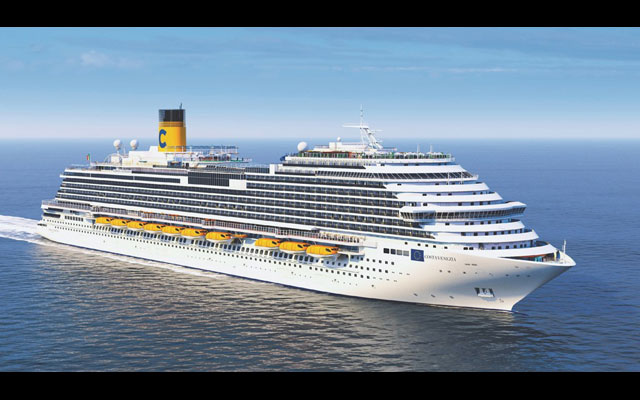
Costa Cruises and Italian shipbuilder Fincantieri have floated out the brand’s first ship designed and built for the China market.
“As our first ship built specifically for the Chinese market, Costa Venezia marks a new era not just for Costa Cruises and Fincantieri but for the Chinese cruise industry as a whole,” said Mario Zanetti, president of Costa Group Asia.
Costa Venezia
Costa Venezia was designed with the leisure and entertainment preferences of Chinese guests in mind, while also incorporating Venetian cultural elements such as the Carnival of Venice and the city’s gondolas.
In addition to Italian dining, luxury retail and entertainment options, guests would also be able to enjoying home comforts including a range of Chinese cuisines and Chinese-style karaoke bars.
At a length of 323m and measuring 135,500 gross tons with a capacity of 5,260 guests, Costa Venezia will be Costa’s largest ship operating homeport cruises from China. It will also be followed by the launch of its sister ship in 2020, which began steel cutting by Fincantieri in Italy earlier this year.
Expected to set sail in March 2019, Costa Venezia will arrive in China next May after a 53-day voyage following in the footsteps of Marco Polo. For the inaugural cruise, Costa Venezia will depart from Trieste in Italy and make its way through the Mediterranean, the Middle East, and South-east and East Asia before arriving at its final home of Shanghai on May 18, 2019.
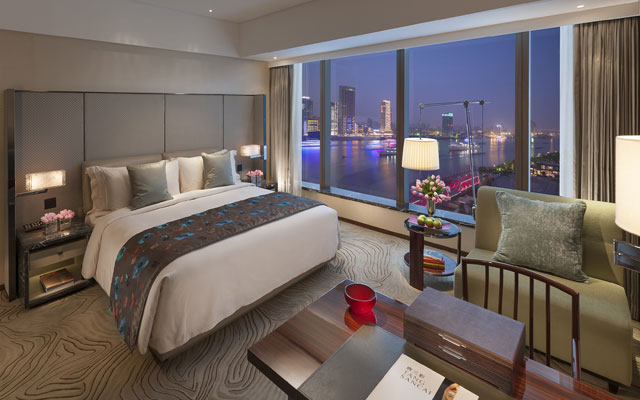
Mandarin Oriental Pudong, Shanghai is highlighting tours that guests can book through the hotel concierge to make the most of their complimentary third night at the hotel.
The hotel’s One More Night offer – priced from RMB2,400++ (US$365) per room per night – entitles guests to a choice of Suite or Club room accommodation with a third night’s stay free, as well as club lounge privileges.
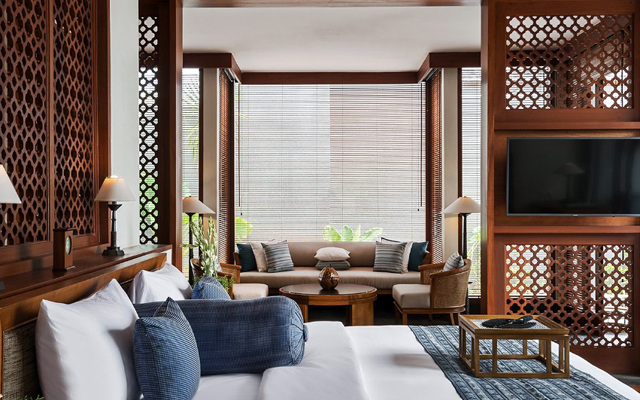
The hotel is throwing in a third night free for guests of either Suite or Club rooms; Deluxe King room with river view pictured
During their stay, guests may also choose to purchase a series of imaginative art and cultural tours.
The Art Ride by Shanghai Insiders tour takes guests on a four-hour sidecar tour themed around art and architecture. The tour can be tailored to guests’ preferences, and will end off with a stop at three art galleries, plus a bottle of champagne.
The tour is priced at RMB2,400 for two people per sidecar with, complimentary hotel pick-up and drop-off service exclusively for Mandarin Oriental Pudong, Shanghai guests.
Guests may also join award-winning Shanghai photographer Gangfeng Wang for a three-hour photo tour of the charming but fast-disappearing historic laneways of Shanghai. On this tour, guests will gain an insight into local life while discovering how best to capture fascinating scenes on camera.
The tour is priced at RMB1,200 per person, and will include a set of Shanghai post cards exclusively for Mandarin Oriental Pudong, Shanghai guests.
In addition, a cycling tour along the colourful Tai Kang Road in Tian Zi Fang will take guests to an arts and crafts enclave that has emerged within this restored residential area of the former French Concession in Shanghai. The tour then heads to Xin Tian Di, where some of the city’s historical and cultural legacies, including Shikumen architecture, can be found alongside stunning modern buildings.
For two pax, the tour costs RMB2,800 and includes transfer between the hotel and the former French Concession, plus city bicycle with helmet, and admission charge to sights along the way.
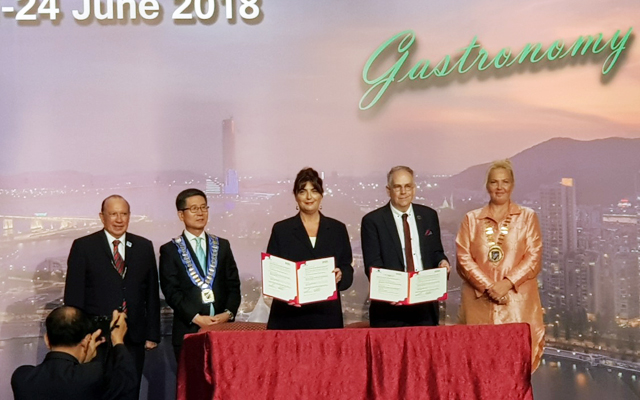
(Middle two) Skål International's Daniela Otero and PATA's Mario Hardy commit to jointly promote responsible tourism
At the recently concluded 47th Skål Asia Congress in Macau, Skål International signed an MoU with PATA to jointly promote responsible tourism in Asia.
Attendees were reminded of the growing importance of Asia at this year’s congress, a bright spot for the association as it grapples with declining membership globally.
(Middle two) Skål International’s Daniela Otero and PATA’s Mario Hardy agree to jointly promote responsible tourism. They are joined by Skal International Macau’s João Manuel Costa Antunes (far left), Skål Asia’s Robert Sohn and Skal International’s Susanna Saari (far right)
Skål Asia president Robert Sohn said: “Asia is the only area in the world where Skål International is experiencing strong growth. In the region, we achieved an increase of 14.7 per cent in the number of members, compared to one year ago and currently there are about 2,400 members in 41 Clubs in Asia.
“This should be noted, since especially the number of members worldwide has decreased.”
Skål statistics since last year revealed that the number of countries in the world with a Skål Club have decreased from 84 to 83, while there was no change to the 19 countries in Asia that has Skal clubs, Sohn pointed out.
“Club wise Skål International lost four clubs going down from 359 to 355 clubs while Skal Asia increased its number of clubs from 40 to 41, and in terms of membership Skal Asia increased its numbers by 311 going up from 2,114 to 2,425,” he elaborated.
Skål International Delhi took over the mantle of the largest Skål Club in the world.
Work is under way to open Skål clubs in more countries. Lebanon, the UAE and Vietnam are some of the countries that are interested to join Skål Asia. Sohn also hopes “the opening of many clubs in China will be a reality soon” with collaboration with Skål’s Macau team .
Amadeus has reached an agreement to combine its solutions with Adobe Experience Cloud, coming after Sabre recently announced cloud services partnerships with Microsoft and Amazon.
John Lonergan, director digital, airlines at Amadeus said: “Amadeus’ collaboration with Adobe Experience Cloud opens a world of opportunities for airlines to deliver personalised experiences to travellers across any digital channel – be it on a laptop, an iPad at check-in, a smartphone, or even a video screen on the back of an aircraft seat – and at any point throughout the customer’s journey.”
Amadeus said in a statement that along with Adobe, it is working with airlines to leverage joint technological capabilities. Further details are not available at press time.
Julie Hoffmann, head of industry strategy and marketing – travel at Adobe commented that the goal of Adobe’s travel arm is “to deliver engaging experiences to all touchpoints”.
“The world’s leading travel and hospitality brands rely on Adobe Experience Cloud, and this partnership with Amadeus will enable us to integrate further with airline brands and take that experience to the next level,” said Hoffmann.
The Swiss hospitality management school will set up an international campus in Singapore
Recognising the importance of Singapore both as an origin and transit market, the Indonesia Ministry of Tourism is upgrading the status of its Visit Indonesia Tourism Officer (VITO) marketing representative in Singapore into a full promotion and information office.
Currently, the paperwork required for the formation of the office is being prepared. When complete, this will be the first such office overseas for Indonesia.
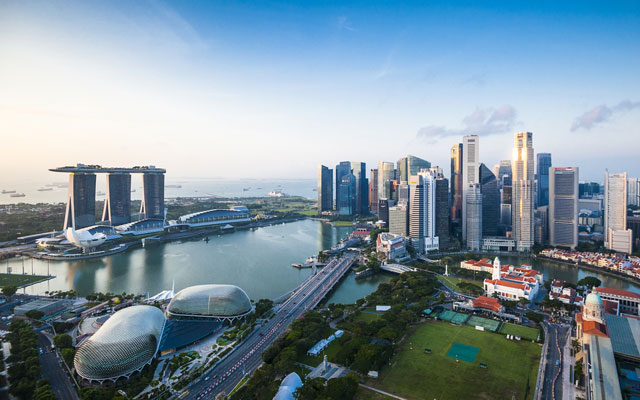
Singapore is a hub for other Asian tourists travelling to Indonesia, and home to a large expatriate community
Indonesia used to have tourism promotion offices during the Soeharto era, but these were closed after the economic and political crisis in the late 1990s. Instead, Indonesia appointed marketing representatives in selected countries known as VITOs.
The move would scale up marketing efforts and trade collaborations in Singapore to a level more proportionate to targets set for the market.
Masruroh Arifin Nurdin, director for marketing development – Singapore, Thailand and Indochina at the Indonesia Ministry of Tourism said: “Singapore has a unique position among all the markets Indonesia is focusing on. Geographically, the country is small, but in terms of number of arrivals, its position is second after China.”
VITO Singapore’s data shows that while Singapore total population is 5.6 million, its outbound traffic movements last year numbered 9.8 million. “Besides being an international hub, Singapore is a hub for travellers from our other international source markets,” Masruroh said, giving examples of the fast-growing Indian and Chinese markets.
With 7,200 flights per week connecting Singapore and 400 cities across the world, there are 62.2 million passengers passing through Changi Airport a year.
“Besides, with our border-crossing promotions, VITO Singapore has a big duty to promote every programme put in place in Riau Islands (Batam and Bintan) as about 60 per cent of (visitors to the) islands (originate) from Singapore.”
This comprises not only the Singaporean citizens but also the expatriate community living in the country, which comprises about 1.6 million residents.
“This year, for example, we have 140 events in Batam and Bintan, which will be promoted in Singapore,” Masruroh said.
Masruroh said the ministry has two VITOs in the Middle East, source of a targeted 200,000 visitors; and India has two VITOs to grab the target of 700,000 tourists. In comparison, Singapore has only one VITO to tap 1.7 million arrivals targeted for this year.
“The tourism minister feels it is unfair for VITO Singapore to take on such a big task on its own. Instead of spending budget on two or three VITOs (in the small country), the minister has decided to open one full office here.”
When ready, Sulaiman Shehdek, country manager of VITO Singapore will continue spearheading the office with one marketing manager and two staff handling social media and sales.
On plans going forward, Sulaiman said: “Under the current arrangement, our resources are limited to only support promotional events and deal with travel agents. By having a dedicated marketing manager, we can expand our reach to associations, corporates and the end users.”
As the Ministry of Tourism is developing new destinations and promoting beyond Bali, there needs to be more awareness campaigns in the market.
“We need to educate the end-users about this. Having a full office will allow us to invite these new destinations to do exhibitions and promotions in our office, for example.
“We will have more consumer shows in the malls in the satellite districts in Singapore, where the locals and families spend their weekends shopping and eating out,” he said.
In relation to working with travel companies, he said the aim was not only to attract Singaporean residents to Indonesia, but also create Singapore-Indonesia combined or extension packages for travellers originating from all over the world.
Masruroh explained: “To tap the Indian market, for example, we need to do dual approach—the outbound operators in India and their ground handling agents here in Singapore. Here is where the promotion office will take part.”
Legian Hotel Management (LHM) is coming out of its “beauty sleep” with a renewed vigour to get the ball rolling on expansion, starting with The Legian Sire, Lombok, scheduled to soft launch by year-end.
The passing of founder Robby Djohan in 2016 put a pause on the budding hospitality company’s plans to expand beyond its Legian grand dame in Bali (which Djohan owned), according to Florian Leven, general manager of the soon-to-open The Legian Sire, Lombok.
The Legian Lombok (photo credit: lhm-hotels.com)
Despite the unfortunate circumstances surrounding the delay in the hotel’s opening, Leven told TTG Asia on the sidelines of ILTM Asia Pacific that LHM is now “well rested after a beauty sleep”, and in the able hands of managing director Irma Djohan (daughter of the late Djohan) and board of management Ralph Ohletz, one of the founders of General Hotel Management (GHM) with Adrian Zecha.
LHM also recently welcomed a new COO, Hans Joerg Meier; he was formerly COO at COMO Hotels and Resorts, and senior vice president at GHM.
Eyes are once again on The Legian Sire, Lombok to kick off the group’s expansion plans. Originally slated for launch in 2017 as the second property in the LHM portfolio, the hotel seems up to the task of continuing the Legian legacy, with a gap to be filled in the luxury sector particularly in northern Lombok.
“There are some well-known hotel brands in Lombok, but most of these are in the south,” he said, citing examples such as Sheraton and Novotel.
Closer to the northern coast, and widely considered to be a better launch pad to the famous Gili Islands, Leven said luxury options are few and the ones that are available tend to be smaller in scale.
The Legian Sire, Lombok is expected to fill this gap, bringing to market a mid-sized inventory of 61 suites and villas, including 500m2 private pool villas, Leven told TTG Asia.
The property is scheduled for a soft opening in December this year, before its official launch early next year. However, after a delay in opening the first time around, Leven now maintains caution and said: “For us, it is more about getting everything right than rushing to launch.”
Antarctica growing in popularity, but Dynasty Travel says many are still have reservations about visiting since few 'reputable agencies' offer the destination
Turning to “experiential tourism” to meet new challenges in the travel business, Dynasty Travel is touting a more worry-free way for Singaporeans to cruise Antarctica with its charter of Ocean Atlantic, an ice-class vessel with a shallow draft operated by Albatros Expeditions.
The Singaporean agency, which celebrates its 40th anniversary this year, says the 15-day Antarctica Expedition Cruise to the Great White Continent in November 2019 will become one of its signature journeys.
Antarctica growing in popularity, but Dynasty Travel says many in Singapore still have reservations about visiting since few ‘reputable agencies’ offer the destination
In a statement, the agency says it is targeting “a new breed of travellers” with their “growing environmental awareness and penchant for off-the-beaten track experiences”. Travel agencies and tour companies are cashing in on the small but growing business segment as they adapt and evolve in a fast changing industry, Dynasty Travel observes.
The agency is betting on experiential tourism to cope with the challenges brought on by the digital revolution, which it says has “severely disrupted the industry not just in Singapore but around the world, where more and more people plan, manage and book their travels online on their own”.
With the new chartered cruise, Dynasty Travel says it is giving travellers in the Lion City a “reputable” and “safe” Antarctica cruise itinerary that goes beyond the traditional packaged tour.
The agency said in a statement: “We know that Antarctica is on many Singaporeans’ bucket list. However, most travellers are deterred because few reputable agencies like Dynasty Travel offer this destination. It is a not a journey that you can book confidently on the internet.”
The chartered cruise will be able to accommodate up to about 200 travellers onboard Ocean Atlantic, with a team of guides to take customers out on Zodiac boats to learn about topics ranging from marine biology to geology.
Star Cruises will relocate the SuperStar Virgo to North China, with the ship confirmed for homeport deployment in Dalian, Tianjin and Qingdao this year.
This will continue Star Cruises’ expansion in China to cover the country’s three main cruise markets – in the south, east and north – after SuperStar Virgo was homeported in Shanghai for the summer, SuperStar Gemini in Xiamen, Sanya and Haikou, and SuperStar Aquarius in Qingdao.
Superstar Virgo
“By deploying Star Cruises to the three key cruise markets in China, we are providing a variety of different cruise experiences from across China, building closer relationships with local travel agents, ports and business partners while boosting our market penetration rate and expanding further into the China market,” said Kent Zhu, President of Genting Cruise Lines.
SuperStar Virgo will sail from Dalian (staring September 9), Tianjin (staring September 30) and Qingdao (starting November 3).
On the four-night itineraries from Dalian, guests will visit Nagasaki, Kitakyushu and Fukuoka. There will be four- and five-night options for itineraries from Tianjin, which will visit Kagoshima, Beppu, Fukuoka and Nagasaki. And for sailings from Qingdao, SuperStar Virgo will call on Kagoshima, Fukuoka and Nagasaki.
“The deployment of SuperStar Virgo to North China during September to November will cover public holidays including the Mid-Autumn Festival and National Day Golden Week, (making the itineraries) suitable for family (travel). And autumn is the perfect time to visit Japan with its comfortable weather conditions and scenery,” said Ang Moo Lim, president of Star Cruises.
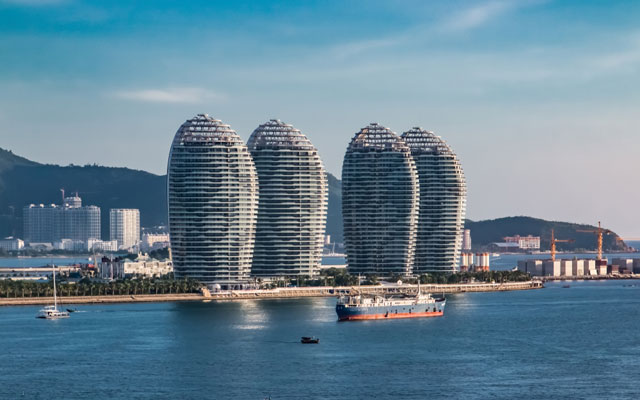
Hainan is doubling down on tourism in a bold move to allow tourists access to Facebook, Twitter and YouTube, in addition to offering visa-free entry into its Sanya for citizens of 59 countries, including eight of the 10 ASEAN nations.
According a Reuters report, a special “gathering zone” will be created in Hainan province for foreign tourists to access the social media websites, a significant exception in China’s hard-line ban of international social media sites, chat apps and search engines.
With a target for 25 per cent arrivals growth, Hainan relaxes rules to lure tourists
The relaxed ruling for tourists was part of a plan announced this month to boost visitor arrivals into the province to at least million by 2020, or by 25 per cent annually.
Meanwhile, a new policy came into effect in May to allow citizens from 59 countries visa-free entry into Sanya – Hainan’s southern-most island and key tourist destination – for stays of up to 30 days.
This applies to individual or group bookings made through travel agencies registered in Hainan Province and approved by the China National Tourism Administration.
The 59 countries that now enjoy the visa-free access to Hainan include: South Korea, Japan, Singapore, Malaysia, Indonesia, the Philippines, Thailand, Brunei, Australia, New Zealand, the UAE, Qatar, Russia, the UK, France, Germany, Norway, Ukraine, Italy, Austria, Finland, Netherlands, Denmark, Switzerland, Sweden, Spain, Belgium, Czech Republic, Estonia, Greece, Hungary, Iceland, Latvia, Lithuania, Luxemburg, Malta, Poland, Portugal, Slovakia, Slovenia, Ireland, Cyprus, Bulgaria, Romania, Serbia, Croatia, Bosnia and Herzegovina, Montenegro, Macedonia, Albania, the US, Canada, Brazil, Mexico, Argentina, Chile, Kazakhstan, Monaco and Belarus.