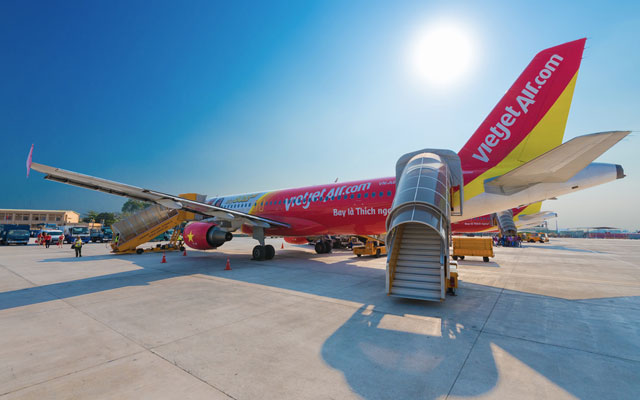
Vietjet launches Hanoi-Tokyo, HCMC-Van Don
Vietjet has launched daily flights between Hanoi and Tokyo’s Narita International Airport. The flight departs from Hanoi at 12.55 and arrives in Tokyo at 08.00. The return flight takes off at 09.30 and lands in Hanoi at 14.00. This is the LCC’s third service to Japan after Hanoi-Osaka and Ho Chi Minh City (HCMC)-Osaka.
The LCC also began its first flight connecting HCMC and the new Van Don International Airport in Quang Ninh province, home to Halong Bay, on January 20. On Mondays, Wednesdays, Fridays and Sundays, the flight departs from HCMC at 07.00 am and arrives in Van Don at 09.15. The return flight takes off at 09.50 and lands in HCMC at 12.05.
JAL to fly to Bengaluru
Japan Airlines (JAL) will launch daily flights between Tokyo (Narita) and Bengaluru during the summer of 2020. Flights leave Narita at 18.25 for arrival in Bengaluru at 00.05 the next day. They then depart Bengaluru at 02.45 to arrive back at Narita at 14.55. JAL will use its Boeing 787-8 aircraft on this route.
PAL goes to Hanoi, Phnom Penh, Delhi
Philippine Airlines (PAL) has announced that it will this summer commence new routes to Hanoi, Phnom Penh and New Delhi from its Manila hub.
Flights between Manila and Hanoi will operate four times weekly (Monday, Wednesday, Friday and Sunday) starting March 31, 2019 with PR595 departing at 22.25 and arriving at Hanoi’s Noi Bai International Airport at 12:45 the following day. Return flights via PR596 leave Hanoi every Monday, Tuesday, Thursday and Saturday at 01.45 and touch down in Manila at 05.30.
Flights between Manila and Phnom Penh will operate five times weekly (Monday/Tuesday/Thursday/Friday/Saturday) starting April 1, 2019 with PR521 departing at 22.10 and arriving at Phnom Penh International Airport at 23.45. On the return, PR522 leaves Phnom Penh every Tuesday, Wednesday, Friday, Saturday and Sunday at 12:45 and touches down in Manila at 04.20.
PAL is targeting April 2019 as the start of the New Delhi service. The new route is slated to run four times weekly between Manila and New Delhi’s Indira Gandhi International Airport using brand-new Airbus A321neo aircraft.
To serve the strategic goal of strengthening the Philippines as a network hub, PAL is also increasing flight frequencies to the following destinations this summer:
• Cebu to Nagoya: from four times weekly to daily
• Manila to Osaka (nonstop): from seven to 11 weekly
• Manila to Bangkok: from 21 to 25 weekly
• Manila to Kuala Lumpur: from seven to 11 weekly
• Manila to Jakarta: from seven to 10 weekly
• Manila to Los Angeles: from 14 to 17 times weekly
• Manila to San Francisco: from 10 to 14 times weekly
• Manila to New York JFK: from five times weekly to daily
• Manila to Toronto: from five times weekly to daily
• Manila to Sydney: from seven to nine weekly
• Manila to Brisbane: from four to five weekly
• Manila to Taipei: from 10 to 14 weekly
• Manila to Doha: from four to five weekly
Hainan Airlines introduces flights from Shenzhen to Vancouver and Dublin
Hainan Airlines is launching twice weekly flights between Shenzhen and Vancouver on January 28, the first nonstop connection from the Chinese city to Canada. Operated using a Boeing 787-9 wide-body aircraft, flights depart Shenzhen on Mondays and Fridays at 12.20 for arrival in Vancouver at 08.50. On the return, flights depart Vancouver at 10.50 and arrive back in Shenzhen at 16.20 the next day.
The airline is also planning to launch flights to Dublin starting February 25. The route, with two round trip flights weekly on Mondays and Fridays, will be serviced by a Boeing 787 Dreamliner. HU755 departs Shenzhen at 01.30 to arrive in Dublin at 07.00. HU756 then leaves Dublin at 09.00 for arrival back in Shenzhen at 05.30 the following day.
Finnair opens routes to Sapporo, ups Hong Kong frequency
Finnair will operate twice-weekly flights on a new route to Sapporo, Japan for the winter 2019/2020 season, from December 15 to March 27.
Finnair will also increase flights to Hong Kong during winter 2019/2020, with double daily flights to Hong Kong continuing from the summer 2019 season throughout the winter season.