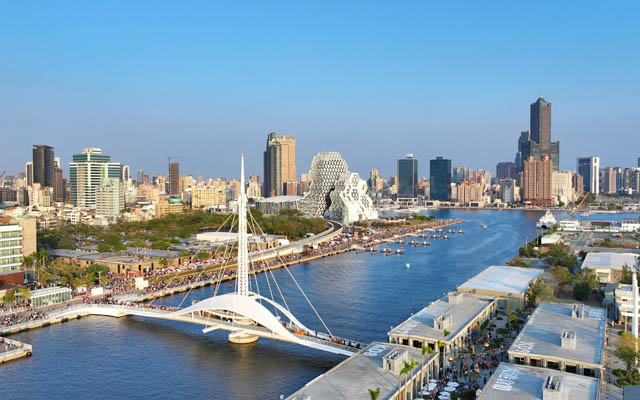
Osaka has won the rights to host the 2025 World Expo, edging out Russia’s Yekaterinburg and the Azerbaijan capital of Baku.
The 2025 World Expo is officially known as the Osaka-Kansai Japan Expo, a reflection of the effort to promote the bid as one with the support of the wider Kansai region, which includes the neighbouring cities of Kyoto, Nara and Kobe.
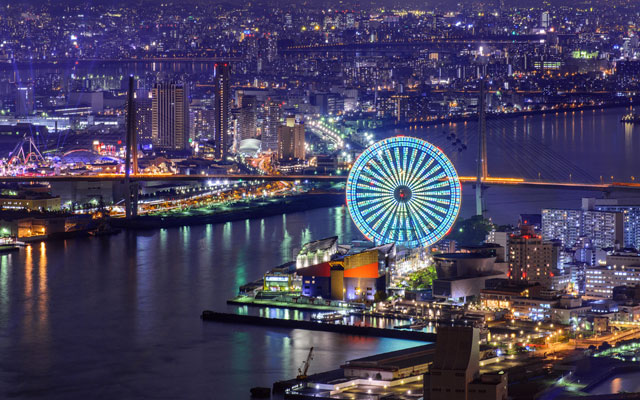
Osaka (night-time view pictured above) has won the World Expo 2025 bid
The theme will be Designing Future Society for Our Lives, and it will be held on Yumeshima, a man-made island in Osaka Bay, between May 3 and November 3.
Pavilions are slated to showcase advanced technologies, particularly in the fields of artificial intelligence and biotechnology, and designed to help meet 2030 United Nations sustainable development goals in health and welfare, especially in ageing societies.
About 28 million visitors are expected to attend the 2025 event and new transportation links to Yumeshima will have to be built, with construction costs estimated at 125 billion yen (US$1.1 billion), financed by the central government, Osaka Prefecture and the city of Osaka, plus the Kansai business community.
The World Expo returns to the city 55 years after the 1970 Osaka Expo, which drew 64 million visitors.
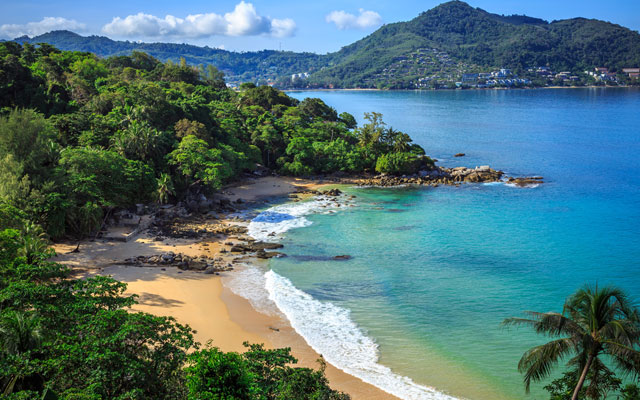
Phuket (Laem Sing Beach pictured above) aims to reduce, and eventually, remove all foam and plastic usage
Hot on the heels of Koh Samet’s plastic clampdown, Phuket will become the next tourist destination in Thailand to tackle plastic pollution with a new initiative to ban the use of plastic and foam.
Phuket’s No Foam No Plastic initiative was announced earlier this month when the island’s key public and private sectors came together to sign a MoU at the Phuket Sustainable Tourism Blueprint 2018.
Phuket (Laem Singh Beach pictured above) aims to reduce, and eventually, remove all foam and plastic usage
Stakeholders of the MoU included Phuket Province and heads of the Tourism Authority of Thailand (TAT) Phuket Office, Phuket Tourism Council, Thai Hotels Association Southern Chapter, Phuket Industrial Council, Patong Hotels Association, Kata-Karon Hotels Association and the Phuket Chamber of Commerce.
The local administration will promote the No Foam, No Plastic effort among the local community and tourism stakeholders to stop using foam containers for food or other items, effective February 14, 2019.
The next phase of the initiative, starting October 1, 2019, will seek to encourage people to switch entirely to paper or eco-friendly bags and straws.
TAT governor, Yuthasak Supasorn, said in a statement: “This is an important step in the right direction in line with the Thai government’s Thailand 4.0 sustainable tourism development goal. Hopefully, Phuket will be a positive case study that the whole country could follow.”
As millennials and transit visitors drive a new standard in budget accommodation, more companies in Indonesia are foraying into the sector to capture the growing business opportunities.
The hostel market is expected to grow seven to eight per cent through 2018, reaching roughly US$7 billion, according to a Phocuswright study.
Nomad Kemang, the inaugural property of Archipelago International’s new hostel brand
Most hostel guests are millennials, with three out of four travellers under the age of 35, according to a joint study by Phocuswright and booking engine Hostelworld.
Recognising the huge business potential young travellers bring, Archipelago International launched its newest brand, Nomad Hostel.
John Flood, president and CEO of Archipelago International, explained: “We know that young travellers try to save as much as they can (when it comes to) hotels and flights, but they are willing to spend more on experiences, so we give what they want and need.”
Millennials tend to embrace the social and sharing aspects of travel. For some of these travellers, dormitory-style accommodation – which better allow guests to exchange travel tips and information – are preferred over closed and private hotels.
Flood added: “Young travellers love to be in close contact with people (and experience a sense of) community. You need to have communal spaces, where they can gather and do stuff together.”
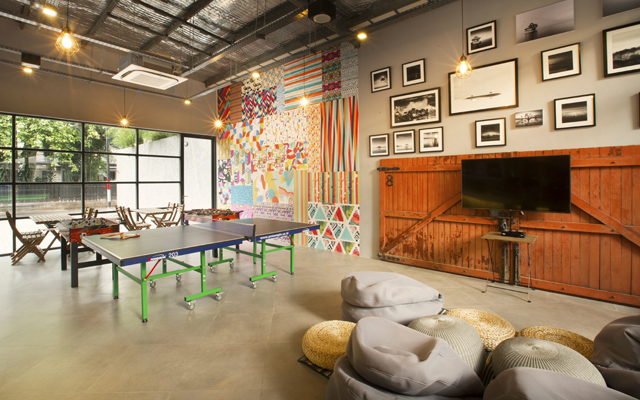
Instead of having a traditional lobby, Nomad Hotel offers a communal space designed for interaction and engagement. There is also a backyard barbecue zone with ping-pong tables, live music, a pool and sun loungers.
Sahid International Hotel Management & Consultant also added brands under the Dotnet concept to appeal to travellers who want less service and more connectivity – both technologically and socially.
Vivi Herlambang, Sahid’s director of sales, marketing and business development, said: “High-speed Wi-Fi is a must for (millennials). The always-connected generation needs to be able to easily share their experiences.”
Miranda Haryoanto, owner of Kini Capsule, found a captive market in transit passengers in Jakarta when she decided to open the hotel. For some travellers, Jakarta is not the main destination, but a gateway to places such as Bali and Yogyakarta.
According to Miranda, who is also the general manager of Kini Capsule, transit visitors do not need facilities typically found in star hotels. For them, the most important criteria are safety and cleanliness.
Another crucial element is experiences. She said: “When you’re travelling, the communal experiences could turn out to be the most memorable part of the trip. Nowadays it’s about real interactions. Younger travellers want to join a community where they can feel the uniqueness of place.”
To cater to experience seekers, even affordable hotels need to be in the vicinity of activities such as movie nights, batik-making lessons, cooking classes and culinary tours.
Angkasa Pura II, state-owned airport services company, has opened the Digital Airport Hotel on the first floor of Terminal 3 of Soekarno-Hatta International Airport.
Muhammad Awaluddin, president director of Angkasa Pura II, said the idea for a capsule hotel was based on a survey finding that lodging at the airport did not need to be large and luxurious.
There remains a myriad of challenges that must be tackled by hostels or capsule properties. Miranda said many still perceive budget hotels to be dirty, and with poor locations and service standard.
With more than 130 million outbound trips made by Chinese travellers last year, this upward trend will continue to fan the development of more direct international air links and charter flight services from China, particularly from second-and third-tier cities.
Chinese lower-tier cities’ connectivity is growing faster than their tier one counterparts, with more than 10 non-stop routes mounted between China and Europe in 1H2018 alone, revealed Ivy Alliance Tourism Consulting.
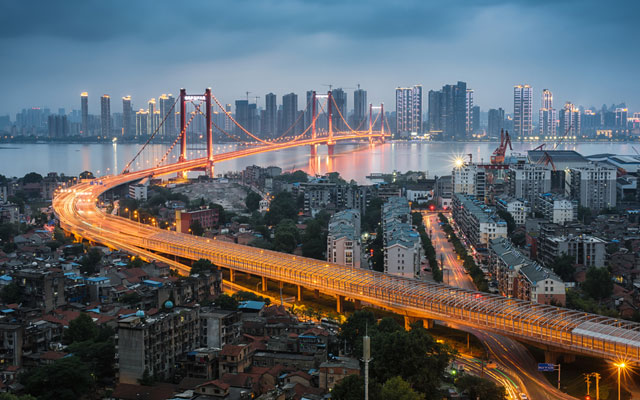
Wuhan (pictured) is one of the lower-tier cities that is benefitting from new air links
Ctrip also lists tier two cities as among the beneficiaries of new air routes launched, such as Shenyang-Frankfurt (Lufthansa), Nanjing-Helsinki (Finnair), Wuhan-London (Hainan Airlines) and Chengdu-Zurich (Sichuan Airlines).
While Shanghai, Beijing and Chengdu remain Europe’s top tourism source markets in China, rapid growth in international air connectivity is now seen for secondary cities like Kunming, Chongqing and Xi’an.
South-west China’s busiest air hub, Chengdu Shuangliu International Airport, last month welcomed a new route to Cairo, while a new airport – now under construction in Jianyang – is set to replace Shuangliu as the biggest airport in the province, Molly Dai, general manager, Sichuan Global International Travel, told TTG Asia.
Sun Bing, general manager of Nanjing-based CITS Jiang Su, said: “After the recent addition to St Petersburg and Helsinki, international flights from Nanjing are expected to grow next year. Scheduled flights to the Philippines’ Cebu and Manila are on our wishlist.”
The trade has been pushing for greater connectivity from western China too. Tokyo-based Eiwa International Tour Consultant’s president Zhou Wen has initiated talks on launching chartered flights linking Japan to cities like Gansu, Xi’an, Chengdu and Qinghai.
He explained: “We are optimistic about entering Western China because many Chinese (in this region) haven’t seen the world yet. For sure, there will be a lot of first-time outbound travellers there.
“I hope to grow (the region) further next year by launching charter flights to Xi’an or Lanzhou,” said Zhou.
However, Shanghai-based iview’s business development manager Zhang Jing-jing played down the threat from second- and third-tier cities, saying it’s “still a long way” for them to catch up with tier-one cities, especially in terms of frequency of international flights.
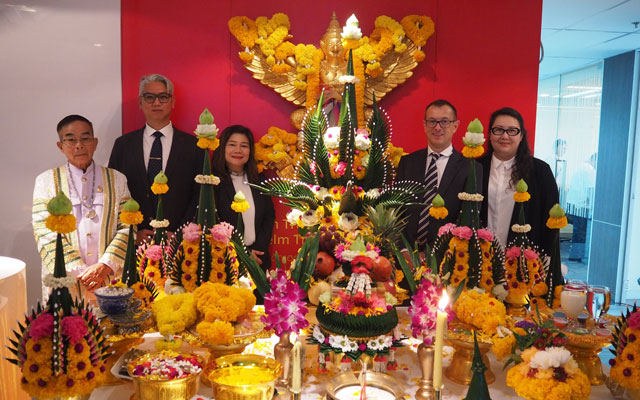
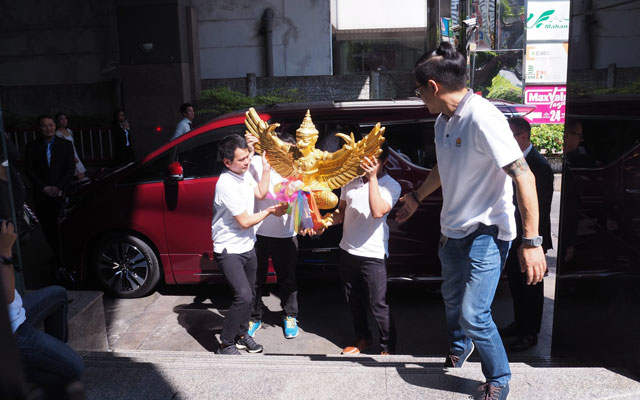
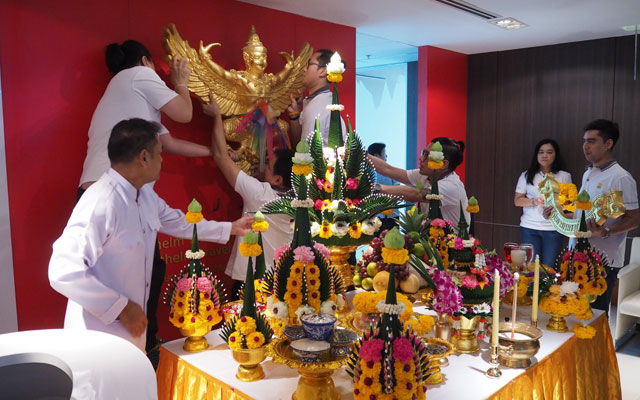
As part of the relocation of its Bangkok headquarters this month, Diethelm Travel Group moved its golden royal Garuda image to its new home in a special ceremony.
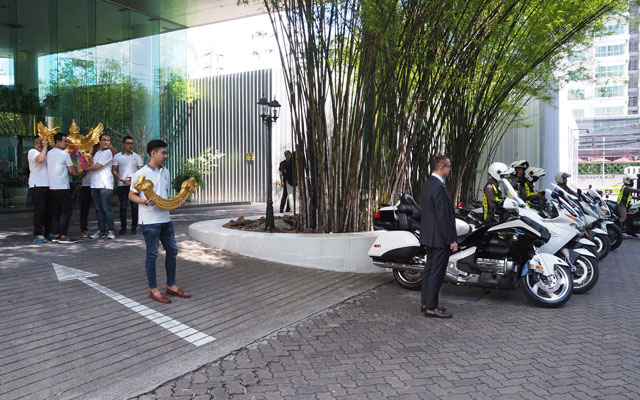
On November 21, a grand procession was held to move the statue from the group’s previous office just north of Lumpini Park to the new location on Silom Road.
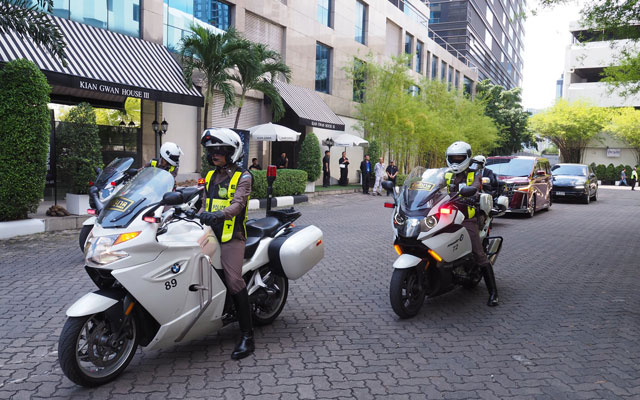
Diethelm's royal Garuda image moves to new office
1 of 6
In line with tradition, the ceremony was led by a Hindu priest, or Brahman, who first made way to the new offices by convoy. The convoy included a police escort, royal escort and the Garuda image enclosed safely within a vehicle followed by the company’s management team.
Upon arrival at the new office, the entire Diethelm Travel Thailand team took part in a blessing ceremony as the Garuda was displayed in its new home.
The Garuda image represents the prestigious royal warrant of appointment from the Thai monarchy. Diethelm is one of the few foreign travel companies within Thailand that has obtained the accolade, bestowed by the late King Rama IX.
Why
Indonesia, or in particular Bali, is hardly known on the world winery map. It is perhaps only a handful of people who know that the island actually grows its own grapes in Buleleng, on the north coast of Bali, which yields around 800,000 bottles a year at Sababay Winery in Gianyar.
Over the past three years, Sababay’s wine collections have won more than 30 awards and accolades at regional Asia wine competitions such as the Korean Wine Challenge, Sakura Wine Awards and China Wine & Spirit Awards. It also won an award at the AWC Vienna International Wine Challenge 2017, the largest wine competition with wine producers from 40 countries.
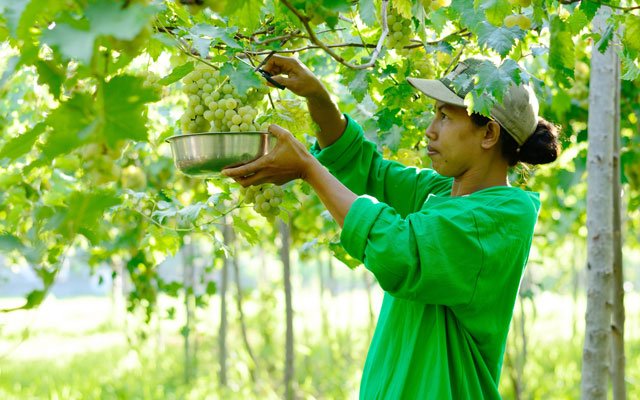
Local grape farmers harvesting the wine
What
I was lucky to visit the Winery Garden after a Muscat harvest, and my group managed to taste the grapes and its juice.
Sababay uses two types of grapes, Alphonse Lavallée, black local grapes – which are actually table grapes, and Muscat Saint Vallier, green grapes. Both are grown at the vineyards which are owned and cultivated by local farmers, in collaboration with the Asteroid R&D Vineyard. The winery is located a four-hour drive away from the vineyard.
Sababay was founded in 2010 by an Indonesian lady, Mulyati Gozali, who is now president director of the company.
The brand, Sababay, is derived from the winery’s location at the Bay of Saba Beach.
Mulyati was saddened by the condition of local farmers, whose grape harvests were sold at Rp500 (less than US$0.10 then) per kilogramme. As such, she decided to establish a local winery dedicated to using local harvests, and doing so through direct fair trade business practices and integrated farming.
“Grape prices today are about 10 times it used to be, and farmers have been able to expand their vineyard and send their children to universities,” the guide told us.
Mulyati invested in grape processing equipment imported from France, the only one in Indonesia so far; an automatic bottling line from Italy; and fermentation and storage tanks from Indonesia. The company also taught the local farmers how to better grow the grapes, cultivate the soil, and use of fertilisers and seeds to meet the requirements for winemaking.
Sababay’s wines were then created by a renowned Indonesia wine connoisseur Yohan Handoyo and Bordeaux-born winemaker Nicolas Delacressionnere.
Inside the winery, a glass of Sababay’s bestselling Moscato dBali welcomed us, before we were escorted to the fermenting area.
Nicolas, the winemaker, then poured us from a tank a glass of one of the Red Velvet series in the making. He then explained the whole process from the vineyard to bottling. We were then brought upstairs where we were given a chance to taste a series of wines here, as well as learn how to pair them with Indonesian food and snacks.
Yohan explained that while wines were usually paired with western cuisine, Sababay had been working with Indonesian chefs and culinary lovers to create Indonesian food pairings.
The Black Velvet, an easy drinking red, is suitable with ayam pepes a la bumbu Bali (steamed chicken wrapped in banana leaves). Meanwhile, the Pink Blossom, an aromatic rose, can be paired with sate lilit (Balinese-style satay) or gado-gado mixed salad with peanut sauce. The White Velvet, the fruity dry white, can be paired with fish cakes and sweet chilli sauce.
Yohan also revealed that Sababay has been appointed official wine partner of Wonderful Indonesia by the Ministry of Tourism.
How
The winery tour is available on Mondays, Wednesdays and Fridays from 15.00 to 16.30. It will cost Rp180,000 (US$12) per person, and includes the tasting of three wines.
The winery can also organise a private tour for groups from 20 to 150 people. In this case, it will cost Rp300,000 per person, and includes the use of the function room for three hours, exclusive use of the air-conditioned Joglo hall and its surrounding garden, and two glasses of wines. Reservations are mandatory.
A tailor-made programme, such as a tour of the vineyard, can also be arranged.
Verdict
The tour was an eye-opener for me, as I discovered that a Balinese vineyard is able to produce award-winning wines and has helped to improve the livelihood of local grape farmers.
New World Petaling Jaya Hotel has named Shona Pang as director of sales & marketing.
Pang will play an integral role in the development and implementation of strategic sales and marketing plans.
Prior to joining New World Petaling Jaya Hotel, Pang was the pre-opening director of sales and marketing for Sheraton Petaling Jaya.
The seasoned hotelier with almost 15 years of industry knowledge in events, MICE and corporate sales, and has worked across various international hotel brands such as The Westin Kuala Lumpur and Mandarin Oriental Kuala Lumpur.
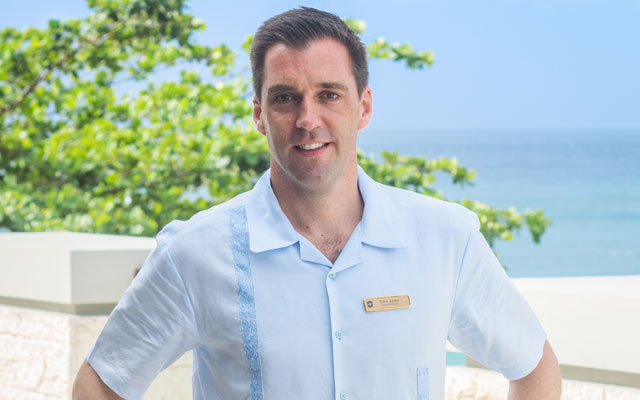
Dave Junker has joined Shangri-La’s Boracay Resort & Spa as its new general manager.
Prior to his most recent appointment at Shangri-La Hotel at the Fort, Manila, Junker has also been assigned to other Shangri-La hotels in South-east Asia, including Sule Shangri-La, Yangon; Shangri-La Hotel, Chiang Mai; Shangri-La Hotel, Bangkok and Shangri-La’s Mactan Resort & Spa, Cebu.
A Luxembourg national, the seasoned hotelier has close to two decades in the industry, and was also stationed at luxury hotels in the UK, the US, India and the UAE before joining Shangri-La.
As China’s outbound travel market enters a new phase of development, increasingly savvy Chinese travellers are eschewing cookie-cutter package tours for customised, personalised experiences during their holidays.
“Many (Chinese) have already been to the major ‘pit stops’ like New York, Las Vegas, Los Angeles and California. Now, tour operators tell us they want to see the ‘real’ America, and our region is considered a new product,” said Lee Anthony McCarrick, executive director of Great Lakes USA.
Chinese tourist taking a selfie in Napa Wine Valley
“We have the big-city experience with Minnesota and Chicago, but the majority of our region is small towns and the great outdoors,” he said. “The Chinese have been the number one overseas traveller market in the Great Lakes region.”
Joy Cao, general manager of marketing division, Guangzhou Dista International Travel Service, has also begun marketing tours anchored on American culture and nature, such as discovering Chicago’s jazz and blues scene, exploring the Yosemite National Park and Napa Wine Valley, as well as visiting the small towns surrounding Yellowstone National Park.
In Europe, Tuscany-based DaVinci Travels recently established a partnership with Chinese tour company Feiyang Italy to bring authentic Italian experiences to the Chinese market.
“We have mainly worked with Americans and Europeans, but now we would like to focus on the Chinese market,” said Beatrice di Tomizio, senior tour organiser and account manager for incoming department of Italia-Experience, the new company formed under the partnership.
She added: “We have cooking classes and wine tasting sessions, and for smaller groups, we can arrange stays in real Italian houses to give them an original and special taste of Italy.”
Elsewhere in Egypt, Chinese travellers are also forgoing direct train and ferry connections in favour of traversing the country on four-wheeled self-drives, noted Castle Tours’ tourism manager Ahmed Abdul Mounem.
This new breed of Chinese traveller seeking transformative experiences hence represents a lucrative opportunity for the industry, driving the development of “experiential products” among tour operators, remarked Wang Xinjun, CEO, Ivy Alliance.
“Experiential travel will be the driver for future growth,” Wang stated. “There is greater demand for themed and customised tour products and more spending on quality hotel, catering and entertainments while extravagant shopping is on the decline.”
Meanwhile, Fosun Tourism Group continues to upgrade its portfolio of overseas and domestic tour products from general sightseeing to more insightful experiences, according to chairman and CEO, Qian Jiannong.
Europe ranks high as a destination where demand for in-depth tours is high, followed by the US, Africa, Morocco and Mauritius, revealed Qian.
CITS Group Shanghai, secretary director and GM, Lu Jun foresees Central and South America will emerge as new destinations in the coming years for sophisticated Chinese travellers seeking in-depth travel.
According to Ctrip’s CEO Jane Sun, FIT and custom tours now accounts for 33 per cent of the Chinese OTA’s business. “In 1H2018, tour customisation requests were up 112 per cent and bookings for Chinese-speaking local guide increased 242 per cent,” said Sun.
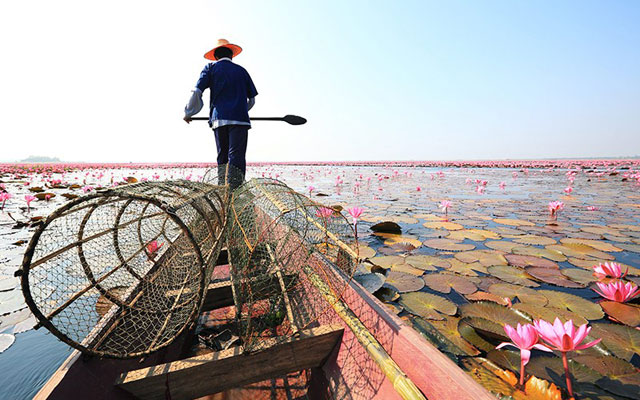
Red Lotus Sea at Nong Han Lake in Udon-Thani pictured
The Tourism Authority of Thailand (TAT) has developed a three-pronged approach to promote 55 secondary destinations, as part of its diversification strategy to better distribute tourism income and visitation across the country while encouraging low-impact, community-driven tourism.
TAT’s research has identified the need to position these secondary 55 provinces within the “big picture” of Thailand’s development by creating conceptual models specific to each secondary province; such as, a sports city in Buri Ram and a wellness city in Chiang Rai.
Secondary provinces like Udon Thani will feature more in TAT’s future destination campaigns; Red Lotus Sea at Nong Han Lake in Udon Thani pictured
These 55 provinces, which get less than four million local and foreign tourists a year, will also get greater prominence in TAT’s future marketing campaigns. According to TAT, there are more than 4,000 tourist attractions and over 8,000 accommodation units in the secondary destinations as of 2018.
A travel trends survey from the TAT Intelligence Centre showed that in the first half of 2018, the 55 secondary destinations hosted nearly 2.3 million foreign visitors, of which Laos (513,046), China (235,573), the UK (110,942), Germany (103,912) and France (84,380) were the top source markets.
The most visited secondary destinations (hosting over 100,000 tourists) are Nong Khai, Udon Thani, Chiang Rai and Mae Hong Son. The cities receiving between 55,001 to 100,000 tourists are Ubon Ratchathani, Mukdahan and Satun.
The three tourism promotion concepts for the secondary destinations identified by TAT are:
Local Experience: Provide visitors with an in-depth experience such as, community-based tourism, lifestyle, wisdom, local identity and distinction of each area.
Future Challenge: Secondary cities have enormous potential to expand their economies and boost the income of the local people if the tourism industry is developed in a sustainable and well-planned manner.
Connecting Destinations: Connecting Thailand’s big cities with smaller cities and also connecting them with neighbouring countries. There are 29 destinations adjacent to the primary cities, 22 airports in these destinations, and 10 destinations with immigration checkpoints.