Holiday Inn Singapore Atrium has appointed Shadab Amin as director of sales & marketing.
In his new role, Amin will manage all aspects of sales and marketing, including business development, customer relationship management, digital marketing, and brand and communication strategies.
Amin brings with him a decade of hospitality experience. He joined IHG in Manila and subsequently, moved to Crowne Plaza Muscat and Holiday Inn Resort Kandooma Maldives, before settling down in Singapore.
During his stint in Manila, Amin played a pivotal role in laying the foundation of IHG’s India global sales team, while at Muscat and Maldives, he held key sales positions that drove revenue targets.
After moving to Singapore in 2017, Amin joined Holiday Inn Singapore Atrium as a senior business development manager. During his three-year tenure in Singapore, he grew progressively to the position of director of sales.
Thailand’s Department of Rural Roads, Ministry of Transport is developing three scenic tourist routes in the south, centre and north-east of the country that will enhance the destination’s tourism competitiveness and appeal.
The routes are the Southern Coastal Road or Thailand Riviera connecting destinations along the western coast of the Gulf of Thailand from Samut Prakan province to Narathiwat province; the Naga Withi route along the Mekong River from Loei Province to Ubon Ratchathani province; and the Burapha Khiri route passing through Nakhon Nayok, Nakhon Ratchasima, Prachin Buri and Sa Kaeo provinces.
Chumphon province, known for coral reefs and long beaches, is on the Southern Coastal Road scenic route
Promising a safe, comfortable and picturesque travel experience, the routes will see the improvement of existing road sections as well as creation of new ones. It will also create job opportunities for the local people, said Pathom Chaloeywaret, director-general of the Department of Rural Roads.
As the longest of the three scenic routes, the Southern Coastal Road is divided into four phases, with construction ongoing now on the Samut Songkhram to Chumphon (Phase 1) and Chumphon to Songkhla (Phase 2) sections. They are set for completion in 2023 and 2026 respectively. Construction of the Samut Prakan to Samut Songkhram (Phase 3) section is expected to begin in 2023, the same year in which design work is scheduled for the Songkhla to Narathiwat (Phase 4) section.
Work on the Naga Withi route is set to begin in 2022 while Burapha Khiri route is currently in the design stage.
Inmarsat’s Passenger Confidence Tracker survey has determined that nine in 10 Asia-Pacific airline passengers will alter their travel habits for the long-term as a result of the pandemic, with half planning to travel less frequently by any means.
The survey, commissioned by Inmarsat and carried out by market research company Yonder. studied 10,000 airline passengers globally, including 2,500 from the Asia-Pacific region.
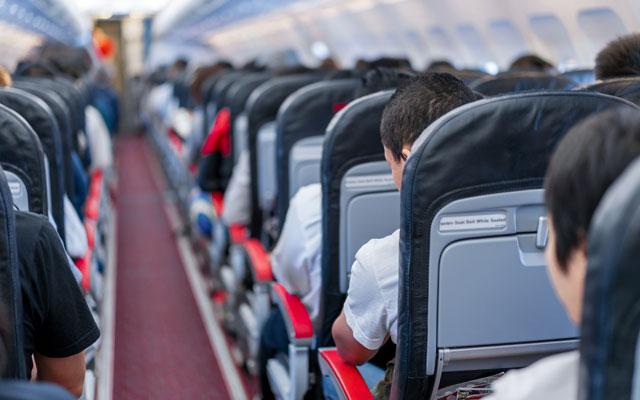
While Asia-Pacific travellers expect to travel less post-lockdown, they are also more ready than global peers to return to the skies
Ninety-three per cent of survey respondents in Asia-Pacific do not expecting to return to their previous travel routines once the pandemic is over, with 57 per cent describing their behaviour towards the pandemic as ‘highly cautious’, compared to 48 per cent globally.
The pandemic also seems to have sparked a shift in attitudes to travel in Asia, where 49 per cent of respondents expect to travel less by any means and 37 per cent plan to fly less in the future. This sentiment is stronger in India and South Korea, with 58 per cent and 55 per cent surveyed planning to travel less in the future respectively.
Despite this, there are early signs that Asia-Pacific travellers are starting to feel confident about flying again. Passengers in the region are more likely than the global average to have flown since the pandemic began: 41 per cent of Asia-Pacific respondents – and as much as 56 per cent of Indian respondents – have taken at least one flight since the pandemic reached their countries, compared to just 34 per cent globally.
The majority – 60 per cent – of Asia-Pacific passengers surveyed expect to feel fully ready to fly within the next year.
David Coiley, vice president Asia Pacific, Inmarsat Aviation, said: “The Passenger Confidence Tracker reveals that Asian travellers are more confident with the safety of the passenger journey than their counterparts.
This also reflects prevailing conditions in the region, where the spread of Covid-19 has largely abated across most markets, relative to other regions experiencing a resurgent wave of infections and further lockdowns. Given the level of consumer confidence, the outlook of the aviation industry in Asia-Pacific is looking optimistic.”
Coiley pointed to domestic travel recovery in China and India as most telling of the region’s travel confidence.
“In China, we saw domestic passenger volumes for the month of September increase from the same period last year, while domestic travel volumes in India are forecast to recover to pre-Covid levels by the end of the year,” he said.
When asked to rate their confidence around the safety and health precautions currently undertaken across all touchpoints throughout the journey, Asia-Pacific respondents recorded an aggregated score of 6.27 (with 10 being the highest level of confidence), higher than the global average score of 5.55.
The majority also perceive public spaces such as restaurants, cinemas, public transport, and public toilets to be either as risky, or even riskier than, taking a flight.
Asian respondents stated a need for clearer information about border restrictions, standardised practices across all airlines and a consistent worldwide set of safety standards as particular areas for improvement. Furthermore, respondents determined that wearing a face mask both inflight and in airports, and only being allowed to fly after a 48-hour test are the most effective personal safety measures. Only 10 per cent identified a 14-day quarantine as a top factor.
While the majority of Asia-Pacific passengers (65 per cent) surveyed feel satisfied with the aviation industry’s response to the challenges of Covid-19, the study reveals areas of opportunity for airlines to encourage passengers back to the skies.
Almost half (48 per cent ) of Asian respondents believe that reputation is a more significant factor when choosing an airline today than it was pre-pandemic. It has therefore never been more vital for airlines to differentiate and gain a competitive edge. The research highlights that improving inflight experience is one way to achieve this.
From extra legroom (44 per cent) to free baggage (36 per cent), value added services are becoming increasingly important to passengers returning to the skies. Digital solutions are fast-becoming essential to an enjoyable inflight experience, with four in ten respondents agreeing that on-board Wi-Fi matters more today than ever before.
Philip Balaam, president of Inmarsat Aviation, said: “With safety and reputation becoming even more important to today’s flyers, there is a clear need for airlines to differentiate themselves in order to encourage passengers back onto their flights.
“Digitalisation lies at the heart of both; minimising critical touchpoints in the passenger journey to improve confidence, all the while keeping passengers connected and entertained.”
The much-delayed JB-Singapore Rapid Transit (RTS) Link that connects Bukit Chagar in Johor Baru with Woodlands in Singapore may finally break ground at the end of this month, following a virtual launch planned on November 22 in conjunction with the birthday of the sultan of Johor Ibrahim Sultan Iskandar.
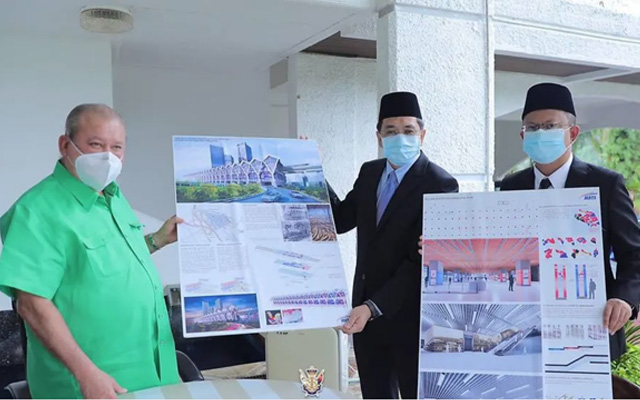
Sultan Ibrahim Sultan Iskandar meets with Malaysia Rapid Transit System representatives on the RTS Link project; photo by The Johor Royal Press Office
The Johor Royal Press Office said the ruler has been presented with project details, including launch arrangements and final designs for the station.
The RTS Link is expected to ease causeway congestions, improve connectivity between the two countries and generate shared economic and social benefits. When complete, it will be a standalone Light Rail Transit (LRT) System with the capacity to serve up to 10,000 commuters during peak periods, for every hour and in each direction.
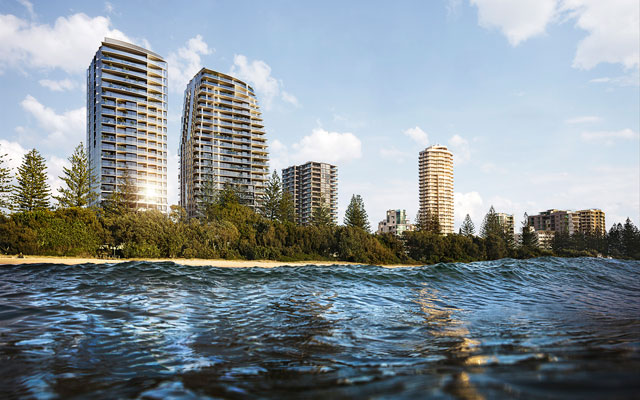
Australia’s first Mondrian hotel and branded residences will open on a prime beachfront location at Burleigh Heads on the Gold Coast, making it one of nine new Mondrian properties to open globally by 2022.
Mondrian Gold Coast will be part of a dual tower development that sits on the corner of First Avenue and The Esplanade Burleigh Heads. Occupying separate wings, the hotel and residence units will be connected by a three-level podium that acts as the building’s common space and hub of activity, including a state-of-the-art fitness centre, spa, restaurants, and swimming pools, all overlooking the world-famous beach and Burleigh Headland National Park.
Mondrian Gold Coast is among nine Mondrian properties to open worldwide by 2022
The expansion of the Mondrian brand follows Accor’s 2018 partial acquisition of sbe.
Chadi Farhat, COO of sbe, said: “With five open properties, nine in development, and six more to be announced, Mondrian has established itself as one of the strongest brands in the sbe lifestyle portfolio, showing staying power for the long-term.”
Accor and sbe have bookmarked Thailand and Vietnam here in Asia-Pacific for Mondrian developments. The region welcomed the first Mondrian property in August, with the opening of Mondrian Seoul Itaewon in South Korea.
Accor Pacific CEO Simon McGrath said Mondrian Gold Coast reflected the company’s commitment to developing innovative, lifestyle-oriented hotels alongside sbe.
“With the Mondrian brand, sbe creates destinations within the destination, bringing together regional authenticity with sophisticated design, creative programming and a lively bar and restaurant scene. Mondrian Gold Coast will be the embodiment of this philosophy: providing residents and guests with elevated hospitality experiences that match the beauty and vibrancy of Australia’s Gold Coast region,” said McGrath.
More than 45,000 essential workers across the globe will bag 7,500 surprise Wyndham Rewards points, which could earn them a complimentary one-night stay in a hotel within the company’s global network.
The initiative is part of Wyndham Hotels & Resorts’ ongoing #EverydayHeroes campaign, which will see Wyndham Rewards points being sent to any healthcare worker, delivery driver, warehouse worker, grocery associate and hotel staff or other essential workers who had opted into the campaign prior October 27, 2020.
Wyndham’s #EverydayHeroes campaign will gift more than 45,000 essential workers with bonus Wyndham Rewards points
The campaign was launched in April 2020.
In Asia-Pacific, the company will issue approximately 10 million reward points along with an upgrade to the Gold membership.
Joon Aun Ooi, president, Asia Pacific, Wyndham Hotels & Resorts, said: “Through the extension of the additional Wyndham Rewards points, we hope to bring encouragement and cheer to these workers by offering a well-deserved retreat at a Wyndham property of their choice, be it for a stay close to home, or a holiday when the world opens up to travel again. We also look forward to providing them a safe and clean stay enhanced by Wyndham’s Count on Us campaign, as well as extending a warm and welcoming Wyndham experience at our hotels.”
Inbound players in Singapore and Hong Kong are reporting a slow but exciting return in travel demand between the two Asian cities on the back of a soon-to-come bilateral air travel bubble, reflecting a different reality from ForwardKeys’ recent report showing sharp spikes in flight searches and bookings between Singapore and Hong Kong.
Singapore inbound player SingExpress Travel has received enquiries after the travel bubble announcement and is now getting regular group bookings every week from several Hong Kong agents. Senior manager – inbound asia, Bernard Yu, is anticipating a further increase during the Christmas holiday period.
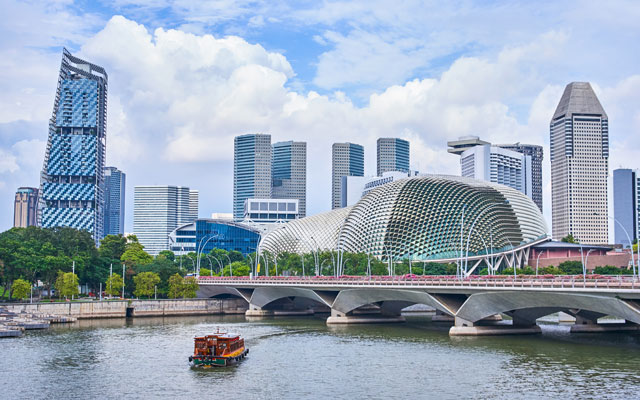
Singapore inbound players are reporting varying levels of interest from Hong Kong travellers
While his Hong Kong agents were worried about extra costs from pricier flight tickets and compulsory Covid-19 tests, most were “excited” about business prospects after a drought of “no outbound business to anywhere”, Yu told TTG Asia.
SingExpress Travel has lined up a collection of tour programmes that are “ready to go once we get the latest updates from both authorities”, said Yu. These itineraries include a theme park programme for families and an affordable Private Premium Food Trail Programme.
Yu said “any number of tourists coming in is a good start”, especially as inbound business had ground to a halt since mid-February.
SingExpress Travel’s state of business appears to be an exception, as things are staying quiet for other ground operators, who speculate that the delay in tour bookings may be due to travellers from Hong Kong bidding their time until more details about the travel bubble are confirmed.
“We believe that travellers from both countries are still waiting for further announcement from both governments as to when exactly the travel bubble will start and what the requirements will be, such as how many tests are required and the costs of the tests,” surmised Stanley Foo, founder and managing director, Oriental Travel and Tours in Singapore.
TY Suen, founder & CEO of Singapore’s Woopa Travels, shared hopes that more enquiries will flow in “after the details are finalised”.
To prepare for the eventual return of visitors from Hong Kong, Woopa Travels is working with the Singapore Tourism Board and its regional offices to monitor demand in Hong Kong and develop enticing offers.
Meanwhile, Oriental Travel and Tours is considering the adoption of Cantonese-speaking guides to attract Hong Kong travellers and cater to this new segment which previously did not represent a substantial portion of demand.
In 4Q2019 – before the onset of Covid-19 – Singapore received 489,000 travellers from Hong Kong, placing it as the top 13th source market for the island nation.
Foo said: “(Although) the Singapore-Hong Kong travel bubble will not substantially impact the tourism industry in Singapore, we see it as the start to the signing of more travel bubble agreements with other countries in the world.”
Hong Kong’s inbound players are also still seeing quiet days, but hopes are growing.
Gray Line Tours, executive director, Ronald Wu, said the business outlook is still “sketchy” without clear information on the daily visitor quota and the number of flights per day.
That said, Wu regards the travel bubble between Singapore and Hong Kong as a “good start for our tourism recovery”.
“If this is implemented smoothly and well, it will be a model for more destinations to come,” he remarked, adding that other favourable conditions must also exist, such as the availability of affordable Covid-19 tests that come with quick results.
Wing Wong, executive director of W Travel, which has entertained some enquiries from Singapore since the announcement, remarked that it is “vital to get moving”, even if the market is small.
The agency is looking to spur demand through tours that feature heritage and environmental protection, and which take tourists away from the crowds.
Wong expects Singapore travellers to surface in December but with concerns mounting over pricey airfares, he believes demand will be confined to luxury and business travellers.
Discova’s country manager for China & Hong Kong, Sandy Ho, shares reserved expectations, saying that Singapore travellers to Hong Kong tend to favour low-cost carriers, so pricey airfares at this stage could stall recovery.
Offering a more optimistic view is The Hari Hong Kong, a hotel due to open in mid-December. The hotel spokesperson told TTG Asia that the travel bubble will bring leisure travel opportunities for the festive season starting around December and running through to Valentine’s Day in February. Business travel will also benefit from the relaxed quarantine requirements and unrestricted activity likely to come with the travel bubble.
The hotel is banking on “revenge travel” to bring about a surge in inbound business to Hong Kong, as well as other bilateral travel bubbles that will be formed following the first Singapore and Hong Kong arrangement.
“It is important for Hong Kong to test the waters and be truly ready to navigate in the new normal. For us and our peers, our goal is to make sure international travel to Hong Kong is once again safe and pleasant,” added the spokesperson. – Additional reporting by Prudence Lui
Malaysia’s Budget 2021, tabled on November 6, has drawn criticism from travel and tourism industry leaders for failing to provide strong relief to safeguard jobs and businesses as well as for directing greater job assistance to the aviation sector over others in the industry.
Malaysian Association of Tour & Travel Agents (MATTA) president, KL Tan, said the budget would do little to help the tourism sector on its road to recovery.
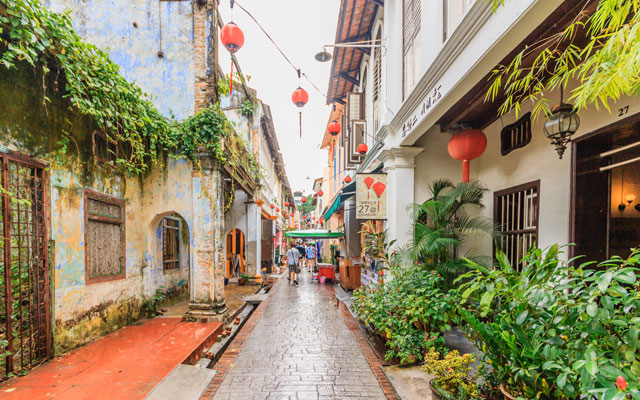
Budget 2021 does not provide sufficient assistance to small and medium-sized tourism businesses and workers, lamented industry leaders; Ipoh’s popular Concubine Lane pictured
He accused Budget 2021 of neglecting the welfare of 3.6 million workers in the field and small and medium-sized tourism companies.
“The allocation of RM50 million (US$12.2 million) for maintenance works and overhaul of tourism facilities are not enough to improve tourism products,” Tan added, warning that the “next 12 months is bleak” and the industry risks drastic contraction “without the right support”.
Tan opined that the government should have also allocated funding for re-skilling and training programmes accessible to all in the tourism industry, and not just the aviation sector.
Budget 2021 will direct RM50 million to re-skilling and deployment programmes for 8,000 of airline employees that were retrenched this year.
Tan, expressed: “MATTA views this support as unfair and biased to only one sector, the airlines, (when the tourism industry comprises also) travel agents/tour operators, hotels, land transportation, F&B operators, shopping, and others that employ more than 3.6 million people and contributes 15 per cent to the national GDP.”
He revealed that the country’s 5,000 travel companies had to lay off five employees on average, amounting to at least 25,000 workers being left without income during this pandemic.
“The Minister of Tourism, Arts and Culture had quoted that near to one million people working in the tourism industry will lose their jobs,” he added, urging the government to “give due and urgent consideration and sufficient allocation to this vulnerable industry that has to face the brunt of the Covid-19 pandemic”.
Yap Lip Seng, CEO, Malaysian Association of Hotels, also lamented the limited reach of Budget 2021, expressing disappointment with the continued insufficient wage support of RM600 per employee per month.
“The industry had repeatedly urged the government to consider a higher amount based on percentage, 50 per cent for employees with wages up to RM4,000 per month and 30 per cent for employees earning RM4,001 to RM8,000. This model is adopted in many countries to support the industry and to protect jobs of the people.”
Yap highlighted the need for higher cash assistance to businesses and correction for the inefficient implementation of loan moratorium, which is at the discretion of financial institutions and commercial banks.
A recent survey conducted by the Malaysian Association of Hotels reported an immediate drop in hotel occupancy with the September spike in Covid-19 cases. Overall occupancy dipped to 35 per cent on the first week of October, 30 per cent the second week, and eventually only 20 per cent on the last week of the month.
“The government needs to acknowledge these indicators and that the industry is in need of more assistance,” stressed Yap.
He said while the industry is grateful that the government is extending direct assistance to displaced airline employees, the government also needs to look at the situation in entirety where airlines, an essential stakeholder of the tourism industry, must also be protected.
“Malaysia cannot afford…anymore closures in the tourism industry; she risks even higher cost of rebuilding the industry and losing tourism capacity leading to loss of revenue in the long run,” he said.
Malaysia Budget Hotel Association deputy president, Sri Ganesh Michiel, said it is critical that the government extend the loan moratorium and wage subsidy programme up to June 2021 for the hard-hit hotel and tourism industry, and provide more tax reliefs for both industry players and domestic tourists.
Tan Ming Luk, country head for OYO Malaysia, also expressed his disappointment that there were no allocation to further stimulate domestic tourism in 2021.
The Malaysian government has extended the Conditional Movement Control Order (CMCO) in Kuala Lumpur, Selangor, Putrajaya and Sabah to December 6 while imposing the same on all states in Peninsular Malaysia except Kelantan, Perlis and Pahang.
The last round of CMCO on the populous Kuala Lumpur, Selangor, Putrajaya and Sabah regions was supposed to have concluded on November 9.
More Malaysian states are under lockdown again as Covid-19 cases spike
The measures are an attempt to stem the spike in Covid-19 cases in these states by reducing movement and travel among the community.
On November 8, Malaysia recorded 852 new infections and four fatalities, bringing the death toll to 286. Up until then, a total of 40,209 cases have been reported in Malaysia.
During this CMCO period, inter-district and interstate travel is prohibited, except for emergencies and with permission from authorities. Concerts, nightclubs, pubs, theme parks, indoor playgrounds and cinemas are prohibited from operating in the affected CMCO areas.
Meetings, workshops, conferences, seminars and exhibitions are not allowed along with social gatherings.
While tourism activities requiring entering or leaving the CMCO areas are not allowed, the state government of Melaka will appeal against the restriction in the state to save the tourism industry.
Its chief minister, Sulaiman Md Ali, was reported to have said that the matter would be brought up at the National Security Council meeting on Covid-19 to look at relaxing the CMCO to allow inter-district travel within the state.
Nigel Wong, secretary general at the Malaysian Association of Tour and Travel Agents (MATTA), said: “The CMCO is going to further hamper domestic tourism in the country. We hope the government will be able to bring it under control and end the CMCO sooner, if possible, in order to re-stimulate domestic tourism.”
Thai Airways International (THAI) will commence a special flight on November 30 that takes pious Buddhists over 99 sacred sites across the country as they chant mantras.
The three-hour flight will not land, allowing worshippers to “receive positive energy from chanting while onboard”, said Wiwat Piyawiroj, executive vice president for THAI’s commercial operations, in a report by Bangkok Post.
Worshippers pray over 99 sacred sites across Thailand with new THAI flight; novices at Ayutthaya Historical Park
The flight is part of the airline’s Magical Flying Experience campaign and in line with the government’s policy to boost the domestic travel sector.
Worshippers will fly over holy sites in the capital and 31 provinces, including Chon Buri, Nakhon Pathom, Ayutthaya and Nakhon Ratchasima. Tickets will cost about 10,000 baht (US$328) for business class and 6,000 baht for economy.














Inmarsat’s Passenger Confidence Tracker survey has determined that nine in 10 Asia-Pacific airline passengers will alter their travel habits for the long-term as a result of the pandemic, with half planning to travel less frequently by any means.
The survey, commissioned by Inmarsat and carried out by market research company Yonder. studied 10,000 airline passengers globally, including 2,500 from the Asia-Pacific region.
Ninety-three per cent of survey respondents in Asia-Pacific do not expecting to return to their previous travel routines once the pandemic is over, with 57 per cent describing their behaviour towards the pandemic as ‘highly cautious’, compared to 48 per cent globally.
The pandemic also seems to have sparked a shift in attitudes to travel in Asia, where 49 per cent of respondents expect to travel less by any means and 37 per cent plan to fly less in the future. This sentiment is stronger in India and South Korea, with 58 per cent and 55 per cent surveyed planning to travel less in the future respectively.
Despite this, there are early signs that Asia-Pacific travellers are starting to feel confident about flying again. Passengers in the region are more likely than the global average to have flown since the pandemic began: 41 per cent of Asia-Pacific respondents – and as much as 56 per cent of Indian respondents – have taken at least one flight since the pandemic reached their countries, compared to just 34 per cent globally.
The majority – 60 per cent – of Asia-Pacific passengers surveyed expect to feel fully ready to fly within the next year.
David Coiley, vice president Asia Pacific, Inmarsat Aviation, said: “The Passenger Confidence Tracker reveals that Asian travellers are more confident with the safety of the passenger journey than their counterparts.
This also reflects prevailing conditions in the region, where the spread of Covid-19 has largely abated across most markets, relative to other regions experiencing a resurgent wave of infections and further lockdowns. Given the level of consumer confidence, the outlook of the aviation industry in Asia-Pacific is looking optimistic.”
Coiley pointed to domestic travel recovery in China and India as most telling of the region’s travel confidence.
“In China, we saw domestic passenger volumes for the month of September increase from the same period last year, while domestic travel volumes in India are forecast to recover to pre-Covid levels by the end of the year,” he said.
When asked to rate their confidence around the safety and health precautions currently undertaken across all touchpoints throughout the journey, Asia-Pacific respondents recorded an aggregated score of 6.27 (with 10 being the highest level of confidence), higher than the global average score of 5.55.
The majority also perceive public spaces such as restaurants, cinemas, public transport, and public toilets to be either as risky, or even riskier than, taking a flight.
Asian respondents stated a need for clearer information about border restrictions, standardised practices across all airlines and a consistent worldwide set of safety standards as particular areas for improvement. Furthermore, respondents determined that wearing a face mask both inflight and in airports, and only being allowed to fly after a 48-hour test are the most effective personal safety measures. Only 10 per cent identified a 14-day quarantine as a top factor.
While the majority of Asia-Pacific passengers (65 per cent) surveyed feel satisfied with the aviation industry’s response to the challenges of Covid-19, the study reveals areas of opportunity for airlines to encourage passengers back to the skies.
Almost half (48 per cent ) of Asian respondents believe that reputation is a more significant factor when choosing an airline today than it was pre-pandemic. It has therefore never been more vital for airlines to differentiate and gain a competitive edge. The research highlights that improving inflight experience is one way to achieve this.
From extra legroom (44 per cent) to free baggage (36 per cent), value added services are becoming increasingly important to passengers returning to the skies. Digital solutions are fast-becoming essential to an enjoyable inflight experience, with four in ten respondents agreeing that on-board Wi-Fi matters more today than ever before.
Philip Balaam, president of Inmarsat Aviation, said: “With safety and reputation becoming even more important to today’s flyers, there is a clear need for airlines to differentiate themselves in order to encourage passengers back onto their flights.
“Digitalisation lies at the heart of both; minimising critical touchpoints in the passenger journey to improve confidence, all the while keeping passengers connected and entertained.”