Safety, value-for-money top priorities for SE Asian Muslim travellers
Muslim travellers in South-east Asia prize safety and value-for-money above the availability of halal food and Muslim-friendly amenities when it comes to key factors influencing their post-pandemic destination choice, a recent study launched by Pear Anderson and Wego has revealed.
The report, which examined Indonesian and Malaysian Muslim travellers’ travel needs and travel readiness, found that 100 per cent of Indonesian Muslims thought safety was important when choosing a destination, while 100 per cent of Malaysian Muslims deemed value-for-money as important.

Highlighting growing awareness towards the importance of hygiene amid Covid, 100 per cent of respondents from both countries rated health and safety protocols as an important factor when selecting accommodations.
On the other hand, the importance of the availability of halal food to choose a destination was 91.1 per cent for Indonesian Muslim travellers and 92.5 per cent for their Malaysian counterparts.
The study also found that the majority of respondents are planning at least two domestic trips between now and the end of 2020 (71.6 per cent for Indonesia, and 74.6 per cent for Malaysia).
Tasting the local, authentic cuisine in the destination is also important to Muslim travellers, with 58.4 per cent of Indonesian Muslims and 46 per cent of Malaysian Muslims rating it as “very important”.
Wanderlust is also very much alive among Indonesian and Malaysian Muslims, who are planning travels to South-east Asia, Europe and North/North-east Asia over the next three years, with an overall preference towards travelling in multi-generational family groups.
Hannah Pearson, director of Pear Anderson, said: “These results challenge the concept that attracting Muslim travellers is difficult. In the ‘new normal’ (for) travel, destinations and accommodation will be selected based on hygiene protocols, safety and value-for-money, and this is no different for Muslim tourists.
“However, Muslim-friendly amenities and halal-certified restaurants are still important – and are a valuable way to stand out from the crowd. For instance, 89.5 per cent of Indonesian Muslims and 95.2 per cent of Malaysian Muslims said that they would be more interested in an attraction if they knew it had Muslim-friendly facilities, so this definitely represents an opportunity for travel stakeholders.”
Nina Kubik-Cheng, vice president, Asia Pacific, Wego, added: “Muslim travel is one of the fastest growing segments in the industry, and a rapidly increasing number of Muslim millennial travellers in Indonesia and Malaysia are looking forward to exploring new destinations when travel is possible again. Muslim travel represents great potential to travel industry providers who choose to seize the opportunity and adapt to the specific needs that make Muslim travellers feel welcome and comfortable to travel.”
The full report can be downloaded here.
Feature-based retail system set to revolutionise hotel distribution in Asia
A new retail system for hotels allowing bookers to DIY rooms, F&B and activity packages, allowing for true personalisation and customisation of the desired experiences, is set to revolutionise the hotel B2C distribution market in Asia.
Originating from Germany, GauVendi Retail System for hotels breaks away from traditional room types and organise inventory by room feature combinations. Guests may design their own room by selecting, ranking and choosing individual room features like views, floors and space.

Guests’ purchase journey starts with accessing the participating hotel’s website and clicking the “Customize Your Stay” button embedded on the booking page. It allows guests to DIY their stay experience, rather than booking a generic standard or deluxe room.
Debuted in 2019, GauVendi Retail System recently made its foray into Asia through key distributor, Hospitality Host (HH), founded by Winnie Chui in 2016 who now serves as the managing director of the company. A hotel veteran with over 30 years of marketing and revenue management experience, Chui formerly served at international chains like IHG, Sterling and Summit Hotels, followed by stints with hotel reservation systems like Micros-Fidelio and TravelSolutiones.
HH’s core business includes GDS connectivity and China online branding solutions. According to Chui, GauVendi pioneers the introduction of feature-based shopping for hotels, catering to current trends in consumer behaviour and purchase patterns by letting customers decide the exact room features, attributes and additional services they desire.
Deploying artificial intelligence to personalise offers in real-time, Chui said the company is now looking to onboard hotel operators who are keen on revolutionising the industry and want to embrace change.

According to Chui, the system benefits hotels by not only offering them differentiated products that they are unable to obtain through current distribution methods, but also boosting their bottomline. It is especially beneficial to hotels which target leisure and long-stay travellers, she added.
Noting that the retail model is common in many industries, especially the retail and airline sectors, she cited the example of how just by unbundling the baggage component, airlines recorded over a four-fold increase in baggage fees annually over a decade.
However, Chui pointed out, the adoption of that operating model is still in the “very nascent stages” in the hospitality industry. Envisioning that the system will drive the future of hotel marketing and sales, she urged hotels to rethink their strategy.
“Such dynamic pricing model is a wake-up call for hoteliers who have the ability to take the lead in transforming their business model at a time where (evolving) is even more critical than ever, helping them not only to generate much-needed revenues that go beyond just the room revenue, but also to stand out from the competition and provide a unique booking experience to create customer delight,” she said.
With today’s travellers becoming more sophisticated and aware of their desires, there is a greater demand for personalisation of experiences.
“Today, the world is a much more global marketplace than ever before, no doubt accelerated by the ‘new normal’ as a result of the challenges created by Covid-19. So we have global reach, as well as a concentration of resources in Asia and Australasia to support rapid growth,” Chui said.
The brand is currently in discussions with several luxury properties and business hotels globally on adopting the system. It is billed as a great fit for resort hotels or hotels which cater to both business and leisure travellers, or even serviced villas and apartments. The system benefits a 10-room beach lodge in the same way it does a 500-room luxury resort.
IHG signs double hotel deal in Thailand
IHG will be growing its footprint in Thailand by bringing both the Holiday Inn and Holiday Inn Express brands to Phuket’s Kata Beach come 2022.
Under the hotel group’s management agreement with K.W. Group, the two properties will form part of the mixed-use development The Beach Plaza Phuket, the largest of its kind in Kata Beach.

Holiday Inn Phuket Kata Beach will have 134 rooms and offer guests a range of dining options and meeting facilities as well as a swimming pool and gym. Holiday Inn Express & Suites Phuket Kata Beach extends the offering to 135 rooms and also features the brand’s signature Great Room.
IHG has 19 hotels in the Holiday Inn and Holiday Inn Express brand family in Thailand, with another 16 in the development pipeline that are due to open within the next three to five years.

Marriott expands Thai portfolio
Marriott International has signed an agreement with Thai real estate group Asset World Corporation to add four new hotels under three brands across Bangkok and Pattaya in Thailand.
The multi-property agreement features a Ritz-Carlton Reserve, Thailand’s first JW Marriott Marquis hotel in Bangkok, and two Autograph Collection hotels, marking the debut of the Autograph Collection brand in the country.

Expected to open by 2024, The Asiatique Bangkok, Autograph Collection hotel will serve as the first Autograph Collection branded hotel in Thailand. Located at Asiatique The Riverfront, the 208-room hotel will showcase the unique ambiance of 19th century Thai-Chinese trade with restored furniture to mimic a former shophouse.
Also targeted to open by 2024 is the Aquatique Pattaya, Autograph Collection hotel, which will weave together the local charm of a Thai fishing village, a steamboat wharf and the underwater world in the resort town at Aquatique The Beachfront Pattaya. Upon opening, the 306-room hotel will be set alongside the Pattaya Marriott Marquis Hotel and JW Marriott The Pattaya Beach Resort & Spa, both still under development.
The remaining two hotels are targeted for a 2027 opening at Asiatique The Riverfront, set on the Chao Phraya River. The 124-key Ritz-Carlton Reserve, Bangkok is expected to serve as a private, ultra-luxury boutique urban resort; while the mindfulness-centric JW Marriott Marquis Hotel Asiatique Bangkok will feature over 1,000 rooms, functional meeting spaces, and a Spa by JW.
Marriott International’s portfolio in Thailand encompasses 45 hotels and resorts currently in operation, including nine properties with Asset World Corporation.
STB leverages local star power in latest tourism push
As part of its SingapoRediscovers campaign to promote local tourism, the Singapore Tourism Board (STB) has launched bundled promotions, personalised itineraries and online content focusing on ten key precincts, as well as extended its run from March 2021 to June 2021.
These “Singapoliday” destinations are Changi/East Coast, Chinatown, Civic District, Joo Chiat/Katong, Kampong Gelam, Little India, Mandai/Kranji, Marina Bay, Orchard Road and Sentosa.

To encourage locals to go on a Singapoliday and explore their favourite precincts, STB will roll out a new video series called S.P.I.E.S. (Secret Places in Exciting Singapore). Over ten episodes, the series will shine the spotlight on lesser-known facts and discoveries for each precinct. Each episode will be hosted by a local celebrity, and broadcasted on STB’s social media platforms.
To be launched in November, the first episode will feature actor Tosh Zhang visiting Little India to uncover its secrets, such as a vintage garment shop and a hotel filled with artworks and sculptures. Upcoming hosts include Siti Khalijah Zainal, Fakkah Fuzz, Rishi Budhrani and Judee Tan.
More content will be released in the coming months to encourage locals to visit the various precincts. This includes a video series titled How To Not Waste Your Annual Leave, hosted by Chua Enlai and Michelle Chia.
As part of the campaign, hotels, attractions, tour operators as well as retail and dining establishments have also come together to offer bundled promotions for each precinct.
Locals can pick from a total of 50 bundled promotions, featuring a combination of products such as staycations, attractions, tours, as well as retail and dining offers in each precinct.
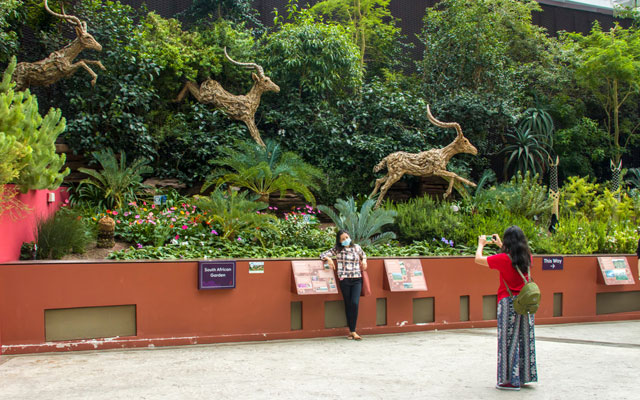
For instance, locals wishing to explore Marina Bay may choose a staycation-attraction package curated by travel agent The Traveller DMC that features Mandarin Oriental, Singapore, and Gardens by the Bay. In the heritage district Kampong Gelam, The Sultan and Tribe Tours have paired up to offer a staycation and Instagram photography tour of areas such as Bugis and Waterloo Street.
Around a quarter of these promotions were curated by local travel agents such as The Traveller DMC and Gourmet Trails, who have pivoted and rallied with industry partners to design promotions for the domestic market.
More offers will be added in the coming months, and tourism businesses may submit their proposed promotions via STB’s Tourism Information and Services Hub.
STB has also designed customisable itineraries to help locals plan mini-holidays of up to three days within each precinct. These itineraries suggest recommended hotels, attractions, tours, as well as retail and dining offerings in each district.
For instance, locals can stay at Hotel Soloha or Oasia Hotel Downtown Singapore and explore the Chinatown precinct on a Trishaw Tour by Trishaw Uncle or a Red Clogs Down the Five-Foot Way tour by Journeys. Those looking for an island retreat on Sentosa can stay at The Barracks Hotel Sentosa or Capella Hotel Singapore, join a kayak fishing tour, and dine at the Ocean Restaurant, touted as South-east Asia’s only permanent underwater aquarium dining experience.
Since the launch of SingapoRediscovers in July, more than 100 businesses – across hotels, attractions, tour operators, retail and F&B – have offered over 600 promotions.
A tourism mission for conservation
Covid-19 has exacted massive damage to world economies as well as the travel and tourism industry, but it is just one of many alarms Nature has sounded, from wildfires and droughts to hurricanes and floods, to retaliate against mankind’s excessive takings from planet Earth.
Conservationists are emphasising that it is in the travel and tourism industry’s interest to protect the environment – the beauty of which is their income generator.

The good news is, some businesses in the industry are already working towards positive change. They include World Wildlife Fund’s collaborations with organisations such as Ctrip, Royal Caribbean Cruises, Hilton Worldwide, and Intrepid Group; Everland’s work with Keo Seima Wildlife Sanctuary in Cambodia where community-based Jahoo Gibbon Camp brings in tourism dollars to improve the lives of natives; and Cardamom Tented Camp, a three-way initiative between The Minor Group, YAANA Ventures and Wildlife Alliance to fight against land and wildlife loss in Cambodia’s Botum Sakor National Park.
In this fifth article by TTG Asia Media for PATA Crisis Resource Center, TTG Asia‘s Pamela Chow and Karen Yue find out why continued environmental degradation is devastating for the world’s travel and tourism industry, what has been done to reverse the damage, and what more is needed.
What has habitat loss got to do with tourism? is now available at PATA Crisis Resource Center.
How hoteliers can bounce back post-Covid

More than a hundred million travel and hospitality jobs will be lost in 2020 due to Covid-19. The devastating impact of that number can only be upstaged by the profound loss of life, globally.
Here in Phuket – where I moved in 1988 as the opening general manager for Amanpuri, Aman’s first-ever resort – we have seen as many as 60,000 job losses in the hotel sector alone, and it’s a similar story on other island destinations around the world.
More than four months have passed with no local infections on Phuket. Yet passenger arrivals have plunged and there are no imminent signs of recovery, despite the country opening up to domestic air travel and guests from Bangkok becoming our “weekend warriors”.
Thailand – the first country to detect the coronavirus outside China – deserves high praise for its decisive actions in late March that successfully stopped the spread of Covid-19. But by closing the tourist-friendly kingdom to all non-resident foreigners, the country’s leading resort island now finds itself at an inflexion point. Local demand cannot stem the dramatic losses on Phuket with its 86,000 registered hotel rooms, nor reverse the rapidly escalating financial and social crisis across Thailand, where the World Bank estimates tourism accounts for 15 per cent of GDP.
What I know – from leading Amanpuri through the 1997 Asian financial crisis, then helping create and operate Trisara resort for 20 years through SARS and the 2004’s Boxing Day tsunami – is that we cannot continue to stand still indefinitely and we need to get safely back to business.
From the very earliest days at Amanresorts, the founder Adrian Zecha schooled his general managers to personally engage with every guest as though they were friends in our own homes. These relaxed, informal conversations led guests to feel more relaxed and trust that the entire experience wasn’t purely transactional.
I learned that ours is a business built on meaningful human connections, and as we emerge from this Covid-19 crisis, creating even more exceptional and surprising moments will be even more important as travellers start to move again in 2021.
Now as president of the Phuket Hotels Association, I work with our 78 members to prepare for the inevitable return of international arrivals. After several aborted plans, the Thai government is currently discussing ‘green bridges’ that may allow entry to foreigners from countries or regions with little or no Covid-19 infections, hopefully from countries such as New Zealand, Singapore, Taiwan as well as parts of China and Australia.
As we face these hurdles in the race towards a new normal, I believe those of us in this incredibly complex business of making people happy should consider a more compassionate and thoughtful guest-centric approach to policies.
Whether or not the Thai government’s trial run to relaunch tourism works – and I hope it does – it’s going to be a buyer’s market for years as we already had an oversupply of hotel rooms in many areas.
With this in mind, I propose we offer a new Guest Bill of Rights.
- Frontline staff needs to be more empowered to make decisions, such as giving guests reasonable refunds or credit when they complain about an actual mistake. We all know the feeling of irritation at check-out when, with your flight take-off time looming, the reception staff disappears to ask an invisible manager about removing an erroneous charge for that Toblerone you didn’t eat.
- Overcharging for cookie-cutter minibars is over. We can and should customise the minibar with healthy (and not so healthy, this is a holiday after all) options including authentic, hygienic and plastic-free packaged local treats. Guests would buy more too, as mini bars are mostly poor investments. My favourite is the totally free local New York mini bar at The Greenwich, Robert De Niro’s hotel in New York.
- No more ‘nickel and diming’ on the hotel bill. We owe it to our guests to stop profiting off necessary conveniences like faster water with breakfast, Internet and hotel laundry.
- Goodbye to 50 per cent or even 100 per cent room charges for late check-outs. Let’s be better at allocating rooms. There should always be a private space for guests who arrive before 14.00 and if hotels are not 100 per cent full, guests should be able to leave after midday without being whacked with a half-day charge.
- Breakfast should be included, full stop, and let breakfast finish late. Since there is nothing more luxurious than a long, relaxed breakfast on a holiday, guests should not have to rush down to their first meal of the day simply because the chef wants to start prepping for lunch at 10.00.
- We can and must protect our guests and the planet at the same time. Drinking water should be in glass bottles, plentiful and complimentary. There must be an unilateral end to plastic shampoo bottles and laundered garments shrouded in cling plastic have to go. In Phuket, we challenged our member hotels to remove plastic water bottles in 2018, which resulted in a reduction of six million plastic bottles from our landfills.
Our industry’s humble beginnings offer valuable lessons for any hotel’s future success. What was not optional for a medieval innkeeper should guide the 21st-century hotelier: buy local, being supportive of our local communities, engagement with and protection of the local environment.
Are you checking in?
Digital Travel APAC returns with a virtual run this December
Asia’s topmost digital travel experts will convene online this year at the fifth edition of Digital Travel APAC, taking place on December 8 and 9.
The flagship conference and networking event will be held entirely online to ensure the ease of access and safety of all its attendees. Content will focus on continuous innovation and progress in the aftermath of the Covid-19 pandemic, and the delivery of safe yet great travel experiences.

Attendees will actively connect with top minds from Asia’s most successful airlines, hotels, OTAs, meta-search platforms, tours and activities, car rentals, cruise lines and tourism boards. The myriad of travel verticals, coupled with a strong profile from the attending delegates will enable high level peer-to-peer discussions throughout the event.
Building upon the success of the previous virtual outing, Digital Travel’s last virtual summit for the year will feature more than 30 speakers and at least 10 cutting-edge technology companies with peer-to-peer interactivity built into its core. More than 300 attendees are expected.
Programme highlights range from one-on-one video meetings and powerful keynotes, to all-star panel discussions and intimate ‘live’ roundtables and think-tank sessions.
A powerful new platform will allow all delegates to seamlessly transit between sessions and connect with fellow attendees and speakers directly.
Travel, OTAs and metasearches executives enjoy free access to the main conference.
Registration is now open.
TTG Conversations: Five questions with Uzaidi Udanis, Tourism Productivity Nexus
A company’s productivity and efficiency are especially tested in challenging times, but business owners are able to improve on these aspects without incurring high costs and making large investments in cutting-edge technologies.
In this new episode of TTG Conversations: Five questions video series, Uzaidi Udanis, chairman of Tourism Productivity Nexus and president of the Malaysian Inbound Tourism Association, shares ideas on what the travel trade can do to maximise their productivity while at the same time keep costs down and stay relevant.


Hilton’s Waldorf Astoria Hotels & Resorts has signed a management agreement with developer Mitsui Fudosan to open the first Waldorf Astoria in Japan come 2026.
Located within a planned mixed-use development that will include office and retail spaces as well as luxury apartments, Waldorf Astoria Tokyo Nihonbashi will span nine stories, from levels 39 to 47.
The hotel will feature 197 guestrooms, three restaurants, and the brand’s signature Peacock Alley lounge and bar. Guests will also have access to an indoor pool, spa and fitness centre, while the hotel’s 583m² of meetings and events space includes a ballroom and chapel for special events.