

The launch of Cambodia’s alternative state quarantine (ASQ) hotel scheme is a welcome move following a raft of complaints over varying standards of quarantine options, said tour and hotel operators.
In April 2020, Cambodia introduced a mandatory 14-day quarantine for all arrivals. This was only available at registered hotels randomly allocated upon landing at Phnom Penh International Airport, with standards vastly varying.
Nick Ray, Hanuman Travel product director, said: “For more than a year, it was a lottery and a lot of people don’t like to gamble. It really was a lucky dip, where for some people it went well, and for others, really badly.”
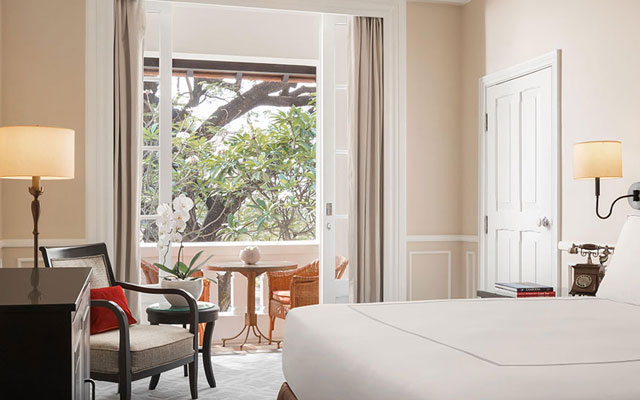
In July, the government introduced an ASQ hotel scheme, with four properties registered to date: Sofitel Phnom Penh Phokeethra, Raffles Hotel Le Royal, Sokha Phnom Penh Hotel & Residence, and Courtyard by Marriott Phnom Penh.
Under the scheme, travellers on a business visa and Cambodians can choose where they stay for the 14-day quarantine period. Prices start from US$1,806 (Sokha) and include a choice of meals from the hotel menu and two PCR tests.
Ray said: “There were a lot of complaints previously about room size and quality, but what was really picked up on and shared across social media was the food standards. With the ASQ scheme, you have guaranteed quality.”
The introduction of the scheme has also proved a welcome boost for hotels that have been left virtually empty since the start of the pandemic.
Garth Simmons, CEO, Accor Southeast Asia, Japan and South Korea, said Raffles and Sofitel have seen a “positive trend” since the hotels signed up to the scheme in August. He noted it is mainly dignitaries and high-level business executives who check in.
Added Simmons: “We are optimistic that business will improve in Q4 and we would expect loosened arrival restrictions early next year with the reopening of the country.”
Marriott also noted a large number of quarantine bookings from existing and new clients.
While the scheme has been a welcome addition, Sinan Thourn, chairman of B2B Cambodia and PATA Cambodia, said there needs to be more choice added to the luxury hotels currently on the scheme.
He remarked: “You can’t limit the choice. The government should open more options, such as three- and four-star properties, and get the private sector involved, especially DMCs and travel companies, who are qualified to provide these services and recommendations.”















Pan Pacific Hotels Group (PPHG) plans to launch 13 new properties across 10 key gateway cities including London, Hanoi and Phnom Penh by 2024.
The expansion will see the addition of more than 3,300 rooms to the group’s inventory, bringing its portfolio to 48 properties across 29 cities.
PPHG is a member of Singapore-listed UOL Group Limited. The move will see the group establish its presence in key gateway cities, including London, Kuala Lumpur, Jakarta, Dalian, Hanoi, Phnom Penh, and Siem Reap.
Among the 13 properties to open is the Parkroyal Collection Kuala Lumpur, which will mark the sustainability brand’s first opening beyond Singapore when it debuts in June 2022.
Located in the heart of Bukit Bintang, the Parkroyal Collection Kuala Lumpur will be a beacon of green design, sporting a lush green facade made up of 78 sky planters and roof terraces showcasing 1,207m² of plants and trees. The hotel will also feature a wellness floor, comprising a spa, a gym and fitness studio, as well as a pool.
The Parkroyal Collection Kuala Lumpur complex will also house Pan Pacific Serviced Suites Kuala Lumpur, catering to long-stay guests. Other new openings in Malaysia in 2022 include the expansion of its Parkroyal resorts portfolio in Langkawi and Malacca. The 301-room Parkroyal Langkawi Resort has a direct beach front, with meeting facilities and a beach club. The 418-room Parkroyal A’Famosa Melaka Resort will see a upgrade as well as new builds offering relaxed accommodation choices.
The group will also plant its flag in Indonesia with a cluster of properties in its capital city, Jakarta. Over the next three years, Parkroyal Jakarta, Parkroyal Serviced Suites Jakarta, and Pan Pacific Jakarta will open within the Thamrin Nine, combining commercial spaces, entertainment, and retail offerings within an integrated environment.
Come 4Q2022, PPHG will open Pan Pacific Orchard, touted as “Singapore’s first zero-waste hotel”. The property will feature foliage covering more than 300 per cent of the hotel’s land area, alongside four thematic sky gardens: Forest Terrace, Beach Club, Secret Garden and Cloud Terrace. The 350-room hotel will employ a rainwater harvesting system, a recyclable water system, and a compactor that transforms food waste into nutrient water for the hotel’s sky gardens.
Marking its next move into China for 2022, PPHG will introduce the country’s first Parkroyal hotel in Dalian, a major sub-provincial city in Liaoning Province. Towering at 52 levels, Parkroyal Dalian will be located on Youting Road, which offers connectivity to Xinghai Square, Dalian World Expo Centre and Dalian Xinghai Convention & Exhibition Centre.
The group will also increase its strength in Indochina to a total of nine properties in the region by 2023. It will make an entry into Cambodia’s capital city with Pan Pacific Phnom Penh, and into the famous city of UNESCO World Heritage site of Angkor Wat with Parkroyal Siem Reap.
The 212-room Pan Pacific Phnom Penh will be situated in the Norodom Boulevard, while the 130-room Parkroyal Siem Reap will be a 10-minute drive from the gates of Angkor Wat.
In 2022, the group will further expand its serviced suites portfolio within the region. Parkroyal Serviced Suites Hanoi will open in the Westlake area, featuring 126 suites with lake views; while Parkroyal Suites Bangkok will occupy a prime location on Sukhumvit Soi 6, within walking distance of Nana BTS sky train station.