Japan’s reopening to international travellers this month and the current favourable yen exchange rate have prompted travel agencies in Singapore to roll out attractive packages to satiate pent-up demand for the Land of the Rising Sun.
Since Japan announced in May that it will reopen from June 10 to tourists from 36 countries, including Singapore, tour companies have sprung into action.
Travellers are advised to book in advance and beat potential airfare hikes for flights to Japan
Even with the higher number of procedures required currently for an organised tour to Japan, travel agencies expect the interest to remain strong into 2023.
For Chan Brothers Travel, one of Singapore’s largest travel agencies and tour operators, the strategy is multi-pronged. According to its spokesperson, Jeremiah Wong, the agency has launched longer tours that pack in enriched content to showcase the country’s offerings in greater detail.
The agency is also the first to introduce seasonal itineraries such as autumn, winter, and ski holidays to Hokkaido, as well as Sakura tours for April 2023.
On top of that, Chan Brothers Travel offers exclusive small group tours to Japan, capped at nine people – perfect for travellers who want more privacy with family and/or friends.
Wong said the agency is encouraging travellers to book in advance and beat potential airfare hikes by offering a time-limited offer of 50 per cent off the second traveller. Early bookers can also enjoy free cancellations and flexible refund policies.
A quick scan of the Internet reveals that a round-trip economy class flight on Singapore Airlines for the week before Christmas will set one back over S$3,000 (US$2,158.80). A flight with the same carrier for the same period in 2019, albeit booked in March the same year, cost under S$1,000.
Rising fares aside, travel agencies like H.I.S. International Travel are determined to appeal to tourists with its local expertise and extensive programmes.
Yusaku Koike, Singapore branch manager, H.I.S. International Travel, said: “The response has been overwhelming as people are thrilled to travel to Japan again. We have a few different itineraries to target different groups of travellers. For instance, our autumn itinerary is for those who want to catch the autumn maple leaf season, and our itinerary to Osaka caters to people who enjoy shopping.”
Koike told TTG Asia that H.I.S. has offices across Japan, and its connection with the Japan government and local prefectures means “we are able to provide not only a comprehensive itinerary but also exclusive services and information that travellers need, such as visa applications and immediate assistance from our Japan branches”.
Mike Harlow, general manager of luxury travel specialist Scott Dunn Asia, said: “It’s pretty clear that Japan will continue to be a popular destination – we are currently working to further expand our product and property offerings to bring more exclusive experiences that would appeal to our guests when the destination opens up for private tours and visits.”
Trip.com is the first to implement Amadeus Travel Safety Conditions in partnership with Riskline as part of its commitment to deliver an exceptional customer experience by instilling full confidence back into the traveller journey.
Amadeus Travel Safety Conditions is a fully-digital solution that provides online players accurate information on Covid-19 risk levels along with general rules and safety measures.
Trip.com customers will receive real-time status updates about travel-related matters
Since 2020, Riskline has been closely tracking the development of the Covid-19 situation and communicating in real-time intelligence to its clients and partners via alert messages, travel advisories, special reports, and informer articles.
Meanwhile, Trip.com customers will receive real-time status updates about their travel destination, airport entry policies, post-arrival quarantine and testing requirements, Covid-19 travel passes, and any mandatory travel health insurance required. The data feed will also provide detailed Covid-19-related information for each country, including how countries respond to the crisis and its impact on travel.
Yudong Tan, CEO, flight business unit, Trip.com said: “Trip.com’s priority during this period of travel recovery is our commitment to safety for our customers. With Amadeus Travel Safety Conditions, we can facilitate efficient, safer and cleaner trips with up-to-date dynamic information in multiple languages, so that they are well prepared for travel with peace of mind throughout their entire journey.”
Frederic Barou, senior vice president, search & online, travel distribution, Asia-Pacific, Amadeus shared: “Amadeus is committed to making travel easy and safe, that’s why we have built a trusted Safe Travel Ecosystem with industry players and relevant authorities.”
Amadeus Travel Safety Conditions covers more than 200 countries and territories, and will support new languages – Chinese, Japanese, Korean, Bahasa, German, and French – during the second half of 2022.
Qantas Airways has reintroduced on June 20 its First Class offering to customers travelling to and from Singapore with the return of its superjumbo A380 aircraft and the reopening of its First Lounge at Changi Airport.
The First Class offering is available on flights between Australia and Singapore, and Singapore and London. There are 14 First Suites and an on-board lounge in a supper club style with seating for 10 people and a snack menu.
Qantas’ First Lounge at Changi Airport offers a fine dining experience
Qantas has also re-opened its First Lounge at Changi Airport, which was launched in December 2019 and became one of the most popular lounges on the Qantas international network. It operated for only three months before closing due to the pandemic.
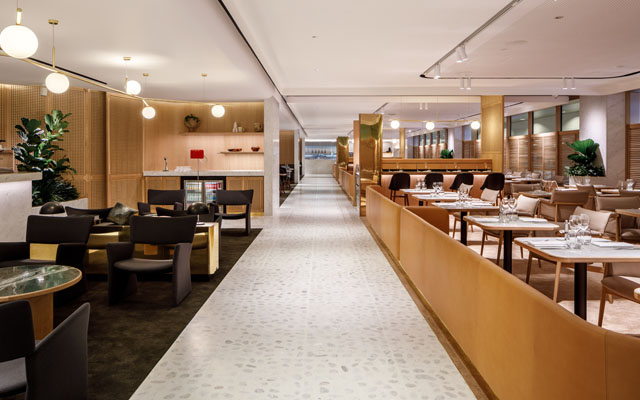
The 1,000m² First Lounge has capacity for 240 guests and offers a fine dining experience with a menu inspired by Singapore’s vibrant dining scene. Featured dishes include signature laksa with crayfish and rice noodles, barramundi with sambal browned butter, and shrimp-paste chicken wings.
The Carrara marble bar has an extensive beverage menu offering champagne, barista coffee and cocktails like the Merlion Blush.
The lounge features zones for dining, working and relaxing as well as 10 shower suites.
The First Lounge operates alongside the existing Qantas Business Lounge.
Stephanie Tully, chief customer officer, Qantas Group, said: “We’d only just opened our brand-new First Lounge before the pandemic forced its closure. Many of our Frequent Flyers never had the chance to see it.
“We’re delighted to once again welcome our customers back to this beautiful lounge at Changi Airport. Our lounge team is excited to be back and eager to offer the warmest hospitality to Qantas and our partner airline customers.”
She added: “Singapore plays an important role in Qantas’s worldwide network as we continue to ramp up capacity in line with strong travel demand. It’s great to have our First offering back both in the air and on the ground at Changi Airport, which is consistently recognised as one of the best airports in the world.”
Wink Hotels is set to open two new hotels in Vietnam’s coastal city of Danang. Wink Hotel Danang Centre is slated to open by the end of 2022, while Wink Hotel Danang Riverside hotel is due early 2023.
With hospitality focused on streamlined services, technology-driven stays, sustainability, and space-smart rooms, Wink debuted its first property in Ho Chi Minh City in March 2021. The two hotels in Danang will mark the next steps in Wink’s plans to expand with 20 hotels in Vietnam by 2029.
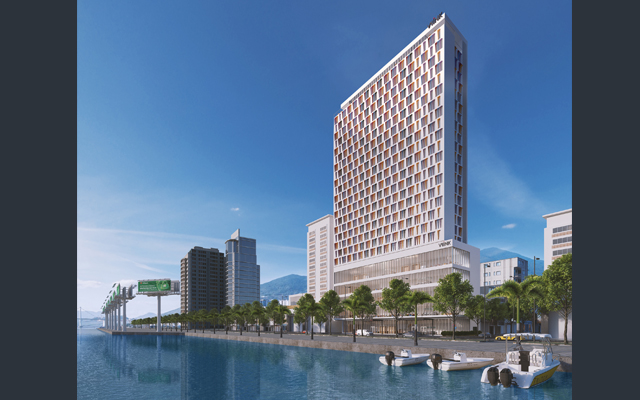
Wink Hotel Danang Riverside is situated along the Han River
Wink Hotel Danang Riverside will offer 287 hotel rooms and 70 Wink Suites, with a 60m-long lobby on the fifth floor facing the Han River, three floors of restaurants, bars and entertainment facilities, a rooftop bar and pool, as well as a co-working space.
Wink Hotel Danang Centre is a 244-room hotel with a 19th floor sky lobby. It will offer 30 family rooms and a one-bedroom apartment.
Accor has signed a management agreement with Samty K.K. for the opening of Mercure Haneda. Slated to complete in 2023, the 363-key property is the first international airport hotel close to Tokyo’s Haneda Airport.
Mercure Haneda will join Accor Japan’s network of 18 hotels and become the eighth Mercure hotel in the country.
Mercure Haneda will be the eighth Mercure hotel in Japan
The hotel will be located within a 10-minute drive from Haneda Airport and a few hundred metres away from Otorii Railway Station. The hotel is a short stroll to Anamori-inari Shrine, Haneda Innovation City, and local eateries.
“Accor has remained committed to expanding its footprint in Japan and has built up a network of 18 hotels in eight destinations. Mercure Haneda will be an exciting addition to its portfolio. Visitors are attracted to Japan as it has long been Asia’s important hub of business, innovation, and culture. The tourism industry is becoming one of the major economic engines for the country and we anticipate increasing arrivals in the coming years,” said Garth Simmons, CEO, Accor, South-east Asia, Japan and South Korea.
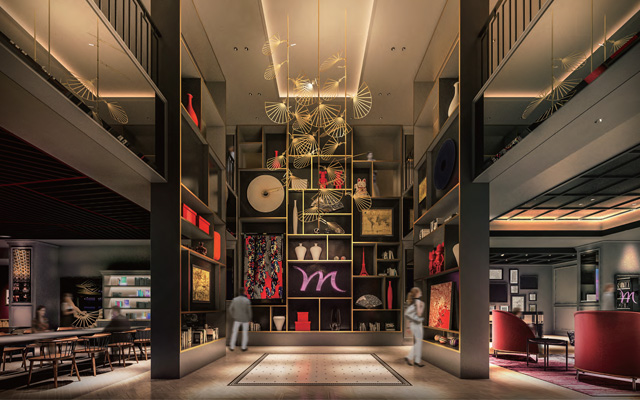
Mercure Haneda will feature a variety of offerings, including a restaurant, bar, fitness centre, three meeting rooms, and lounges for guests and crews. Design elements will highlight the tradition and handicraft, history of the Haneda neighbourhood, and Japanese sub-cultures.
To celebrate its reopening on July 1, Singapore Marriott Tang Plaza Hotel has launched two staycation packages.
The Ultimate Urban Staycation includes a stay in the contemporary guestroom, complimentary breakfast for two, and S$100 (US$72) F&B dining credits. Prices start from S$395++.
Singapore Marriott Tang Plaza Hotel offers two staycation packages to celebrate its reopening
The Ultimate Family Staycay comes with children-friendly arrangements, such as the M Passport Wallet, which contains an activity map, and free dining for little ones up to 12-years-old. The package includes complimentary breakfast for the family. Prices start from S$420++.
Guests can also enjoy an international buffet at Crossroads, where breakfast and lunch are priced from S$48++ per adult and S$28++ per child.
Marriott Bonvoy members can also earn and redeem points for their stay.
Four Seasons Hotel Hong Kong has named Christian Poda as regional vice president and general manager.
A seasoned hotelier and business leader with 23 years of global luxury hotel experience, Poda will supervise the completion of Four Seasons Hotel Hong Kong’s renovation. He will also oversee operations at Four Seasons Hotel Guangzhou, Shenzhen and the upcoming opening of Four Seasons in Suzhou.
Prior to his latest appointment in Hong Kong, he was general manager of Four Seasons Hotel Beijing, where he welcomed important dignitaries to the hotel during the Beijing 2022 Winter Olympics.
Louis Sailer is the new senior executive vice president of The Imperial New Delhi.
He brings with him an extensive multi-cultural business management background, having turned around global luxury hospitality brands and operations in Germany, Japan, Singapore, China, London, California, Hawaii, the Caribbean and India.
Greater personalisation needed for airlines to bring back the romance of air travel
Data collection and understanding can present new business opportunities
Access to customer data will come with greater quality of service expectations
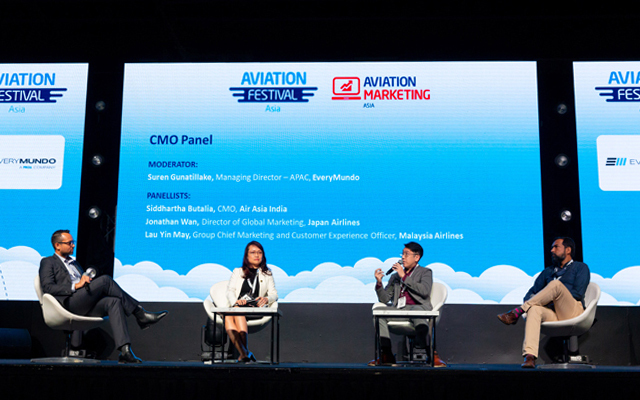
Travel disruptions posed by the pandemic have present opportunities for airlines to demonstrate that they are more than just a mode of transport, and are also means to facilitate connections and link people with their families, friends and businesses, opined industry specialists on the CMO (chief marketing officer) Panel at the Aviation Festival Asia 2022 held last week in Singapore.
Marketers from AirAsia India, Malaysian Airlines and Japan Airlines also discussed a range of topics from digitisation, to building trust and leveraging new opportunities. Suren Gunatillake, managing director, APAC of EveryMundo, sat in as moderator.
Airline marketers say digitisation and data mining can improve customer engagement
The consensus was that despite disruptions to air travel, the industry has lived up to its reputation of being resilient. It has been able to adapt and even take a step back to understand where it is flying towards.
“I think what we have learnt is to be really agile… (to) innovate and do new things,” said Lau Yin May, group chief marketing and customer experience officer of Malaysian Airlines.
“That is how you continue to engage with the customers and get them so excited to continue that association with the brand.”
Personalisation is the way forward
Siddhartha Butalia, chief marketing officer of AirAsia India, was candid in his sentiments about how the industry has done a disservice to itself over the last 30 to 40 years: “We have commoditised travel into transportation.”
Undoing this would mean explicitly expressing how airlines add meaning into consumers’ lives. One way to do so, he opined, is through personalisation. For this, digitisation is an enabler, not just in the business process but in the mining of data – everything from travel duration, destination, and the types of trips.
“It’s really important to make sure that we’re collecting data and using it to add value to that customer,” noted Jonathan Wan, Japan Airlines’ director of global marketing.
Wan added that customers would “have certain expectations” of the airline now that it possesses their information. “There is this understanding that ‘hey, I’ve given this information freely, and I expect this personalisation’,” he elaborated.
Butalia agrees that consumers are now more conscious than ever of the data they are sharing and if they are doing it, brands must provide something in return.
Drawing upon an example of a recent loyalty campaign AirAsia India ran, Butalia said it invited consumers to “join the family” and conveyed the point that “being part of a family is supposed to be a rewarding experience”.
“What we’re also saying is that you can share a lot of personal information… because we are a brand that you can trust,” he said.
Malaysia Airlines created 257 new products since the start of the pandemic, one of the enduring ones is the MHexplorer
Wide ranging data application
Panellists reflected that data collection and understanding can bring multiple advantages to airlines and set them down paths to new business opportunities.
Data led Japan Airlines to focus on repatriation support for business travellers, and to strengthen its position as a carrier between Asia and the US.
In analysing data, Malaysian Airlines created 257 new products since the start of the pandemic. Of these, seven are still in use today, including the MHexplorer, a fully digitalised travel programme for students.
Lau reflected: “We know two things. One, our team is really good, they can do this stuff overnight. Two, we have a much better understanding of our consumers, what appeals to them, and how we can use this (experience) as a learning (point for) future product development.”
Understanding data obtained from organic searches during the pandemic also helped airlines to better respond to consumer needs.
“We were able to look at what people were searching for and make quick inclusions of these keywords,” said Wan.
For instance, in the early days of the pandemic, consumers were looking for things like “flexible ticketing” and “free changes”. Japan Airlines immediately saw to it that these key words were added to its web pages.
Over at AirAsia India, it was observed that traffic from online check-ins had tripled, informing the airline of changes to website usage and a growing preference for more direct engagement with the brand, shared Butalia.
Elaborating on the value of direct customer engagements, Wan said Japan Airlines partnered with Chinese online travel agents to create flagship stores in China that allow customers to purchase a ticket without friction.
Booking.com launched its inaugural APAC Travel Confidence Index, providing a snapshot of how confident consumers feel about exploring the world again, as well as whether they would welcome inbound travel. The commissioned research polled 11,000 travellers from 11 countries and territories across Asia and Oceania between April and May 2022, combining this with the company’s proprietary data and insights over the past 25 years.
The Travel Confidence Index explores the overall comfort levels, motivators and concerns of consumers across the Asia-Pacific and how this varies across the region. While there is a strong overall desire to travel more sustainably, the research also showed the more pragmatic considerations of travellers, such as cost and variety of sustainable stays, which impact whether sustainable intent ultimately translates into action.
India emerged most confident with 86% of India travellers stating they intend to travel in the next 12 months
As Asia starts to emerge from several years of strict border closures and lockdowns, the diversity in terms of consumer travel sentiment and confidence across the Asia-Pacific has certainly become more pronounced.
Travel confidence market ranking
Across the 11 markets polled, India emerged most confident with 86% of India travellers stating they intend to travel in the next 12 months; followed closely by Vietnam and China. South Korea, Taiwan and Japan ranked lower on the index in terms of overall confidence, although travel intent among respondents remained above 60%.
The research indicates that Indian, Vietnamese and Chinese respondents were most willing to put up with and/or overlook key travel deterrents in order to travel, such as enduring disruptions and travel costs; as well as confidence with their home countries/territories in receiving inbound travellers. However, 82% of Japanese respondents expressed uncertainty with their country’s preparedness to safely receive international travellers and border reopening (75%).
Singapore ranked sixth on the Travel Confidence Index despite having some of the most eased border restrictions in comparison to many markets across the region. Key factors that impacted Singapore’s standing in the index included general aversion towards any disruptions to their travel (65%), sharing personal information for public health and safety (57%) and personalisation (45%).
When it came to looking at how far Singaporeans would travel, 69% of respondents stated that they planned to take trips (of up to eight hours’ flight) to popular holiday destinations closer to home, such as Thailand and Indonesia.
Top travel motivators
The desire to travel remains strong among Asia-Pacific travellers overall, with ease of planning and booking travel as well as cost being the top two considerations. Both ranked consistently high across all markets, even as restrictions continue to ease around the region.
The desire to “just get away” (46%) also emerged as the top motivator to travel for Asia-Pacific consumers after two years of lockdowns and a rapidly evolving travel landscape; followed closely by a “getaway to recharge mentally” for 36% of respondents. In fact, for Thailand, such retreats were the prime motivator for an overwhelming 76% of respondents, a percentage far higher than any other market.
Across the region, only 13% indicated that work was a reason for them to book a trip, despite many employees having returned to the office across the Asia-Pacific, which could bode a slower revitalisation in corporate vs leisure travel. In fact, for Australia, work was the least common reason for travel at 6%.
Top travel deterrents
The uncertainty due to the constantly evolving Covid-19 situation is evident among travellers, who shared their top concerns and what would prevent them from booking a trip. “Travel cost” was listed as the number one deterrent by 38% of all respondents. This was followed by the “fear of having to undergo quarantine” (37%) and the “possibility of getting stuck because of frequently changing border regulations” (37%).
Top concerns for several destinations varied quite significantly. In Singapore, China and Hong Kong, the top concern was the possibility of getting stuck at the destination because of new border regulations (61%, 53%, 55% respectively), while in Japan the top concern of 47% of respondents was falling ill while travelling.
When asked whether travellers accepted disruptions as being part and parcel of travel now, 47% of Japanese and 32% of South Korean respondents said no – the only two markets to do so.
Sustainable travel remains important
According to Booking.com’s 2022 Sustainable Travel Report, 81% of global travellers affirm that sustainable travel is important to them, with 50% stating that recent news about climate change has influenced them to make more sustainable travel choices.
India once again topped the index in terms of intent to travel sustainably, with 93% of respondents agreeing on the importance of making sustainable travel decisions.
On the other hand, for travellers from Australia, New Zealand and Japan, cost and a wide variety of sustainable stay options are core considerations when it comes to making sustainable travel decisions. Singapore showed a strong belief in the need to prioritise sustainable travel, with 77% of respondents indicating its importance.
However, the Travel Confidence Index found that for the Singaporean traveller, a combination of having a variety of sustainable options conveniently accessible at a good price point, together with sustainability measures undertaken by properties transparently displayed would go far in empowering them to make sustainable travel decisions.
Staycations look set to stay for Singaporeans
Staycations as an escape from daily life look to become part of the permanent vacation roster with 36% of Singapore respondents indicating that they would continue to book staycations for events such as family trips (46%), milestone celebrations (38%) or even as part of their self-care regimen (23%).
Cruises, however, look set to sail into the sunset with just 9% of respondents indicating that they would book one as their next trip, potentially hinting at the desire for Singaporeans to take flight and rediscover both new and old destinations.
With the country slowly shifting toward endemic living with Covid-19, Singaporeans look determined to make up for lost time and are ready to do their part to care for the places they visit.






 Prior to his latest appointment in Hong Kong, he was general manager of Four Seasons Hotel Beijing, where he welcomed important dignitaries to the hotel during the Beijing 2022 Winter Olympics.