To commemorate the milestone anniversary of the iconic Merlion on September 15 this year, The Fullerton Hotel Singapore is rolling out a month-long celebration beginning September 1.
The Merlion’s Golden Jubilee Experience is happening on September 9-10 and comprises a one-night suite accommodation for a family of four, Merlion-themed welcome cookies and pralines, one complimentary extra bed, late check-out, and Straits Club access and privileges.
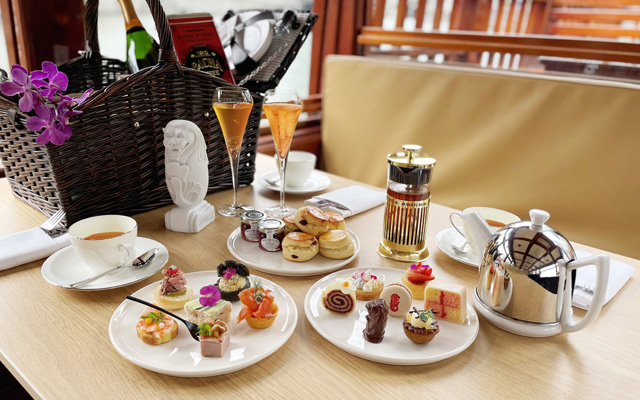
Celebrate the 50th anniversary of the Merlion at The Fullerton Hotel Singapore
Guests will also receive a Lion’s Pride Merlion Art Bundle set, and get to indulge in an afternoon tea for four onboard a bumboat that will ply Singapore River and Marina Bay.
In addition, there will be a light-up of the hotel façade every evening, a birthday cake-cutting event, and a selection of Merlion merchandise at The Fullerton Shop.
Priced from S$1,180 (US$854) per suite per night, bookings are open from now to August 31.
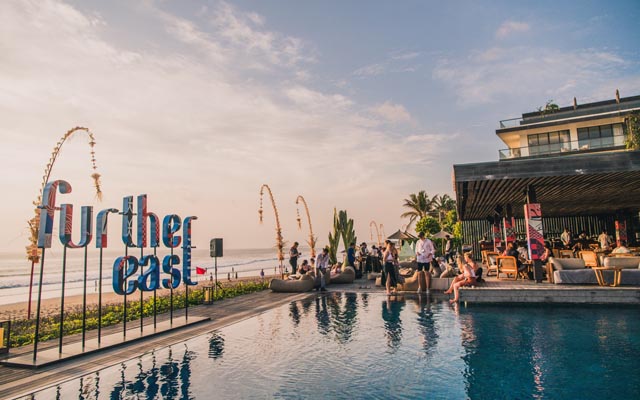
Further East’s third edition in Bali has sold out almost all its supplier spaces, while a majority of buyers have confirmed their attendance at the event.
Organised by This is Beyond, Further East will take place from November 7 to 10, and is predicted to set a new record in terms of attendance as the reopening of travel sees global interest in Asia-Pacific reach new heights.
Further East 2022 is predicted to set a new record in terms of attendance
This edition will also mark the show’s expansion to include new luxury exhibitors encompassing the entire region – many of which are well-attuned to wellness and sustainability.
More international buyers are expected to join this November; the current buyer attendance from Asia-Pacific stands at 24 per cent compared to 29 per cent from North America (Canada included) and 35 per cent from Europe. Up to 450 Asia-Pacific focused global buyers and suppliers in the region will also partake in this event.
Joining the elite list will be 20 exclusive international media, featuring senior editors and travel experts, with official partners including Alila Seminyak, Desa Potato Head, W Bali – Seminyak and The Legian Seminyak, Bali.
“We are immensely proud to be able to work with the most original, most iconic and most forward-thinking in the travel business through Further East,” said Serge Dive, founder of This is Beyond. “For months, we’ve pushed ourselves to provide industry and thought leaders with meetings, ideas and inspirational tools that will inspire all to explore the potential of travel and towards a united, more sustainable future.”
The event will include up to 42 pre-scheduled appointments for various business objectives, invitations to official lunches and evening parties with fellow thought leaders, as well as express workshops for transformative business insights between meetings.
2022 will also see the launch of Open House by the House of Beyond; the event replacing the well-attended AWAKEN, Further East’s distinct and immersive ‘un’-conference.
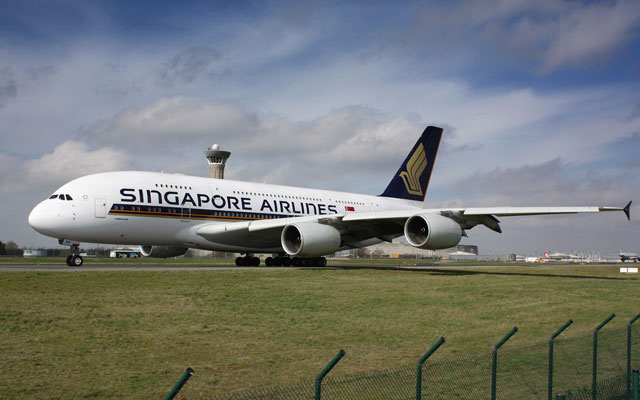
The Singapore Airlines (SIA) Group has reported a first-quarter operating profit of S$556 million (US$402.9 million), as travel demand rose sharply after Singapore fully reopened her borders to vaccinated travellers in April this year.
This is the group’s second-highest quarterly profit in its history, and a S$623 million improvement from the S$67 million loss in the previous quarter.
SIA and Scoot carried 5.1 million passengers during the quarter, up 158.2 per cent from the previous quarter
On a year-on-year basis, this was better by S$830 million from the previous year’s operating loss of S$274 million.
SIA and Scoot carried 5.1 million passengers during the quarter, up 158.2 per cent from the previous quarter and fourteen-fold higher than a year before.
Passenger traffic and load factors were robust across all cabin classes and travel segments, as well as all regions except East Asia where border restrictions remain in certain markets.
SIA’s quarterly revenue per available seat-kilometre was 10.2 cents, a record for the full-service airline.
Passenger flown revenue rose S$1,456 million (+119.3 per cent) quarter-on-quarter to S$2,676 million on the back of a 126.7 per cent growth in traffic.
Passenger load factor rose 34.1 percentage points to 79.0 per cent, the highest since the onset of the pandemic, as the traffic growth outpaced the capacity expansion of 28.9 per cent.
In a press statement, the group said travel demand is expected to remain robust in the near-term as it heads into the year-end holiday travel period, with forward sales staying buoyant for the next three months up to October 2022.
However, inflationary pressures including elevated fuel prices remain a concern, while rising interest rate and slowing economic growth around the world, including the group’s key markets, pose risks to travel recovery.
Raising the Tourism Goods and Services Tax (T-GST) to 16 per cent from 12 per cent effective next year would significantly impact Maldives’ tourism performance, particularly at a time when destination competition is intensifying post-lockdown, said industry stakeholders.
Abdulla Ghiyas, president of the Maldives Association of Travel Agents and Tour Operators (MATATO), said the government’s decision to raise taxes “is not a wise move”, stating that businesses would be “severely affected” as Maldives is already “a pricey destination and airfares are also increasing”.
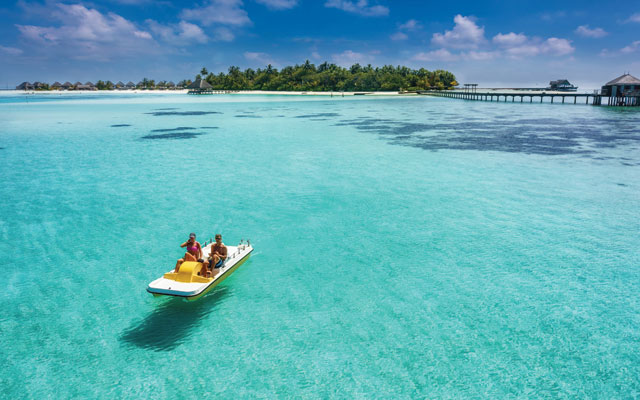
Tourism tax will increase further, putting the Maldives at risk of losing out to competing beach destinations that have reopened their borders
His views were echoed by Mohamed Khaleel, CEO of Pulse Resorts and CEO of Manta Air, who noted that the government has not done a proper evaluation of the situation.
Khaleel told TTG Asia: “We had good tourism growth but that was when other destinations were closed due to the pandemic. Now the world is opening (up), including our competitors like Mauritius, Seychelles and Zanzibar, which have beaches as beautiful as the Maldives.”
On July 5, finance minister Ibrahim Ameer not only announced the increase in T-GST, but also the general goods and services tax (GST) – which covers the domestic sector – from six per cent to eight per cent in 2023. The T-GST covers all goods and services provided by the tourism sector, including resort supplies, travel agency services, and domestic air transport for tourists.
The T-GST was first introduced at 3.5 per cent from October till December 2011. It was adjusted to six per cent in January 2012, eight per cent a year later, and then 12 per cent in November 2014.
The tourism industry has repeatedly raised concerns over the tax increment, saying it makes the destination costlier.
In a separate statement, MATATO said this may not be the optimal time to implement tax increments, and that the full implications should be taken into consideration, including its impact on the nation’s primary revenue generating sector: tourism.
Tourism accounts for 74 per cent of the gross national income and should be properly accounted for. As all the competing beach destinations have opened their borders, it is important to stay competitive, it said.
“Any price increases will magnify the existing negative impact of fuel increases on operations, air travel, and, most of all, demand for the Maldives’ products,” MATATO noted.
Philippine president Ferdinand Marcos, Jr has directed regional offices of the Department of Tourism (DOT) to work with their respective local government units to determine the extent of damage, and extend assistance to tourism-related establishments (TREs) affected by Wednesday’s earthquake.
The DOT’s infrastructure arm, the Tourism Infrastructure Enterprise Zone Authority (TIEZA), has also been tasked to explore support specifically for cultural and heritage sites impacted by the earthquake.
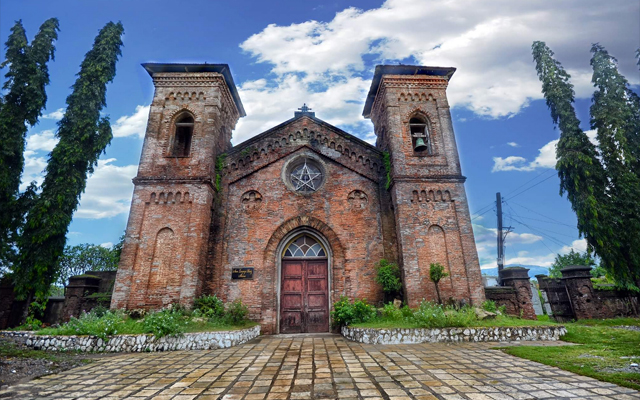
San Lorenzo Ruiz Shrine in Bangued, one of the oldest churches in Abra, suffered heavy damage post-quake
Initial reports note that at least two churches, declared National Cultural Treasure by the National Museum of the Philippines, are affected while several heritage and ancestral houses also sustained notable damage.
Other impacted tourism sites include the Vigan Cathedral in the Heritage City of Vigan in Ilocos Sur; multiple ground faulting in the popular Santa Ana Beach Area; and Lafaayette Luxury Suites Hotel and Crown Legacy in Baguio City.
Two properties managed and owned by TIEZA sustained damage as well. The riprap and ceiling of the Banaue Hotel and Youth Hostel in Ifugao partially collapsed, according to an initial report by the agency.
The quake also brought down the ceiling in the fireplace and lobby area of Mt Data Hotel in Bauko, while several hotel decorations were also damaged.
According to TIEZA, bookings for both impacted properties will be cancelled until a thorough assessment has been made.
DOT secretary Christina Garcia Frasco said in a press statement: “My concern and sympathy are one with those who have been affected by the recent earthquake in Northern Luzon. The Department will extend whatever help it can to tourism stakeholders and establishments that have been directly affected by this incident.
“Our resilience as a nation has already been tried and tested in the past. I am certain that this can be strengthened by the essential collaboration between our national agencies, local governments, and crucial stakeholders as we conquer our challenges.”
Klook and Singapore Tourism Board (STB) have joined forces to drive travel recovery across South-east Asia and promote Singapore as a choice destination.
The partnership builds on the collaboration agreement signed in 2020 and includes an integrated marketing campaign targeting travellers from key South-east Asian markets including Indonesia, Malaysia, Thailand, Vietnam, and the Philippines.
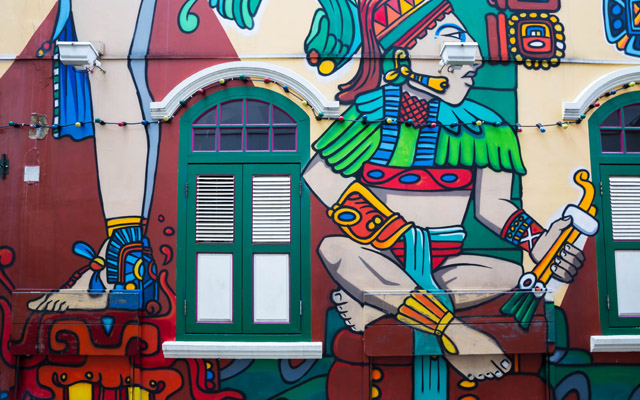
Klook’s Singapore campaign will showcase the lesser-known and unexpected sides of Singapore, with specially curated experiences centred around Singapore’s cultural precincts; Haji Lane pictured
Klook has planned a series of content produced with in-market Influencers, giveaways, special deals, and five unique landing pages to enable visitors to discover and book their trip seamlessly.
Visitors will be able to select from more than five Klook-exclusive Multi-Passes that centre around the themes of Attractions, Wildlife, Playgrounds, Adventure, and Wellness.
Marcus Yong, vice president marketing, APAC, Klook, said: “As travel roars back, we want to continue to enable travellers in South-east Asia to experience a sense of joy and wanderlust when they visit Singapore. As Asia-Pacific’s leading travel and leisure e-commerce platform, we are uniquely placed to help drive demand back to Singapore and lead travel recovery.”
John Gregory Conceicao, executive director, South-east Asia, STB, said: “We have seen strong demand for travel to Singapore from South-east Asia since we opened our borders to fully-vaccinated travellers without testing or quarantine.
“Visitors from South-east Asia accounted for nearly half of all international visitor arrivals in Singapore for the first six months of 2022 and continue to drive Singapore’s tourism recovery efforts. STB will continue to work with leading platforms like Klook to tap on new trends as we invite travellers to reimagine what Singapore has to offer.”
Klook has been supporting local merchants since the start of the pandemic, by increasing the number of Singapore experiences, events and accommodation options available. Today, the number stands at 1,200.
Bookings on the platform from South-east Asian markets in 1H2022 have grown month-on-month by an average of two to three times.
From left: OR's Rajsuda Rungsiyakull and Jiraphon Kawswat; Traveloka's Ferry Unardi at the signing ceremony
PTT Oil and Retail Business Public Company (OR) will invest in Traveloka through its subsidiary PTTOR International Holdings (Singapore), providing additional lifestyle solutions to OR customers and growth opportunities to both companies in domestic and international markets.
OR and Traveloka will seek new investment opportunities together with partners to provide more solutions to address customers’ needs.
From left: OR’s Rajsuda Rungsiyakull and Jiraphon Kawswat; Traveloka’s Ferry Unardi at the signing ceremony
According to Jiraphon Kawswat, president and CEO of OR, the company has chosen to focus on the travel sector as tourism is one of the major economic contributors to the Thai economy.
Kawswat said: “OR foresees many opportunities and possibilities that we can realise from this collaboration. Not only can this partnership provide new opportunities to OR in the travel sector, it can also provide additional venues for OR’s existing partners and business alliances to grow together with OR and to deliver greater offerings and experiences to OR customers.
“Given Traveloka’s position as a leading online platform for travel and lifestyle services in South-east Asia, as well as its strong technology capabilities, I believe there is a range of areas OR can explore together with Traveloka, to further enhance our tech capabilities.”
Ferry Unardi, co-founder and CEO of Traveloka, added: “We see immense value from the collaboration as we see the region growing at a rapid pace, leading to greater opportunities in the industry. We are excited to work with OR, with its expertise in creating great businesses with a customer-focused approach, to capture the demand and provide enhanced solutions to our customers, while also creating new opportunities for our merchant-partners in Thailand and the region.”
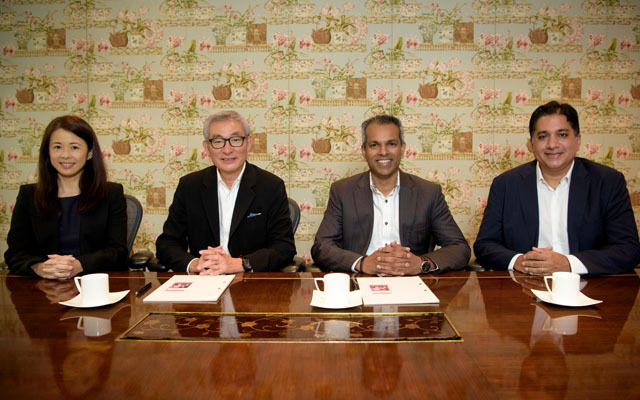
From left: STC Property Management's Hwei Yee Tan; Straits Developments' Eric Teng; IHG Hotels & Resorts' Rajit Sukumaran and Vivek Bhalla sign on an agreement to bring the Crowne Plaza brand to Penang
IHG Hotels & Resorts signs off two management contracts this week that will see it bring the first Crowne Plaza brand to Penang, Malaysia and a fifth hotel to Rajasthan, India.
In Malaysia, the partnership between IHG and STC Property Management will result in the 343-room Crowne Plaza Penang Butterworth Straits City, set within a sustainable high-end mixed-use development on the waterfront.
From left: STC Property Management’s Hwei Yee Tan; Straits Developments’ Eric Teng; IHG Hotels & Resorts’ Rajit Sukumaran and Vivek Bhalla sign on an agreement to bring the Crowne Plaza brand to Penang
Rajit Sukumaran, managing director, South East Asia and Korea, IHG said: “This signing underscores IHG’s commitment to further expand its footprint across Malaysia and grow its portfolio in strategic destinations.”
Crowne Plaza Penang Butterworth Straits City adds to an already impressive list of IHG properties scheduled to open in Malaysia in the next few years, most notably, Crowne Plaza Kota Kinabalu, Crowne Plaza Kuala Lumpur City Centre, Hotel Indigo Kuala Lumpur on the Park, and Kimpton Kuala Lumpur.
Over in India, Crowne Plaza Resort Pushkar will join four other IHG properties – two in operation and two under development – in Rajasthan.
Crowne Plaza Resort Pushkar will be a new-built property featuring 125 rooms and is expected to be operational by early 2026.
Located on the outskirts of Pushkar, the hotel will be well-connected to one of the most significant highways in India passing through Delhi, Mumbai and Jaipur. Set in a serene locale, the hotel will be an ideal choice for leisure travel and destination weddings.
Sudeep Jain, managing director, South West Asia, IHG Hotels & Resorts said: “We are thrilled to announce the signing of a new Crowne Plaza Resort in Pushkar which has become a hotspot for leisure and spiritual tourists visiting Rajasthan. The city’s growing popularity as a weekend and wedding destination also presents a great opportunity for us, and bringing our premium brand, Crowne Plaza to the city will help us cater to this increasing demand.”
He added that there is growing tourism potential in secondary Indian destinations, and the company is committed to “fill the need gap for quality branded accommodation in these cities”.
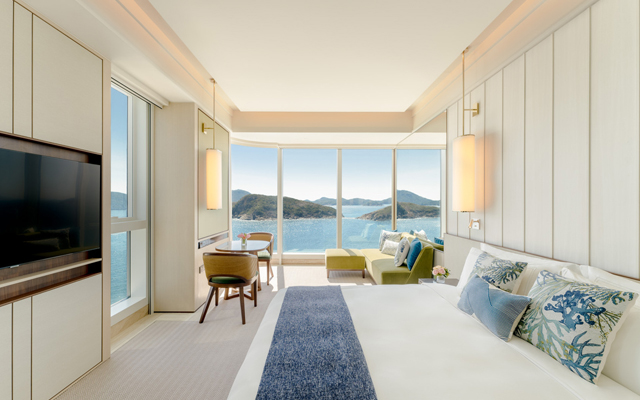
Fullerton Ocean Park Hotel Hong Kong, Hong Kong
The 425-key Fullerton Ocean Park Hotel Hong Kong sits adjacent to Water World Ocean Park, offering rooms with sea views, nine kids-themed rooms for families, and two top-level signature suites with a private pool and expansive outdoor terrace.
There are five dining concepts within the property – signature Chinese restaurant Jade, Lighthouse Lounge, Lighthouse Café, Satay Inn; Giardino, an oceanfront Italian restaurant, will open later this year.
Facilities include a gym, spa, infinity pool, indoor kids zone, kids lagoon, and event spaces.
Upon request, the hotel’s F.U.N. Desk will curate a range of Fun, Unique, Neigbourhood and Nature-immersive programmes for all guests. There are opportunities for children to learn about marine life and sustainability.
Selina Serenity Rawai Phuket
Selina Serenity Rawai Phuket, Thailand
Located on the coastline of Rawai, a village in south-east Phuket, Selina Serenity Rawai Phuket offers guests direct beach access and views of the Andaman Sea.
The 52-key hotel features a 24-hour waterfront coworking facility with a private pool, stunning rooftop yoga and wellness centre, beach club, and café HOWM Beach Bar and Kitchen that serves a Latin Thai fusion concept.
Accommodation choices range from ocean view suites to one- and two-bedroom apartments, as well as private cabanas with outdoor seating.
Admiral Hotel Manila – MGallery
Admiral Hotel Manila – MGallery, the Philippines
Admiral Hotel Manila – MGallery is set along Roxas Boulevard and is a portal to the city’s golden era of the early 1940s.
A 20-minute drive from Ninoy Aquino International Airport, the hotel features 123 rooms, including seven suites. Leisure facilities include a spa, rooftop pool, gym, and meeting venues. Pets are also welcomed at the hotel.
There are four dining options: Admiral Club Manila Bay rooftop restaurant; Coconut Grove rooftop bar; El Atrio for high tea with freshly baked pastries and beverages; and Ruby Wong’s Godown, a hand-pulled noodle joint.
Guests can explore places in the city as well as attractions like the Manila Cathedral, San Agustin Church, Ruins of San Ignacio church, Barrio San Luis, and the historic walled city, Intramuros.
Ace Hotel Sydney
Ace Hotel Sydney, Australia
The 257-room Ace Hotel Sydney is situated in the inner city neighbourhood of Surry Hills in New South Wales.
Rooms range from 22m² to 78 m², and feature double and king beds.
The hotel offers dining options from cocktails and wines at The Lobby, to daily meals at Loam restaurant. A café will open at a later date.
Ace Hotel Sydney also offers event spaces and private suites.
The Clan Hotel Singapore has created a new experiential stay package – The Clan Uncovers: Heritage & Craft – to engage guests as they learn about the city-state’s rich heritage and history.
The package includes a curated itinerary and a two-night stay in the hotel’s signature Master Series Premier Room, as well as daily breakfast for two, limousine transfer upon departure, late check-out, choice of one experiential activity for two, four-course dinner, and a complimentary local precinct tour (available on Wednesday or Saturday).
The Clan Hotel Singapore’s new experiential stay package lets guests learn about Singapore’s heritage and history
Experiential activities include a choice of a trishaw and bumboat ride by Uncle Trishaw or a Supermama Bento Workshop Experience.
Priced at S$995 (US$717), bookings are open from now till December 21 for stays between June 18 to December 30.












Philippine president Ferdinand Marcos, Jr has directed regional offices of the Department of Tourism (DOT) to work with their respective local government units to determine the extent of damage, and extend assistance to tourism-related establishments (TREs) affected by Wednesday’s earthquake.
The DOT’s infrastructure arm, the Tourism Infrastructure Enterprise Zone Authority (TIEZA), has also been tasked to explore support specifically for cultural and heritage sites impacted by the earthquake.
Initial reports note that at least two churches, declared National Cultural Treasure by the National Museum of the Philippines, are affected while several heritage and ancestral houses also sustained notable damage.
Other impacted tourism sites include the Vigan Cathedral in the Heritage City of Vigan in Ilocos Sur; multiple ground faulting in the popular Santa Ana Beach Area; and Lafaayette Luxury Suites Hotel and Crown Legacy in Baguio City.
Two properties managed and owned by TIEZA sustained damage as well. The riprap and ceiling of the Banaue Hotel and Youth Hostel in Ifugao partially collapsed, according to an initial report by the agency.
The quake also brought down the ceiling in the fireplace and lobby area of Mt Data Hotel in Bauko, while several hotel decorations were also damaged.
According to TIEZA, bookings for both impacted properties will be cancelled until a thorough assessment has been made.
DOT secretary Christina Garcia Frasco said in a press statement: “My concern and sympathy are one with those who have been affected by the recent earthquake in Northern Luzon. The Department will extend whatever help it can to tourism stakeholders and establishments that have been directly affected by this incident.
“Our resilience as a nation has already been tried and tested in the past. I am certain that this can be strengthened by the essential collaboration between our national agencies, local governments, and crucial stakeholders as we conquer our challenges.”