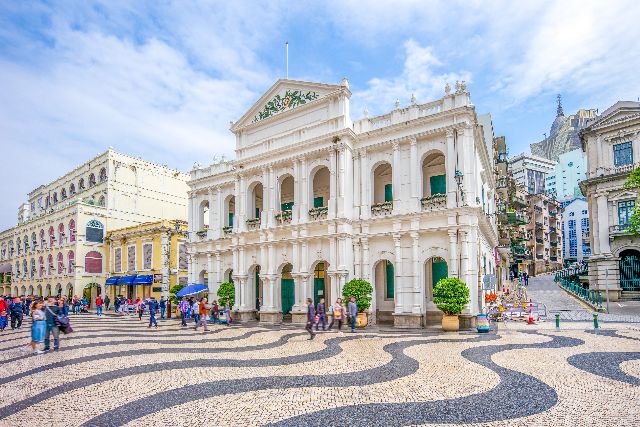
Macau Holy House of Mercy, a historic building in Senado Square
Macau will follow at the heels of China’s revised inbound travel policy, requiring five days of centralised medical observation and three days of home isolation after.
The new entry requirements will come into effect November 12 and apply to individuals arriving from Hong Kong, Taiwan and any foreign countries.
Individuals entering Macau from November 12 will serve five days of centralised medical observation and three days of home isolation after
Travellers will need to take a nucleic acid test on the first four days of their centralised medical observation. Negative test results from all tests will clear the individual from centralised medical observation on the fifth day.
Travellers will hold a code red Macao Health Code during their home isolation, and will only be allowed to leave home to perform nucleic acid tests. Tests are needed on all three days, starting from their exit from centralised medical observation. Furthermore, individual must obtain a negative RAT/ART result prior to leaving home for nucleic acid tests.
Their Macao Health Code will only turn yellow once sample collection is completed, and then green when a negative result is eventually obtained.
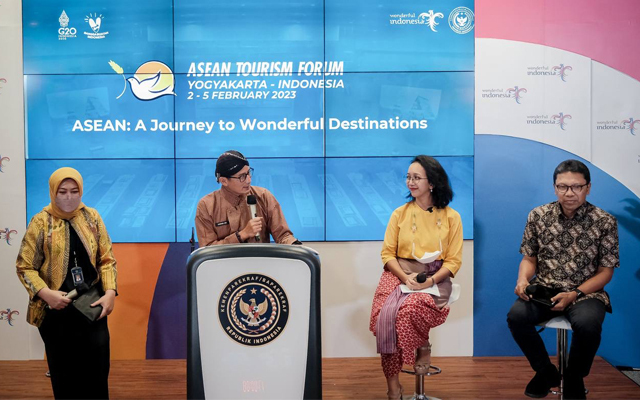
ASEAN Tourism Forum (ATF) 2023 will take in a series of government meetings on February 2 and 3, NTO meetings on February 4, and a new concept for its TRAVEX tourism exhibition component.
Speaking at a press conference last week, Sandiaga Uno, Indonesia’s minister of tourism and creative economy, said plans were well underway to host next year’s event.
ATF 2023 will feature two new components within TRAVEX to showcase more of Indonesia and local creative industies
“The government, both central and regional, are committed to the success of ATF 2023, (and are getting ready) to welcome participants and delegates,” he said.
Martini Mohammad Paham, deputy for resources and institutions of the Ministry of Tourism and Creative Economy (MoTCE), revealed that the high-level meetings would address issues related to marketing, investment, human resources, and sustainable tourism. Discussion outcomes would be shared in a joint statement by the ASEAN ministers at the end of the event.
Meanwhile, TRAVEX will carry the theme, Journey to Wonderful Destinations. Held at Jogja Expo Center, the exhibition in 2023 will feature two new components, shared Rizki Handayani, deputy of tourism products and events of MoTCE.
The Indonesia Tourism Exhibition B2C show will provide regional tourism offices and industry members an opportunity to present and sell their products, while an SME exhibition will showcase creative industries from Yogyakarta and its surroundings.
TRAVEX, to be held from February 3 to 5, targets 250 exhibitor booths and 250 international buyers in attendance. Ninety buyers will be fully hosted by MoTCE, and some will be semi-hosted in cooperation with trade members.
Rizki said: “We are working with ASEANTA, as the steering committee, to organise ATF, and with ASTINDO and ASITA to invite their overseas partners to participate.”
As part of its aggressive expansion to improve passenger service and experience in South-east Asia, the Plaza Premium Group has launched at Clark International Airport a Plaza Premium Lounge, ALLWAYS bespoke Meet & Assist Services, and TGM Root98 dining outlet.
On level three of Clark’s international departure terminal, the Lounge is suitable for passengers’ layover, with pay-per-use shower, VIP Meet & Greet service, in-lounge flight information and smoking room.
Lim: Plaza Premium Group’s expansion continues to gain pace
It also serves as the Business Class lounge of Philippine Airlines, Emirates and Qatar Airways.
Plaza Premium Group regional general manager (South-east Asia), Steven Lim, also disclosed plans to have an airport VIP Lounge where departing passengers will be picked up by limo straight to check-in and immigration, bypassing the main terminal. They will then get to rest at the VIP Lounge while waiting for their flight.
Also by next year, an Aerobar overlooking Mount Pinatubo will take shape at the airport’s international departure terminal.
The group, which already has an 11-key airport transit hotel Aerotel and a Plaza Premium Lounge each at the domestic and international terminals of Cebu Mactan International Airport, is also in discussion to have a Plaza Premium Lounge at Manila’s Ninoy Aquino International Airport (NAIA).
Lim said Plaza Premium Group’s global expansion picked up speed during the pandemic, growing from 170-plus lounges pre-Covid to 250 today.
He said that within a month, the group will open its first mega lounge – “a lounge within a lounge” – in Terminal 3 of Jakarta’s international airport. The lounge can hold 700 pax at once, and will contain the Singapore Airlines Lounge that the group will also manage.
A similar “lounge within a lounge” will be launched at Kuala Lumpur International Airport by 1Q2023. It will feature both Plaza Premium Lounge and Plaza Premium First for first class passengers.
Elsewhere in South-east Asia, Lim said the company is looking to expand in Vietnam and Cambodia where it already has a presence, particularly to operate in Ho Chi Minh Airport when it is ready in three years’ time and a new airport in Phnom Penh. It is also keen to enter Laos and Brunei.
Airline leaders at the Association of Asia Pacific Airlines (AAPA) 66th Assembly of Presidents in Bangkok, Thailand last week agreed to resolutions that seek to address regulatory challenges relating to passenger facilitation, safety and sustainability.
Noting the proliferation of onerous regulations imposed on the air transport industry during the pandemic, AAPA airline chiefs stressed the critical importance of governments adopting a more coordinated approach to ensure the speedy recovery of the sector in the coming months.
Members of the Association of Asia Pacific Airlines agree to address regulatory challenges relating to passenger facilitation, safety and sustainability following their assembly in Bangkok last week
“AAPA carriers have shown great resilience in confronting the challenges brought about by the prolonged Covid-19 pandemic, while maintaining the highest safety standards,” said Subhas Menon, AAPA director general.
“However, the lack of coordination of travel requirements across borders, and the burden of restrictive government regulations, hold back the sustainable recovery and growth of Asia’s carriers, as well as their ability to fully contribute to the social and economic development of the region.”
While many governments introduced digital apps to process contactless pre-travel verification of health status, many of these apps were neither interoperable with each other, nor enabled for other purposes, such as for immigration clearance or check-in, resulting in confusion for travellers.
AAPA calls on governments and border control agencies to work together in the adoption of interoperable digital applications for air travel, in accordance with ICAO guidance, so as to reduce unnecessary pre-departure congestion, delays and inconvenience to the travelling public. It also urges the use of existing passenger data exchange systems to provide integrated pre-travel verification responses to aircraft operators related to immigration, security and public health requirements, while fully respecting passenger privacy rights.
Another area of serious concern for AAPA airline members are unilateral regulations introduced by national/regional aviation regulators, failing to take into account the international nature of airline operations.
In the current instance, the US Federal Aviation Administration (FAA) now requires that all commercial aircraft be retrofitted with new or modified radio altimeters by July 2023 to maintain their operations to the US, in order for telecommunications companies to power up their 5G networks to the full capacity authorised by the Federal Communications Commission, even as the full effects of 5G on aircraft operations are being studied.
Unresolved spectrum issues relating to aeronautical safety services have resulted in flight cancellations, degradations of air traffic management services, and interruptions of flight operation.
A comprehensive frequency spectrum strategy in line with ICAO Standards and Recommended Principles is required to support timely availability and protection of adequate spectrum for civil aviation. AAPA believes that introducing regulations to meet specific regional or sectoral goals that are counterproductive to aviation safety and recovery, is not in keeping with ICAO’s “no country left behind” principle.
AAPA calls on governments, aviation regulators, safety agencies and other stakeholders to support the ICAO frequency spectrum strategy. AAPA also calls on governments to consult with aviation safety regulators, subject matter experts and airspace users, to provide all necessary considerations and to establish regulatory measures to ensure that incumbent aviation systems and services are free from harmful interference.
AAPA member carriers are fully committed to achieving the ambitious industry target of net zero carbon emissions by 2050. Achieving sustainable objectives require global government support and incentives to ensure that sufficient investment is made by all stakeholders, including fuel suppliers, in infrastructure and frameworks that will provide sufficient quantities of Sustainable Aviation Fuel (SAF) at affordable cost to meet the long term needs of the airline industry.
AAPA calls on governments to work with relevant stakeholders such as fuel suppliers to accelerate the fuel research, certification and development as well as processing technology and feedstock production, and the certification of new aircraft and engines to allow the scaling-up of SAF in sufficient quantities at competitive cost to meet the long term needs of the industry. The association also renews the call on governments to participate in ICAO’s Carbon Offsetting and Reduction Scheme for International Aviation (CORSIA) scheme, to respect the scope and the integrity of CORSIA, and refrain from applying duplicative requirements on international aviation carbon emissions.
Six Senses will open its first Australian property at Burnham Beeches, a heritage mansion 40 kilometres from Melbourne, Australia.
The Six Senses Burnham Beeches, expected to welcome guests in 2025, will occupy what is said to be one of the finest examples of domestic Art Deco in Australia.
Six Senses Burnham Beeches will occupy an Art Deco mansion and offer guests access to a vibrant Village Square
The original three-story Art Deco Streamline Moderne mansion is reminiscent of an ocean liner. Named after the eponymous English forest, Burnham Beeches was added to the Victorian Heritage Register in 1991, and the extensive Alfred Nicolas Memorial Gardens are now managed by Parks Victoria.
The property will launch with an initial collection of 43 keys and various hospitality venues such as a welcome lounge and terrace, a restaurant with outdoor seating, a library bar, and a rooftop retreat encased by garden planters. Subject to planning applications, the masterplan will incorporate a premium and unique glamping offer to bring the total accommodation inventory to 82.
Six Senses Burnham Beeches will incorporate sprawling farm gardens from which its kitchens will obtain fruit and vegetables. The herb garden will produce healing and aromatic plants for use in Alchemy Bar workshops and Six Senses Spa treatments.
A tactile nature playground is planned as part of the Grow With Six Senses approach to connecting children with nature through play and interactive learning experiences.
Guests seeking regeneration can head to Six Senses Spa, which will sport a botanical environment.
Six Senses CEO Neil Jacobs said the property would be a regenerative project that would serve the community and the ecosystems that underpin the place.
“For Six Senses Burnham Beeches to be regenerative, it will not be a static place. We’ll evolve and respond to bring the rich heritage of Burnham Beeches to life, inviting moments of exploration, discovery, connection to nature, and delight through interactive gastronomy, wellness, and sustainability experiences,” said Jacobs.
Trenerry Consortium, owners of Burnham Beeches, has plans for a Village Square that will serve as the heart of the site, which gives hotel guests access to an additional collection of venues, such as The Hearth, The Barn, Steak House, The Baker, Brew House, and Providore.
Burnham Beeches, Sherbrooke, and Nicholas Gardens are connected by a series of walking trails that weave throughout the site. Guests will be able to explore the historical, ecological, cultural, and indigenous stories from Burnham Beeches and the Wurundjeri and Kulin nation lands, incorporated into the art, architecture, signage, and landscaping throughout the grounds.
Minor Hotels is set to launch Avani+ Fares Maldives Resort in early 2Q2023, the first property for the brand in the destination and the first new hotel development in more than three years in the coveted Baa Atoll UNESCO Biosphere Reserve.
The new-build private island resort promises a premium Maldivian escape through a variety of accommodation options, from beach pool villas and four-bedroom beach pavilions to three-bedroom over-water villas.
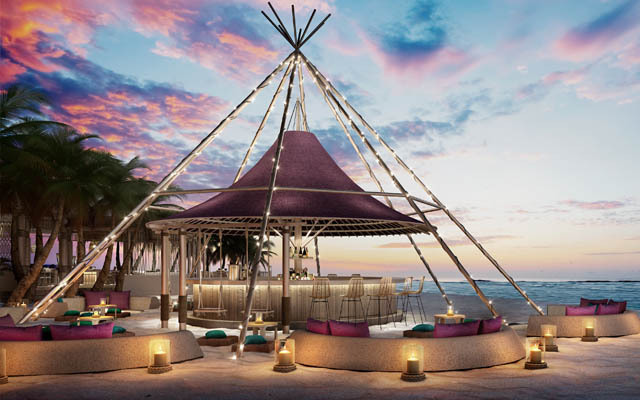
Avani+ Fares Maldives Resort’s Tribe Bar
Avani+ Fares Maldives Resort will appeal to couples, families and friends with an array of dining, fitness, water sport recreation and spa treatments.
The resort will provide easy access to the world renowned Hanifaru Bay, home to what is regarded as the Indian Ocean’s best biodiversity and underwater ecosystem and one of the best places to see manta rays. With twelve individual dive sites off the beach at Fares, divers are spoilt for choice. In addition, guests will have access to the Avani house reef, a 220-metre reef teeming with marine life including turtles and dolphins and the nearby Fares reef which is 600 metres off the shore.
“The arrival of Avani+ Fares in the Maldives meets a growing niche in demand for guests seeking alternatives to traditional luxury by providing a contemporary new offering, enabling a wider audience to experience one of the world’s most exclusive destinations,” said William Costley, Minor Hotels’ senior vice president of operations for Asia.
“Avani+ Fares will continue to highlight Avani as a trailblazing hotel brand, filling a gap in the Maldivian hotel landscape and delivering exceptional products in a fresh and accessible manner,” he added.
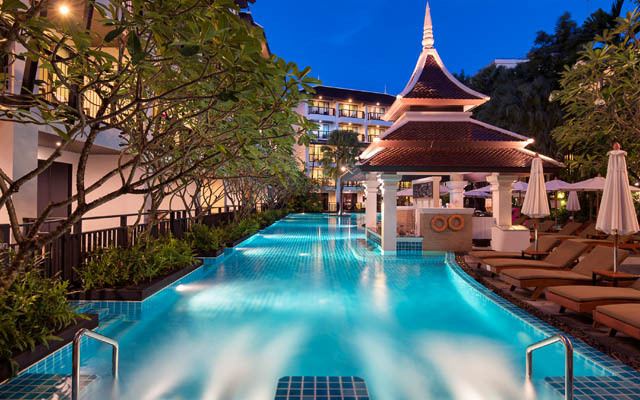
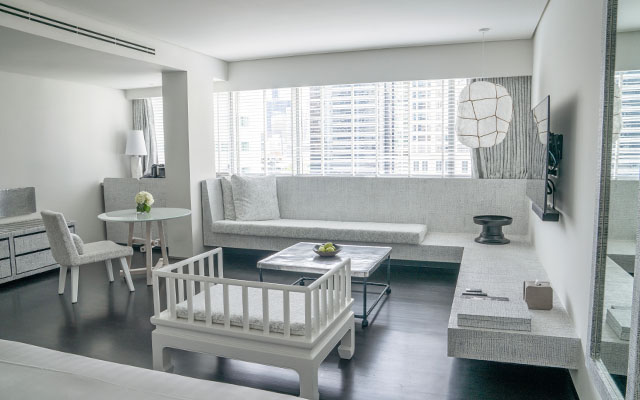
Thailand’s Centara Anda Dhevi Resort & Spa Krabi reopens on November 15 with a variety of perks to welcome guests once more.
The Place to Be offer includes up to 30 per cent off best available room rates, 500 baht (US$14) in F&B credits, complimentary Wi-Fi, daily breakfast for two guests, free stays for up to two children, as well as late check-out and complimentary room upgrade to the next room category, subject to availability.
The offer is valid for booking and stays until June 30, 2023.
Asian airline executives have reacted positively to China’s decision to ease inbound travel procedures, but said the announcement would not trigger immediate changes to their flight schedules.
“It is always encouraging to get updates like this, especially from China which is a big market for Malaysia. We are hopeful that the reopening momentum will continue,” Izham Ismail, group CEO of Malaysia Airlines, told TTG Asia.
Changes to China’s travel restrictions are not inspiring immediate and major reinstatement of flight capacity
Malaysia Airlines currently flies twice a week to Guangzhou with limited capacity, and has long redirected operations elsewhere in response to China’s steely travel restrictions.
As rescheduling flights requires time and careful planning, Izham said Malaysia Airlines would “stick to our plans”.
“We normally plan our capacity every summer and winter season, and the next change would only come in March 2023. Even if China reopens tomorrow, it is not possible for us to redirect our flights there,” he explained.
“However, the next season will coincide with our optimistic projection that China will resume international travel in 2Q2023,” he said.
Some airlines are also choosing to hold their horses for now, as the restriction updates are regarded as too slight to inspire a spike in travel interest.
“While this is a step in the right direction, it is still not enough to move the needle for a major reinstatement of flight capacity at the moment,” opined Mayur Patel, head of Asia, OAG Aviation.
When asked if Thai Airways International would bring forward its intended commencement of services to China’s Shanghai and Guangzhou, Korakot Chatasingha, chief commercial officer of Thai Airways International, would only say that “as long as China retains its quarantine requirement for inbound travellers, it will not convince people to resume their travel to the country”.
The Thai flag carrier currently has 68 aircraft in operation this year, across THAI and THAI Smile, with two aircraft ready for activation to China when the time is right.
Japan Airlines (JAL) will not respond to China’s Friday announcement with flight changes too, but only because it has maxed out its slots to the country.
JAL, which used to operate 98 flights a week to China pre-Covid, has just announced 15 flights to the country last week, including the resumption of services to critical cities Shanghai and Beijing.
Ross Leggett, JAL’s executive officer and deputy senior vice president – route marketing, international relations and alliance, told TTG Asia: “If we could, we would fly more to China but flight capacity is not our decision to make. The Chinese government still tells us which routes and how many we can fly. We’ve already gone from the five-one rule to 15 flights.”
Although China’s travel updates are minute compared to most part of the world, where barriers to travel have largely been dismantled, Leggett said “any (reopening decision) will stimulate more traffic, especially for Japanese business people looking to go to China”.
Agreeing, Subhas Menon, director general of the Association of Asia Pacific Airlines, said airlines could consider reinstating flights to “interesting and important” Chinese metropolises, like Beijing, Shanghai and Guangzhou, where travellers would be willing to undertake a five-day quarantine and three-day home isolation just to reconnect with important business partners.
China will reduce the quarantine period for travellers and close contacts of infected people, as well as drop its airline penalty should infected passengers be brought into the country.
While no implementation date has been identified, the changes announced today will cut quarantine from seven days to five days at a hotel or government quarantine facility. The requirement for three further days in home isolation after centralised quarantine remains.
China will reduce the quarantine period for travellers and close contacts of those infected from seven days to five days, followed by a three-day home isolation; Shanghai pictured
Travellers entering the country will now only need to take one pre-departure PCR test instead of two.
While close contacts of those infected will still be identified, the country will no longer be identifying secondary contacts.
Plans to accelerate vaccinations in China are also in development, stated the National Health Commission.
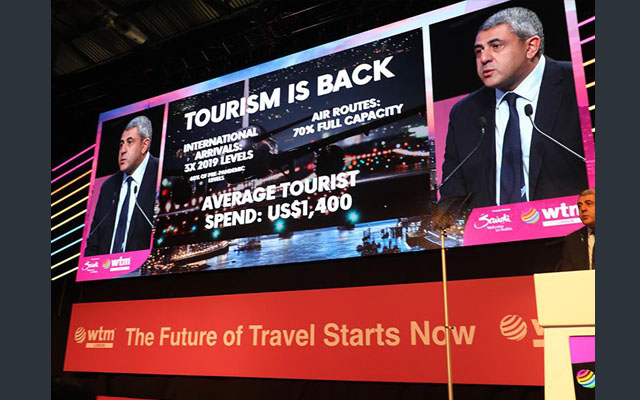
Tourism education, sustainability, and governance took centre stage at the World Travel Market’s Ministers’ Summit. With the theme Rethinking Tourism, the 16th Summit gathered ministers and high-level delegates from 19 countries, alongside business leaders.
UNWTO secretary-general Zurab Pololikashvili told tourism sector leaders that “our job is to create jobs” during this consolidated platform for public and private sector leaders that addresses tourism’s most pressing issues and sets the agenda for the years ahead.
Pololikashvili: we need to rethink tourism
Opening the event, Pololikashvili emphasised the unique opportunity to transform the sector. He said: “The window of opportunity will not stay open forever. We need to rethink tourism – as a provider of jobs, an economic pillar, and, against the backdrop of COP27, as a solution to the climate emergency.”
Education and jobs key to tourism’s future
Pololikashvili presented an overview of UNWTO’s work leading the transformation of tourism, with focus on investing in sustainable infrastructure and in people (through quality education and providing decent jobs).
Echoing UNWTO’s position, Juliette Losardo, exhibition director at World Travel Market, noted that “a post-pandemic world has revealed exciting opportunities, and given us a once-in-a-lifetime opportunity to reconsider tourism and ask ourselves how we can rebuild and better prepare for the future”.
Julia Simpson, president and CEO of the World Travel and Tourism Council (WTTC), which co-organises the summit with UNWTO, spotlighted the “talent, speed and capital” of the private sector.
Global expertise for common challenges
The roundtable brought together ministers of tourism from every global region, each providing unique insights from their own countries.
Ahmed Al-Khateeb, minister of tourism for the Kingdom of Saudi Arabia, stressed putting “sustainability above everything”, as well as the country’s focus on innovation and youth.
Highlighting the importance of diversifying national tourism sectors, including through domestic and rural tourism, and creating new products were Abdulla Mausoom, minister of tourism for the Maldives, the minister for Portugal, Rita Marques, and the minister for Egypt, Ahmed Issa.
Meanwhile, the deputy prime minister and minister of tourism for Mauritius, Ivan Collendavelloo, pointed out its ability to promote peace, adding that “we need to look beyond tourism to rebuild tourism”.
Also contributing to discussions were the ministers from Bahrain, Costa Rica Ecuador, Croatia, Ethiopia, Ghana, Jordan, Malawi, Malta, Mexico, Montenegro, Nicaragua, the Philippines, and Sri Lanka.
Tourism’s unprecedented political relevance
High-level participants emphasised that now is the time for the tourism sector to focus more on cooperation rather than competition.
The ministers also acknowledged Pololikashvili’s call for tourism to be mainstreamed within the political agenda and for greater collaboration between ministries of tourism and those of economy, business and environment.
The World Travel Market will also host the launch of the new Travel Trends Report 2023, produced by UNWTO in partnership with leading broadcaster Euronews.





 Thailand’s Centara Anda Dhevi Resort & Spa Krabi reopens on November 15 with a variety of perks to welcome guests once more.








ASEAN Tourism Forum (ATF) 2023 will take in a series of government meetings on February 2 and 3, NTO meetings on February 4, and a new concept for its TRAVEX tourism exhibition component.
Speaking at a press conference last week, Sandiaga Uno, Indonesia’s minister of tourism and creative economy, said plans were well underway to host next year’s event.
“The government, both central and regional, are committed to the success of ATF 2023, (and are getting ready) to welcome participants and delegates,” he said.
Martini Mohammad Paham, deputy for resources and institutions of the Ministry of Tourism and Creative Economy (MoTCE), revealed that the high-level meetings would address issues related to marketing, investment, human resources, and sustainable tourism. Discussion outcomes would be shared in a joint statement by the ASEAN ministers at the end of the event.
Meanwhile, TRAVEX will carry the theme, Journey to Wonderful Destinations. Held at Jogja Expo Center, the exhibition in 2023 will feature two new components, shared Rizki Handayani, deputy of tourism products and events of MoTCE.
The Indonesia Tourism Exhibition B2C show will provide regional tourism offices and industry members an opportunity to present and sell their products, while an SME exhibition will showcase creative industries from Yogyakarta and its surroundings.
TRAVEX, to be held from February 3 to 5, targets 250 exhibitor booths and 250 international buyers in attendance. Ninety buyers will be fully hosted by MoTCE, and some will be semi-hosted in cooperation with trade members.
Rizki said: “We are working with ASEANTA, as the steering committee, to organise ATF, and with ASTINDO and ASITA to invite their overseas partners to participate.”
Yogyakarta last hosted ATF in 2002.