TTG Asia
Asia/Singapore Saturday, 17th January 2026
Page 579

Creating a mark in the travel domain

0

EbixCash entered the tourism space in 2017 and acquired a number of Indian travel companies like via.com and Mercury Travels to expand its presence in the travel domain. How has the company grown since then?
Like you mentioned, 2017 was an acquisition period for us. We have since then created a spectrum of travel brands for us and strengthened our position in various markets where we operate, be it India, the Middle East, or the South-east Asia region.

If you consider countries like Indonesia and the Philippines, we are one of the leading players in the market in every segment of business be it online or offline, corporate or luxury, inbound or outbound. We are probably the only company in the South-east Asia region to be present in every spectrum of travel vertical. There is nothing that we don’t do in the travel domain, except run a visa facilitation centre.

The emergence of the pandemic was a major blow to the growth of the tourism sector. How did the pandemic impact your plans as a relatively new entrant in the travel sector during that time?
The pandemic was harsh on the tourism business. It did impact our growth plans as well, but I think things are now back on track. What we did during the pandemic was to grow organically. We focused on our technology offerings as many micro, small and medium enterprises used the period to have an online presence. Now we are growing in every vertical where we operate as we were in the pre-pandemic period.

In the past, you have signed strategic sales agreements with wholesalers in markets like Malaysia and Saudi Arabia to distribute via.com’s travel products. Which other markets are you looking at for similar partnerships for expanding your B2B presence?
We have plans to further expand rapidly now in the B2B space. Following strategic sales agreements with wholesalers in markets including Malaysia and Saudi Arabia, we are now considering similar arrangements in markets including Bangladesh, Sri Lanka and Vietnam.

Corporate travel was one of your focus verticals when you signed an agreement with Cox & Kings in 2019 to take over its business travel clients, with expectations to double your corporate travel revenue. Going forward, considering scenarios like global economic challenges and the Russia-Ukraine conflict, how do you see the demand for corporate travel shaping up?
Our corporate travel vertical has grown 45 per cent over pre-Covid levels. We are highly focused on corporate conversions within the Ebix group. We offer a wide range of solutions to corporate clients be it foreign exchange, expense management tools, inward remittance, or travel technology products.

When we reach a corporate, we offer a 360-degree travel solution to the entity. For us, corporate business is very large and we want to further grow this vertical. Right now, we have seen no deterrent in the growth of corporate business be it due to economic scenarios or other global developments like the Russia-Ukraine conflict.

Ebix Cash has created a mark in the B2B travel domain through acquisitions and partnerships, do you also plan to replicate the same success in the B2C space?
We are present in the B2C space with via.com. Already we are witnessing 30,000-40,000 per day visitors organically on the portal. However, we don’t go berserk in marketing or offering discounts. If we consider the B2C market in India, our competitors want to capture the market by offering ‘cheap’ deals. However, we have no intention to dilute our profitability or go for a price war.

We will definitely make a stronger presence in the B2C space but it is going to be sustainable and organic growth where we will choose customers who are willing to travel with us because of the high service standards we offer. If you see other B2C portals, there is barely any service available to the client.

Going forward, are you looking at more acquisitions to further consolidate your position in the market?
We are always open to any acquisitions as long as it offers an edge to our business or an edge to our customer offerings.

In the various travel segments that you operate like luxury, MICE, corporate, outbound etc, which vertical do you think will drive the growth for you in India in 2023?
India is a volume market so there will be enough demand from every segment. I think the growth for travel in 2023 is going to be phenomenal. This year, we have just touched the tip of the iceberg.

The demand is unbelievably high for outbound tourism and in fact, we are finding it difficult to meet the demand. The demand is for both short-haul and longhaul markets and every type of holiday. The question is how well the international markets are geared to handle the outbound demand from India. This is something we all have to wait and see.

A lot of small and mid-size travel agents in India have been finding it difficult to adapt to technology. Do you see potential in offering technology solutions to such players?
We have tools in via.com that helps micro, small and medium-sized companies to sell a wide range of travel products online. For travel management companies (TMC), we offer travel technology under Zillius brand.

Zillius’s product range offers a complete end-to-end technology suite encompassing an advanced internet booking engine designed to address the travel booking needs of all TMCs. We have been conducting roadshows across the country including smaller Indian cities to educate travel agents about our various technology products and the response has been phenomenal. Our focus is to reach every nook and corner of India.

Worldwide Hotels taps industry veterans to build up its brand

0

Worldwide Hotels, a hospitality company headquartered in Singapore, is ramping up its expansion plans both in Singapore and overseas by tapping on the expertise of several local industry veterans.

Chu Poh Yong, COO, Worldwide Hotels, told TTG Asia: “These industry veterans have come onboard (to show us) how to manage our brand better, establish a better brand and build on it, and have brought along their relevant experience, skills and knowledge. This will help us grow the business. We are also looking for more veterans to join us, anyone who can contribute to the group.”

From left: Worldwide Hotels’ Gabriel Ng, Chu Poh Yong, and Sunshine Wong

In Singapore, Worldwide Hotels currently owns and manages 38 hotels and over 6,500 rooms. Two more properties amounting to 1,500 keys will come online next year. Although the company has a history of over 20 years, the Worldwide Hotels branding – a consolidation of two hotel management companies – has only been around for three.

Currently, the group also owns eight properties – managed by a range of brands from Travelodge to Holiday Inn – in five countries: Australia, Japan, South Korea, Malaysia, and Thailand. These overseas properties are fully owned by Worldwide Hotels and are freehold, with the latest buy being in Thailand.

When asked why these are not managed by Worldwide, Chu shared: “When expanding overseas, you must have economies of scale. In these cities, we only have one hotel. But in the mid- to long-term, we may manage it ourselves. We need to build a base, a certain number (of hotels) first.”

When asked what the magic number was, Chu declined to give a figure.

That aside, Chu’s immediate focus is to establish the brand, as he feels it is “not sufficiently” known in the market yet. To do so, it is “necessary” to participate in more tradeshows to gain more exposure and meet with potential partners.

“This is the challenge when developing your own brand, as opposed to letting your properties be managed by others.”

Dusit first to offer organic rice at its Thailand properties

0

Dusit Hotels and Resorts is the first hotel chain in Thailand to offer 100 per cent organic rice across its entire portfolio of properties nationwide, aligning with the company’s ‘Farm-to-Table’ concept.

While benefiting guests, customers, and employees, this also provides sustainable income gains and life-changing developments to agricultural communities in the kingdom’s Thung Kula Rong Hai area, specifically Surin and Sisaket provinces.

Dusit works closely with the farms to help enhance their output and drive sustainable development long-term

The initiative sees Dusit work directly with farm collectives and provide all the support they need – from quality control, training, packaging to distribution – to deliver well-packaged, high-quality organic Jasmine rice to its hotel, restaurant, and catering businesses.

Four farming communities were carefully selected to work with Dusit based on their passion for high-quality produce and eagerness to co-develop and enhance their agricultural offerings – these include farming collectives in Surin Province’s Cor Ko and Nhong Pai subdistricts, and Sisaket Province’s Huai Thap Than and Nong Khae subdistricts.

Siradej Donavanik, vice president – hotel business development, Dusit International, and chairman of Dusit’s sustainability committee, said that the organic rice initiative is part of the company’s strategy to optimise its culinary offerings: “Jasmine rice from Thung Kula Rong Hai is known around the world for its strong aroma, soft texture, and slender grain – the long-grain white rice we source is among the finest of its kind.

“As a business, our organic rice model helps to optimise quality and overall costs within the group, so it’s truly a win-win.”

Dusit is also working closely with the farms to help enhance their output so they can reach more customers and grow their business, ultimately driving sustainable development with long-term benefits for all farmers involved. Some examples are purchasing new rice mills to help speed up production and enhance their capacity to generate more sales, selling the rice on online channels, and using the rice in the culinary offerings of other business units.

Other subsidiaries under Dusit International that are using the organic Jasmine rice in Thailand include Le Cordon Bleu Dusit Culinary School, and Epicure Catering, the leading provider of quality food services to the educational sector in Thailand, which Dusit acquired in 2019. More business units are expected to follow next year.

Costa Cruises to pull Asia trips due to China’s zero-Covid policy

0

Costa Cruises is cancelling all future Asia departures amid waning expectations that China will ease its zero-tolerance Covid-19 policy and border restrictions any time soon. The cruise line is a unit of Carnival Corp that targets the nascent Chinese market.

Port stops in China, Hong Kong, Taiwan, Singapore, Japan and South Korea will be cancelled as international cruises in those locations still have not resumed. All employees and local stakeholders in Asia affected by the reorganisation and cancellation of Asian cruises are in the process of being informed.

Costa Cruises is cancelling all future Asia departures in light of China’s zero-Covid policy

Costa Cruises said the decision was made due to the continuous delay in the resumption of international tourism across the whole region. The company had big plans to tap consumers in China, and was the first cruise brand to enter the country in 2006.

The cruise line will now look into reorganising its business in the region.

Consumer spending in Asia-Pacific remains strong, despite rising costs: Mastercard Economics Institute

0

The Mastercard Economics Institute’s Shifting Wallets: New consumer spending habits report looks at how consumers across the world are holding tight to habits that offer convenience, experience or both.

Asia-Pacific has seen a sharp recovery in outbound travel following the re-opening of borders, despite the growing cost of air travel. This is notable in markets like Singapore and Australia, with strong demand persisting even beyond the initial loosening of restrictions. Equally, spending on experiences is continuing to exceed spending on things, reflected in the spending patterns for experiences including dining out or entertainment. Asia-Pacific consumers are ordering from restaurants – both in-person or online – over making their own meals at home, with spending on restaurants up 16% in August 2022 from January 2022 levels, while grocery spending is down 5%.

Spending on travel and experiences remains strong for consumers in South-east Asia despite rising costs

“Consumers in Asia-Pacific are looking to make up for lost time after a challenging few years,” said David Mann, chief economist of Mastercard AP & MEA. “The pent-up demand to see new places and experience new things is influencing consumer spend in a big way. With the ongoing prioritisation of getaways, dining, entertainment, and experiences, we are expecting to see even more rebound in the travel and entertainment sectors.”

There are also new opportunities for online businesses, as both goods and experiences spending shifts away from the weekends. As digital shopping and remote work continue to influence everyone’s daily habits, consumers will adjust and re-adjust their spending preferences accordingly.

Consumers prioritise travel spending
Despite personnel shortages and a surge in crude oil prices pushing up the cost of air travel, spending on travel and experiences remains strong for consumers in South-east Asia.

Singapore shows the greatest demand in South-east Asia for international travel, with consumer flight bookings at more than 10% above 2019 levels as of June 2022, despite heightened logistical challenges and price pressures.

In Australia, longhaul flight bookings are up 92% in August 2022 compared to August 2019, and short-haul flight bookings are up 155%.

Consumer spending in South-east Asia is experiencing a recovery in the key categories of retail, travel and entertainment, with retail spend at 1.5x pre-pandemic levels as of June this year.

Small businesses show gains in online services
Globally, large businesses dramatically outperform smaller ones in the shift to digital – but small online service providers in South-east Asia are still finding ways to thrive.

In Singapore, small online business services (tutoring, healthcare, and personal care services) rose over 3.5x compared to 2019.

However, the gap between large and small online businesses is particularly evident in the retail sector in more developed economies – e-commerce sales for Singapore’s large businesses grew 200% versus 59% for small online retailers in August 2022 compared to 2019. Similarly, for Australia, large businesses grew 93% versus 24% for small online businesses.

Gone are designated days for spending
Working from home and the shift to digital have blurred the lines: date night is any night, and leisurely shopping trips are no longer limited to Saturday and Sunday. This has significant staffing and supply chain implications for retailers, restaurants, and other businesses.

Consumers in Malaysia, Singapore and New Zealand have drifted away from weekend entertainment in 2022 as compared to 2019, beating the weekend crowd by going for weekday tickets and emptier theatres on Mondays and Tuesdays.

This blurring of lines from conventional weekend spend is also apparent in department stores. In Hong Kong, the share of spending on Saturdays and Sundays at department stores fell, by 1.22% and 1.42%, respectively, relative to 2019, while spending on Tuesdays rose 2.84%.

A similar effect was seen in retail-loving Singapore, where department store spending fell 2.8% and 2.46% on Fridays and Saturdays respectively, but increased 1.87% on Thursdays.

Conversely, eating places have seen a boom in weekend spend, with strong share shifts on Saturdays for Hong Kong, up 2.75%; Malaysia, up 2.1%; and Singapore, up 1.8%.

View the full report here.

Mandarin Oriental to manage Tianfu property in 2028

0

Mandarin Oriental Hotel Group will be managing a new hotel in Tianfu, a modern business district south of Chengdu, come 2028.

The hotel will comprise 267 guestrooms and suites, as well as a club lounge. Four restaurants and bars will provide a variety of cuisines, while ample meeting and event space will ensure the hotel is well-positioned for business and social gatherings. A Mandarin Oriental spa will provide a range of beauty and massage treatments, and a fitness centre with an indoor swimming pool will expand the wellness offering.

The new Mandarin hotel in Tianfu is slated to open in 2028

The Central Business District of Tianfu sits approximately 25km south of the old city of Chengdu and is accessible from Chengdu’s two international airports.

The hotel will sit in the primary development zone, comprising regional offices and headquarters of multinational corporations, as well as international convention and exhibition venues.

The overall district is being designed as a Park City featuring over 3,000 hectares of green space which will be within walking distance of the hotel. Adjacent to the hotel is a mixed-use development housed in the tallest skyscraper in Western China, featuring a top-floor observation deck with F&B outlets.

PATA names Megan Epler Wood as special advisor for sustainable tourism development

0

The Pacific Asia Travel Association (PATA) has appointed Megan Epler Wood as its special advisor on sustainable tourism development for destinations, business, and civil society.

Wood’s knowledge and expertise will be invaluable to driving progress towards a more resilient and sustainable Asia-Pacific travel ecosystem. She has dedicated over 30 years towards the creation of professional guidelines, tools, policies, and educational resources focusing on sustainable tourism development. In 1990, she founded the first sustainable tourism NGO, The International Ecotourism Society.

She is currently the managing director of the Sustainable Tourism Asset Management Program (STAMP) at Cornell University’s Center for Sustainable Global Enterprise and the SC Johnson College of Business, a role she has held since 2017.
Indulge in a tea-cation at Pan Pacific

0

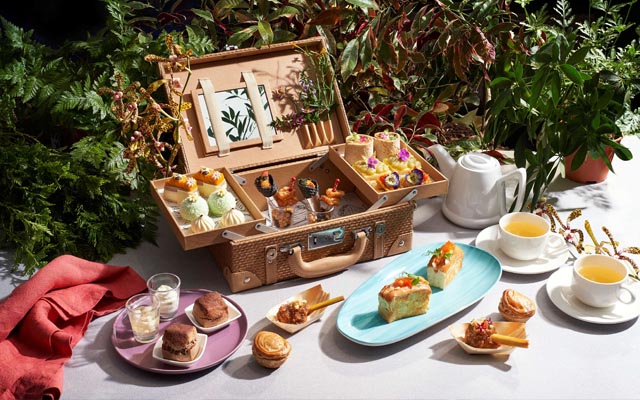
Pan Pacific Hotels Group is offering a special stay and teatime package at five of its Singapore properties.

Guests will be rewarded with an afternoon tea for two when booking a two-nights’ stay. The Tea-cation Relaxation package also includes daily breakfast for two guests, late check-out, 20 per cent savings on spa treatments, and more.

Enjoy a complimentary afternoon tea for two when booking a two-nights’ stay at participating Pan Pacific hotels

Pan Pacific Discovery members also enjoy an additional 10 per cent savings on room rates.

Participating hotels include Pan Pacific Singapore, Parkroyal Collection Marina Bay, Parkroyal Collection Pickering, Parkroyal on Beach Road, and Parkroyal on Kitchener Road.

Valid for bookings and stays from October 20, 2022 to June 30, 2023.

One redemption of Afternoon Tea experience per stay – reservation of afternoon tea is required upon check-in.

For more information, visit Pan Pacific Hotels Group.

Stop saying Asia is resilient as this time is different, warn economists

0
  • Even when China rebounds in the long term, the market will be less robust
  • Inflation from the energy crisis and the supply shock will affect travel intentions
  • More challenging economic conditions ahead
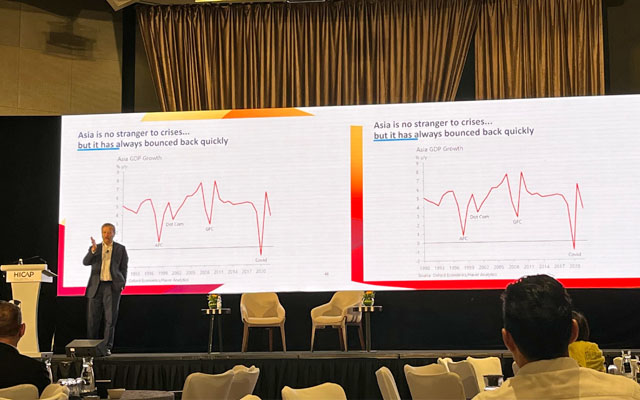
Arup Raha at the Hotel Investment Conference Asia-Pacific 2022 held in Singapore

While Asia is no stranger to crises and has always bounced back quickly, “this time is different”, warns Arup Raha, chief economist Asia of Oxford Economics, at the Hotel Investment Conference Asia-Pacific (HICAP) 2022 in Singapore last week.

Raha said in previous crises – the two largest being the Asian and global financial meltdowns – the region had two solid factors behind it, which were steady interest rates, and China.

“The US Fed (Federal Reserve System) kept interest rates steady, but typically during these times they were reducing interest rates, which then gave Asian countries the freedom to be able to reduce rates,” said Raha.

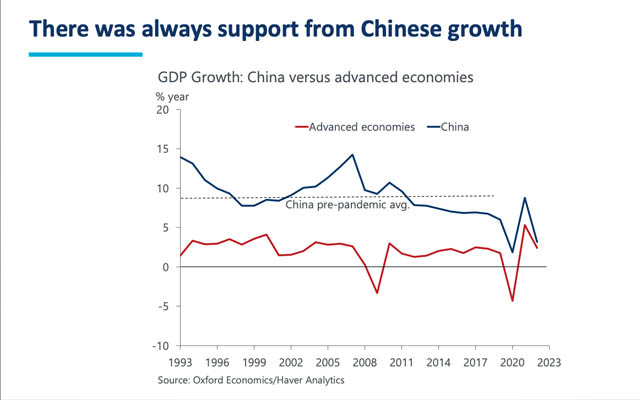
“The second big thing is, there was always support from China. But China’s GDP was 0.4 per cent in 2Q202 (over the same period in 2021), the worst growth rate in 40 years.”

Slow recovery for China
China’s slowdown is not today’s story; it has been going on for a decade (see blue line in chart), said Raha. Covid and the policies China implemented during the period exacerbated its downturn. Even if China rebounds in the long term, due to its demographics, productivity growth and shift from an export to service economy, Raha stated that “China isn’t going to be the China we are used to”.

What also matters to the tourism industry is the price of energy, which has never been this high or this prolonged, and the difficulty of predicting where it would go.

A consequence of the energy crisis and the “severe” supply shock is inflation. Apart from higher costs of operation, although mitigated by higher rates and efficiencies wrought through Covid, inflation will also affect travel intentions. Raha said: “Tourism is a bit of a luxury good. If I have to tighten my belt, foreign travel is the first thing to go out of my budget.”

The right response
The one bright spot from this crisis is that governments have learnt to deal with a fiscal response. Singapore, for example, responded with two packages that amounted to nearly 20 per cent of its GDP.

“You can claim that the problems of inflation we see today are (because) governments over-responded, that there was too much fiscal stimulus. But I think that’s the right policy. Given the uncertainty related to the pandemic, the right way was to over-respond than under-respond – because you could get institutional damage if it went on too long,” he opined.

“We are much stronger institutionally. We had the ability to deal with a fiscal response.”

China’s slowdown has been going on for a decade

As well, with rising inflation, governments have not rushed to tighten policy, said Raha, citing Indonesia, which raised interest rates only a few months ago.

Institutional ability aside, the environment is “not nice”.

“Our forecast for Asia is that you see the initial bounce take place and now, the slowdown is coming. China will pick up but (will not be as) robust as in the past. Thailand is going to do much better – they should get half the number of tourists (40 million in 2019) in a year or a couple of years. Russians and Chinese face institutional constraints to travel, it has nothing to do with economics and it is almost impossible to predict when they are going to open up.

“Secondly, we don’t know how much structural damage has been done to the hospitality sector. In Phuket, a lot of restaurants and hotels have shut down.”

Challenging times ahead
Another economist, Jennifer Kusuma, titled her presentation Economic outlook: Brace for a hard landing.

In the post-pandemic environment, demand has rebounded quickly, but supply is slow to respond. Russia’s invasion of Ukraine triggered upheaval in the commodities market, where investments in traditional energy have been low, said the senior rates strategist at ANZ Bank.

Currently, the dollar is “king”, as Europe and the UK are grappling with a cost of living crisis, and China is facing “the risk of inflation”. Asia, excluding China, is caught deep in this global crossfire, said Kusuma.

On China, she said: “It’s hard to rebound when you are forced into lockdowns. Property buyers did not react positively to interest rates cuts.”

ANZ Bank does not expect China to reopen in 2023.

Said Kusuma: “Even if we see a path to a soft landing, we should prepare for more challenging economic conditions ahead of us and recognise where the opportunities are.

“Some of this will be temporary but geopolitical tensions, as well as de-globalisation, will suggest that some of the supply constraints will stay with us for longer.”

ATF 2023 postpones to February

0

The annual ASEAN Tourism Forum (ATF), which includes the Travel Exchange (Travex), has been postponed from January to February 2-5, 2023, with Yogyakarta remaining as the host city.

Eddy Soemawilaga, president of the ASEAN Tourism Association (ASEANTA), mentioned the new dates in his travel association presentation at ITB Asia in Singapore on October 20. ASEANTA oversees the rotational ATF.

ATF 2023 has been pushed to February 2-5, 2023 instead; Prambanan Temple pictured

Bearing the theme Empower Talents, Embrace Technology, Recover Tourism, ATF 2023 will be held at the Jogja Expo Center (JEC) Yogyakarta, the biggest business events venue in Central Java, while NTO and government meetings will be at Yogyakarta Marriott Hotel.

The opening ceremony will be held at Prambanan Temple, while the farewell dinner will be at the Kraton (Royal Palace).

Speaking to TTG Asia on the sidelines of ITB Asia, Soemawilaga said: “I am excited since this will be the first fully in-person ATF event (post-lockdown) where many stakeholders including NTOs, industry members and media will gather in the beautiful city of Yogyakarta to reap the potential of tourism and travel within the ASEAN region.”

Yogyakarta is the gateway to two UNESCO World Heritage Sites, Borobudur and Prambanan Temple. The city is serviced by two airports – Adisutjipto Airport and the new Yogyakarta International Airport.

Preparations are underway with the event microsite/webpages recently uploaded.