Accor has signed a development agreement with Amsa Hospitality to develop and franchise 18 hotels across second-tier cities within Saudi Arabia over the next 10 years.
The Saudi start-up company will develop a range of Accor’s economy and midscale brands, including ibis Styles, Mercure, Mercure Living, Novotel, Novotel Living, and the recently launched Handwritten Collection, and act as the third-party operator by leasing and franchising the assets.
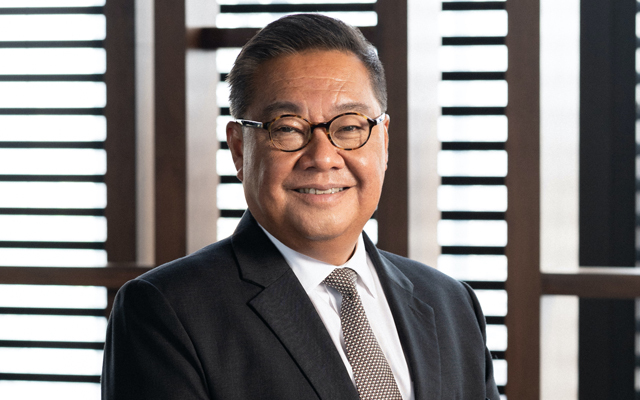
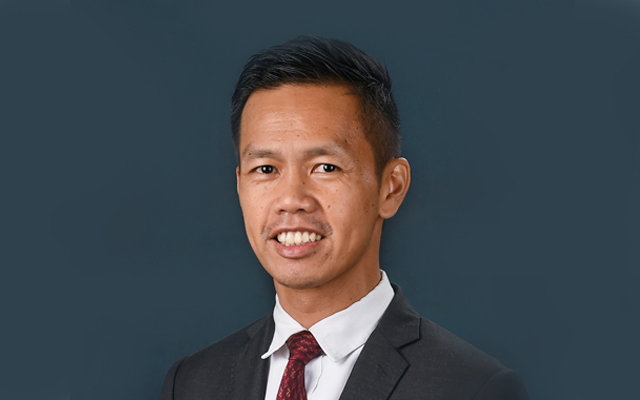
From left: Amsa Hospitality’s Mohammad Alathel and Accor’s Duncan O’Rourke
Speaking at a press conference during Arabian Travel Market last week, Mohammad Alathel, CEO, Amsa Hospitality, said that the company is aligned with the Kingdom’s plan for the development of the country’s second-tier cities.
“Such an enterprising strategy must be accompanied by quality hospitality, offering the best international standards,” he said. “Committed as we are, we believe that Accor is the finest hospitality company to deliver the high level of guaranteed quality we are looking for, together with their wide choice of brands, giving us the ability to propose the optimum hospitality regarding each city environment.”
As part of the agreement, Amsa Hospitality will be responsible for hotels in several cities in Saudi Arabia.
Duncan O’Rourke, CEO, MEA & Asia Pacific – premium, midscale & economy division, Accor, remarked: “Securing a long-term relationship with Amsa Hospitality underscores our commitment to supporting the Kingdom’s tourism goals while maintaining the focus on the Arabian traditions and Arab culture that Amsa Hospitality is focused on delivering.”
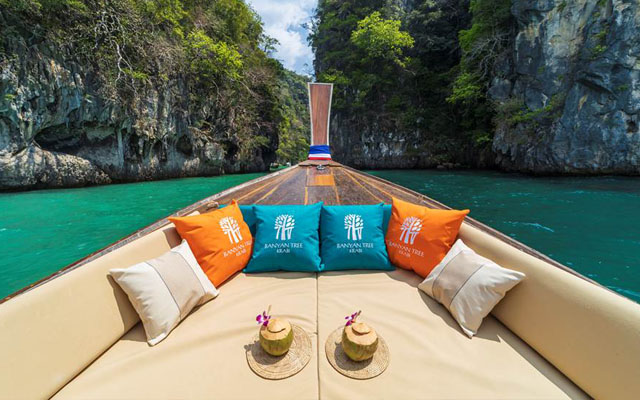
Banyan Tree Krabi has unveiled a new longtail boat that will take its guests on day trips and island-hopping excursions during their stay.
Built by local craftsmen using materials sourced from around Krabi, The White Pearl offers luxury and comfort on board for up to eight passengers.
Banyan Tree Krabi offers day trips and island-hopping excursions on its new longtail boat
Visitors can choose from either a half-day longtail boat trip to nearby Koh Hong or a full-day (eight-hour) tour of the four islands among the islets of Hat Noppharat Thara-Mu Ko Phi Phi National Park, where the boat anchors for guests to spend the day swimming and snorkelling in undisturbed clear waters.
All day trips on The White Pearl include fresh coconut, fruit and soft drinks, snorkelling equipment, life vests, toilets, and an English-speaking Boat Host.
Private bookings for non-guests are also available.
There is a huge opportunity for tourism to help rural areas by improving the well-being of residents, maintaining population, creating jobs, and even reviving local agricultural businesses and traditions, opines Sandra Carvao, chief of tourism market intelligence and competitiveness at United Nations World Tourism Organization (UNWTO).
In this episode, Carvao recalls the formation of the Best Tourism Villages by UNWTO initiative, details why supporting rural development is so important, what is being done to ensure successful tourism villages do not lose themselves to commercialisation, and more.
While still in its early stages of development, having launched only in November 2022, the artificial-intelligence chatbot ChatGPT has lured major OTAs with its use potential.
Developed by OpenAI, ChatGPT is able to take prompts – or questions – from human users and sweep through vast data on the Internet to generate a human-like and comprehensive response. Its capability is regarded as a major step up from the chatbots the world has been relying on, which are only able to respond with structured answers to a limited set of keywords and instructions.
So appealing is ChatGPT that, according to Similarweb, it gained 100 million monthly active users in January, just two months after its launch. Its developer, OpenAI, also became one of the 50 most visited websites in the world, found Digital-adoption.com.
Making sense of what that adoption rate meant, Time magazine wrote that Instagram took 2.5 years to reach 100 million users while TikTok got there in nine months.
Among the companies that are riding the ChatGPT wave are Trip.com and Expedia Group.
In February, Trip.com unveiled TripGen, a chatbot that is integrated with the OpenAI API and designed to provide travellers with live assistance through artificial intelligence (AI) technology, enabling users to receive tailored travel routes, itineraries and booking advice in real time on the Trip.com platform.
TripGen supports English, Japanese, Korean and traditional Chinese, with more languages to be added in the future. Work is also being done to allow users to book directly with Trip.com after TripGen searches, and to integrate with the new WhisperAPI for speech-to-text transcription and translation.
Amy Wei, senior product director at Trip.com Group, told TTG Asia: “Users can make more complex requests, such as suggestions for a romantic holiday. Business travellers (with packed schedules) can easily enquire about one- or two-day tours. This is an efficient way of finding out and narrowing down information for time-starved travellers.”
So far, response to TripGen has been good, according to Wei. User numbers have been doubling every day since it launched, with users asking four to five questions during their searches.
In March, Expedia Group introduced a plugin for ChatGPT users to bring their travel conversations to life. Powered by Expedia Group’s 70 petabytes of travel data, the Expedia pluggin allows ChatGPT users to get real recommendations on how to get to a desired destination, where to stay, and what to see and do.
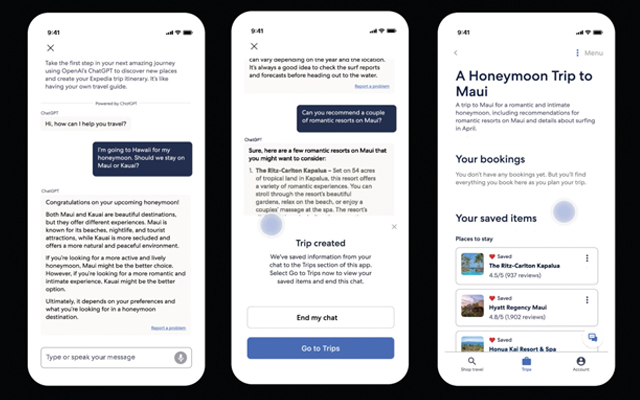
Barely a month later, Expedia Group deepened its ChatGPT use by bringing a ChatGPT trip planning capability into its app. The new function allows Expedia members to have an open-ended conversation in the Expedia app for recommendations on destination activities and tourism products, and have hotels discussed in the conversation saved for future booking. Expedia members can choose dates, check availability, and add on other trip components, such as flights, cars, or activities.
The conversational trip planning beta experience is rolling out globally in English on the Expedia iOS app.
Kurt Weinsheimer, chief solutions officer at Sojern, a marketing specialist for hotels, attractions, and destinations, said these ChatGPT integrations are “exciting and inevitable”.
“Travel experts (right away) saw the potential of ChatGPT to offer an end-to-end user experience. It can help in the (travel) planning stage… and also tell that story when (travellers) are done with their trip,” he told TTG Asia.
“ChatGPT, Natural Language Processing (NPL) and AI require… content. The algorithms that power them need a ton of data in order to maximise their potential. Hence, having ChatGPT partner with a travel company like Kayak Group or Expedia Group makes a ton of sense. Now, a travel enquiry on ChatGPT will not just give you broad information and ideas, but very specific options that can be pulled from Kayak’s data and lead the customer to real-time rates, availability and a booking function,” he explained.
A boost for marketing
The conversational nature of ChatGPT’s output has not escaped the eyes of travel and tourism marketers.
Weinsheimer said: “In the history of tech, we know that innovations have taken away some roles only to replace them with new ones. Calculators did not take away math jobs; they allowed mathematicians to advance to higher levels of computing and engineering. So, we see NLP providing an opportunity to enhance content creation. It will be good for good writers and make marketers even better at their job.”
Ewan Cluckie, founder of Thailand-based travel operator and distributor, Tripseed, has “done some quite extensive testing with ChatGPT”.
Cluckie sees potential use cases for it within the travel industry, particularly in content creation. “It can speed up copywriting tasks and rewrites, and help to lay basic structure,” he remarked.
“I have also found it can be surprisingly competent at the localisation of existing content for different language markets,” he added.
Joleena Seah, managing director – Southeast Asia with leading regional publicity agency, GHC Asia, told TTG Asia that her company has been experimenting with the possible uses of ChatGPT and alternatives, like YouChat and Bing. Her team recently chose ChatGPT to trial a questionnaire that sought to draw media representatives’ opinion on a hospitality brand.
Seah said: “ChatGPT and the likes can be useful for our line of work. We could use it to start a draft for itinerary suggestions, drafting general factsheets and FAQs for our clients (destinations, hotels or brands), researching ideas to promote destinations, and understanding guest sentiments, and more, before we embellish the content. Basically, ChatGPT can help us to reduce time spent on research so that we can add more value to our clients’ press materials.”
However, Weinsheimer emphasised that travel and tourism companies should not limit their vision to just ChatGPT. Rather, they need to think about their investment in big data and AI in general.
He said: “It is a challenging time for marketers today. A recent study shows that over 70 per cent of consumers want a personalised experience, and almost the same percentage expressed concerns about how their data is being used.”
Balancing personalised experience in a permission-based world can be attained through AI, he opined. Sojern uses AI to predict the likelihood of travellers acting in a certain way or wanting certain experiences.
“You need models to go through billions of data points to come up with the right matches. You also need to understand that within those billions of travellers, there will be those that don’t want to get advertisements,” he said.
With AI, Sojern is able to fine-tune the audience, and provide the opt-in audience with the right messages at the right time for the maximum impact.
“The same way that we see ChatGPT is leveraging conversational data to write personalised experiences, big data and AI can be used to create personalised marketing and advertising. AI is here to stay, and it is up to companies to leverage it to minimise the number of monotonous tasks they have to deal with, and free them up to do more interesting, revenue-generating work,” said Weinsheimer.
Expedia members can move from trip recommendations to bookings
Limitations
As promising as ChatGPT is, corporate users are clear about the chatbot’s limitations – the system relies on data on the Internet and, for now, its knowledge is limited to 2021 content. And with it accessing an assortment of published data online, there is also the possibility of it pulling inaccurate information.
People with subject matter expertise continue to remain important even as ChatGPT comes into the picture, asserted Weinsheimer.
“ChatGPT is sometimes accurate and other times not quite, but it is always 100 per cent confident. And that’s where you need human experts to ascertain accuracy,” he said.
Seah said: “There are also limitations when a job requires senior leadership’s personal insights, brand messages and new announcements. Most of our work involve hotel launches and new brand initiatives, which render AI chatbots ineffective because these information are not yet available on the Internet.”
Thiam Wei Toh, founder and chief storyteller of Indie Singapore Tours, has trialled chatbots for customer service and the creation of itineraries, but found that “even (OpenAI’s latest) GPT-4 is still a bit off from being able to be properly harnessed”.
Thiam is looking into other AI tools like Midjourney, Stable Diffusion and Copy.ai to to help with content generation and productivity.
Cluckie agrees that ChatGPT and the likes “will not be replacing any jobs anytime soon”.
“We’ve being doing more extensive testing on the localisation of content for different markets but even this still requires a human editor. The inaccuracies in content produced by ChatGPT, and the generic blandness of its responses, are still far too prevalent for it to be used as much more than a writing aid,” said Cluckie.
He added that the system’s reliance on training data prevents it from generating original thought.
“Innovation and originality is, for now at least, still safely within the biological domain. In the context of travel, this limitation means that tools like ChatGPT inherently perpetuate issues such as overtourism unless specifically prompted otherwise, and even then, they are fundamentally limited to what is already provided to them in their training data,” he said.
To address potential inaccuracies, Trip.com is working to embed booking links into TripGen, so that the existence of system-recommended products can be verified, shared Wei.
On Expedia’s part, its collaboration with OpenAI is currently in the beta testing phase, allowing it to rapidly evolve the experience based on members’ interaction.
“It’s also important to remember that while many measures have been taken to limit inaccurate results and inappropriate responses, at times the experience may not work exactly as expected. Feedback from both our employees and all those using the experience will be continually evaluated to make sure responses meet our standards,” commented Rathi Murthy, CTO, Expedia Group.
To travel companies eager to weave ChatGPT and similar AI functions into their system, Murthy has a word of advice: “Travel is a complex industry with lots of tech debt, so before companies can integrate with technologies like ChatGPT, they need to make sure the technological fundamentals of their platform are sound, and their data quality is high.”
It would be a long-term investment. She said: “For AI to truly deliver on its potential, including commercially, it requires large quantities of high-quality data and a highly skilled team; it must be viewed as an essential part of the infrastructure to run a business, and it needs time. AI is not productive or efficient on day one – it takes time to get the data, train, evolve and scale up the models. It’s an ongoing capability and there’s not really an end in terms of value that it can bring to a business.”
Singapore Tourism Board refines marketing messages to appeal to more targeted audiences
Manpower limitations and sustainability constraints are challenging considerations
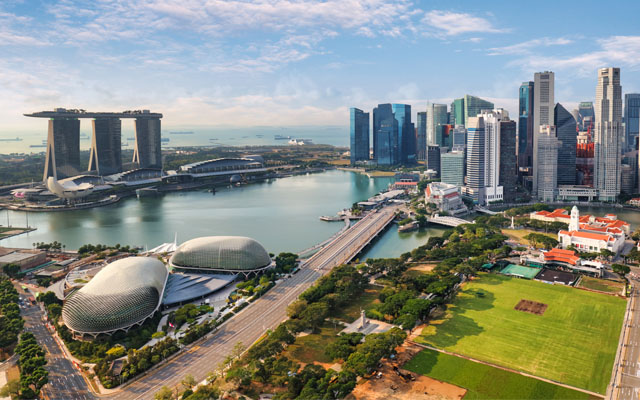
Singapore to leverage on its progressive and innovative identity recognised by the world
Singapore will be revitalised as a destination offering quality tourism
Singapore Tourism Board (STB) unveiled in April its plans to sustain and future-proof the industry, with chief executive Keith Tan stating that the blueprint zeroes in on “quality tourism”, “driving higher yield” and “creating good jobs”.
While details are still to come, these strategic and significant innovations will give Singapore a shot-in-the-arm in finding the new equilibrium for quality tourism amid a post-lockdown supply and demand environment.
STB’s Tan acknowledged that “Singapore cannot be a low-cost destination”, and manpower limitations and having to deal with sustainability constraints were “hard truths”.
The post-lockdown supply chain may still be playing catch-up, but pundits believe the city-state can and will reinvent itself.
For Arthur Kiong, CEO, Far East Hospitality Management, the reality is that hotels need to be able to pay better wages not only to retain but to attract staff.
Nobody is oblivious to how severely the industry is being challenged and that “it is a real struggle”, he noted.
But Kiong is confident there will be transformational paths to cope with delivering an experience with less manpower and charging more.
“Quality tourism is not only a vision, but a functionality and derivative of business reality today. Singapore has to go after certain segments, (and offer compelling reasons and propositions that are sustainable),” he explained.
According to Kiong, Singapore’s “secret weapon” is the ability of trade associations, government and the private sector to cooperate and pull stakeholders together, citing how Singapore managed the Covid-19 pandemic.
The success of the STB blueprint rests on the ability of execution and “nowhere in the region or in the world” can do it like Singapore, he proffered.
Setting standards in Singapore An industry practitioner questioning how Singapore’s vision of quality tourism should be defined, asked: “Are we talking about product innovation and differentiation in the type of hotels, retail concepts and the culture being played up?”
There are certain expectations of what a multifaceted global destination is, where the visitor comes for the experience and is willing to pay, he said, and while regional competition is “so competitive”, Singapore stands out because it has “some element of a cultural identity that is significantly progressive and innovative”.
Kiong: quality tourism is not only a vision, but a functionality and derivative of business reality today
He explained: “Singapore is a hub with a transformative environment and that sets it apart. It is where start-ups can benchmark against Hong Kong or Shanghai if they want to go into China, or are interested in Delhi or Mumbai.
“Singapore needs to make a lot of noise about being able to provide the opportunity to meet different people and form new networks to create a global community.
“If Singapore is to be laser-focused on quality tourism, it has to set the tone and what quality tourism is, where the new basic is a S$250 to S$300 room rate, and to ring-fence business events with bleisure (or blended travel).
“Singapore cannot find the solution overnight, and the strategy is how to make it practical, market-led and authentic.”
Meanwhile, Neeta Lachmandas, executive director, Institute of Service Excellence, Singapore Management University and former STB assistant chief executive, business development group, said the term “quality tourism” was coined around 2010, with the opening of the integrated resorts.
Agreeing “it is very important that quality tourism is reinforced”, she stressed the right perspective of what quality tourism is and how to create a customer experience that the visitor “feels is value” must be made clear to the industry.
Singapore, and industry members, needs to understand who the destination is going to appeal to, be “much more targeted” and “sharpen and refine marketing messages”.
Lachmandas gave the example of business events looking for “a certain quality, a certain brand – leveraging on the Singapore trademark – and are willing to pay.
“Delivering service excellence is complex and it has been reduced to a simplistic perspective – customer service,” she said, adding that every industry, not only tourism, needs to understand how to provide what the customer needs, pivot to the customer and be “customer obsessed”.
According to Lachmandas, customer satisfaction data shows Singapore “has done well” and “has improved”; still, organisations need “to reorganise and think very, very differently about customer journey mapping”.
Singapore also needs to understand “price versus value” and “the concept of value for the customer”, she highlighted.
STB’s Tan: Singapore cannot be a low-cost destination
“Technology is important but it cannot be the starting point and I advocate a chief customer officer in every company. This person (should) understand customer satisfaction research, what customer experience means, is data savvy, understands empathy and is designed-trained.”
Cinn Tan, chief commercial and marketing officer, Pan Pacific Hotels Group (PPHG), commented that Singapore could count on its highly educated and skilled workforce.
She pointed out Singapore is recognised as a global city and is deeply connected to the neighbouring region and many other parts of the world. Quoting STB, she said there were 180,000 visitors from Latin America and Africa in 2019.
Singapore as a quality tourism destination also has to focus on the continuous upgrade of its “lifestyle infrastructure”.
“Conscious travellers are a rapidly growing visitor segment,” PPHG’s Tan noted. “Singapore has a stronghold in urban greening with great potential to become a top sustainable urban destination and leader in environmentally friendly hospitality.”
Meeting planners and events are picking Singapore for its world-class facilities, international outlook and a business-friendly environment, she quipped.
She opined that Singapore can cater to “travellers looking to deviate from a standardised one-size-fits-all customer experience” towards more authentic, personalised journeys, noting that the industry is seeking to shift towards creating more opportunities for customisation and personal connections.
Kempinski Hotels has set its sights firmly on Asia as a key region for expansion, with talks being held in a string of destinations.
Speaking to TTG Asia at the Arabian Travel Market, Kempinski’s chief commercial officer Amanda Elder stated they have a strong commitment to South-east Asia.
Elder: Asia has so much potential
To help grow business, the hotel management company has just hired a head of development based in Bangkok and another in China. They have been tasked with sourcing new projects across the region.
“They are both very experienced and I’m very excited about that because they’ll find new projects,” Elder said, adding the company is close to signing opportunities in Thailand in Khao Lak and Phuket. Initial discussions are also taking place for Chiang Mai.
In addition, there are talks about opening Kempinski’s first property in Vietnam, with a Kempinski slated to open in Lombok in 2027.
“We opened Apurva Kempinski Bali last year and it’s been a very successful hotel,” said Elder. “It’s the number one RevPAR in Nusa Dua. The same owner gave us an additional property in Lombok and there is talk of a third hotel in Indonesia with the same owner.”
Development also continues in Malaysia’s Kuala Lumpur in the form of 8 Conlay Kempinski Hotel, a mixed-use development comprising residences, an office tower and hotel complex. It is slated for completion in about 2.5 years.
Elder shared that initial talks on opening a property in Japan are also ongoing.
“Asia has so much potential. You can really tap into global markets in the region. Everybody is looking to go to Asia at some point of their travel experience, and it’s very accessible, about seven to nine hours from most parts of the world,” added Elder.
Luxico, an Australian luxury home rental service which started in 2013 and is exclusively managing A$700 million (US$464 million) worth of property in Australia, has recently launched a web portal for travel agents.
The portal will enable travel agents to obtain real-time rates on the spot, check on immediate availability, as well as put in provisional bookings without having to wait for the reservations team in Australia to return their call.
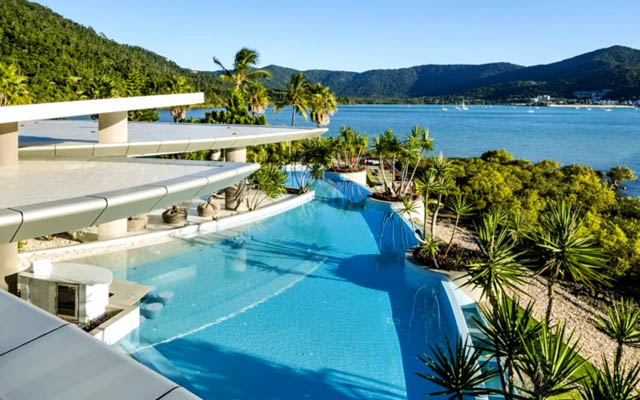
Australian luxury home rental service, Luxico, has launched a web portal for travel agents; Aqua in Airlie Beach, pictured (Photo: Luxico)
“There is no other villa platform that’s integrated with trade in Australia, and provides (clear) commissionable rates. For any other company, agents don’t know what they are going to get. But for us, all of our products have the travel agent’s commission included in the advertised rate. Even if the client were to book directly, there is rate parity, and they will never find it cheaper online than what a travel agent can offer. That’s the beauty of the portal,” Alex Ormerod, managing director of Luxico, shared with TTG Asia.
The reason Luxico can do this is because it manages every aspect, which means that the company “controls the keys, and both the rates and availability”. It is also part of the Virtuoso network where a number of the bookings actually come through.
She added: “Some of our villas in the higher price points also have an upgrade option, where travel agents can request for additional services such as a private butler or daily housekeeping service. These all cost extra, and can be added to the package. At Luxico, these add-ons are also commissionable for travel agents, which is something they like because normally, add-on services are not commissionable.”
This is a boon for agents based in Asia, as most of Luxico’s Asian clients, particular the high-end travellers, comes through travel agents. It also helps that Luxico has staff to meet and greet the guests, which “takes the pressure off the travel agent, particularly when they are based somewhere else”.
When asked about the business breakdown, Ormerod shared that pre-Covid, 51 per cent of the company’s business – mostly multigenerational and family groups, as well as the occasional celebrity – were from international markets, most of whom came from the US and the UK, followed by Singapore, Hong Kong and New Zealand.
“We’re starting to see internationals pick up but it’s still a long way from where it was. Families are our core business, but we haven’t yet seen international visitor visitation come in,” she said.
Ormerod attributed this to the “long purchase decision” for international travellers, where a holiday to Australia is usually longer in length, and planned several months in advance.
“We’re anticipating that we’ll start seeing a lot more international travellers coming through this summer and into 2024. We plan to go pretty hard at trade events next year, but for this year, we’re focusing more on the existing direct connections that we have within our travel agent networks. We (have working relations) with over 5,000 agents, so we’re doing a lot of online webinars (to keep them updated of our latest products),” said Ormerod.
Radisson Hotel Group (RHG) and La Vie Hotels & Resorts have signed a Master Collaboration Agreement to add over 30 hotels to the RHG’s portfolio over the next 10 years.
RHG is identified as La Vie’s preferred partner, enabling the latter to develop, manage and operate properties under the former’s five brands: Radisson Blu, Radisson RED, Radisson, Park Inn by Radisson, and Country Inn & Suites by Radisson.
Radisson Hotel Group will add 30 hotels to its portfolio over the next 10 years; Radisson Blu Resort, Galle, pictured
The collaboration will drive the expansion of RHG’s portfolio in key strategic growth markets including Australia, New Zealand, Vietnam, Thailand, Singapore, Cambodia, Myanmar, Malaysia, Indonesia, Sri Lanka, Maldives, Bangladesh, Fiji and Vanuatu.
Jerry Xu, CEO of La Vie, commented: “With the team at Radisson Hotel Group, we launched three landmark hotels under the Radisson Blu and Radisson brands in Sri Lanka in 2022 and within the space of 12 months they have enjoyed immense success. To now be extending our partnership and signing a Master Collaboration Agreement is a nod of confidence to our amazing team and we look forward to building on our successes together in the years to come.”
Elie Younes, executive vice president and global chief development officer, RHG, added: “We’ve enjoyed a strong partnership with La Vie Hotels & Resorts with successful property conversions in Sri Lanka to-date. This latest news marks the next step on our journey together and the expansion of our partnership across key regional markets.”
With the growth of RHG’s portfolio across the region, a centralised franchising service will soon be extended into Australasia, enabling independent and small-scale hotel companies to benefit from the group’s global network.
The centralised franchising services model will enable owners to leverage the support, brand recognition and global distribution of RHG through proprietary systems and business intelligence tools. In addition to the group’s standard franchising services, additional resources will be made available for owners which includes revenue management, 24-hour reservations support, as well as advisory support that will enhance revenue and reduce their operating costs.
The Club of Revenue Management by RHG will also expand into the region, enabling hotels to revolutionise their revenue management with cost-effective, cutting-edge system for maximum efficiency and rate optimisation.
The Australian Tourism Exchange (ATE) will return to Melbourne next year for the first time since 2015, with Australia’s largest annual tourism trade event to be held at the Melbourne Convention and Exhibition Centre from May 19 to 23, 2024.
This announcement was made by Tourism Australia managing director, Phillipa Harrison, during ATE23 on the Gold Coast.
Melbourne will host the Australian Tourism Exchange next year
She said: “After a couple of years of hybrid events, it has been great this year to have ATE back to its traditional format on the Gold Coast and we can’t wait to work with Visit Victoria to deliver another amazing ATE in 2024.
“ATE brings together tourism businesses, tourism wholesalers and retailers from around the world for four days of appointments, as well as networking events, which are more important than ever before as competition grows for the tourism dollar.”
ATE24 will be organised by Tourism Australia and Visit Victoria – it will be the ninth time the travel trade event has been staged in Melbourne.
Delegates from 30 countries are expected to attend ATE24.
Hilton Singapore Orchard has a new wedding venue, The Manor on Level Five, which is an exclusive botanical enclave ideal for couples looking to have a one-of-a-kind wedding venue.
Comprising seven function rooms of varying sizes, The Manor is an interconnected space complemented with communal areas that are transformed into a romantic, floral paradise perfect for matrimonial celebrations.
The Manor is an interconnected space with communal areas that transform into the perfect wedding venue
For menu choices, there is the Western menu which includes dishes such as Lobster Bisque with Cognac, Pan Fried Toothfish and Black Angus Beef Tenderloin, as well as the Dessert Bar of artisanal sweets like the Macaron Tower and Croquembouche, Forêt Noire and Marsala Wine Tiramisu.
Hilton Singapore Orchard has also partnered with local watercolour artist and wedding stationer, A Brush With Mel, to create three bespoke illustrations that couples can choose to customise for their wedding and incorporate into their menu design and as their digital backdrop for the grand march-in.
In addition, the hotel will be introducing four new enchanting wedding themes: Classic Elegance, Whimsical Garden, Bohemian Chic, and Luxe Foliage.