Tokyo Haneda International Airport’s Terminal 2 (T2) facility has reopened after a hiatus of more than three years due to the Covid-19 pandemic.
T2 was solely a domestic flight hub until March 29, 2020 when its use was expanded to include international flights to accommodate more flights in and out of Japan as well as to improve transit between international and domestic flights. Less than two weeks later, however, on April 11, its international lobbies were shuttered in response to the growing coronavirus outbreak and resultant drop in global travel.
Tokyo Haneda International Airport has reopened after a hiatus of over three years
Now, T2 will be capable of handling up to 30 international departures per day.
All Nippon Airways (ANA) welcomed the reopening, noting that it will ease the strain on Terminal 3 (T3) – which handles only international flights – amid Japan’s rapid inbound tourism recovery and during the busy summer vacation season. ANA’s international flights to and from T3 alone are expected to recover to pre-pandemic levels by the end of July.
ANA will initially operate five flights a day from T2 to Hong Kong, Shanghai, Taipei and London between 0.500 and 13.00. The airline plans to increase the number of flights at the terminal at the end of 2023 while continuing to operate international flights from T3.
Speaking of the reopening, ANA president Shinichi Inoue said: “We have finally resumed operations (at T2) as we are moving out of the Covid-19 pandemic. Recovery of demand for international flights is clear and the facility will play a key role in Japan’s economic recovery.”
ANA staff servicing the first departure from T2 on July 19 held celebratory banners and greeted about 800 passengers as they departed for Hong Kong, Shanghai, Taipei and London on five flights.
Japan Airlines will continue operating international flights from T3.
The Thai court on June 15 dismissed Minor International’s legal action against Marriott International related to the JW Marriott Resort & Spa but Minor says it will continue to pursue the case in other jurisdictions.
Marriott said the court held that there was no wrongdoing by it, and no breach of Thai law. All of Minor’s claims against Marriott were dismissed, according to the US chain.
Minor International will continue to pursue the case against Marriott International; JW Marriott Phuket Resort & Spa, pictured (Photo: Marriott Bonvoy)
A statement from Marriott in Asia-Pacific said: “Marriott International welcomes the decision of the Thai Court and looks forward to continuing to work in close partnership with hotel owners to operate properties that deliver excellent experiences for guests, as well as providing opportunities for career growth to its 18,000 associates in Thailand.
“The company looks forward to maintaining its focus on delivering exceptional customer service at the JW Marriott Phuket Resort & Spa, and across its extensive portfolio of hotels worldwide, working in partnership with hotel owners to deliver memorable experiences for valued guests.”
Minor’s CEO Dillip Rajakarier said the court’s decision is “a temporary setback” and that it will continue to pursue the case until it reaches “a fair outcome”.
“The decision was made on technical grounds and we will shortly file our appeal to challenge it. Moreover, the judgment also gives us important insight into the Thai court’s considerations and will guide our further Thai law claims against Marriott,” said Rajakarier.
“We are committed to holding Marriott accountable for its behaviours and actions. We will continue to fight for full accountability and to insist on full transparency by Marriott in the interest of hotel owners throughout the Marriott system worldwide.”
Minor is claiming damages of 571 million baht (US$17 million). Allegations include Marriott’s failure to protect owner’s interest and that Marriott is enriching itself “through non-transparent license fee arrangements, supplier rebates and use of monies in the Marriott loyalty programme fund”.
The Bangkok-based chain first filed the lawsuit against Marriott and its Thai subsidiary Luxury Hotels & Resorts in July 2019. In 2020, Marriott succeeded in getting the case to be moved to Singapore for arbitration, as per the arbitration clause in the management agreement.
Minor fought back and won the right for the case to be transferred to the Thai court. In TTG Asia’s article on this published in April last year, Minor’s chief commercial officer & general counsel Steve Chojnacki said moving the case to Thailand was “extremely important to us”.
He said: “Marriott clearly wants to avoid Thai court, but we strongly feel that this is the appropriate forum to hear Thai law claims relating to a business that operates in Thailand.”
According to Rajakarier, Minor is fully confident of its long-term strategy and is hopeful for a better resolution.
India’s airport services aggregator DreamFolks and Plaza Premium Group (PPG) have partnered to include over 340 Plaza Premium Lounges in over 70 major international airports into the DreamFolks global lounge network, offering an enhanced travel experience to its members worldwide starting July 24.
This collaboration will facilitate extensive coverage of Plaza Premium Lounges across four continents including key travel hubs such as Australia, Canada, the UK, Hong Kong, Florida, Brazil, Italy, Indonesia, Malaysia, Singapore, Dubai, Saudi Arabia, Jordan and more.
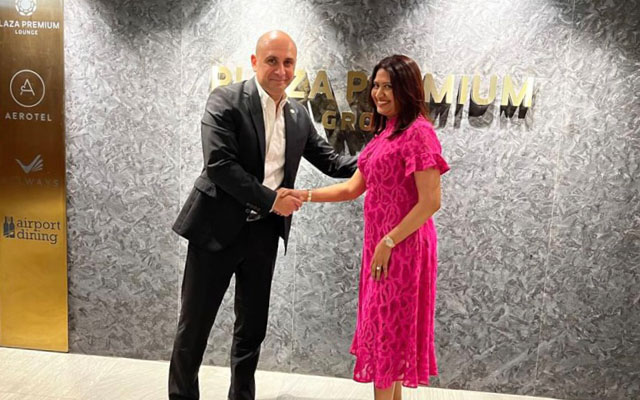
Plaza Premium Group’s Bora Isbulan and Dreamfolks Services’ Liberatha Kallat
With the inclusion of Plaza Premium Lounges, DreamFolks’ global touch points will increase to over 1,700. This expanded network will offer members unparalleled access to premium lounges across key travel destinations worldwide, ensuring a seamless and comfortable travel experience.
Liberatha Kallat, chairperson & managing director, Dreamfolks Services, said: “The strategic collaboration marks an important step towards enhancing the global travel experience for all. With increased lounge coverage and access to an extensive network of touchpoints, travellers can look forward to enjoying unparalleled comfort and hospitality at key travel locations worldwide.”
Bora Isbulan, deputy-CEO, PPG, commented: “India is one of the biggest fastest outbound markets in Asia (and) this strategic collaboration enables PPG to further its mission to make travel better by curating unique airport hospitality solutions to travellers to meet the evolving needs of Indian travellers.
“Through this collaboration, we can tap into DreamFolks’ extensive exposure and deep understanding of India’s travel market and consumers, while also leveraging PPG’s strong global network and expertise in airport hospitality to introduce innovative products and services to the Indian market more effectively.”
Location
The 18-villa resort sits snugly at the foot of Kep National Park’s gentle slopes, providing a tranquil oasis in the midst of nature. It sits a five-minute drive from the centre of the sleepy town, beachfront area and crab market, and has easy access to trails that snake through the 66.64km² national park.
Accommodation
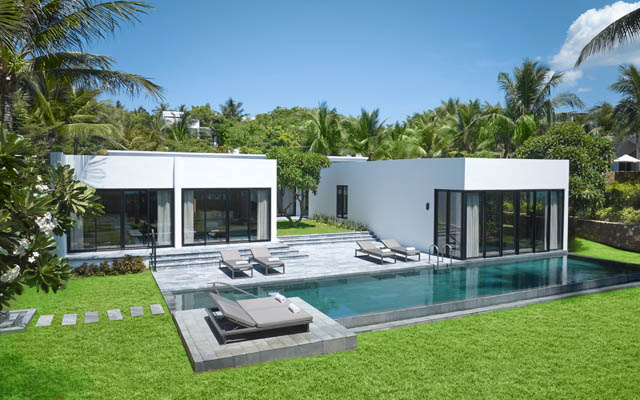
I stayed in one of 18 twin- and double-bed villas that are dotted around well-manicured tropical gardens bursting with colour. Minimalist but chic in design, each comes with double or twin beds, a desk area and fridge. A separate bathroom boasts a standalone shower. Rust-coloured tiles complement white walls, wooden beams and thatched roofs. Plus, an outdoor seating area provides the perfect camp to soak up the serene scenery and sounds of jungle life.
Maniltoa
1 of 3
Villas
Villa interior
Restaurant and pool
F&B
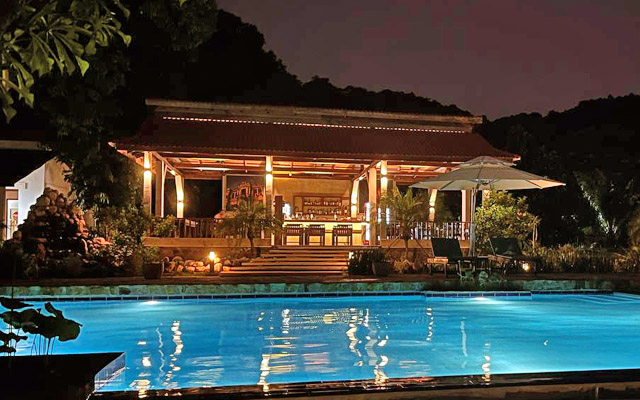
Maniltoa is a foodie’s dream. Overlooking the swimming pool sits an open-air restaurant with vistas that sweep to the sea. Here, a mouth-watering menu sees fine French and Khmer cuisine collide. Each dish uses a blend of local ingredients, while tapping into Kep’s coastal location – so seafood features heavily. Creative culinary offerings include jackfruit burrata, Mekong lobster, fresh wild Kep prawns, and barracuda fresh from the market. Each is perfectly plated to the quality you’d expect at an upmarket Parisian restaurant, at a fraction of the price.
Facilities
In fitting with the tone of Kep, Maniltoa embodies the ultimate in relaxation. A large swimming pool takes centre stage, flanked by sun loungers and parasols. It is possible to arrange for motorbike rental, and staff are on hand to organise activities in the area, including sailing, day trips to nearby Rabbit Island and excursions to world-famous Kampot pepper farms.
Service
Cambodia is famed for its warm hospitality, and that’s exactly what you receive here, where smiles abound and staff are attentive. When we mentioned we were mulling a trip to the nearby crab market for lunch, they offered to head there themselves and then cooked up a crab salad fit for royalty.
Verdict
Maniltoa is perfect for couples, friends and families seeking a short, tranquil break away from it all surrounded by nature on the Cambodian coast.
Meliá Hotels International has inked an agreement for a new hotel in Ha Long, Meliá Halong Bay, which is set to debut in 2027.
Owned by Hanoi Halong Tourism Company, Meliá Halong Bay will boast 240 guestrooms and 302 serviced apartments spread over two towers, and feature four restaurants and bars, indoor and outdoor swimming pools, a spa, and 2,000m2 of event venues.
Meliá Halong Bay is set to open in 2027
Meliá currently has 23 hotels throughout Vietnam, including the upcoming opening of Gran Meliá Nha Trang. Sol by Meliá Cam Ranh Bay, Meliá Nha Trang Beach Resort, and Meliá Quy Nhon Beach Resort will open over the next few years.
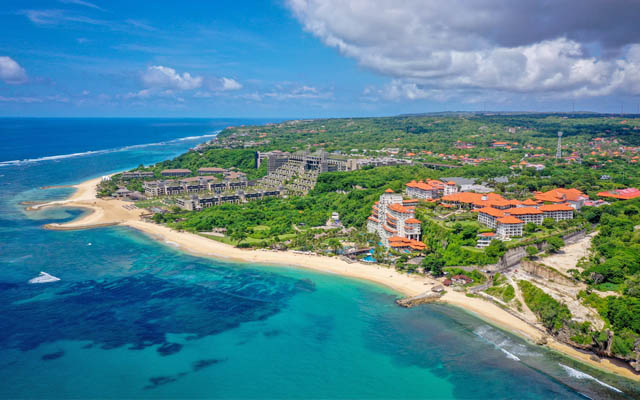
Jumeirah Bali in Uluwatu has unveiled a collection of on- and off-property cultural immersions for guests.
From making traditional Gebogan and Canang Sari ceremonial offerings to learning common phrases in Bahasa Indonesia, guests will find various activities that promote well-being and cultural involvement. These are changed every day.
Guests can try their hand at playing the rindik, Bali’s traditional musical instrument
Starting with a blessing ritual which takes place at one of the sacred Dang Kahyangan Hindu temples, the experience offers a spiritual journey and insights into Balinese beliefs.
At the resort, guests can join a number of educational classes, such as a rindik session where they can try their hand at playing Bali’s traditional musical instrument; a cooking class with a Jumeirah chef focusing on healthy, easy-to-make Balinese dishes; batik-making workshop covering everything from pattern creation using dyes to producing a finished one-of-a-kind masterpiece; and Balinese dance class for ladies.
The resort also offers a range of holistic activities for the body, mind and spirit – morning and sunset yoga; candle-pouring workshop using natural wax and aromatherapy; a session of bayu suci, Bali’s movement meditation; and banyu raga – a series of invigorating pool exercises that are gentle on the joints while offering a satisfying workout.
At Talise Spa, a sound and breath healing experience promotes deep relaxation with yogic breathwork and Tibetan sound bowls, while aromatherapy oil blend workshop focuses on how essential oils affect our emotions and includes a personalised botanical blend to take home.
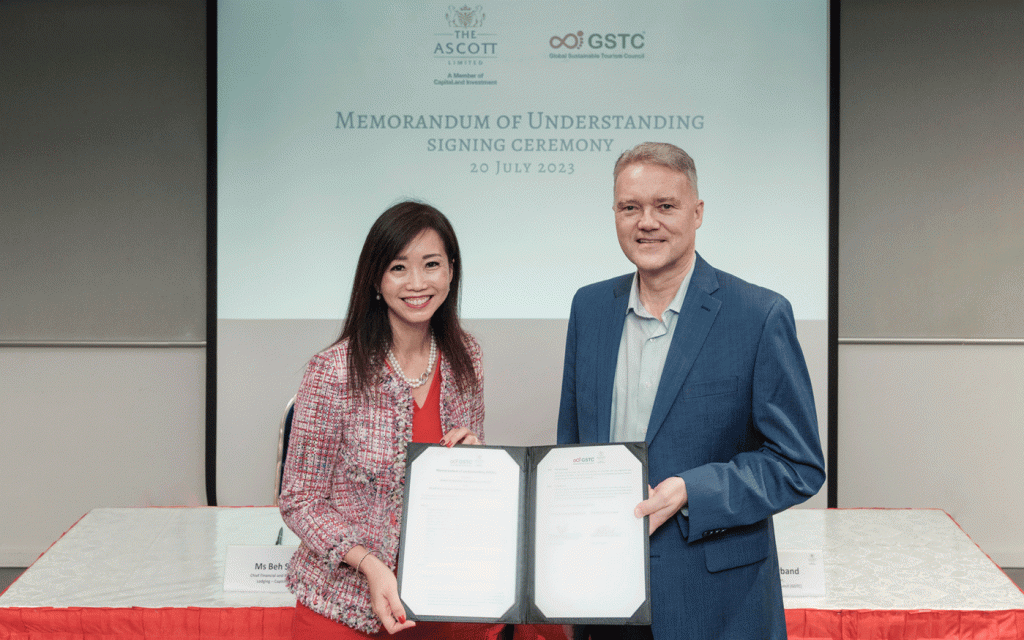
Singapore-based hospitality firm, Ascott and the Global Sustainable Tourism Council (GSTC) signed an MoU yesterday afternoon that reflects their commitment to facilitating sustainability education and supporting the acquisition of internationally-recognised sustainability certifications among local tourism and hospitality industry stakeholders.
The partnership will see GSTC deliver its Sustainable Tourism Course (STC) and Sustainable Hotel Course (SHC) to an in-person audience at The Ascott Centre for Excellence (ACE), which is Ascott’s human capital training centre for the hospitality industry.
From left: Ascott’s Beh Siew Kim and GSTC’s Randy Durband ink their training partnership at the ACE Learning Festival on July 20
This is the first such partnership for onsite GSTC training in Singapore.
STC, to be launched in October 2023, is designed to equip trainees with a deeper understanding of environmental tools and techniques to address sustainability gaps, regulations and guidelines. These new skillsets will allow trainees to integrate sustainability as a core value across the tourism ecosystem.
SHC, which will begin classes in November 2023, will be customised by ACE for hotel and accommodation professionals. It will provide practical insights into sustainability practices for hotels and feature expert tips and resources to tap on key solutions around current issues and trends.
These courses, open to all in the industry, will support Singapore’s hotel sustainability roadmap, where at least 60 per cent of total hotel room stock are expected to achieve internationally-recognised sustainability certifications by 2025.
Beh Siew Kim, chief financial & sustainability officer, lodging, CapitaLand Investment (which Ascott is part of), said the initial intake would be for 20 to 30 participants, as the goal is to “allow for quality interactions”.
Beh told TTG Asia: “There is no trade secret in sustainability efforts. We want people to share their best practices, so that we can all do better together.”
The partnership is expected to facilitate over 700 training hours during the initial intake.
“That is a fairly aggressive target for the first run,” said Beh, who added that it is important to “grow a team of trainers in Singapore soon, which will allow local professionals to conduct the programme thereafter”. Most of the trainers are based outside of Singapore.
Developing a pool of qualified trainers here would take half a year, according to Beh, as GSTC is “very strict with the quality of trainers and who it selects to deliver its programmes”.
Based on the objectives of the partnership, Randy Durband, GSTC CEO believes that the courses will be “available in perpetuity”.
He said: “The courses will remain in demand for many years, as there are so many people who need and want it. Even among the willing, it will take hotels several years to get all their personnel trained. Furthermore, some hotels will resist initially and come around later, so the programme will have legs for quite a while.”
Durband added that continued education in sustainability is also needed, as “technology, attitudes and conditions change”.
Looking ahead, Beh and Durband shared that additional courses at ACE will be determined as needs arise, while Beh is keen to train Ascott staff around the world.
“Ninety per cent of the Ascott portfolio is outside of Singapore, so we need to think about how to get our people access to GSTC training. Of course, the first step is to train our sustainability champions – the people driving our efforts in clusters – and have them train their community,” said Beh.
Both parties hope that improved understanding of sustainability topics will help organisations to get started on this journey.
Durband said: “The lack of awareness is the number one obstacle to sustainability efforts. People are just focused on the investment, but there is so much that can be done (without huge expenses). For example, a hotel can get massive cost savings just from simple food waste management. All it needs to do is train its staff to weigh (fresh) food going out and (leftovers) coming back in, so they can track consumption, see trends and make adjustments. (Being sustainable) isn’t all about expensive procedures like refitting buildings.”
Beh added that “payback will justify the investments most of the time”.
She also hopes that the courses will create a larger pool of individuals with sustainability skillsets and experience, which is now in short supply in Singapore.
Indonesia’s efforts to gain tourism volume and revenue from sports tourism have fallen through as three international events are cancelled this year.
Bali was set to host the second edition of the World Beach Games 2023 in August, but Indonesia withdrew from the World Beach Games as well as the ANOC General Assembly due to a budget shortage.
Indonesia withdrawing from the World Beach Games 2023 has affected hotels in Bali, namely Seminyak, Kuta, and Nusa Dua, pictured
The decision at such a late hour caught the organising body off guard. The cancellation comes three months after football’s world governing body, FIFA, stripped Indonesia of its rights to host the Under-20 Men’s World Cup (U-20 World Cup) this year.
Fate of the 2024 World Super Bike is also unclear; the organiser has revealed funding woes after the government decided not to continue with its financial support.
Sandiaga Uno, Indonesia’s minister of tourism and creative economy has estimated a potential foreign exchange loss of US$16.2 million due to these cancellations.
Fransiska Handoko, chairman Bali Hotel Association (BHA), said the loss of the World Beach Games would hurt the tourism industry the most.
“With the Games scheduled to take place in a month’s time, the late notification makes it difficult for hotels to fill rooms that participants and delegates would have taken,” she explained.
According to BHA data, most of the hotels appointed by the World Beach Games 2023 have lost more than 1,000 rooms a night. Bookings for meeting rooms and ballrooms that were secured for activities related to the General Assembly of the National Olympic Committee Association were also cancelled. Hotels that were most affected were located in Nusa Dua, Seminyak and parts of Kuta.
Fransiska said: “Hotels have to work three times harder to cover losses because August is high season… and travellers usually book far in advance.”
Loss from the 2023 World Beach Games alone is estimated to be US$13.5 million, according to the Ministry of Tourism and Creative Economy. This calculation is based on the estimated 6,900 international visitors and the chain impact on publications revenue, employment opportunities, venue and hotel bookings, and transportation earnings.
Loss from FIFA U-20 is estimated at US$2.1 million, and World Super Bike 2024 at US$572,000.
Indonesia’s hopes of securing the Summer Olympics 2036 bid are dimmer as a result, opined Ndang Mawardi CEO of Inspiro Group.
However, Sandiaga promised to bring more events to Indonesia and expressed his administration’s continued commitment to ”assist associations in bidding on international events”.
To avoid future event cancellations due to financial woes, Ndang suggested that a new regulation should be in place to “lock up” tactical funds for organising international sporting events hosted by Indonesia.
Additionally, recurring events should only be funded by the government in the initial two years, and leave the promoters to take over after, added Ndang.
A new hospitality training centre has been launched in Vietnam’s Danang in a bid to fill the employment gap in the sector left by Covid-19 while providing underprivileged youth with opportunities.
Vietnam-based B&B Ideas Group has teamed up with Rotary Club Danang and social enterprise Sunrise Potential Partners to create Cocoon, a vocational introduction course to F&B for orphans and less fortunate people living in the area.
Cocoon is a vocational introduction course to F&B for the less fortunate people living in Danang
The first batch of 25 students aged 15- to 17-years-old from Danang Street Children’s Centre and Danang Disabled People’s Association started the one-year course in June. The aim is for them to secure employment with the region’s local and international hotels upon graduation.
“Although still in its infancy, we aim to achieve our first semester of budding young F&B people looking to gain access in further hospitality training or working within the restaurant and hotel community,” said Andrew Joyce, B&B Ideas Group founder, who started working as a chef at the age of 15.
“I myself worked at a very young age after being given the opportunity to enter the hospitality industry with almost no experience and qualifications. It is vital that the F&B industry holds an open-door policy to all young people,” he added.
“Worldwide, the F&B industry is suffering immensely from lack of staff. We need to ensure that young people from all walks of life, cultures and backgrounds enter this industry.”
In the Central Vietnamese coastal city of Danang, the hospitality and service industry accounts for 31.4 per cent of the city’s GDP. However, the sector has been hit hard by the pandemic, with a 50 per cent reduction in its labour workforce.
According to Cocoon, the city lacks qualified employees, particularly chefs and waiting staff. However, it is hoped that the vocational training course will fill part of this gap.
“B&B Ideas group will always keep at the forefront of its strategy, helping young people get started in the industry, as well as vulnerable people and people of determination. This is key for us and we will continue to find new ways that we can help make an impact,” said Joyce.
He added that future plans include supporting young women who have been abused and victims of trafficking.
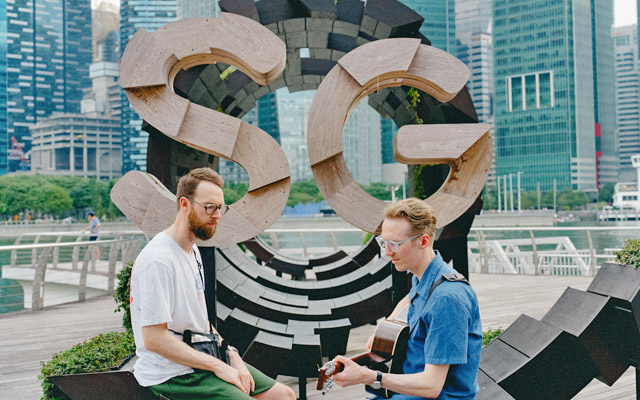
Singapore Tourism Board’s (STB) partnership with Warner Music Singapore has led to yet another star-studded destination promotion collaboration – this time with English alternative pop duo HONNE to create inside-out in Singapore, a video series that uses the power of music to showcase a fresh perspective of the city-state.
Initially started by HONNE’s Andy Clutterbuck and James Hatcher in 2021, inside-out is a video collection of the duo performing acoustic renditions of their hit songs, captured by a camera placed inside a guitar. While the series has so far only featured scenes from their daily lives at home due to the pandemic, it will now head overseas and is the band’s first-ever collaboration with a destination.
inside-out in Singapore will see HONNE introduce viewers to a different neighbourhood in the city
Through this series, STB hopes travellers will discover a different side of Singapore with HONNE’s new take on some of their most-streamed hits.
Each instalment introduces viewers to a different neighbourhood in the garden city – Joo Chiat, Keong Saik Road, and Marina Bay – and features exclusive performances of some of HONNE’s biggest songs in the region such as Location Unknown, No Song Without You, and Day 1.
The campaign was launched across STB and HONNE’s social media platforms on July 18.




 Location