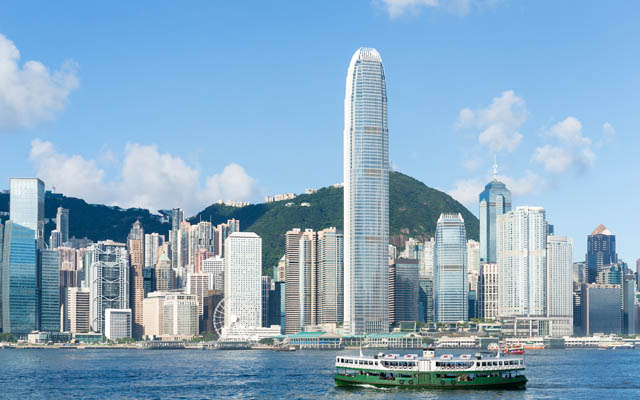
More initiatives to support Hong Kong’s travel and tourism industry have been detailed, following the government’s 2023/24 budget announcement last week.
The Travel Agents Incentive Scheme, which is due to expire end of March 2023, will be extended by three months. New schemes for fully guaranteed loans will be offered to eligible passenger transport operators and licensed travel agents, with about HK$2.7 billion (US$344 million) set aside for this purpose. Furthermore, some HK$30 million will be injected into the Information Technology Development Matching Fund Scheme for Travel Agents.
The government’s 2023/24 budget has allocated funds to help with the recovery of the travel and tourism industry
Hong Kong Tourism Board (HKTB) will also get an additional HK$200 million to fund its fight for more international business events and high value‑added visitors, allowing it to consolidate Hong Kong’s position as the premier business events destination in the region.
In response to these measures, Travel Industry Council (TIC) chairman Gianna Hsu told TTG Asia that the industry is disappointed that the proposed Travel Industry Resumption Fund had fallen through.
The fund, first put forward to secretary for culture, sports and tourism Kevin Yeung by Legislative Council member Perry Yiu Pak-leung in a meeting last November, was meant to support the beleaguered travel and tourism industry in relaunching their business.
Yiu recognised that the industry needed to recruit manpower and carry out repair and maintenance for equipment and facilities that have been left idle for a long period of time, putting them under tremendous cash flow pressure as they prepare for tourism recovery.
In a press statement, TIC reiterated the financial and manpower challenges faced by its stakeholders in the present early stage of tourism recovery.
Hsu also told TTG Asia: “We wish for more supportive measures to be deployed in future. Hopefully, the government will keep monitoring our business situation and lend its support in a timely manner.”
The return of arrivals from China, a major source market, is still slow, according to Hsu. While Chinese tour groups are now allowed to travel to Hong Kong, the destination receives no more than 20 tour groups from China daily.
“It is hoped that the numbers will triple in March,” she said.
PATA’s latest forecasts predict strong annual increases in inbound visitor numbers for Asia-Pacific under each of the mild, medium, and severe scenarios in 2023, with growth rates ranging from 71% under the latter scenario conditions to as much as 104% under the mild scenario.
The report gives a deeper quantitative overview of the international visitor landscape into and across the Asia-Pacific region at the regional, sub-regional and destination levels out to 2025. This is done at both the annual and quarterly levels over the same period, and by scenario. In addition, the growth in key source markets between 2023 and 2025 is forecast for Asia-Pacific as a whole, and for each of the regions/sub-regions.
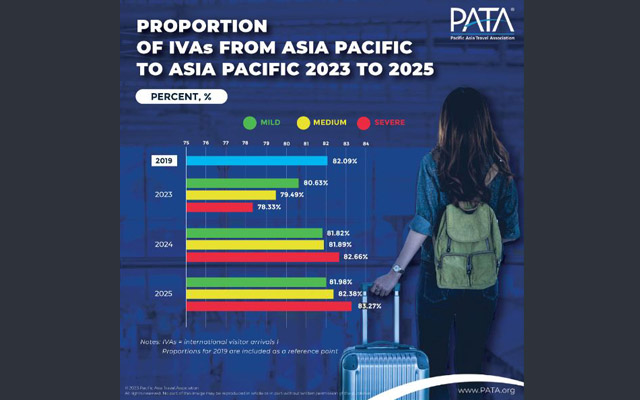
By 2025, IVAs from Asia-Pacific markets into Asia-Pacific destinations are expected to return to similar proportions as that of 2019
The annual increase in the absolute number of international visitor arrivals (IVAs) in 2023 is predicted to range from 158.7 million to 437.5 million under the severe and mild scenarios respectively, lifting the total volume of visitor arrivals to between 382.9 million and 712.7 million, under those same scenarios.
Substantial annual increases in IVA numbers are also forecast for 2024 and 2025, under all three scenarios, although the volume of these gains will slowly reduce over the years as the absolute volume base of foreign arrivals increases.
The impact of these increases is such that under the mild scenario, a return to better than the benchmark number of IVAs in 2019 is predicted to occur in 2023, while under the medium scenario that position is projected for 2024. Under the severe scenario, however, even by 2025, the volume of international visitors into and across Asia-Pacific is forecast to still fall short of the 2019 benchmark by around 12%.
The mix of source regions is forecast to remain dominated by flows from Asia-Pacific markets into Asia-Pacific destinations, with 2025 expected to return to roughly similar proportions as that of 2019, under all three scenarios.
These intra-regional proportionate flows differ for each Asia-Pacific destination region, however, especially for the Americas and Asia, both of which rely heavily on intra-regional visitors. The Americas accounted for 55.4% of visitor numbers in 2019, and this is predicted to gradually increase to between 56% and 57% in 2025, depending on the scenario that plays out at that time. The Asia-to-Asia flows accounted for 80.4% of total IVAs for that region in 2019, and this is forecast to reach between 80% and 82% by the end of 2025.
The Pacific as a destination region within Asia-Pacific is somewhat different, however, since its source regions in 2019 were dominated by Asia which had a slim margin over the Americas. Those positions are forecast to change over the years to 2025, at which time both source regions under the mild scenario are predicted to generate roughly equal proportionate shares of IVAs into the Pacific. Under the medium and severe scenarios, however, the Americas is projected to have a slight relative share dominance in delivering IVAs into the Pacific by the end of 2025.
As IVA growth builds between 2023 and 2025, it is worth noting that the source markets of Asia collectively generate the bulk of the additional annual increases in absolute numbers of arrivals across Asia-Pacific each year. Under the mild scenario, for example, the annual increase in IVAs from Asia in 2023 are forecast to number 330.7 million and account for three-quarters of the net increase in total IVAs between 2022 and 2023.
Across the years and under all scenarios, the visitor footprint of the Asian source markets, at the aggregate Asia-Pacific level, is predicted to remain very strong. The Americas already has a strong intra-regional visitor flow, and forecast to receive more than half of its annual increase in IVAs in both 2023 and 2025, under the mild scenario, from source markets within that same region. That proportion is predicted to reach as much as 68% under the medium scenario in 2024 and 78% under the severe scenario in that same year, and although the proportions may reduce a little by 2025, they are still predicted to favour the Americas as the main generator of annual IVA growth in absolute numbers into that same region.
“These current forecasts are easily the most positive since 2019 and while inbound numbers are predicted to strongly increase each year to 2025, they will not do so evenly across the Asia-Pacific destinations nor at the same rates. In addition, growth will not necessarily be by passive osmosis; work needs to be done for destinations to remain competitive and to deliver experiences to these visitors that consistently rate above and beyond their expectations. A blatant profit-grab at this time will resonate badly with visitors now and will work against destinations and operators in the future,” noted PATA chair Peter Semone.
“Now more than ever before, destinations need to work with host communities, operators, and visitors to deliver results and experiences that bring the best of the travel and tourism sector to the fore, across all involved parties and in a responsible, equitable, meaningful, and thereby sustainable manner. Such an approach will also create a certain resilience to future shocks as and when they appear, and rest assured that they will,” he added.
View the PATA Asia Pacific Visitor Forecasts Full Report 2023-2025 here.
The Thai government’s decision to charge international travellers an entry fee of up to 300 baht (US$9) from this June has attracted mixed views from the country’s travel and tourism players.
Dan Fraser, founder of destination management and tour company, Smiling Albino, believes the fee is justifiable.
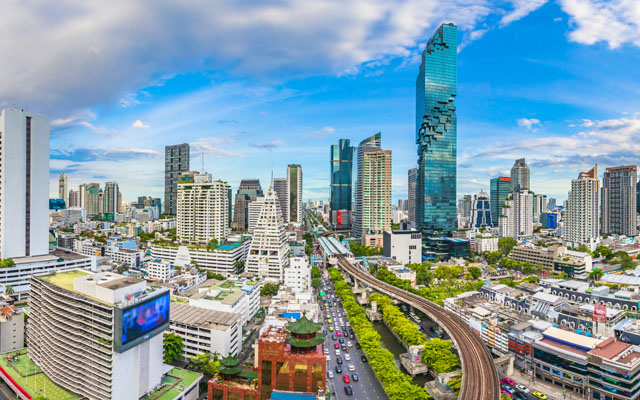
The new entry fee could help boost tourism earnings for the country; Bangkok pictured
“It is reasonable to have a tax on inbound arrivals, many countries do it, and it is almost always built into the cost of an airline ticket or similar. I think if we look into the data, we’ll see that studies probably review it has almost zero net effect on tourism members. Much like the cost of expressways, people need to get places, and the cost probably doesn’t deter participation,” he told TTG Asia.
Fraser added that the entry fee is a way for Thailand to boost tourism revenue after years of pandemic struggles.
He said: “Introducing fees like this is a reasonable way to bring in some additional revenue on a per-user basis rather than an additional tax on the population.
“Short-term or long-term, it will have zero effect on people’s decisions to travel to Thailand, and very quickly, people will forget that there is even a fee, as it is not visible.”
On the other hand, Hat Yai Songkhla Hotels Association’s president Sitthiphong Sitthiphatprapha had stated in the Bangkok Post that the entry fee could impede tourists, especially those from Malaysia.
“A family of four would have to pay 600 baht to enter by land, which would result in a longer decision-making period for travelling families. Although an exemption has been made for those holding border passes, 80 per cent of arrivals over the border are using their passports,” he said.
Reserving his judgment for now, Dieter Ruckenbauer, general manager, Le Méridien Bangkok, wants clarity on how the collected fees will be spent.
“If the funds are used to enhance the tourism industry, such as the development of local attractions, investment in tourist services, and business support, then it could be a good idea. But we need to wait for the government to reveal its budget and spending information to the public before we can make a judgment,” Ruckenbauer stated.
Dirk De Cuyper, CEO of S Hotels & Resorts, suggested identifying this tourism fee as a green tax or development tax to reverse the negative narrative.
“Using taxes to enhance sustainability is something we should all get behind and get used to. However, there should be a transparent approach which shows how these funds will support the development of tourist destinations and encourage a shift towards longer-staying, higher-spending guests,” he added.
In earlier news reports, Phiphat Ratchakitprakarn, minister for tourism and sport, justified the charge, saying that the fees would be used to support the care of tourists while in the country. The government expects to collect up to US$115 million this year from the tourism fee.
The minister cited reports of the two-year period between 2017 and 2019, when tourists’ use of public hospitals cost the country 300 to 400 million baht.
The process of collection worries a Bangkok-based industry veteran, who leads one of the region’s top DMCs. “I don’t see how it can be levied practically. The only way for it to be collected efficiently is for it to be done by the airlines. But, as the government has said they won’t charge Thais and residents with work permits when they fly into the country, it isn’t reasonable to expect carriers to carry out this level of bureaucracy,” he commented.
AirAsia and Plusgrade have teamed up to allow AirAsia customers to bid for upgrades and reserve the seat(s) beside them for extra space and comfort.
The deal was unveiled at the Aviation Festival Asia held in Singapore.
From left: Plusgrade’s Ho Hoong Mau and AirAsia’s Paul Carroll
The partnership will offer ancillary services to customers such as upgrades or the ability to reserve open seats beside them, and enable them to experience premium products and services that might otherwise be out of reach – which in turn helps drive revenue for the airline too.
Ken Harris, CEO of Plusgrade, said: “We look forward to supporting AirAsia as they continue to innovate and develop new products and services for their customers, and to expanding our footprint in the thriving Asia-Pacific region.”
Karen Chan, group chief commercial officer at AirAsia shared that the collaboration “will enable us to offer more passengers the chance to access our premium products and services” such as flatbeds or popular seats with extra legroom.
“We are confident that our guests will love this innovative and seamless way to enhance their travel experience,” she added.
The Arival | Activate conference will take place from June 12 to 14 at the Bangkok Marriott Marquis Queen’s Park in Thailand this year.
The event will bring together leaders from the experiences industry – tours, activities and attractions – to delve into the major trends shaping travel’s third-largest and fastest-growing sector.
The Arival | Activate conference will take place in Bangkok from June 12 to 14
It aims to help experience creators and sellers re-activate their businesses after the pandemic, and will highlight shifts in consumer behaviour that are shaping travel experiences across Asia-Pacific and Oceania in 2023 and beyond.
“Experiences are now a primary driver of travel, with three in five Gen-Z and millennial travellers prioritising experiences over things,” said Douglas Quinby, co-founder and CEO of Arival. “But traveller expectations and behaviour have changed dramatically as the Asia and Oceania regions have emerged from the pandemic.
“The Arival | Activate Bangkok conference will deliver the insights, tools and connections that tour, activity and attraction businesses need to gain a competitive edge in this dynamic new landscape.”
The conference – which has secured Klook, Viator, Go City, TUI Musement, BeMyGuest and Headout as partners – will feature an impressive speaker roster spanning many of the experience sector’s most well-known brands.
More than 500 attendees from across the tours, activities, attractions and experiences sectors are expected to attend.
Quinby noted that travellers are “prioritising memorable activities that connect them with local cultures, history and people” post-lockdown.
“They are prepared to pay more for meaningful experiences, and areas such as outdoor pursuits, sightseeing and small group or private tours have grown significantly in popularity since the pandemic. This puts the experiences sector in the limelight, creating a golden opportunity for companies that can give their customers what they want.”
Delegates can expect to gain an in-depth understanding of the entire online ecosystem, alongside the most pertinent trends that are shaping travel in the Asia-Pacific region. Topics will include tapping into revenue opportunities from pent-up travel demand, how new technologies can help enable growth, and how food tourism continues to gain traction in the dynamic new experience-focused travel industry.
For Princess Cruises 2024’s season, Royal Princess will mark the first Royal-Class ship to sail in Japan, with a series of cruises on offer as well as four breath-taking summer festivals to experience.
Royal Princess will sail a new Japan and North Pacific Crossing, calling to the northern Tohoku and Hokkaido regions during the cherry blossom season with the option to combine with the cruise line’s popular Voyage of the Glaciers cruise to witness the glaciers of Alaska. Guests can opt to disembark in Anchorage (Whittier) for a 15-day voyage or continue to Vancouver for a 22-day cruise. The cruise departs Tokyo (Yokohama) on April 27, 2024.
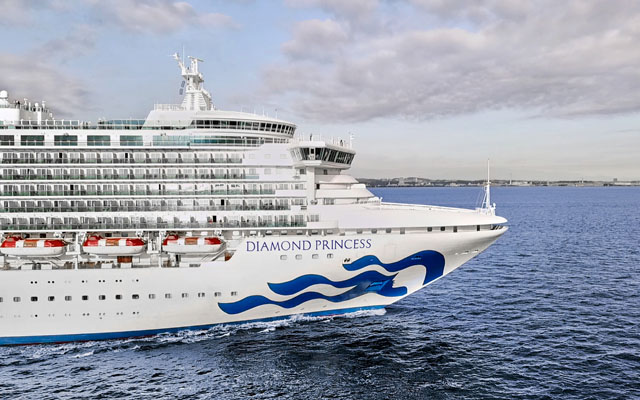
Diamond Princess will offer four 10-day Spring Flowers voyages for guests to experience various festivals
Diamond Princess returns to Japan for a March through August 2024 season, sailing roundtrip from Tokyo (Yokohama), calling to 35 destinations in three countries on 31 itineraries and 36 departures, ranging from seven to 23 days.
Diamond Princess will offer a series of four 10-day Spring Flowers voyages, calling at all four of Japan’s main islands to experience various festivals with late-night stays in each port, such as the Kumano Fireworks Festival (August 17), a display of over 10,000 fireworks visible from the decks of the ship.
Additionally, Diamond Princess will sail on nine-day Southern Islands voyages that call to two Okinawan ports and two Taiwan ports; nine-day and 10-day Sea of Japan voyages that will feature ports along the historic Kitamaebune trading route; 10-day Hokkaido voyages that will visit Otaru (for Sapporo), Hakodate and Kushiro; and the 10-day Japan Explorer voyages that will call on destinations like Shimizu (for Mt Fuji), Osaka or Kobe (for Kyoto), Hiroshima, and more.
To celebrate the opening of Centara Ubon, the 160-key hotel is offering nightly rates from only 2,555 baht (US$72).
Guests will also enjoy complimentary hotel credit of 555 baht per day, early check-in and late check-out, complimentary minibar and more.
Centara Ubon celebrates its opening with exclusive room rates
Located in Ubon Ratchathani in Thailand, the hotel features an all-day dining restaurant, outdoor swimming pool and pool bar, fitness centre, and event spaces.
Nearby are food and shopping experiences at the adjacent Central Ubon shopping centre.
This offer runs from now to June 30 for stays from March 10 to June 30.
Sarah Clark has been appointed the role of chief executive officer of Tourism Tasmania.
Clark has served on Tourism Tasmania’s board since September 2021 and brings significant skills and global experience to the role, having been a leader in the tourism industry specialising in travel and marketing across multiple continents.
Before joining Tourism Tasmania, she was managing director ANZ at Intrepid Travel.
Tourism Western Australia (WA) is stepping up destination marketing in Hong Kong, with the launch of Walking On A Dream brand campaign last week to bring attention to four key destinations, namely the Kimberley, the Margaret River Region, Ningaloo Reef and Perth.
The launch event brought 19 Hong Kong travel agents together for an afternoon of artistic rug tufting.
Tourism Western Australia has launched the Walking On A Dream brand campaign in Hong Kong
Tourism WA marketing representative, Vivian Chow, said Hong Kong agent partners can also look forward to a seven-day trade fam trip in mid-March 2023 to rediscover Perth, Mandurah, the Swan Valley and Australia’s Coral Coast. Supported by with Cathay Pacific, the trip will be for a select group of five to six top players.
She added that trade engagement in Hong Kong has persisted through the Aussie Specialist agent-only training programme as well as partnerships with key airline partners Cathay Pacific and Singapore Airlines, and consortium agents.
A partnership with Singapore Airlines, for instance, has birthed a collaboration with new outbound travel specialist, Ulu Travel, and Hong Kong Canto-pop musician Serrini Leung. The Serrini’s Digital Broadcast from February 27 to March 7 is used to upsell the Follow Serrini’s Footprint Western Australia package for FITs.
Chow told TTG Asia that the Hong Kong travel market has rebounded “rather quickly in the last few months since borders reopened”.
Shorthaul trips have done especially well for a start, and Chow expects Hong Kong leisure travellers – especially the DINK, family and FIT segments – will turn to longhual vacations come 2H2023, after their immediate “travel revenge” has been served.
Hong Kong remains an important market source for Tourism WA. It was WA’s seventh largest market for visitor spend in 2019, with 32,000 travellers from Hong Kong spending A$92 million (US$61.9 million) in the state pre-pandemic.
For now, success in rebuilding the Hong Kong market hinges on airlift recovery. Cathay Pacific is the only airline flying direct to Perth, with a thrice weekly service. Singapore Airlines flies to Perth via Singapore.
Chow said Tourism WA’s aviation team is working closely with both airlines to build strong access to Perth by leveraging the Aviation Recovery Fund, which provides “major incentives” to increase flight frequency and support marketing tacticals.
Sri Lanka intends to abandon its tourism tagline So Sri Lanka, as it calls for fresh proposals to market the country on the global stage.
The state-owned Sri Lanka Tourism Promotion Bureau (SLTPB) has called for tenders to appoint a creative agency to develop strategies and creatives for a new global tourism promotion and marketing campaign.
Sri Lanka looks to revamp its tagline to showcase its diverse offerings such as nature, culture and adventure; Sigiriya in Sri Lanka pictured
According to the terms of the tender, the creative agency is not required to retain the current tagline in the proposed campaign.
SLTPB chairman Chalaka Gajabahu said that the effectiveness of the So Sri Lanka brand is rather unclear, as the country lacked an integrated communication campaign during the past decade to build the brand focus.
The So Sri Lanka tagline was launched in 2018 but was not backed by any proper promotion.
However, industry players said it was more important to get a global promotion campaign off the ground quickly.
“It’s not about changing or keeping the tagline. What is more important and a priority is to get the promotion campaign started quickly as this has not happened (for nearly a decade),” noted Hiran Cooray, chairman of Jetwing Symphony Hotels and past chairman of the Hotels Association of Sri Lanka.
With many hurdles to overcome, such as the negative repercussions of the 2019 Easter Sunday terrorist attack, airport closure during the pandemic, and protests in 2022 over the country’s economic crisis, the industry needs a proper campaign to raise the positive profile of the country among tourists.
Until 2000, Sri Lanka’s brand focus was on its sun, sea and sand but this has gradually extended to other offerings such as nature, culture and adventure.
The tagline has undergone a few changes: from A land like no other to Sri Lanka – Wonder of Asia in 2012. This was followed by So Sri Lanka in 2018, which focused on Sri Lanka’s diverse product range.
Under the proposed campaign, Sri Lanka would promote the destination in nine key market – the UK, Germany, France, India, China, Australia, Russia, the Middle East and Scandinavia, said Gajabahu during a media conference.
The industry is also relaunching its annual tourism trade fair, not held for a couple of years owing to the pandemic and the economic crisis. Set for May in Colombo, the event expects to see the participation of some global tour operators.
State-owned Sri Lanka Convention Bureau will also host its inaugural MICE – EXPO 2023 trade show in Colombo from March 13-15, 2023.







 Before joining Tourism Tasmania, she was managing director ANZ at Intrepid Travel.