Thai Vietjet will be increasing its flight services between Bangkok (Suvarnabhumi) and Surat Thani to a total of three round-trip flights daily from October 12, 2023.
Surat Thani
The additional flight will be operated in the early morning between Bangkok (Suvarnabhumi) and Surat Thani. The flights will be operated with A320 and take approximately 1 hour and 15 minutes.
The following flight schedule is as follows:
Currently, Thai Vietjet is the only airline that operates direct flight services between Bangkok’s Suvarnabhumi Airport and Surat Thani International Airport.
KP Ho, executive chairman of Banyan Tree Holdings, believes that Phuket is poised to leverage its temperate weather conditions to become a tropical hub for business and leisure over the next decade.
“I think a greater Phuket effect is going to happen eventually over the next 10 years where Phuket will transform into a ‘Honolulu’,” Ho predicted during his talk at Phuket Hotels for Islands Sustaining Tourism (PHIST) 2023 earlier this month.
KP Ho speaking at PHIST
Southern Thailand, particularly along the Andaman Sea, can evolve into a dynamic hub similar to Hawaii’s cluster of resort cities over the next decade, given ample attractions in neighbouring regions like Krabi, Phang-Nga, Khao Lak, and Surat Thani.
He cited the government’s investments in the Phang Nga and Krabi airports as being instrumental in this transformation.
“There are very few truly international class destinations in this part of Asia which perfectly meet the climactic needs of people living in temperate climates,” he said.
Taking a broad view as an owner of resorts in various tropical spots, he pointed out that many resorts in Indonesia, Vietnam, and China – even Bali and Samui – experience cold and wet winters.
“If you look at the map, only Phang Nga and the Greater Phuket area are perfectly attuned to winter conditions. Of course, Burma would be too – but (due to current events) it has fallen out completely as a tourist destination,” he stated.
He indicated that the Banyan Tree group is “doubling down on Phuket purely from a climactic point of view,” and also added that North-east Asia should not be overlooked as a significant source of travellers seeking to escape cold weather.
Banyan Tree Phuket, established in 1994 as the group’s first property, remains the most lucrative for the group, which now has properties in over 25 countries and will celebrate its 30th anniversary next year.
Phuket is also positioned to withstand the impacts of climate change, given its geographical location near the equator.
A recent study published by UNICEF and authored by the Thailand Development Research Institute shows that Phuket consistently holds the lowest risk among Thai provinces in various climate change projections, including both RCP4.5 and RCP8.5 baseline emissions scenarios.
A Peranakan Heritage Room in The Fullerton Hotel Singapore
The Fullerton Hotel Singapore has partnered The Intan, a private Peranakan home museum, to launch an exclusive Peranakan-inspired accommodation experience for hotel guests.
Those who book the Peranakan Heritage Stay room package will enjoy accommodation in guestrooms that have been dressed up with details reflecting the unique blend of Chinese and Malay cultures that defines the Peranakan community, alongside other specially curated privileges.
A Peranakan Heritage Room in The Fullerton Hotel Singapore
Guests can expect floral motifs and batik-inspired fabrics in the rooms, while an artful display of decorative ceramics, porcelain, and pottery adorned with Peranakan-inspired designs. Completing the experience is a selection of handmade Ondeh Ondeh and Hae Bee Hiam cookies, embodying the taste of classic Peranakan flavours.
Guests who book the room package will also be able to enjoy a nostalgic Peranakan afternoon tea at The Courtyard, featuring classics such as the Kueh Pie Tee (an appetiser featuring a crispy tart shell filled with shredded Chinese turnips and a mix of thinly sliced vegetables and prawns), and Mackerel Otah and Cucumber Sandwich. There will also be a house-made Pandan Coconut Scone served with Nyonya kaya and clotted cream, alongside an assortment of sweet treats — Rainbow Kueh Lapis, Ang Ku Kueh, Kueh Dadar, and more.
Guests will also receive a pair of passes to the newly-reopened Peranakan Museum to further delve into the Peranakan community’s traditions, influences and lifestyles.
MGTO’s Maria Helena de Senna Fernandes welcomed North American trade partners at the September 14 trade seminar
The Overseas Affairs Office of the Ministry of Culture and Tourism of the People’s Republic of China, Department of Culture and Tourism of Guangdong Province, Hong Kong Tourism Board, Macao Government Tourism Office (MGTO), and Air Canada recently came together to bring a delegation of North American travel trade professionals to inspect the Guangdong-Hong Kong-Macao Greater Bay Area.
The fam trip to Macau ran for three days, from September 12 to 14, and concluded with a seminar on September 15, during which participants connected with Macau tourism professionals and both parties explored ways to grow the longhaul visitor market for the destination.
MGTO’s Maria Helena de Senna Fernandes welcomed North American trade partners at the September 14 trade seminar
The fam programme featured Coloane, Taipa and several integrated resorts, as well as Macau’s diverse “tourism +” experiences.
Attendees also crossed the new Hong Kong-Zhuhai-Macao Bridge.
The complete experience is expected to inspire the travel trade to design Macau and multi-destination travel products for the North American market, as well as support Macau’s longhaul market development and the transformation of the Greater Bay Area into a world-class destination.
North America is one of Macau’s major longhaul visitor markets and the US currently ranks seventh among Macau’s top 10 visitor markets. MGTO has maintained a destination presence in North America over the past three years.
Just as Silver Nova is the most sustainable ship in the Silversea Cruises fleet, careful considerations are also taken in planning shore excursions for the new ship, with meaningful experiences that support local communities and showcase traditions being a top priority.
Walter Barinaga, senior director, destination experiences with Silversea Cruises, told TTG Asia that such a goal required a different approach to curating shore programmes.
Silversea Cruises designs unique culinary showcases with three Michelin-starred restaurant Mirazur in Menton,(Photo by Les impatients, Florent Parizi)Gou
“The way we develop shore excursions is quite different from others in the industry,” said Barinaga. “Rather than simply selecting pre-existing excursions from a list, we endeavour to work with local operators who have deep, local roots in the destination to identify the unique experiences we want to provide for our guests. We then challenge the operator to build a programme around these experiences.”
Barinaga said the team is able to “develop deep, proprietary knowledge of the destinations we visit, which allows us to identify the experience, and also understand the role it plays in delivering the larger destination story”.
Justin Poulsen, vice president, itinerary planning & destination development with the luxury cruise line, pointed out that “the ship must function as the best platform from which to experience the destination”.
With Silver Nova, for instance, Silversea Cruises hopes to present local communities and heritage through culinary experiences.
“Some considerations that influenced our deployment and itinerary planning decisions were to find destinations where our S.A.L.T. Lab could provide an opportunity to get hands-on with regional ingredients and dishes. We also sought destinations that would amplify the experience in the public venues, such as sunset aperitifs anchored off Sorrento, and destinations that could come alive and in which guests can take advantage of unobstructed views from the ship, such as Alaska’s famed Inside Passage,” shared Poulsen.
S.A.L.T. Lab is part of Silversea Cruises’s signature dining programme, Sea And Land Taste, hence S.A.L.T, which showcases flavours of the destinations and region the ship calls at. It was conceived by Adam Sachs, former editor-in-chief of Saveur and who is now director of the programme. S.A.L.T is an exclusive programme, available only on Silver Moon, Silver Dawn, Silver Nova.
S.A.L.T, according to Sachs, is an “ecosystem” that comprises S.A.L.T shore excursions, which are in-depth tours led by food experts who delve into local culinary traditions; S.A.L.T onboard dining through S.A.L.T. Bar and Kitchen, where the menu changes with the ports of call and local recipes are made with local products; and S.A.L.T Lab, where small groups of guests will learn local recipes in a professional kitchen. On Silver Nova, guests have the added benefit of the first-ever S.A.L.T Chef’s Table, where a chef duo who will serve, interact and feed an exclusive group of just 18 guests.
Some of the meaningful experiences that have been created for Silver Nova guests were birthed from a unique collaboration with the three Michelin-starred restaurant Mirazur in Menton, a town on the French Riviera, headed by celebrated chef Mauro Colagreco. Tailor-made for Silversea Cruises’s guests, the experiences take guests closer to the heart of French culinary traditions and offer a deep-dive into local food and drink culture.
Guests will join Mirazur’s talented chefs, bakers, and gardeners to explore the central market in Menton’s old town, and meet with Mirazur’s local producers; visit chef Colagreco’s artisanal bakery, Mitron, where they will learn about ancient grains and taste a range of traditionally baked breads and pastries, all produced sustainably through certified organic agriculture; learn about the research being undertaken at the Sanctuaries del Mirazur, five biodynamic vegetable gardens at varying altitudes that are owned by the restaurant; and enjoy a nine-course tasting menu in Mirazur’s private tasting kitchen.
Other carefully crafted ways to appreciate ports of call through fine flavours include a half-day tour of the Karst region to visit a herbal farm and for brunch with wine tasting; and an intimate day with a natural wine master in the medieval town of San Miniato, which features a visit to a wine estate, wine tasting, and a three-course lunch with wine pairing.
Travel analytics firm ForwardKeys has identified six major trends in global air travel this summer, with US dominance, a patchy post-pandemic recovery, improvements in the Far East, resilience of classic beach destinations, and limited impact of heatwave being among them.
Worldwide, summer (July 1 – August 31) flight bookings were 23% behind pre-pandemic (2019) levels and 31% ahead of last year.
Source: ForwardKeys actual air tickets
US dominates the ranking
In the ranking of the most visited country destinations by share of scheduled flight bookings, the US was top of the list by a substantial margin, attracting 11% of all international visitors this summer. It was followed by Spain, the UK, Italy, Japan, France, Mexico, Germany, Canada and Türkiye.
The US was even more dominant in outbound travel. In the ranking of source markets, the US was top with an 18% share of scheduled flight bookings. It was followed by Germany, the UK, Canada, France, South Korea, China, Japan, Spain and Italy.
Patchy recovery
For most countries, travel was up on last year by a double-digit figure, but volumes have yet to reach pre-pandemic levels. A closer look at the world’s traditionally largest outbound travel markets reveals the patchy nature of the recovery. The US, 17% up on last year, was just 1% down on 2019 volumes. However, other traditionally large source markets were much further off the pace – Germany, 21% down on pre-pandemic levels; the UK 20% down; France, 17% down; South Korea, 28% down; China, 67% down; Japan, 53% down; and Italy, 24% down.
The Far East revs up
Striking are the differences in travel volumes compared to last year, which reveal how much the Far East was still in lockdown but is now revving up, with all three Asian countries in the top 10 source markets, namely South Korea, China and Japan, showing at least a triple-digit growth rate compared to 2022. While the Chinese outbound travel market has been among the slowest in the world to recover, it still manages to hit seventh place thanks to its sheer size.
Countries famous for their beaches and warm waters did very well this summer
Classic beach destinations are most resilient
Looking at the destinations which have done best against 2019 levels, the list is dominated by countries famous for their beaches and warm waters. The top 10 all exceeded the summer of 2019 and most showed strong growth from last year. Top of the list is Costa Rica, 19% up on 2019 and 15% up on 2022. It is followed by the Dominican Republic, Columbia, Jamaica, Puerto Rico, Argentina, Greece, Tanzania, the Bahamas and Mexico. Throughout the pandemic, leisure travel to beach destinations proved to be the most resilient, with many highly tourism dependent economies in the Caribbean and Gulf of Mexico working hard to keep their borders open and the tourists coming; and their efforts have certainly paid off. The same has also been true of Greece, Portugal, and the UAE.
Limited impact of the heatwave
While the unusually high temperatures and the outbreak of wildfires in Greece and Portugal made a very substantial impact on television screens, they made only a limited impact on tourism, as most holidaymakers had already booked. A spate of cancellations affected Rhodes, but flight bookings recovered to normal levels in a matter of weeks. While bookings for Northern Europe and the Nordic region were 16% and 17% behind 2019, they demonstrated better performance in the late bookings market, probably influenced by the heatwave.
The Air France-KLM Group has appointed Femke Kroese general manager for South-east Asia & Oceania.
Based in Singapore, Kroese is responsible for Air France and KLM commercial passenger sales and flight operations throughout Singapore, Malaysia, Indonesia, Thailand, Vietnam, Philippines, Australia, and New Zealand.
Prior to her move to Singapore, Kroese was commercial director UK and Ireland with Air France-KLM Group.
She joined KLM in 2002 and held several positions in the Air France-KLM Group within sales, pricing revenue management and other commercial roles while being based in the Netherlands, France, Canada and the UK.
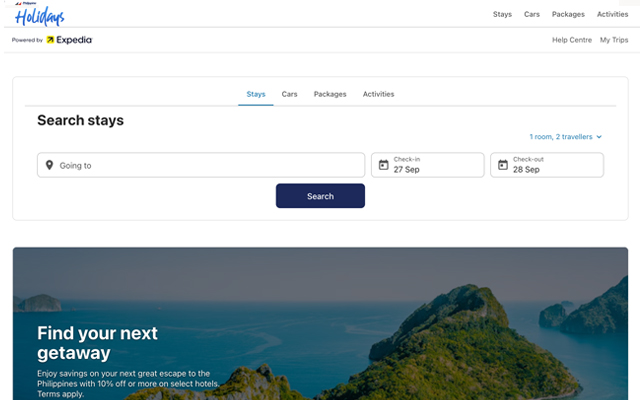
Philippine Airlines (PAL) and Expedia Group have launched PAL Holidays, a one-stop travel website that offers travellers a comprehensive platform for all their travel needs. The new site is now live in the US, Canada, Australia and the Philippines.
The new platform is powered by Expedia Group’s White Label Template technology and is designed to help passengers plan and book their entire journey, from securing PAL flights to booking travel activities, all in one location.
A screenshot of the platform
PAL Holidays will offer access to over 900,000 properties across the globe, and feature promotional deals and exclusive offers.
Bud Britanico, vice president for sales at PAL, said: “By partnering with Expedia, we are confident that our customers will enjoy unparalleled access to a superior range of great offers for hotels, experiences, and transport that can go together with the Philippine Airlines flights that they book. PAL Holidays reflects our dedication to providing exceptional travel experiences, and we look forward to serving our customers in a more convenient and efficient way.”
There has been a reshuffling among general managers in several Radisson Hotels in the Philippines.
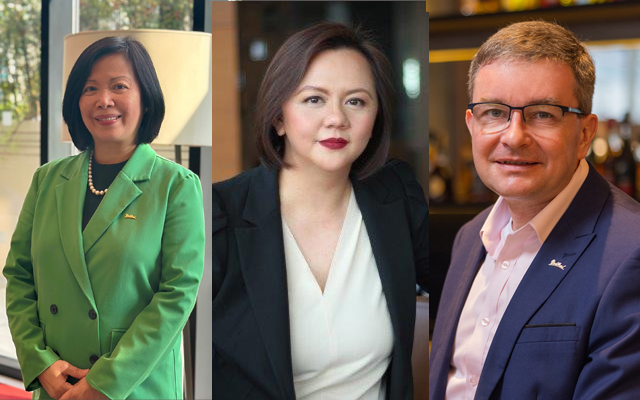
From left: Ann Olalo; Christina Dumaraos; Sven Tourne
Ann Olalo has moved to Park Inn by Radisson North EDSA in Quezon City. Replacing Olalo as general manager of Park Inn by Radisson Clark is Christina Dumaraos, former director of operations at Hilton Clark Sun Valley Resort.
Previously the general manager of Banwa Private Island, Sven Toune has moved to Park Inn by Radisson Davao in the same capacity.
From left: Ogie Manuel; Marko Janssen; Sherwin Lucas
Ogie Manuel, GM of Park In by Radisson Iloilo, used to oversee Shangri-La Hotels and Resorts in Southeast Asia, Fiji and Australia as director for global leisure destination.
Ogie Manuel is now the general manager of Park Inn by Radisson Iloilo. He was previously director, global leisure distribution at Shangri-La Hotel and Resorts.
Marko Janssen joins Radisson Blu Cebu as general manager. He was previously holding the same position at Radisson Blu Resort Phu Quoc.
Sherwin Lucas, former director of events service at Sheraton Grand Macau and The St. Regis Macau, has moved to head Park Inn by Radisson Bacolod as general manager.
Speakers at the recently concluded Adventure Travel World Summit (ATWS) in Hokkaido, Japan, have called on the adventure travel trade to set an example for others to follow amid increasing global challenges as the travel industry rebounds from the pandemic.
Adventure tourism tends to be more sustainable and responsible than other forms of travel because it typically involves smaller groups visiting more remote areas, supports local communities, and promotes the conservation of natural resources. This experience therefore presents opportunities for industry leaders to help tourism build back better, they said.
Adventure Travel World Summit 2023’s theme was chowa (harmony in Japanese) to emphasis the need for tourism development to support local nature, communities and economies
Global tourism recovered to about 66 per cent of pre-pandemic levels in 2022, and to 80 per cent in the first quarter of 2023, indicating the industry’s resilience and “swift recovery,” according to the UNWTO World Tourism Barometer.
However, the trajectory also indicates the possibility of over-tourism in future.
“In seven years we’ll have 1.8 billion international travellers, 80 per cent higher than ever before,” Adventure Travel Trade Association (ATTA) CEO Shannon Stowell told delegates. “The world is in a transitional phase… we can be the model of how to do tourism right.”
Adventure travel, he added, is about “slow travel” – absorbing the essence of a destination and all the things it has to offer. It is a responsible form of travel that results in 65 per cent of tourist spend being retained in local communities. In comparison, travellers on bus or cruise trips spend only 10 to 15 per cent of their budget locally, he said.
ATWS 2023’s theme was therefore chowa (harmony), which is most often used in Japan to describe the collective spirit that connects people.
“This concept of harmony can teach us to create a sustainable ecosystem of nature, communities and economies worldwide. In looking to the future of adventure travel, we ask ourselves what will be possible when our individual intentions pursue a shared vision,” said the ATTA chief.