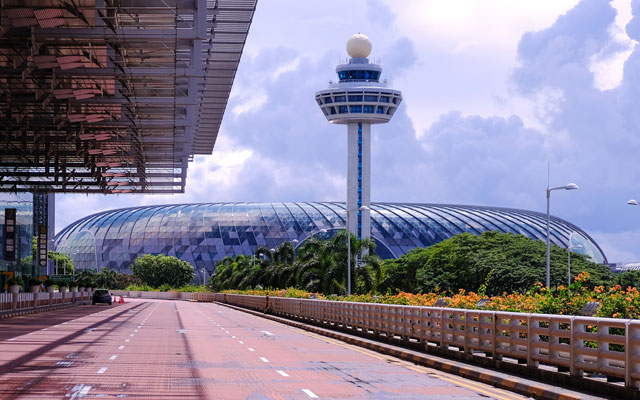
The new Siem Reap Angkor International Airport will officially begin operations on October 16, with non-commercial and non-profitable test flights set to be conducted from October 5 to 15.
All commercial passenger and cargo flights currently operated at the existing Siem Reap International Airport will be transferred entirely and one time only to the new facility on October 16.
Siem Reap Angkor International Airport will start operations on October 16 (Photo: Khmer Times)
The US$1.1 billion-worth airport is located in Kriel Pong village and Provall village of Por Pel commune and Ta Yek commune, and around 40km east of Siem Reap town.
Construction began in March 2020 by Angkor International Airport Investment (Cambodia).
SSCA spokesman Sinn Chanserey Vutha said: “The new Siem Reap Angkor International Airport will be an important gateway for flights from around the world given its contemporary facilities and larger size than the existing airport.”
He added that the new airport will have 38 gates and will be able to handle large passenger planes like the Airbus A-340-300 and A350-900 as well as the Boeing B777-200/300ER and B747-300/400.
Wego, the largest online travel marketplace in the Middle East and North Africa (MENA), has inked a global partnership with IHG Hotel & Resorts to provide its users with a wider array of hotel offerings across the globe.
Wego users will now be able to search and book 15 of IHG’s 18 brands worldwide. These include Regent Hotels & Resorts, InterContinental Hotels & Resorts, Vignette Collection, Kimpton Hotels & Restaurants, Hotel Indigo, voco hotels, Hualuxe Hotels & Resorts, Crowne Plaza Hotels & Resorts, Even Hotels, Holiday Inn Hotels & Resorts, Holiday Inn Express, avid hotels, Atwell Suites, Staybridge Suites and Candlewood Suites.
Wego users will now be able to search and book 15 of IHG’s 18 brands worldwide
IHG’s latest offering will also be promoted across all Wego’s channels, providing travellers with information on the latest properties and trending destinations.
Craig Hewett, chief hotels officer and co-founder, Wego, commented: “Through this partnership, we will promote IHG Hotels & Resorts to our large user base in the MENA region and aim to convert more bookings to IHG’s global network of hotels.”
“Travellers will enjoy more convenience and access to 15 of our brands across our luxury & lifestyle, premium, essentials and suites portfolio in global destinations when booking their trip on Wego,” added James Britchford, vice president commercial, India, Middle East and Africa at IHG Hotels & Resorts.
Dubai is on track to becoming one of the most visited international destinations of 2023, welcoming 4.67 million overnight visitors in 1Q2023 – and it has its eyes firmly pinned on the Chinese rebound to further bolster arrival. According to figures from Dubai’s Department of Economy and Tourism (DET), this marks a 17 per cent uptick on the same period last year, positioning Dubai as the fastest recovering destination globally, with the nation achieving 98 per cent of pre-pandemic levels.
DET’s director general said this has been achieved by rolling out aggressive marketing campaigns worldwide, as well as attracting a string of major international business and leisure events.
Dubai cityscape
“As we look ahead to further accelerating momentum in our tourism sector, the pillars of sustainability, gastronomy, trade, and technology will form the foundation of our future success,” said Helal Saeed Almarri. He added that as Dubai prepares to host UN climate change conference, COP28, Dubai is focusing on promoting sustainable tourism.
During 1Q2023, South Asia accounted for 16 per cent of total international arrivals, with North Asia and South-east Asia taking in six per cent, and Australasia one per cent. In fact, South Asian arrivals have almost reached pre-pandemic tourism levels.
India was Dubai’s top source market, attracting 612,000 visitors in the first three months of 2023. China came in at 11th place with 94,000, the Philippines 18th with 57,000, and Australia 19th with 56,000.
Mohamed Al Rais, deputy managing director of Al Rais Travel, said the Asian market continues to grow, with all eyes pinned on China’s full rebound, which is predicted for the 2H2023. He added that with Dubai slated to host COP28 from November 30 to December 12, the company’s main focus is on promoting sustainable tourism.
“We are trying to increase awareness of sustainable tourism, with a focus on sustainable travel, accommodation and other related segments within the market,” he said, adding this is also increasingly what travellers are demanding.
In addition to hosting the UN climate change conference, Dubai will welcome a series of major international events in 2023 that are expected to attract more international visitors to its shores. These include Dubai Summer Surprises, Dubai Esports and Games Festival, which Dubai Tourism expects to be a hit with Asian nations, and Dubai Fitness Challenge.
Anabela Radosevic, manager of B2B sales and service at Arabian Adventures, said desert safaris, private city tours and morning desert adventures remain popular activities with the Asian market, in particular Japanese, South Korean and Chinese visitors. Arabian Adventures has sales offices in Japan and China.
Tourists in the ancient covered textile souq Bur Dubai in the old city centre
“Asia remains a top source market for Arabian Adventures in its capacity as a DMC, offering end-to-end destination services to international travel trade partners, as well as Dubai desert safari and UAE city tour offerings, cruise handlings and events services,” said Radosevic. “Of all Asian markets, for Arabian Adventures, Japan has been showing the strongest recovery post-pandemic, followed by South Korea and China.”
Attractions are also eyeing up Asian visitors. Madame Tussauds Dubai, which opened in 2021, said India is currently its strongest market from the region, while Indonesia, Thailand and the Philippines are growing source markets.
“An increase in visitors from Asia is definitely evident since travel resumed. We are excited to welcome more visitors as this trend continues,” said Samantha Joffe, marketing manager at Madame Tussauds Dubai.
She added that visitors from the Asia region are excited to see international stars in the attraction, mainly Tom Cruise, Audrey Hepburn, and Taylor Swift’s wax figures, as well as the dedicated Bollywood Zone with figures of Shah Rukh Khan, Katrina Kaif, Salman Khan and Ranveer Kapoor, and wax figures of Xi Jinping and Jackie Chan.
“China remains an important source market for both Dubai as a destination and Madame Tussauds Dubai, with strong growth potential and focus as travel resumes,” she added.
In 2019, Dubai welcomed almost one million visitors, marking an almost 15 per cent year-on-year (YoY) increase.
In 2022, 177,000 Chinese visitors landed in Dubai. While this represents a 131 per cent YoY increase, China only lifted its Covid restrictions in January 2023 and tourism players are awaiting the big rebound.
Al Rais said that other than Dubai, AlUla in Saudi Arabia, Egypt and Jordan are destinations that are traditionally marketed to Chinese visitors – he anticipates these will be among the first to benefit from the Chinese travel rebound.
In a bid to cement its title as the most visited destination of 2023, Dubai is continuing to provide simplified entry and stay measures for international arrivals, such as the golden visa, five-year multi-entry visa, virtual working, and retirement in Dubai programmes.
Manila’s Ninoy Aquino International Airport (NAIA) will finally undergo modernisation, upgrading and privatisation.
This looms as transportation secretary Jaime Bautista disclosed that the proposal of the Department of Transportation and Manila International Airport Authority – the latter currently managing NAIA – for a solicited bidding for the project has been approved by the National Economic Development Authority.
Ninoy Aquino International Airport will undergo modernisation and upgrading to improve its capacity
The project’s terms of reference is expected to be published next month, proposals accepted by end-October or early November, winning bidders awarded by year-end, and concession agreement which started a few months after, Bautista said on Tuesday at the discussion on infrastructure development and connectivity post-state of the Nation Address of the Philippine president.
NAIA’s modernisation and upgrading, roughly estimated to cost at least 141 billion pesos (US$2.6 billion), “will result in increased capacity… considering that it is already congested”, said Bautista, who was also president of Philippine Airlines for many years.
With a capacity for 32 million people a year, NAIA is now handling more than 40 million people a year. Today, it has around 140,000 people a day compared with 115,000 people a day a year ago.
“So that’s a big increase in the demand and in the number of passengers that pass through Manila,” he pointed out.
NAIA is so congested that a growing number of people from Manila choose modern and spacious Clark International Airport for domestic and international flights. To Clark airport, they either take shuttle buses with frequent departure from NAIA’s terminal 3 or from Trinoma in Quezon City – many also take the two-hour drive to Clark airport, parking their cars there.
Bautista said the Philippines has 90 airports, but only 45 are in commercial operations hence the need to upgrade a number of them including Bicol International Airport, regional airports in Palawan and Dipolog, and all other smaller airports.
The airport being built by San Miguel Corp in Bulacan is “very promising” to decongest NAIA, he said. Land development is almost 70 per cent complete and by 2024, the passenger terminal building and runway will begin construction.
New research from Collinson that looks at customer engagement and loyalty in Asia-Pacific has identified a strong lure of travel-related rewards or benefits, and the opportunities they bring to financial services brands that are keen to drive better commercial returns.
The New Rules of Engagement: Customer Expectations Revealed report, which surveyed 4,750 respondents across 10 markets in Asia-Pacific, saw mass consensus (93%) among respondents that the availability of such rewards is what encourages them to engage regularly with a brand. This sentiment is strongest among respondents in Vietnam (97%), Thailand (94%) and Malaysia (90%).
Collinson’s report showed that respondents in Asia-Pacific will engage regularly with a brand if there are rewards or benefits available to them
Most (78%) consumers are also motivated to use their payment cards for travel expenses if the cards offer travel-related rewards or benefits. This trend is especially apparent among consumers from Malaysia (84%), India (83%), Vietnam (82%), Thailand (81%), China and Hong Kong (both 80%).
Meanwhile, 75% are more likely to use their card for everyday expenses, when travel rewards and benefits are available. This sentiment is strongest among consumers from India (83%), Vietnam (82%), Hong Kong SAR (81%), Malaysia (81%) and China (79%). Within this group, millennial consumers make up the largest segment.
Among travel-related rewards, airport lounge access is the most appealing among Asia-Pacific respondents in the Millennials, Gen X and Boomer age segments; access to airport transit hotels placed first for Gen Z respondents.
Millennials, Gen X and Boomer respondents in the region identified access to airport transit hotels as their second favourite perk.
The appeal of airport lounge access strongly correlates with age and income, stated the report. For financial services’ consumers, for example, Collinson found that older and more affluent consumers are more likely to rank this benefit as most appealing – and are willing to pay more for it. 74% of Gen X consumers, for example, expect to be offered airport lounge access as a reward on a premium payment card.
Rohan Bhalla, vice president, business solutions, Asia-Pacific, Collinson, said: “Travel rewards have the power to impact across the entire customer journey from acquisition to engagement and even retention. The high perceived value associated with travel related rewards and benefits makes them a key strategic, value proposition to influence customer behaviour and drive long-term loyalty.
“By drawing on a deep understanding of their customers and key touch points along the buying journey, brands can tailor their communications, offers and rewards to ensure these are relevant. That way, they will be better able to build engagement and loyalty over time.”
When asked if travel perks have the same strong appeal for consumers engaging with travel and tourism companies, which are already selling the same experiences, Todd Handcock, global chief commercial officer and president Asia-Pacific at Collinson, answered in the affirmative.
Bhalla told TTG Asia that travel and tourism companies build status into their loyalty and reward programmes, with the pinnacle of most aspirational rewards often being a travel perk, such as an airline ticket redemption, room upgrade or access to an exclusive lounge.
“Travel and tourism companies are successfully building aspirational value into their travel benefits. The other thing they are doing, is to take the same aspirational value to the lower tier of programme status, the broader segments, and giving these customers a taste of (the top) experience at a price or as a surprise,” detailed Bhalla.
With consumers being part of seven different loyalty programmes on average, Bhalla emphasised the need for companies to continuously review their engagement strategy and pay heed to “predictable personalisation”, which he defined as knowing the customer, showing the customer that he/she is valued, and engaging the customer in relevant ways.
IHG Hotels & Resorts has seen a peak in hotel signings this year, half of which are in South-east Asia. Properties in focus comprise Holiday Inn Hotels & Resorts and Holiday Inn Express, of which both brands continue to generate around half of IHG’s global openings in 2022, accounting for about 70 per cent of its total estate.
With hotels launched last year in Vietnam’s Ho Tram, the Philippines’ Cebu and Thailand’s Koh Samui and Krabi, IHG is seeing a growing interest from owners in other destinations. To date, there are 33 open Holiday Inn Hotels & Resorts properties and 26 in the pipeline across South-east Asia.
Holiday Inn Hotels & Resorts and Holiday Inn Express continue to generate around half of IHG’s global openings in 2022; rendering of Holiday Inn Express & Suites Bangkok Central Pier, pictured
IHG has made several announcements this year – Holiday Inn Resort Phuket Karon Beach, Holiday Inn Resort Phuket Surin Beach, Holiday Inn Resort Pattaya, Holiday Inn Express & Suites Bangkok Asoke and Holiday Inn Express Bali Sunset Road, as well as the first Holiday Inn Express & Suites in Singapore – growing its estate to 95 open and pipeline hotels.
Rajit Sukumaran, managing director, South East Asia & Korea, IHG Hotels & Resorts said: “We’re also recognising the growing popularity of longer stays and the increase in larger travelling parties by developing more Holiday Inn & Suites and Holiday Inn Express & Suites properties across our markets.”
Aside from Holiday Inn Express & Suites Singapore Novena’s recent opening in May, other upcoming properties in 2024 are the first Holiday Inn Express & Suites hotel in Bangkok Central Pier, Thailand, and a Holiday Inn & Suites in Vientiane Laos.
Other hotels soon to open include Holiday Inn Sepang – Airport, Holiday Inn Resort Bali Canggu, and Holiday Inn Lampung Bukit Randu.
In addition, the Holiday Inn Express experience will be further enhanced with the new Express Café & Bar, an all-day-dining experience that provides guests with simple-to-deliver 24/7 F&B options.
Hilton has announced a number of new signings in China in the first half of this year, marking continued growth across multiple brand categories with properties strategically located in ancient capitals, cultural hotspots, vacation resorts and wellness retreats.
The signings include Conrad Qingcheng Mountain, Hilton Shanghai City Centre, Hilton Shanghai Jing’an, Curio Collection by Hilton hotels in Yantai and Anji, Hilton Garden Inn Hangzhou Grand Canal and Hilton Garden Inn Chengdu Chenghua.
Hilton has signed on several properties in China, including Conrad Qingcheng Mountain, pictured
Slated to open in 2027, Conrad Qingcheng Mountain, in the Sichuan Province of Dujiangyan is located near UNESCO World Heritage site Qingcheng Mountain. The hotel will feature 180 rooms, all equipped with private hot tubs, as well as a spa, fitness centre and swimming pools.
Two Hilton Hotels & Resorts will open in Shanghai, one downtown and the other in an emerging development zone. The 382-room Hilton Shanghai City Centre is scheduled to open in 2024, while Hilton Shanghai Jing’an located in the Shibei Hi-Tech Park of Jing’an District will offer 250 rooms when it opens in 2025.
Hilton’s lifestyle brand Curio Collection by Hilton will welcome its first hotel in north China with The Puyuan Hotel Yantai, Curio Collection by Hilton, opening in 2024.
A Thousand Moons Anji, Curio Collection by Hilton is situated in Zhejiang Province of Anji and slated to open in 2025. The 115-key hotel is just a ten- minute drive from Dazhuhai, the largest bamboo-themed eco-tourism area in south-eastern China.
Finally, two new Hilton Garden Inn properties will open in 2024 – the 210-room Hilton Garden Inn Hangzhou Grand Canal and the 207-room Hilton Garden Inn Chengdu Chenghua.
“Hilton’s strong brand portfolio offers owners the options and solutions that leverage evolving market opportunities, while achieving stable returns,” said Jerry Huang, president of development, Greater China & Mongolia, Hilton.
“As we stay focused on strategic brand deployment and organic growth, the robust signings from the first half of this year underscore owner confidence across our brand spectrum including: luxury, lifestyle, full service and focused service segments.”
Brand differentiation for travel companies can be challenging especially in a crowded field. By embracing innovative technology that bridges the gap between providers and customers, travel firms can deliver tailored and seamless online experiences, as well as develop compelling content that showcases distinctive travel services and experiences.
This also means that travel firms can hone their brand strength, which is a critical factor in business success as it allows them to effortlessly command their presence in the market. At the end of the day, strong brands possess distinct characteristics that set them apart from competitors: they are easily recognisable, highly regarded, and boast a dedicated and loyal following.
Snyder: travel firms can analyse trends and their impact on market forces and customer experience
Uri Snyder, senior vice president, APAC, Similarweb, shared that while loyalty programmes have their benefits, they should be supplemented with a strong, well thought out digital strategy.
He said: “Typically, this will equip the business to research competitors, understand their product offerings, marketing, and differentiation, and identify threats. Travel firms can then analyse trends and their impact on market forces and customer experience.
“As a result, this will help them better understand audience motivation and digital behaviour, identify attractive features, and consider enhancing their lives through digital technology. All this amounts to a more intimate relationship with the customer, which can make them feel seen and heard, positioning the business to retain customers – and even win new ones.”
His advice to travel companies keen on crafting their brand strategy is to understand the ‘connected’ digital traveller. To do this successfully, Snyder stated that travel and hospitality companies need to be able to analyse traffic and engagement metrics. This rests on optimising the company’s digital strategy so that travel providers possess a deep understanding of consumer behaviour as well as their search and planning patterns.
He elaborated: “Through detailed analysis of consumer demographics, frequently visited sites can be identified, which then allows the business to pinpoint customers’ browsing behaviours and anticipate emerging trends. This can then be used to examine visitation and booking metrics such as conversion rates and converted visits, to meet customers where they are; allowing the business to identify the most effective channels for driving revenue.
“Additionally, this level of granularity allows businesses to isolate specific information about key business lines to unpack and track performance over time. As a result, travel firms can confidently spot and explore strategic market opportunities such as high-demand offerings by area. This knowledge will facilitate informed decision-making that capitalises on consumer trends and maximises brand performance.”
A successful brand campaign will include clear, achievable Key Performance Indicators based on web metrics that can be measured and tracked.
According to Snyder, the most successful data-driven organisations will compare their campaigns with competitor brands to understand how successful their strategies are when compared to the market benchmark.
Third party data providers such as Similarweb provide a meaningful boost to measuring marketing performance – it provides a better understanding on the campaign’s success and how the organisation relates to competitors, so that resources can be allocated accordingly.
Staybridge Suites Bangkok Sukhumvit has launched its Extended Stay Promotion, offering 20 per cent off for guests staying 15 nights or more.
The promotion includes accommodation in a suite with kitchenette, daily breakfast for two, complimentary Wi-Fi, and access to fitness, swimming pool and Japanese onsen facilities.
Guests will have access to fitness, swimming pool and Japanese onsen facilities
There is also a co-working space, The Den, and a complementary social networking hour hosted by the hotel every Monday to Wednesday.
The promotion is available for bookings from now to October 31 for stays anytime.
Wharf Hotels has appointed Gerhard Aicher as the new area general manager of Marco Polo Hotels in Hong Kong.
He will lead the teams at Marco Polo Hongkong Hotel, Gateway Hotel, Hong Kong and Prince Hotel, Hong Kong.
The Austrian national has more than 20 years of experience in the hospitality industry, having held the role of director of finance at several hotels. Prior to joining Wharf Hotels, he was CEO of the OTT hospitality division in Toronto, Canada.