Hong Kong-headquartered hospitality group Wharf Hotels has launched Maqo, a new premium lifestyle brand, joining sister brands Niccolo Hotels and Marco Polo Hotels.
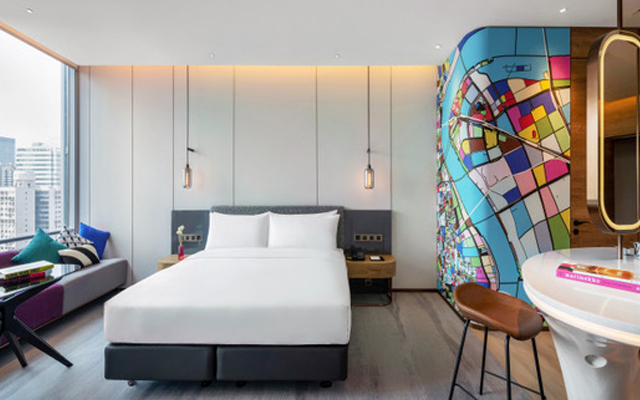
Maqo envisions itself as stylish and edgy, where its approach is based around the art of selection where “editors” meticulously refine possibilities to arrive at crafted and “edited” art and culture programmes, F&B offerings, music playlists and wellness concepts. Designed to provoke and inspire guests with the unexpected at every stay, Maqo is for those who want to connect, and are attracted by the edited experiences the brand provides.
Grand Deluxe Plus King room
Wharf Hotels’ president, Thomas Salg, stated in a press release: “Maqo has given us the opportunity to rethink hotel spaces and experiences, and we believe the brand will resonate with guests who appreciate blended spaces and our edited collections. Looking ahead, we are confident that the brand’s offerings will appeal to diverse guest segments from business and leisure and are keen to take on development prospects in North Asia, South=east Asia and China.”
The brand’s first property will be Maqo Changsha on November 1, 2023, in Tower Two of International Finance Square, featuring 286 rooms and suites, a restaurant, bar, co-working space, as well as a gym. Its sister hotel, Niccolo Changha opened in 2018 at Tower One of International Finance Square.
Salg added: “We are optimistic about the future outlook of Mainland China and its steady resurgence of outbound and domestic travel… Among all the progressive cities contributing to the exponential growth of travel within China, Changsha continues to be a core domestic destination with considerable market potential, and we are confident the brand’s inaugural hotel in the city will be popular for leisure and business travel.”
The launch of a new brand is one of many strategic opportunities to realise Wharf Hotels’ vision of “25 by 2025”, as it targets more openings in key Asian destinations such as Singapore, Shanghai, Tokyo and Bangkok.
The new Thai cabinet has proposed a temporary visa exemption for Chinese tourists in support of the country’s tourism industry recovery and efforts to welcome at least 28 million visitors by year’s end. The policy is expected to begin next month and remain in effect until the end of the next high tourism season.
New prime minister Srettha Thavisin, who has expressed his government’s commitment to supporting tourism as a stimulus for the economy, met with key stakeholders on September 10 to iron out the mechanics of the rollout. Visa offices nationwide are reportedly preparing for the additional workload of visa-free Chinese entries.
Thailand works to ease entry for Chinese visitors
Thailand already offers 30-day visa-free entry to another significant market, Russia.
Adith Chairattananon, honorary secretary-general of ATTA, noted that visa exemptions can serve as a short-term marketing tool to increase demand, citing a 2019 WTTC study that showed visa waivers lead to a 16.6 per cent increase in travel demand, while introducing new types of visas can increase travel by 8.1 per cent.
“The Chinese market is sensitive to visa fees and overall ease of entry procedures, so we believe that these measures should increase visitors from these markets by at least 10 per cent,” he told TTG Asia.
He added that additional flights between Thailand and China were also needed to maximise the positive outcomes of visa exemptions.
“If there aren’t enough carriers, passengers cannot be transported (to Thailand),” he remarked.
Adith also stressed the importance of government-led efforts, especially by the prime minister, in engaging China in tourism discussions and creating incentives for airlines to boost flight operations to Thailand.
The new government has included in its policy statement plans to increase flight volume to Thailand and boost the local airport infrastructure.
On September 11, Thai Airways International (THAI) announced in response to a visit from the prime minister that it will increase flight frequencies to various destinations in China during this year’s high season. Between October 29 and March 30, THAI will operate daily flights to Shanghai and Guangzhou. Starting December 1, THAI will also operate daily flights to Beijing, Chengdu and Kunming.
As of July, ATTA recorded 1.9 million Chinese arrivals – approximately 40 per cent of the corresponding period in 2019.
China is currently grappling with economic challenges such as a weak yuan and inflation that have led to lower spending power, curbing outbound travel demand.
The Tourism Authority of Thailand in August revised its estimates for Chinese arrivals down to four million, from 5.8 million previously.
Singapore Airlines (SIA) will launch non-stop flights between Singapore and Brussels, the capital of Belgium, from April 5, 2024, marking a return to the city after more than 20 years.
SIA schedules non-stop services to Brussels
The airline will operate four weekly flights to Brussels with the long-haul variant of its Airbus A350-900s, which feature 253 seats in three cabin classes: 42 in Business Class, 24 in Premium Economy Class, and 187 in Economy Class.
Subject to regulatory approval, flight SQ304 will depart Singapore for Brussels on Mondays, Wednesdays, Fridays, and Sundays at 2355hrs (local time). The return sector, operated as flight SQ303, will depart Brussels for Singapore on Mondays, Tuesdays, Thursdays, and Saturdays at 1210hrs (local time).
The addition of Brussels increases the number of European destinations in the SIA network to 13.
The Adventure Travel World Summit (ATWS) kicked off Monday in Japan’s northern-most island, marking the first time the Adventure Travel Trade Association (ATTA) event has been hosted in Asia.
Some 800 travel professionals, including national and local tour operators, destination management representations and thought leaders, joined a Day of Adventure on the first day of the four-day event. Each of the adventures were designed to introduce the best Hokkaido has to offer in adventure activities. Options ranged from hiking the indigenous Ainu people’s Mountain of God and rafting on the Shiribetsu River to farming, exploring Daisetsuzan National Park and making traditional Ainu crafts.
Adventure Travel World Summit opens with Day of Adventure; delegates getting ready to head down Hokkaido’s Shiribetsu River
Under the summit theme of chowa (harmony), the ATTA plans to showcase the potential of Hokkaido for adventure travel, defined as a trip that includes at least two of the characteristics of physical activity, interaction with nature and cultural learning or exchange.
“Hokkaido was one of the first destinations within Japan to attend an ATTA event, and to be inspired by the potential that adventure travel could bring to the destination, beyond it being seen as a snow and ski destination. And indeed, there is so much adventure in Hokkaido – from hiking to kayaking, learning more about local Ainu culture to indulging in the fabulous food here,” Hannah Pearson, regional director – APAC, of the ATTA, told TTG Asia.
“Holding ATWS has really been a rallying call for adventure travel in Japan,” she added, noting that other prefectures have been motivated by the attention that Hokkaido and the Japan National Tourism Organization have given to adventure travel and hosting ATWS, and see how it could help address the challenges they are facing, such as overtourism.
“I think we can expect to see more adventure travel options throughout the country, as demand grows from both the international community, and tour operators themselves want to get more involved in adventure travel,” Pearson concluded.
Arrivals from South-east Asia have performed strongly for Hong Kong in the short months following the latter’s full reopening to travel and tourism in February this year.
The region contributed 971,000 visitors between January and July 2023, representing six per cent of total arrivals (16.4 million) to Hong Kong. The top performing markets are the Philippines (36 per cent), Thailand (23 per cent), Singapore (18 per cent), Indonesia (12 per cent) and Malaysia (11 per cent).
HKTB has lined up a series of events for the coming months, including Wine and Dine Festival 2023 in October, and Christmas light-ups and New Year countdown party in December; Winterfest 2022 pictured
As a result, the region is now Hong Kong’s second largest source market after China.
There were 13 million arrivals from China during the same seven-month period.
Speaking to TTG Asia, Martin Gwee, director, South-east Asia, Hong Kong Tourism Board (HKTB), said: “January and February were slow for us, as our borders were not fully reopened then, but once the last barriers were lifted, South-east Asian travellers came back very quickly from March.”
He said the Philippines “has proven to be a strong market”, with July arrivals – 70,637 – surpassing that of July 2019. He shared that trade partners in the Philippines said many Filipinos made Hong Kong their first post-lockdown overseas holiday destination.
For Indonesians and Filipinos, new attractions and experiences as well as shopping in Hong Kong were top draws; for the Singapore and Malaysia markets, local food and pop culture were hot favourites; for Thais, Hong Kong’s temples and fortune-paying tours were priorities.
Vietnam at the moment is a developing marketing for HKTB, so travellers are attracted to “everything Hong Kong has to offer, as all experiences are fresh to them”, shared Gwee.
Gwee believes that HKTB’s Hello Hong Kong campaign is instrumental in reigniting South-east Asians’ interest in the destination.
The campaign, launched with the full reopening of Hong Kong, is fronted by three legendary pop icons – Aaron Kwok, Sammi Cheng and Kelly Chen. One of the commercials showed Kwok dancing his way through different locations in Hong Kong, Chen swivelling excitedly in an eatery and serving up a multitude of favourite local fares, and Cheng jogging down a trail. In another commercial, Kwok addressed the audience, saying that Hong Kong’s food and shopping attractions await along with many other points of appeal.
When asked if these pop icons resonated with the non-Chinese-speaking Asian markets too, Gwee said Hong Kong’s pop culture has a strong grip across the region.
He said: “The campaign is well received in the other South-east Asian markets. The three pop artistes, in particular Aaron, are familiar faces with both the older and younger generation in Thailand, Indonesia, the Philippines and Vietnam. In fact, TVB (Hong Kong-based broadcasting company) dramas from a decade ago are still popular with the Vietnamese audience today. During our recent trade engagement trip to Indonesia, many agents asked about Andy Lau and Tony Leung (other popular Hong Kong entertainment personalities).
“The campaign reinforced the cultural closeness of Hong Kong and South-east Asia, and made it easier for us to get back into the minds of travellers from this region.”
The star-studded Hello Hong Kong campaign will soon be updated with a new set of content, revealed Gwee. Storylines will play up aspects of Hong Kong that will appeal to a younger audience, with a focus on culinary, entertainment, great outdoors and culture. Hong Kong’s night life will also be promoted. The updated campaign visuals will roll out end-September.
The youthful and vibrant face of Hong Kong can expect more limelight when HKTB hosts a reunion of 30 Hong Kong Super Fans from South-east Asia this October, during which they will partake in the destination’s Wine & Dine festival and Halloween parties. These participants are popular content creators and celebrities who are strong advocates of Hong Kong as a tourist destination.
The recent announcement in the Royal Gazette regarding the Thai government’s plans to update Ministerial Regulations regarding the operation of short-term rentals (STR) has proved a popular one.
At the end of August, the existing criteria for the definition of ‘non-hotel accommodation’ was changed from a maximum capacity of 20 guests and four rooms to no more than 30 guests and eight rooms.
The revised short-term rentals regulations recognise the value of smaller accommodation providers, say trade players
The amendment acknowledges the unique status and increasing popularity of different types of accommodation, including tents, treehouses and floating homes, alongside traditional hotel and homestay options. The updated legislation is designed to recognise these types of businesses and create a pathway for smaller accommodation providers to be registered.
Mich Goh, Airbnb’s head of public policy for South-east Asia, India, Hong Kong and Taiwan, believes that new rules will be a boon to business and noted the potential knock-on effect for second-city tourism in Thailand.
Goh said: “We (Airbnb) are very pleased to see the Thai government recognising a diverse range of Thai tourism entrepreneurs as part of the country’s reopening efforts. The updated regulation marks a positive step in the right direction, and will help more tourism entrepreneurs and smaller accommodation providers benefit from the global travel rebound.
“They will further help drive travel to secondary destinations and support a more inclusive travel recovery across the country, which we have strongly advocated for in our initiatives with the Ministry of Interior and the Tourism Authority of Thailand.”
Goh also noted how the updated criteria reflect modern travel trends, “In addition to supporting local entrepreneurs, the new regulations also reflect how travellers’ preferences and behaviours have changed. Post-pandemic, travellers are staying longer, exploring more off-the-beaten-path destinations and seeking new travel experiences.”
Manosit Jaengjob, chairman of the Small Hotels Subcommittee, Tourism Council of Thailand, agrees.
“The updated Ministerial Regulations are an important step forward for Thailand’s travel accommodation sector and a much-needed change. While both large and small travel accommodation contribute to the economy, our smaller operators often provide an authentic Thai face and experience for guests,” said Manosit.
Manosit added: “It’s encouraging that the importance of smaller operators has been recognised and that we have more appropriate sector-specific rules. The new regulations will enable more small operators, local communities and families to derive income from Thailand’s tourism and spread the benefits to nearby neighbourhoods.”
However, Udom Srimahachota, vice-president of the Thailand Hotel Association’s western chapter, has sounded the alarm on potential tax evasion stemming from the revised STR regulations.
Udom told the Bangkok Post that the new regulations would exempt more properties from operating under the same rules as registered hotels. Instead of adding value to government coffers, this arrangement could lead to a potential loss of 20 per cent in income for the travel sector.
Citing an example, Udom said registered hotels would have to pay a hefty land and building tax, while non-hotel accommodation operators would get away with a second household rate.
He argued that unscrupulous developers would take advantage of the updated regulations to reduce their tax burden illegally.
Regala Skycity Hotel in Hong Kong’s transforming Lantau Island is helping parent company, Regal Hotels International, to cater to a growing segment of travellers who blend leisure and business and also expect wellness and sustainable features as part of their stay experience.
While the five-star 1,208-key hotel was officially opened in late-2021, it went on to support the government’s hotel quarantine programme for almost a year and has only just begun its first year with normal commercial operations, following Hong Kong’s full reopening to tourists this February.
Regala Skycity Hotel offers an assortment of wellness, entertainment and event facilities on top of its prime location on Lantau Island
The recent months have brought healthy business for Regala Skycity Hotel, shared Dora Liu, vice president-sales, with Regal Hotels International.
Liu told TTG Asia that the hotel’s location – as an airport hotel supporting Hong Kong International Airport (HKIA), directly connected to AsiaWorld-Expo convention and exhibition centre, and a 15-minute drive to Hong Kong Disneyland – has allowed it to acquire an average occupancy rate of over 80 per cent.
Since the start of the year, Regala Skycity Hotel has seen a stronger showing from transit guests than event guests, as “it takes time for mega events to return to a destination”. Its transit guests are made up of travellers stopping over at HKIA as well as from China who would cross the Hong Kong-Zhuhai Macao Bridge to access more international flights out of HKIA.
However, Liu expects the business events and transit guest mix to even out starting 2024, as business, leisure and sporting events pick up speed in the coming months.
“The strong advantage of Regala Skycity Hotel is that it is not your traditional airport hotel. It has 1,208 rooms and suites, many with a patio so that guests can exercise in private while taking in fresh air; a very nice swimming pool, gardens (as well as jogging track and outdoor gym on the Sky Deck); five game rooms that will appeal to all ages; three restaurants; themed rooms for families; and a selection of event venues.
“We also offer packages that combine room and access to top attractions, allowing the hotel to encourage guests to head out and appreciate Hong Kong as a destination,” said Liu.
She said the family- and fun-focused aspects of the hotel ensure that guests will have a memorable stay, even for just one night in transit.
“These facilities also attract locals, who enjoy the hotel for staycations,” she added.
As for its sustainability pitch, the hotel is awarded Silver EarthCheck Certification and Beam Plus Gold Cetification.
This unique work and play, rest and recharge positioning taken by Regala Skycity Hotel also avoids cannibalism with the long-established sister hotel Regal Airport Hotel in Chek Lap Kok, explained Liu. Furthermore, it occupies a sweet spot between the top-end Regal collection and the select-service iclub Hotels collection.
She believes that the Regala brand has the potential of growing beyond Hong Kong. Regal Hotels International currently has six Regal hotels and six iClub Hotels in Hong Kong, as well as four Regal properties in China’s Dezhou, Shanghai and Xi’an. The company is developing a boutique product in London, which could open in 2024; the brand has yet to be determined.
Traditional travel agencies (TTAs) in the Philippines are welcoming a changing customer landscape that is no longer dominated by online travel agencies (OTAs), with the core reason being the comfort of having human assistance in a complex travel environment.
Dorothy Lauron-Aytona, president and general manager of Skynet Travel Corp., told TTG Asia: “Travellers appreciate that there’s a warm body to inform them, reply to their questions, and troubleshoot for them.”
Philippines travellers are relying more on traditional travel agents
She added: “When destinations were opening up after the lockdown, travellers who booked with OTAs did not know where to go and who to talk to (for) refunds for cancelled and overbooked flights as well as changes in visa processing and entry requirements for various countries.”
Philippine Tour Operators Association (PHILTOA) president, Fe Abling-Yu added that as the pandemic has proven, people serving the people-oriented travel and tourism cannot be taken out of the equation.
Abling-Yu said “groups can never be online as they have requirements different from leisure travellers and some of these requirements cannot be met by the hotel.
“They have to pass through TTAs because we have to cater to their other needs, ancillary services like transport, tours and negotiating with hotels for room rates,” said Abling-Yu.
Bluewater Resorts director of sales and marketing, Margie Munsayac, recalled how hotels “had a very big percentage of online bookings” as they emerged from the pandemic, but that was only because offline operators were not back in business yet.
Even OTAs are realising the value of travel agencies and tour operators, and have started dealing with the latter within their B2B platform. “Now, OTAs have a strong B2B because they have to find other sources of income,” Munsayac said.
In a previous interview, Hotel Sales and Marketing Association (HSMA) president, Loleth So, had estimated that 90 per cent of hotel bookings go through travel agencies and 10 per cent go directly to hotels.
“That’s why travel agencies or tour operator business are critical to accommodation. We have very limited resources in the hotel, but with a travel agency partner we can reach more,” So noted.
So said the channels that travellers book through are changing even as travel agencies are evolving, with OTAs, consortia, DMCs and others added to the list. A number of TTAs now have their own online platform.
Owners and stakeholders in the outdoor lodging and glamping sector have come together to form the Asia Pacific Outdoor Lodging Association (APOLA), aimed at playing a pivotal role in guiding, promoting, and structuring the burgeoning industry in the region.
This announcement was made at the recent Phuket Hotels for Islands Sustaining Tourism (PHIST).
Outdoor lodging and glamping operators form association to professionalise the increasingly important travel niche (photo by PHIST 2023)
Bill Barnett, managing director of C9 Hotelworks and a founding member of APOLA, outlined the association’s mission. “APOLA’s mission will be to help define the standards for the region, raise awareness, develop an accounting system for project financing, and educate the industry about the advantages of this lower-impact, sustainable hospitality model,” he shared.
The establishment of APOLA comes in response to the surging popularity of outdoor lodging and glamping, fuelled by changing consumer preferences for experiential travel and a desire to connect more closely with nature. The Asia-Pacific region, known for its pristine locations and cultural richness, has witnessed significant growth in this sector. However, it currently lacks comprehensive regulations, general standards, or guidelines.
APOLA aims to become a repository of best practices, offering support to public and private entities seeking to establish standards for outdoor lodgings. Its primary goal is to assist members in providing safe, exceptional, and unforgettable guest experiences while advocating for sustainable practices to reduce environmental impact.
Paul Dean, principal at Dean & Associates international resort development consultancy, emphasised the need for industry collaboration.
“Our immediate priority is to reach out to regional developers and operators to bring them onboard so that our new platform can become a repository of industry knowledge for the Asia-Pacific region,” he stated.
APOLA has already begun engaging with prospective members from diverse locations, from Nepal to Australia, to ensure comprehensive representation of the Asia-Pacific region.
More details on the association will be provided in the coming weeks. APOLA’s next meeting is scheduled for January 15, 2024, during the Thailand Tourism Forum.
Air France-KLM Group and Etihad Airways have signed a Memorandum of Understanding (MoU) aiming at enhancing their collaboration opportunities across passenger operations, loyalty programmes, talent development, and maintenance.
The companies are looking to expand their codeshare and interline agreements initiated in 2012, subject to regulatory approvals. As a first step, more than 40 new routes covering destinations across Europe, the Middle East, Asia-Pacific and Australia have been made available for booking upon the signing, for travel as early as the winter 2023 season.
The signing ceremony took place at the Air France-KLM Group’s headquarters in Paris, France in the presence of Etihad Airways’s Arik De (left) and Air France-KLM’s Angus Clarke
The MoU also proposes the ability for frequent flyers of both Flying Blue and Etihad Guest to earn and redeem miles with Air France, KLM, and Etihad. The airlines will also explore terminal co-location, reciprocal lounge access and ground handling, among other initiatives.
Etihad currently operates daily flights to both Paris-Charles de Gaulle and Amsterdam Schiphol from Abu Dhabi international airport.
Air France will start operating daily flights between Paris-Charles de Gaulle and Abu Dhabi International Airport from October 29, 2023.
Angus Clarke, executive vice president and chief commercial officer at Air France-KLM Group, said: “This 11-year collaboration is now expanding even further, as we aim to explore opportunities in maintenance and loyalty, in addition to enhancing our route network for the benefit of our customers from all around the world. The attractiveness of Abu Dhabi as a destination and a hub, powered by Etihad’s large footprint spanning South and South-east Asia, as well as Australia, brings significant richness to this partnership. This moment marks our shared commitment to providing seamless, premium, customer-centric travel experiences to our shared global customer base.”
Arik De, chief revenue officer at Etihad Airways, added: “This MoU builds on our existing partnership by exploring deeper network enhancements as we offer improved connectivity between Abu Dhabi and Paris, and leveraging the extensive AF-KL network to Europe and beyond. It reaffirms Etihad’s intent to bolster Abu Dhabi’s cultural and economic growth as we look forward to welcoming more guests to our home enjoying better travel benefits and enhanced customer experiences along the way.”