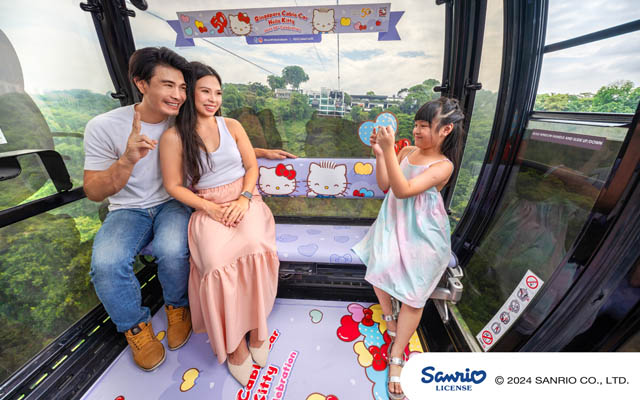
Singapore Cable Car is sharing its 50th birthday with a friend – Hello Kitty – and everyone is invited to the party. From June 1 to December 31 this year, visitors can ride in birthday-themed Hello Kitty cable car cabins along the Mount Faber Line from Mount Faber Peak to Sentosa.
These unique cabins, dressed in vibrant designs bearing images of Hello Kitty, her companion Dear Daniel, her sister Mimmy, and her parents, are first in South-east Asia.
Visitors can ride in birthday-themed Hello Kitty cable car cabins along the Mount Faber Line from Mount Faber Peak to Sentosa from June 1 to December 31
Beyond the Hello Kitty-themed rides in the skies, visitors can also make photo memories with an exclusive two-metre-tall Hello Kitty sculpture as well as at a special photo spot where vintage cable car cabins adorned with Hello Kitty anniversary designs are on display.
Within Earth Holidays, an inbound tour operator and destination management company based in Kuala Lumpur and specialising in the European inbound market to Malaysia, is expanding its operations to Saudi Arabia’s Jeddah and Indonesia’s Bali in the coming months to better serve its European clients for leisure and business events.
Executive director, Saini Vermeulen, announced that the company had recently secured its inbound license for Saudi Arabia, allowing the company to offer non-religious tours.
Within Earth Holidays will soon open an office in Jeddah to promote Saudi Arabia as a destination; Jeddah in Saudi Arabia, pictured
The company sees significant potential for inbound tourism from Europe to Saudi Arabia and will be establishing a sales and marketing office established in Jeddah in July – Within Earth Holidays will also collaborate with Saudi Tourism Authority to draw more visitors to the destination.
In addition, the Bali office will open in 2H2024, targeting inbound leisure and business events from Eastern Europe and German-speaking countries such as Germany, Austria, and Switzerland. He remarked that the German-speaking markets have shown increased interest in visiting the Far East post-lockdown, supported by improved air connectivity.
“We have been working with a good representation company based in Germany, who has great connection with agents in the German speaking markets and Europe who have brought leisure and business event groups to Malaysia and Indonesia for many years. Our agents appreciate our operations in Malaysia, and when our representation company ended their cooperation with an Indonesian ground handler, we saw it as an opportunity to open an office in Bali to service our European agents.”
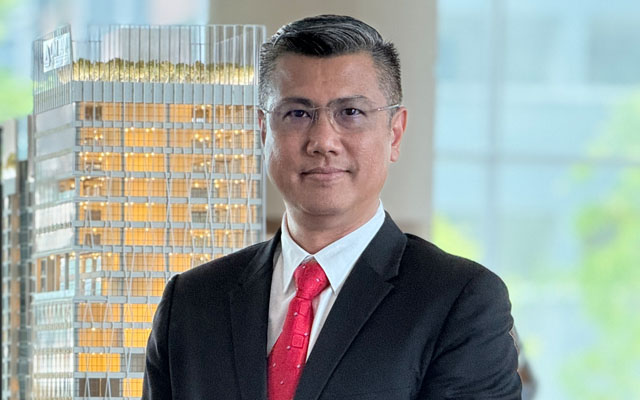
Pierre Boudville has been appointed as the inaugural hotel manager of Ozo Medini Johor in Malaysia, which is set to open in July this year.
With over two decades of hospitality experience, he will be instrumental in setting new benchmarks for guest experiences at the new 198-key hotel.
He has previously held key roles at Amari Johor Bahru, Tunamaya Beach & Spa Resort Desaru, Meritus Pelangi Beach Resort & Spa Langkawi, and Hotel Royal Penang.
The Tourism Authority of Thailand (TAT) and Traveloka have signed a Memorandum of Agreement (MoA) to enhance the travel platform’s commitment to Thailand’s tourism industry, with both parties collaborating to promote inbound and domestic tourism, including secondary destinations.
The MoA provides the legal framework for Traveloka to collaborate with TAT on dual marketing campaigns, sustainability initiatives and travel insights. This agreement also allows Traveloka to collaborate directly with the TAT head office in Bangkok and all domestic and overseas offices, further strengthening Traveloka’s support of the Thai travel industry.
From left: Traveloka’s Albert and TAT’s Thapanee Kiatphaibool
Both TAT and Traveloka had implemented earlier this year a joint campaign, Unveiling Thailand’s Treasure, which was “highly successful in showcasing the potential of lesser-known tourist destinations to a wider audience”, according to Traveloka co-founder Albert.
TAT’s campaign has broadened the spectrum of tourism activities, spanning economic advantages to emerging destinations, and promotes the exploration of secondary cities, with support from Traveloka such as flights, accommodation, and local attractions offers in the Traveloka app.
“This enhanced partnership with Traveloka will help solidify Thailand’s position as an industry leader in moving towards experience-based and sustainable tourism,” said TAT governor Thapanee Kiatphaibool, adding that the MoA “is in alignment with TAT’s direction to elevate Thailand’s travel industry and enhance its competitive advantage”.
Hotel Okura Co. has signed a multiple-property framework agreement with Asset World Corporation (AWC) on May 17 to operate a new hotel being developed by AWC in Chiang Mai, scheduled to open in 2028.
The collaboration also includes several upcoming Okura Group luxury hotels across Thailand that will add more than 500 rooms in the country, as well as the launch of Hotel Okura’s river cruises on the Chao Phraya River starting this December.
Hotel Okura and Asset World Corporation have expanded their partnership on May 17
This extended agreement will help bring the hotel group’s presence in Thailand to over 2,000 new and existing rooms by 2030.
The hotel, which will be the first Okura-branded hotel to open in Chiang Mai, will be part of AWC’s Lannatique project, a commercial development in Chiang Mai’s Chang Klan area. Hotel services will promote physical and mental well-being with facilities such as a spa, Zen garden and Japanese tea café.
Hotel Okura will also provide hospitality services on Okura Cruise river excursions on the Chao Phraya River in Bangkok, between Asiatique the Riverfront Destination and Rama VIII Bridge. Beginning this December, passengers on the cruise ship will enjoy meals while taking in river scenery.
Toshihiro Ogita, president, Hotel Okura, said: “We are excited to build on our success with The Okura Prestige Bangkok through our expanded partnership with AWC. Going forward, we are committed to leveraging our expertise and tradition of offering the essence of Japanese hospitality to deliver top-quality accommodation and cruise services in Thailand, including to strengthen AWC’s leadership in the Thai lifestyle real estate market.”
Ascott has teamed up once again with Warees Investments to launch lyf Chinatown Singapore, which is scheduled to open mid-2026.
Ascott had previously partnered with Warees in 2004 for the launch of Somerset Bencoolen Singapore.
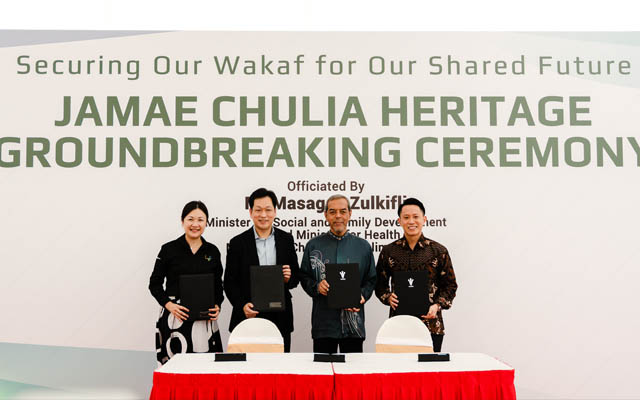
From left: Ascott’s Wong Kar Ling and Kevin Goh, and Warees’ Abdul Razak Maricar and Masagoes Isyak at the signing ceremony of lyf Chinatown Singapore
Commissioned by Warees through WJC Heritage and managed by Ascott, lyf Chinatown Singapore spans 3,394m² and is the fifth property in Singapore under the lyf brand.
The hotel will comprise 90 accommodation units along with social spaces such as co-working lounge ‘Connect’, social kitchen ‘Bond’, launderette ‘Wash & Hang’, gym ‘Burn’, rooftop swimming pool ‘Dip’, as well as an outdoor courtyard and terrace.
In April, Sofitel introduced its new campaign starring Gillian Anderson and Dali Benssalah, the brand’s two ambassadors in a short film set in the Sofitel Mexico City Reforma, one of the brand’s flagship locations.
In this campaign, the brand pays tribute to cinema and Mexican culture, by showcasing Mexico City’s National Museum of Anthropology and a traditional market.
Sofitel’s new campaign video stars celebrities Gillian Anderson and Dali Benssalah
The two-and-a-half-minute film, The Encounter, shows two celebrities living the Sofitel experience differently, each at their own pace, guided by the same desire for freedom. For one, a film shoot at a colourful outdoor market, an exploration of local traditions and a lively gastronomic experience. For the other, wellness, sport, adventure and laughter with friends.
Anderson, a British-American actress famous for her roles in The X Files, The Fall, The Crown, and Sex Education, commented: “I have always had a restless spirit and this new campaign by Sofitel embodies exactly that hunger to explore and what better location to celebrate that mindset than the phenomenally stimulating and sensuous Mexico City.”
“The pleasure of getting lost in Mexico City. The joy of meeting up at the Sofitel. Both already look like movie sets. (It’s) an honour to be a Sofitel ambassador in front of these cameras,” shared Dali Benssalah, a French-Algerian Benssalah, who achieved international fame with his role in the James Bond movie, No Time to Die.
The campaign invites travellers to discover the local culture, to open up to others, and to live the Sofitel experience.
Dorsett Hospitality International has teamed up with Cathay to allow members of its loyalty programme, Dorsett – Your Rewards, to enjoy greater convenience, flexibility and rewards.
This collaboration allows Dorsett – Your Rewards members to convert their points into Asia Miles, with a conversion rate for each Dorsett – Your Rewards point equivalent to 10 Asia Miles.
Dorsett – Your Rewards members can convert their points into Asia Miles through this new partnership
Members of Dorsett – Your Rewards can earn and accumulate points by staying at any of the 22 participating Dorsett, Dao by Dorsett, d.Collection and Silka hotels across Mainland China, Hong Kong, Singapore, Malaysia, London and Australia.
The programme also offers instant benefits, including an additional 12 per cent discount on room bookings made via the hotel websites or membership platform.
Plaza Premium Group (PPG) has opened an office in Saudi Arabia with investment plans of US$100 million to expand its presence in the Middle East.
With a major focus on Saudi Arabia, the funds will be allocated to opening world-class lounges, establishing a global airport concierge service with white-glove service, creating innovative dining outlets, and exploring opportunities for in-terminal hotels.
Plaza Premium Group will expand its presence in the Middle East by launching airport lounges, airport concierge services, and more
Deputy CEO Bora Isbulan will lead this initiative, and will direct the business development, commercial, and marketing divisions, as well as forge robust alliances throughout the region.
With a presence in the Middle East since 2014, PPG has developed a robust portfolio of airport lounges, hotels, and F&B outlets; the company currently operates in 15 locations across eight international airports within key regional cities including Amman, Riyadh, Jeddah, Dammam, Dubai, and Muscat.
The investment aims to establish a corporate presence in the Kingdom and support the company’s goal of expanding its global footprint to 500 locations by 2025, The targeted investment in the Middle East is part of US$300 million that PPG intends to invest over three years globally.
According to Song Hoi-See, founder and CEO of PPG, the projected investment will help to add value to development of airport hospitality services at the existing and upcoming destinations throughout the Middle East.
“This is an exciting time to invest in the Middle East, a region that exemplifies the future of travel and tourism. It is rich in ancient culture yet embraces modernity, reflecting PPG’s ethos of innovation and growth alongside our travel partners,” he said.
PPG is currently in 80 airports, 30 countries and 250 locations.
Seek Sophie, a Singapore-based experiences booking platform, signed a Memorandum of Understanding with Indonesia’s Ministry of Tourism earlier this week, having been selected as the exclusive partner in Singapore for the latter’s inaugural sustainable tourism initiative.
The initiative, named Wonderful Indonesia Climate Friendly Journey, is the first of its kind in Indonesia, and directly addresses the rising global demand for sustainable travel experiences.
Seek Sophie and Indonesia’s Ministry of Tourism at the MoU signing
“We will be spending the next few months developing and promoting a diverse range of low-carbon thematic tours, highlighting Indonesia’s rich marine heritage, adventure and ecotourism opportunities, culinary delights, and wellness offerings,” Jacinta Lim, co-founder of Seek Sophie, told TTG Asia.
Lim added that Seek Sophie wants to “set a new standard for responsible travel in the region”, as travellers increasingly seek ways to minimise their environmental impact.
The platform’s other plans include the expansion of sustainable experiences across Asia, by working closely with local conservationists and social enterprises to develop unique, eco-conscious travel experiences.
To make sustainable choices even easier for travellers, Seek Sophie has also rolled out two new product categories on its website: Low Carbon and Responsible Experiences. These categories will highlight experiences like farm-to-table low carbon experiences, coral reef restoration projects, and other initiatives that directly benefit the planet.
“We believe the Indonesian Ministry of Tourism’s forward-thinking initiative is a significant step towards a more sustainable future for travel in the region. We’re proud to be a part of this movement and look forward to sharing more updates as our sustainability efforts continue to grow,” Lim added.



 He has previously held key roles at Amari Johor Bahru, Tunamaya Beach & Spa Resort Desaru, Meritus Pelangi Beach Resort & Spa Langkawi, and Hotel Royal Penang.













Within Earth Holidays, an inbound tour operator and destination management company based in Kuala Lumpur and specialising in the European inbound market to Malaysia, is expanding its operations to Saudi Arabia’s Jeddah and Indonesia’s Bali in the coming months to better serve its European clients for leisure and business events.
Executive director, Saini Vermeulen, announced that the company had recently secured its inbound license for Saudi Arabia, allowing the company to offer non-religious tours.
The company sees significant potential for inbound tourism from Europe to Saudi Arabia and will be establishing a sales and marketing office established in Jeddah in July – Within Earth Holidays will also collaborate with Saudi Tourism Authority to draw more visitors to the destination.
In addition, the Bali office will open in 2H2024, targeting inbound leisure and business events from Eastern Europe and German-speaking countries such as Germany, Austria, and Switzerland. He remarked that the German-speaking markets have shown increased interest in visiting the Far East post-lockdown, supported by improved air connectivity.
“We have been working with a good representation company based in Germany, who has great connection with agents in the German speaking markets and Europe who have brought leisure and business event groups to Malaysia and Indonesia for many years. Our agents appreciate our operations in Malaysia, and when our representation company ended their cooperation with an Indonesian ground handler, we saw it as an opportunity to open an office in Bali to service our European agents.”