Anna Rohm has been appointed as the new general manager of Renaissance Pattaya Resort & Spa.
With a seasoned international career in hotel management spanning Europe, the Middle East and Asia, she brings a wealth of experience and leadership to her new role where she will oversee day-to-day hotel operations and drive the resort’s overall business strategy.
Before joining Renaissance Pattaya Resort & Spa, Rohm served as hotel manager at one of the flagship hotels of the Banyan Tree Hotel Group in Thailand.
Travel trend analyst ForwardKeys has found Chinese New Year travels taking place earlier than usual this year, as Chinese consumers make smarter holiday plans to dodge crowds and expensive fares during the holiday rush. Consumers are also choosing to take a longer break after long years of staying put on home grounds.
ForwardKeys’ latest data showed that issued flight tickets for international travel from China for the period spanning January 26 to February 29 – comprising the official Chinese New Year public holidays from February 10 to 17 – are just 37 per cent behind 2019’s levels.
More Chinese travellers are planning ahead for their holidays, with issued tickets to Dubai, pictured, surpassing 2019 levels during this year’s Chinese New Year season
Departure activity spiked earlier than usual – as early as January 27.
According to ForwardKeys researchers, this year’s holiday season is particularly significant as it marks the first celebration following the easing of pandemic restrictions. The traditional seven-day holiday has also been extended to eight days.
Kuala Lumpur (up 15 per cent), Dubai (up eight per cent), and Macau (up eight per cent) surpassed 2019 issued ticket levels for this year’s Chinese New Year season, benefitting from relaxed entry requirements for Chinese travellers. Sydney (down five per cent) and London (down eight per cent) showed resilience with single-digit decreases against 2019 volume, while Singapore (down 18 per cent) and Seoul (down 22 per cent) continued to attract Chinese tourists with advanced flight connectivity and simplified visa procedures, noted the report.
ForwardKeys projects a peak in travel on the last two days of the Chinese New Year period and the day after the holiday period, as the Chinese choose to extend their vacation.
Examining Chinese travellers transferring on their way home, ForwardKeys’ data showed Istanbul and Abu Dhabi increasingly vital as connecting hubs, with Chinese transfers reaching 104 per cent and 75 per cent respectively of 2019 levels.
In terms of domestic trips, Haikou (up seven per cent against 2019) maintained popularity, while destinations in China’s north-eastern region, like Harbin and Changchun, exceeded 2019 levels by 15 per cent, driven by the appeal of winter sports and effective social media marketing.
Nan Dai, ForwardKeys’ China expert, commented: “The robust recovery of Chinese travel during the Chinese New Year period reflects not only the resilience of the tourism industry but also the strategic measures taken by the government and the changing preferences of Chinese tourists”
“The early spike in departure activity and the positive performance of various destinations signal a promising trajectory for the travel sector in the coming year. This presents a golden opportunity for tourism-related businesses, such as retailers, who can potentially take advantage of this surge in consumer activity and capitalise on the increased spending propensity of Chinese travellers during their extended holidays.”
Tourism Malaysia officials are in India this month on an intensive destination promotion campaign to position the destination as the preferred choice among Indian travel agents and travellers.
Initiatives kicked off with Tourism Malaysia’s participation in the Outbound Travel Mart (OTM) 2024 in Mumbai from February 8 to 10. Ammar Abd Ghapar, director general of Tourism Malaysia, led 43 organisations representing tour agents, hotel/resort operators, tourism product owners, state tourism boards, airline operators to the show.
Tourism Malaysia hopes to attract more Indian travellers to the country; Malaysia Food and Cultural Festival held in Mumbai, pictured
The tourism board’s last OTM participation was in 2020.
Through its presence at OTM 2024, Tourism Malaysia showed off niche products such as shopping, golfing, luxury tourism, theme parks and honeymoon packages, as well as the destination’s appeal for weddings and film-induced tourism.
The Malaysia Food and Cultural Festival was also hosted from February 5 to 11 in the same city, while an extensive roadshow spanning four key cities in India – Bangalore, Chennai, Calcutta, and Ahmedabad – is ongoing from now till February 19.
These promotional efforts will culminate in South Asia’s Travel & Tourism Exchange in Delhi, taking place from February 22 to 24.
Ammar said: “India holds considerable importance as a priority market for Malaysia, boasting robust economic ties and deep cultural connections. It stands as Malaysia’s fifth-largest source of tourists, contributing significantly to the tourism landscape. The period from January to September 2023 witnessed Malaysia welcoming 14.4 million tourists, with 472,479 arrivals originating from India.”
Malaysia is offering visa-free entry for Indian tourists until December 31, 2024.
Malaysia’s ambition to welcome more Indian visitors is supported by various airlines, such as Malaysia Airlines, Batik Air, AirAsia, and IndiGo, which provide 180 flights and 33,374 seats weekly between India and Malaysia.
International visitors to Thailand will be able to receive medical coverage of up to 500,000 baht (US$13,861) if involved in any accident while holidaying in the country – in the event of death, there will also be a compensation of up to one million baht.
Launched on February 14, this insurance coverage is to assure tourists of their safety when travelling in Thailand, and is part of the government’s new campaign in collaboration with Thailand’s Ministry of Tourism and Sports (MOTS) and the National Institute of Emergency Medicine (NIEM) under the Ministry of Public Health.
Thailand will provide medical coverage for tourists who travel in the country between January 1 and August 31 this year (Photo: )
Foreign tourists are eligible for coverage if they have valid passports and are travelling in Thailand between January 1 and August 31, 2024 for the purpose of tourism only.
The Thai government has set aside 50 million baht to fund the scheme in order to ensure tourists’ safety as well as to strengthen the positive image of Thailand as a global holiday destination. The funds will come from the ministry’s budget for emergency expenses and will be used to compensate foreign tourists on a case-by-case basis during their travel in Thailand.
Foreigners with a tourist visa can apply for the coverage by submitting documents at the provincial tourism and sports offices, or at tourist assistance centres located in Bangkok’s Suvarnabhumi and Don Mueang airports. Applications can also be submitted via post and e-mail.
The maximum coverage is one million baht per person in case of death and 300,000 baht per person for permanent organ loss, loss of sight or permanent disability. Medical expenses will be covered up to a maximum of 500,000 baht. Tourists can claim medical expenses within 15 days of the incident and compensation is expected to be paid 15 days after that.
Tourists will not be eligible for the coverage if the incidents are ruled as risky or careless behaviour, or an intention to participate in illegal activity.
Meanwhile, MOTS has also initiated the Thailand Traveller Safety system for foreign visitors to check if they are eligible to apply for relief.
In addition, NIEM has proposed the establishment of a Tourist Emergency Medical Assistance Centre to facilitate coordination with the MOTS’s Tourist Assistance Center, the Tourist Police Hotline, or the NIEM Hotline to verify tourists’ eligibility for compensation under the scheme in order to refer them to the hospital for medical treatments.
Furthermore, the Tourist Police is operating the existing Command and Control Operation Centre and the Strong Tourism Community initiatives under the guidelines for implementing the Smart Safety Zone project and applying technology to maintain tourist safety such as strict law enforcement, suppressing exploitation of tourists, and fraud incidents.
Minor Hotels is aiming for more than 200 new openings globally within three years, and has unveiled new details of its dynamic commercial strategy for 2024 and beyond.
The group’s goal is to increase its global portfolio by almost 40 per cent from its current count of 540 properties, and adding more than 30,000 rooms to its present inventory of almost 80,000.
Minor Hotels aims to launch 200+ new hotel openings by end-2026; Avani+ Luang Prabang Hotel, pictured
Of the new openings targeted by the end of 2026, approximately half will be in the Asia region, while Europe and the Middle East are expected to add more than 50 properties each. Other regions, such as Australia and New Zealand, the Americas and Africa, will also see new openings across the Minor Hotels brand portfolio.
The Anantara, Avani, Oaks, Tivoli and NH Hotels brands are expected to be the key drivers of portfolio growth over the next three years, with Avani alone expected to more than double its property count to almost 100. Minor Hotels also expects to unveil multiple new brands in 2024 and 2025 to fill unmet consumer demand and provide more tailored options to hotel owners.
The group’s luxury brand Anantara Hotels, Resorts & Spas will continue its strategic growth during 2024 with key openings including Anantara Palais Hansen Vienna Hotel in Europe, Anantara Santorini Abu Dhabi Retreat in the UAE, Anantara Ubud Bali Resort in Indonesia, and debuting in India, Anantara Jaipur Resort.
Additions to Avani Hotels & Resorts in 2024 will include properties in Frankfurt, Amsterdam and the Seychelles, in addition to its first hotel in China.
NH Collection Hotels & Resorts will continue to grow its global footprint with new openings in Thailand, Qatar, Finland and Portugal, while NH Hotels & Resorts has added Minor Hotels’ first properties in Paris this year, with upcoming hotels in Mexico and China. Tivoli Hotels & Resorts will continue its expansion in Europe and the Middle East, while nhow Hotels will debut in Peru in 2024 with nhow Lima, and add a property in Italy, nhow Rome.
Elewana Collection, a collection of boutique lodges, camps and hotels in iconic locations across Kenya and Tanzania, will also see its first Explorer by Elewana collection, Serengeti Explorer, scheduled to open in March.
In addition, the group’s forthcoming 12-key Anantara Kafue River Zambia Tented Camp will offer an entirely new luxury experience for guests of Minor Hotels’ flagship brand, while Vietnam-based luxury rail experience The Vietage by Anantara is adding a new Quy Nhon – Nha Trang route to its itinerary from May this year.
Under its long-standing ‘asset right’ strategy, Minor Hotels owns or leases almost 70 per cent of its global portfolio of 540 hotels – this is expected to decrease by about half as the group pursues a more aggressive mix of management and franchise agreement options. Minor is targeting more than 150 new management agreements over the next three years, which would grow its share of the overall operating model mix from 19 per cent in 2023 to 38 per cent by 2026. New franchise agreements are also being targeted, while Minor will continue to grow its hotel investment portfolio.
Dillip Rajakarier, group CEO of Minor International and CEO of Minor Hotels, commented: “2023 has been a record year and the figures, both financial and regarding the group’s expansion, confirm this. Looking ahead, we intend to increase this pace of openings, expanding our brands within our existing areas of operation and growing our global footprint into new regions in which we are not yet present.”
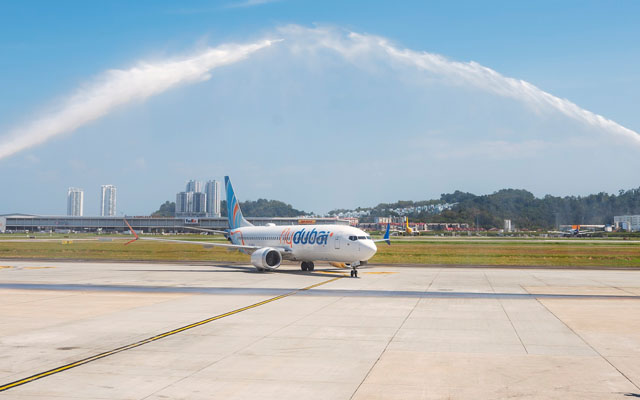
Dubai-based carrier, flydubai, has commenced its operations to Langkawi and Penang, flying daily from Terminal 3, Dubai International to Penang International Airport and Langkawi International Airport.
flydubai is the first carrier to serve the two airports with a daily service from Dubai, along with its two other South-east Asian destinations, Krabi and Pattaya in Thailand.
flydubai has introduced services from Dubai to Penang and Langkawi
Flights to Langkawi will operate via a short stop in Penang, offering passengers from the UAE and across the region convenient travel options to explore both destinations.
Greater Bay Airlines (GBA) will launch its Singapore-Hong Kong route from April 26, operating daily between Singapore Changi Airport and Hong Kong International Airport.
Greater Bay Airlines launches flights from Singapore to Hong Kong
Travellers can easily connect from Singapore to Greater Bay Area cities such as Shenzhen, Guangzhou, Dongguan, Macau upon arriving at Hong Kong International Airport with the available high-speed ferry services, or land transportation via the Hong Kong-Zhuhai-Macao Bridge.
Sri Lanka is planning to extend a free visa facility for visitors from some of its main source markets beyond March 2024 in order to boost tourist arrivals in the country as it embarks on record levels this year.
Officials said that the free visa facility for visitors from seven countries as a pilot project was introduced in November last year and set to end in March 2024. However, with promising arrivals in January and setting an ambitious target of 2.4 million arrivals for this year, higher than the record of 2.3 million achieved in 2018, the authorities were contemplating on extending this facility beyond March. The new date on when this facility will end is under discussion.
Sri Lanka hopes to attract more international visitors and may extend its free visa facility beyond March 2024; Nine Arch Bridge in Sri Lanka, pictured
The seven countries are India, China, Indonesia, Russia, Thailand, Malaysia and Japan. Indonesia and Japan are considered strong emerging markets while the rest are top source markets. The country fell short of the 2023 target of 1.5 million with arrivals at 1,487,303 in 2023, sharply up by 106.6 per cent from 719,978 in 2022.
January 2024 arrivals totalled 208,253, more than double the figures from the previous year. Provisional data showed that 60,122 travellers arrived in the first eight days of February 2024 alone with another promising month expected.
Along with this move, the authorities are also promoting a special visa for nomads who can work online from the country, said Harsha Ilukpitiya, immigration and emigration controller general. He added that this is to encourage work visas for this category of tourists. Nomad travellers are those who move from one country to another while working in remote locations.
Korean Air has appointed a new country manager in Cambodia who has unveiled grand plans to lure more South Koreans to the Kingdom of Wonder’s shores.
“Not many South Koreans know much about Cambodia, apart from Angkor Wat. Many have explored a lot of South-east Asia and are looking for new places to visit. They know Thailand and Vietnam, but not Cambodia, so I have to provide more information (for them),” said Hoyeon Chang.
Korean Air is looking to expand its network by launching more flights between South Korea and Cambodia
Chang has set his sights firmly on expanding the network to lure more South Koreans to the Cambodia’s shores. This includes plans to explore launching flights between South Korea and the recently opened Siem Reap-Angkor International Airport, as well as the coastal city of Sihanoukville.
“Cambodia is a very important destination for Korean Air because we have leisure demand and business demand too,” Chang said, adding that the airline currently operates daily flights between Seoul Incheon and Phnom Penh.
According to the latest figures from Cambodia’s Ministry of Tourism, South Korea ranks the nation’s sixth strongest source market. Between January and September, there were 125,732 arrivals. In addition, about 300 South Korean companies are based in Cambodia.
“We have a good mix of leisure and business traffic from South Korea but we can further build on the leisure market. South Koreans are searching for new places to visit, so we have to develop new destinations,” Chang noted.
He added that the route connecting South Korea with the Vietnamese island of Phu Quoc, which launched at the end of last year, has got off to a strong start due to the appeal of the beaches.
“Sihanoukville also has nice beaches and islands, which will make it attractive to South Koreans, and, of course, Siem Reap has a lot – but to make it viable very much depends on the support we get from travel agents and tour operators. It needs this support.”
Chang also noted that a strong part of Korean Air’s Cambodia traffic is outbound business, with many Cambodians travelling to the US. From Seoul Incheon, passengers can fly directly to 13 destinations in North America and Canada.
Since the airline reintroduced its direct connection from Phnom Penh to Japan in 2023, Chang said that the route has proved popular. “We’re seeing a lot of demand between Cambodia and Japan, especially to northern parts like Sapporo,” he said.
SITA’s 2023 Air Transport IT Insights report has revealed that both airports and airlines saw information technology (IT) spend increase year-on-year into 2023, reaching an estimated US$10.8 billion and US$34.5 billion respectively, with over two-thirds of airport and airline chief information officers (CIO) expecting continued growth into 2024.
Airports also boosted IT spend as a percentage of revenue in 2022 and 2023 even as business benefitted from an uptick in travel demand, signalling just how crucial a role technology will play in the next-generation travel experience.
Airports and airlines are spending more on IT solutions
Aviation CIOs’ key investment priorities include a biometrically enabled passenger journey, leveraging data to unlock operational efficiencies, and green solutions to optimise energy consumption and emissions.
From a seamless passenger experience to optimised operations
Airlines and airports have made strides in optimising the passenger experience, with over half having implemented IT to improve efficiency across check-in, bag tag, and boarding in 2023. Biometrics are becoming commonplace to help curb congestion, with 70 per cent of airlines expecting to have biometric ID management in place by 2026, and 90 per cent of airports investing in major programmes or R&D in this area.
CIOs are now looking to supplement passenger processing advancements with innovative solutions on the operations side. To boost efficiency, protect operations against disruption, and streamline processes for both passengers and staff, CIOs are embracing IT solutions for business intelligence (BI), artificial intelligence (AI), and data sharing.
BI is the biggest area of technology investment for airlines in the coming three years, with 73 per cent investing in major programmes. Nearly two-thirds of airports and airlines collect and integrate data, and with the rise of generative AI, they are now looking to AI and machine learning to leverage this data and generate insights. With most citing the “use of data to improve operational efficiency” as at least somewhat of a business challenge, it makes sense that 97 per cent of airlines and 82 per cent of airports are investing in AI by 2026.
David Lavorel, CEO of SITA, said: “As we approach a full recovery of passenger demand for air travel, with domestic travel even surpassing pre-pandemic levels in some regions, airlines and airports have learned from the congestion and disruptions seen in the past two years. Advanced data sharing and analytics tools will allow them to unite stakeholders and identify opportunities for greater efficiency and leaner operations. Solutions like total airport management and BI for passenger processing provide airports and airlines real-time insight into the management of assets and passenger flow, allowing for agile, collaborative responses to any disruptions.”
Smart IT to improve sustainability
Sustainability is also high on the agenda, with industry milestones for carbon reduction as well as regulations on emissions coming into view. CIOs are setting their sights on technology solutions that can deliver concrete emissions reductions.
By 2026, over 90 per cent of airlines plan to have IT in place to boost the efficiency of flight operations and aircraft turnaround. More than half have implemented IT to optimise both aircraft taxiing and the take-off/landing and cruise phases of flights, with nearly all expecting to have this in place by 2026.
On the airport side, building and energy management systems are a key priority for offering a unified view of emissions and opportunities to reduce them. Investment in energy management systems is expected to grow the most of any airport sustainability initiative, with over half of airports planning this by 2026.
“With industry ambitions to achieve net-zero CO2 emissions by 2050 in mind, airlines and airports are taking necessary steps towards reducing their carbon footprint, adopting digital tools for accurate monitoring and optimisation of energy consumption and emissions,” Lavorel added.
The SITA 2023 Air Transport IT Insights research was conducted from August to November 2023, and represents the views of over 250 senior airline and airport executives, covering a quarter of global passenger traffic.



 Before joining Renaissance Pattaya Resort & Spa, Rohm served as hotel manager at one of the flagship hotels of the Banyan Tree Hotel Group in Thailand.