TTG Asia
Asia/Singapore Friday, 30th January 2026
Page 2667

Watching costs of travel

0

Corporate travel in Asia stays buoyant but interest in policy compliance and cheaper options heightens as prices rise
13apr2012_story1_1
Courtesy of Park Hotel Group

Despite an anticipated economic slowdown in Asia this year, airfares and hotel rates are continuing to rise across the region, representing another year of consecutive increase.

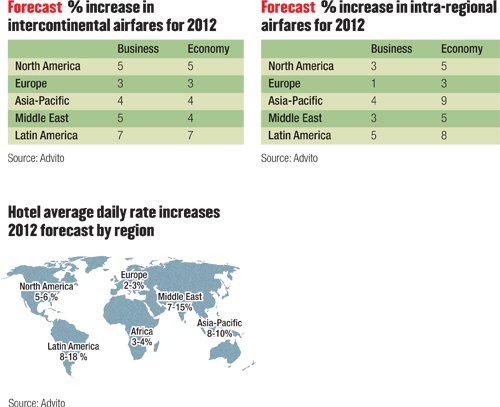
Carlson Wagonlit Travel (CWT) predicts a three to four per cent rise for Asia-Pacific airfares this year, while hotel rates in the region are expected to jump by up to 15 per cent.

But contrary to popular belief that a hike in hotel rates and airfares would curtail corporate travel, business travel demand in Asia is expected to remain fairly robust.

Large Asian economies, with the exception of Japan, have so far appeared to be spared the full impact of the economic turmoil erupting across the US and Europe.

Preliminary data from Pegasus revealed that, as of February 28, advanced corporate net reservations for June 2012 in Asia-Pacific rose by 27.9 per cent over 2011, compared to 7.6 per cent in North America, 8.5 per cent in Europe and a decline of 15 per cent in the Middle East and North Africa.

Looking further ahead, the Global Business Travel Association (GBTA) anticipates corporate travel expenditure in Asia-Pacific to grow by up to 11 per cent by 2015, almost three times the predicted rate for the US.

Against a backdrop of more expensive airfares and hotel rates, corporate travel managers are tightening travel polices to keep costs at a manageable level.

Travel management companies (TMCs) that TTG Asia spoke to all agreed that while companies and the travel managers they deal with in Asia have not trimmed their travel budgets this year, they are now intent on sniffing out ground and air savings.

“As airfares and hotel rates go up, corporates tend to examine their travel policies more closely, making tweaks to optimise spending and returns, for instance, by telling their staff to downgrade from business class to economy, or by switching to four-star from five-star hotels.

“This is happening to a degree at the moment (in Asia) as airfares and hotel rates escalate, but it is not evident across all sectors and organisations,” said Greg Treasure, Hogg Robinson Group’s managing director for the Asia-Pacific region.

Mike Orchard, senior director, CWT Solutions Group, Asia-Pacific, said more clients were considering integrating low-cost airlines into their travel programmes to reap the substantial cost savings that could be derived by switching to such carriers, especially on shorthaul routes.

“Companies can expect to save up to 20 per cent on their airline expenditures simply by using low-cost airlines,” he said.

Alternatively, some firms are reducing the frequency in which employees undertake business trips, replacing face-to-face meetings with technology such as video conferencing or by combining multiple destinations into a single trip, according to a spokesperson for FCm Travel Solutions.

Adherence takes centre stage
The renewed interest on cost control has given precedence to travel compliance. A CWT survey found that improving traveller compliance ranked the top priority for Asia-based travel managers in 2012, as they often face an uphill battle in ensuring that travel policies are being adhered to.

GBTA’s regional director for Asia-Pacific Welf Ebeling said: “Asia is still woefully behind the US and Europe when it comes to getting employees to toe the line, and in utilising online tools to keep travel expenses in check, even though they might have a travel programme and policies in place.”

This point was reiterated by Advito (see related article below, left), which said in its 2012 industry forecast that Asia was 15 to 20 years behind the West in its travel management evolution.

Orchard argued that the laissez-faire approach to travel policies among Asian employees was rooted in the perception that booking directly with suppliers was the cheapest option. “However, our research found that average hotel rates offered by TMCs are around 18 per cent lower than those directly quoted by hotels,” he said.

Policy restrictions are also a cause for employees skirting the rules. “Multinational firms that have not adapted their global travel policies to accommodate local cultural differences and idiosyncrasies usually see more incidents of travel policy defiance,” Orchard said.

Best road to compliance
While adherence to travel policies is crucial, travel managers should not be overzealous when clamping down on employees, said Carl Jones, director of advisory services, Japan, Asia-Pacific, Australia, American Express Business Travel.

Instead of wielding the stick, employees should be encouraged to follow policies through constant communication and engagement. “After all, (business) travel is a prime motivator, and if policies become too restrictive, this will demoralise workers, which could in turn affect retention rates,” he said.

Orchard, on the other hand, prefers “gamification” techniques. “Persuade employees to accumulate points in exchange for rewards for good travel behaviour, instead of harking on about rules and regulations.”

“Alternatively, give employees a traveller score card that lists exactly where their behaviours are driving savings – it’s a good solution to keep employees on the straight and narrow.”

13apr2012_story1_2


Setting sail on growing demand

0

Asia’s cruising scene heats up as more international ships arrive, helping to also cultivate outbound markets

13apr2012_cruise

13apr2012_story_hk

Travel consultants in Hong Kong are gearing up to sell more cruises as they anticipate an even bigger market with the opening of the country’s new Kai Tak terminal next year. Last month, Worldwide Cruise Terminals Consortium was finally announced as the terminal’s operator and manager.

Crystal Cruises, regional sales manager, Asia-Pacific, Marnie Whipple, said: “(The new terminal) shows the commitment of Hong Kong to provide superior berthing (facilities) for cruise ships. Increased cruise visits – and simply greater visibility of ships in the harbour – help to build awareness and lead to more queries.”

The refurbished Crystal Serenity recently called at Hong Kong, while Crystal Symphony will visit the city for three days in 2013. “In 2014, both ships will call on Hong Kong on expanded 10-, 12-, 14- and 16-day itineraries, plus longer combination cruise options,” said Whipple.

The number of ships calling at Hong Kong in 2013 is not yet available, but confirmed cruise liners include Queen Mary 2, Seabourn Pride, Celebrity Millennium and Azamara Journey, according to a Tourism Commission spokesman.

To tap the Asian market, UK-based Cunard Lines appointed Cruise Vacations – led by cruise expert Nancy Chung – as its GSA in Hong Kong and Macau in 2010. Earlier this year, Chung set up an office in Seoul “to manage and build rapport for Cunard” due to the significant size of the South Korean market. Last year, she appointed a GSA in Jakarta to oversee the growing Indonesian market.

Memory Holidays, a subsidiary of Lotus Travel Group, also recently launched the GeoTraveller Cruise Center, a brand that aims to lead the cruise vacation industry through product innovation.

Meanwhile, travel trade members said they preferred to keep the existing cruise terminal in operation, even when Kai Tak opens in mid-2013. Kai Tak’s second berth is set to be completed in 2014.

Wharf Holdings, which has been managing the popular Ocean Terminal since 1966, is still negotiating with the government to renew the lease expiring on June 15. Prudence Lui

OLYMPUS DIGITAL CAMERA
Whipple: longer trips in pipeline

13apr2012_story_phil

The Philippines Department of Tourism (DoT) is eyeing a greater slice of the lucrative cruise travel industry as more international liners call at the destination.

The 694-guest Azamara Quest, part of the Royal Caribbean International (RCI) fleet, made its maiden call at Manila on March 28. (Although at press time, the ship had to cut short its 17-day itinerary due to a fire.)

RCI’s 2,074-guest Legend of the Seas will also visit Manila before making its inaugural call in Boracay this October, a rare win for the Philippines which hardly receives ships of this size. And ships like Classic International Cruises’ Princess Danae are visiting new ports like Davao, where it called at this week. The majority of its 371 passengers opted to take a city tour, said DoT regional director Art Boncato.

Despite underdeveloped port facilities compared to Hong Kong and Singapore, the country is keen to pursue the cruise segment as it is “a resilient market”, said Maria Corazon Jorda-Apo, who heads DoT’s North America and Asia-Pacific teams. The NTO is participating in major cruise shows, as well as collaborating with ASEAN counterparts in Singapore, Malaysia and Thailand to invite more ships into South-east Asia.

Cruise tourism has been identified as one of the priorities within the National Tourism Development Plan, with plans underway to move cargo business away from Manila’s South Harbor to pave the way for better cruise liner-ready facilities. The deepwater port of Subic is also being positioned as a cruise destination.

Business is getting noticeably better, said Carla Mariano, groups manager, Blue Horizons Travel & Tours. “Last year, we handled three ships; this year, we’ve already handled seven ships in the first quarter.”

Most ships coming to the Philippines bring about 300-400 pax, and some call at as many as four ports in the country, such as the Spirit of Adventure which visited Palawan, Cebu, Manila and Subic.

Orion II, which sails in July, will also make stops in Puerto Galera in Mindoro and Coron in Palawan, and Fuji Maru is expected to visit in May and November. – Marianne Carandang

OLYMPUS DIGITAL CAMERA
Mariano: jump in cruise sales

Trump targets luxury projects in India

0

AMERICAN property conglomerate, Trump Organization, is going for India’s luxury hotel market with plans to expand into cities including New Delhi, Bangalore and Goa.

The company entered India last year through a joint venture with real estate developer, Rohan Lifescapes, for an upcoming 45-storey luxury residential tower in Mumbai. Trump Organization, whose portfolio consists of properties in the US, Turkey and South Korea, also intends to bring in the Trump Hotel Collection by 2016.

“India, among other emerging markets, is the biggest push for our organisation,” Donald Trump Jr, executive vice president of Trump Organization, is reported to have said at the Hotel Investment Conference South Asia held in Mumbai on April 3-4.

According to reports, the developer is looking at building several residential and hotel projects in India over the next five years, and is close to signing a few deals with Indian developers.

Niche luxury travel consultants hope this will materialise. Rajendra Dhumma, director of Classis Travel and Tours, Mumbai, said: “Indian tourism is in need of more value-add options. We expect the Trump Hotel Collection to add a new dimension to luxury hospitality in India.”

YTL’s new Borneo resort to launch in July

0

YTL Hotels, the hospitality arm of Malaysian conglomerate YTL Corporation, will open the Gaya Island Resort, Borneo on July 1, 2012.

Located just off the coast of Kota Kinabalu on Pulau Gaya, the largest island in Tunku Abdul Rahman Marine Park, the property will comprise 121 standalone hill villas offering views of the ocean and Mount Kinabalu.

Facilities at the resort will include several dining outlets, a pool bar & lounge, a 40-metre infinity swimming pool, and a spa centre featuring six treatment rooms with outdoor decks, a walk-in theatre and a yoga retreat space.

There will be a host of activities for guests to participate in, such as as kayaking, paddle surfing, scuba diving, PADI open water courses, island hopping, guided snorkelling expeditions, guided nature walks and private yacht charters.

The resort is a 30-minute combined car and speedboat ride from Kota Kinabalu International Airport.

Carlson Rezidor to open 49 Park Inns in India

0

CARLSON Rezidor Hotel Group is joining forces with Bestech Hospitalities to open a bumper crop of Park Inn by Radisson mid-scale hotels in India.

The deal grants Bestech with exclusive rights to develop Park Inn by Radisson properties in central and north India, and will herald a new generation of Park Inn by Radisson targeted at the growing middle class in key emerging markets.

Carlson Rezidor will operate the new properties through a management company in which Bestech is a partner. Forty-nine Park Inn by Radissons are scheduled to open by 2024.

To kick off the expansion, Carlson Rezidor and Bestech will invest US$42 million in a joint venture to develop the first two properties, Park Inn by Radisson Gurgaon Sector 88 and Park Inn by Radisson Chandigarh, Mohali.

K.B. Kachru, executive vice president, South Asia, Carlson Rezidor Hotel Group said: “We jointly believe that Park Inn by Radisson provides an effective and compelling investment opportunity for the Indian hotel property market, and we are confident that we will be able to attract additional investors in pursuit of this opportunity.”

The 11 states covered by the partnership include Chattisgarh, Chandigarh, Delhi, Haryana, Himachal Pradesh, Jammu and Kashmir, Madhya Pradesh, Punjab, Rajasthan, Uttar Pradesh and Uttrakhand.

Park Inn by Radisson is currently present in 33 countries, with 127 hotels in operation and 65 in the pipeline.

San Miguel buys 49-per cent stake in Philippine Airlines

0

SAN Miguel Corporation (SMC, one of the Philippines’ largest conglomerates, has purchased a 49-per cent stake in Philippine Airlines (PAL) and its low-cost subsidiary Airphil Express for PHP21.5 billion (US$500 million).

In a joint statement to shareholders, PAL chairman Lucio Tan and SMC president & COO Ramon Ang said: “The new investment will allow the two airlines to strengthen operations and stay competitive with the implementation of PAL and Airphil’s fleet modernisation programme.”

Lucio Tan will remain chairman and controlling shareholder of the Philippine flag carrier after the deal is concluded.

The sale comes after PAL’s announcement over the weekend of a new Manila-Bali route that will operate twice weekly, starting April 28.

PAL spokesperson Cielo Villaluna told TTG Asia e-Daily: “We are also planning to open a route connecting Cebu to Darwin, Australia, which is only three hours away. It is definitely in the pipeline.”

PAL received its fourth Airbus A320 last week, bringing its fleet to 37 planes. The carrier will acquire two more Boeing B777-300s by end-2012 and in 2013, respectively.

Meanwhile, SMC, which recently diversified into airport infrastructure development, is interested in investing in Clark International Airport.

Clark recently issued a PHP360 million tender for expansion of its existing passenger terminal, and is looking to construct a new budget terminal in anticipation of increased arrivals.

Japanese embassy in India outsources visa processing services

0

THE JAPANESE embassy in India has appointed VFS Global and Cox & Kings to process visa applications from Northern Indian states, effective April 2, 2012.

“We hope that the new system will ease the process of visa handling,” said Akitaka Saiki, Japan’s Ambassador to India.

VFS Global has also been tasked with managing two application drop-off offices in Punjab (Chandigarh and Jalandhar), while Cox & Kings will oversee a separate drop-off office in Rajasthan (Jaipur).

The new system will allow travellers to submit their visa applications from 08:30am – 17:30pm (Monday-Friday). Previously, requests could only be sumitted to the embassy from 09.30am – 12.00noon.

Meanwhile, the embassy, which is located in Chankyapuri, New Delhi will continue to accept applications for diplomatic and official visas, and other instances requiring special attention on humanitarian grounds.

The Japanese consulates in Bengaluru, Mumbai, Chennai and Kolkata will continue to process applications from their respective regions.

Last year, 59,000 Indians travelled to Japan. The Japan National Tourism Organisation, which recently appointed Mileage Communication Delhi as its representative in India, is targeting 90,000 Indian arrivals this year.

Reporting by Divya Kaul

Roomorama merges with Lofty.com

0

ONLINE short-term rental accommodation provider Roomorama.com, which is headquartered in Singapore, has merged with Lofty.com, a Europe-focused short-term rental site, in the process generating US$2.1 million in seed funding.

“By combining the strengths of both companies, Roomorama will now be the leading marketplace for mid-range to high-end rentals,” said Fabrice Grinda, founder of Lofty.

Incoming investors include Jose Marin, PROfounders Capital, Lerer Media Ventures, and Thrive Capital Partners.

According to a press statement, Roomorama registered an average gross booking value of US$1,330 last year, with over 80 per cent of bookings for 8-14 nights.

Booking statistics from Roomorama also revealed that the number of APAC travellers booking their accommodation via the platform had tripled as compared to when the company first expanded into the region in 1Q2011.

Roomorama currently lists 50,000 private properties in more than 3,600 locations worldwide, and is aiming to more than double its inventory by end-2012, with over 20 per cent of listings in Asia Pacific.

Chic to open China outlet

0

13apr2012_tipsheet_1
Chic Outlet Shopping’s La Roca Village, close to Barcelona, is featured here

Chic Outlet Shopping, which counts markets such as China, Singapore and Malaysia as its top producers, is pursuing travel experts in the region through commissionable packages, marketing support in brochures and fam trips, as it gears up for the opening of its first shopping village in Asia in 2013.

Having established nine villages across Europe, the 10th will be in a lakeside location in Suzhou, China, Chic Outlet Shopping head of tourism, Ian Stazicker, told TTG Asia at ITB Berlin. Scheduled to open in October, it will be similar in size to the collection’s largest village – Bicester near London – which has around 140 stores offering savings of up to 60 per cent.

“There will be a huge focus on the domestic and regional markets, and we have to make sure it does not dilute Europe’s market share,” he said, adding that he was not too worried as only the first-tier cities had been tapped so far. Japan and South Korea are targets, while Vietnam and Cambodia are emerging as markets.

Based on 2011 figures, China is currently Chic Outlet Shopping’s fastest-growing market (79 per cent), followed by Singapore/Malaysia (69 per cent) and Russia (65 per cent).

Stazicker said the strategy was to arm tour operators with product knowledge and help to “find a spot in their itineraries”, with the selling point being that “everyone likes a bargain”, especially in the current economic climate. It is also buying space in brochures.

For FITs, standalone shopping packages including transport, meals and gift cards for retail spend are available. These allow travel experts to earn an average of 10 per cent commission.

A 10-12 day fam trip for six to eight key partners in the region is being scheduled around this month, incorporating two or three villages. Chic Outlet Shopping will also be exhibiting at this year’s ITB Asia for the first time.

Borobudur fee hike incites travel trade uproar

0

TAMAN Wisata Candi Prambanan, Borobudur dan Ratu Boko’s (TWCPB&RB) plan to implement a single pricing policy at Borobudur and hike the summit access fee from US$15 to US$20 starting June 1 has resulted in a backlash from tourism stakeholders in Jogjakarta.

Tri Agung Pramono Adi, director, Panorama Tours Jogjakarta said: “On one hand, we understand that the management is bound to agreements with international partners to apply a single pricing policy. However, the decision is very difficult for the trade like us to implement.”

“For international tourists, a Jogjakarta package is already more expensive than one for Bali. International operators have even compared our package prices to Vietnam and Cambodia (for similar heritage products), saying ours are much more expensive.”

“As for domestic tourists, it is very difficult to justify such a huge increase,” he added.

Bagus Baliantoro, president, Dewata Sakti Tours Jogjakarta, said: “I am afraid we will see more agents putting Borobudur as an optional tour. Those who want to climb up the temple will have to pay extra, because the package will become too expensive if we put the cost in.”

Edwin Ismedi Himna, chairman, Association of the Indonesian Tours and Travel Agencies Jogjakarta chapter said: “Jogjakarta is still dependent on Bali as a tourist gateway, especially for longhaul travellers. If the entry fee is increased, I am afraid our partners in Bali will take Jogjakarta out of their packages and make it an optional tour, as Borobudur is a major highlight for Jogjakarta tours.”

“I understand the value of a (UNESCO) World Heriage site, and I do not mind the price if Jogjakarta airport becomes an international gateway attracting direct flights from overseas,” he added.

Tazbir Abdullah, director, Jogjakarta Tourism Office said: “Jogjakarta is working very hard to grow the number of arrivals. I appeal to the (Borobudur) management to consider (the potential impact on both domestic and international traffic) before implementing a (new price structure).”