Interest in Thailand has intensified among travellers following the February 16 season three premiere of The White Lotus, with Agoda noting a 12 per cent increase in accommodation searches for Koh Samui, the series’ main shooting location.
Interest from the US grew by 65 per cent compared to last month’s average, placing the market among Koh Samui’s top five inbound markets based on accommodation searches made on the travel site.
Lamai Beach on Koh Samui pictured
In fact, the top international markets searching for travel to Koh Samui in the past two days are now all from the other side of the globe: Israel, Germany, France, the US, and the UK.
The White Lotus season three was filmed in Bangkok, Koh Samui, Koh Pha-Ngan, and Phuket, with a star-studded cast including the likes of Patrick Schwarzenegger and Lalisa Manobal.
Pierre Honne, country director Thailand at Agoda, said: “The third season premiere of The White Lotus has been a highly anticipated event in Thailand as it has across the rest of the world. It’s thrilling to finally see beloved Thai destinations like Bangkok and Koh Samui as the settings for a global TV sensation. The potential positive effects on Koh Samui and Thailand’s tourism are undeniable.”
Khiri Travel has joined The Long Run, a global community of purpose-driven tourism businesses committed to making positive impact around the world. With its membership, the DMC will work closely with fellow members to collectively protect 23 million acres (9.3 million ha) of biodiverse landscapes, support 130,000 people through employment, education and training, and spend over US$13 million on conservation, community and culture projects.
The Long Run, which has 73 members, mostly ecolodges, tourism experiences and destinations on six continents, was founded in 2009. Its ambitions and projects are based on the four Cs: conservation, community, culture, and commerce.
From left: Khiri Travel’s Willem Niemeijer and The Long Run’s Anne-Kathrin Zschiegner
“We are pleased to join The Long Run, not least because their diverse members are highly inspirational,” said Willem Niemeijer, founder and CEO of Khiri Travel. “Yes, there is technical support and best practice exchange, but more than that, The Long Run members work together, listen, learn and collaborate to elevate sustainability standards for all. There is real enthusiasm and inspiration in everything they do.”
Khiri Travel’s charitable arm, Khiri Reach, is implementing the 4Cs concept by advancing conservation and community projects such as seagrass planting in Kalpitiya, Sri Lanka and supplying boats to help children safely cross the Kambaniru River to and from school in Sumba island, Indonesia.
Khiri Reach will add more regenerative travel projects this year with the aim of improving ecosystems, communities and economies engaged in tourism.
“Around the world, The Long Run members have the authority and hard-earned experience to speak out on regenerative travel,” said Anne-Kathrin Zschiegner, executive director of The Long Run. “That’s why we welcome Khiri Travel. They bring both a passion for responsible travel but also over 30 years’ of experience.”
TTNQ’s Corrinne Singleton, Kirsty Boase, Tara Bennett and Harriet Ganfield planting trees at Reforest’s Mabi forest restoration site on the Atherton Tablelands.
Tourism Tropical North Queensland (TTNQ) has published its first annual Sustainability Report that charts the work undertaken to guide the industry towards reducing carbon emissions and contributing to the local environment and community.
TTNQ chief executive officer Mark Olsen said the industry had taken many steps forward in recent years after establishing the brand promise in 2020 that visitors would: See Great, Leave Greater.
From left: TTNQ’s Corrinne Singleton, Kirsty Boase, Tara Bennett and Harriet Ganfield planting trees at Reforest’s Mabi forest restoration site on the Atherton Tablelands
“Global expectations are rising for the tourism industry to move beyond providing experiences to ensuring that tourism is sustainable and contributing to the future of our natural environments and our communities,” Olsen said.
According to the report, Tropical North Queensland has the greatest number of eco-accredited businesses in any region in Australia and one of the highest in the world. There are 84 operators and 191 experiences with Ecotourism or EarthCheck accreditation, which accounts for 21 per cent of TTNQ’s total membership.
He said: “The region is on track to reach its net zero aspiration in 2050 by aiming to reduce the average carbon emissions per visitor from 55kg per day to 42kg in 2032 through the adoption of sustainable aviation fuel, emissions reductions by businesses through solar, reducing waste to landfill and transitioning to renewables.
“At least 20 per cent of TTNQ members are measuring and offsetting their impacts through local conservation programmes such as Reforest’s Mabi forest rehabilitation for the endangered tree kangaroo on the Atherton Tablelands.”
There is manpower commitment to TTNQ’s sustainability journey. It appointed a part-time sustainability coordinator in September 2023 to support members and established a Sustainability Leaders Cluster Group which has increased from 71 to 113 members in the past year.
Beyond environmental achievements, the number of Indigenous experiences in the Australian Tourism Data Warehouse has also almost tripled from 12 to 32 on the back of the Tropical North Queensland First Nations Tourism Plan, which was launched in May 2023.
Olsen shared that media and marketing activities are deployed to help the public to understand challenges and show how they can be more involved in making a difference in the destination.
“Initiatives like the Guardian of the Reef programme add value by rewarding consumers for learning about the Reef and its challenges,” he said. This programme earned A$7 million (US$4.5 million) in accredited product sales last year with 55,000 people using the platform to drive 18,000 bookings. It also generated more than 60 global media articles worth A$20 million that reached 200 million people around the world.
He acknowledged that “the sustainability journey is a long one”, but TTNQ and members are committed to promote their destination “with the promise that every visitor will not only see great, but they will also leave greater knowing they have contributed to the protection and management of World Heritage areas.”
From left, seated: Geonet Group of Companies' Chad Egan link hands with Cross Hotels & Resorts' Harry Thaliwal in the signing ceremony
Cross Hotels & Resorts, which has 28 hotels across Asia, is growing its presence in Indonesia with the signing of a hotel management agreement with Geonet Property & Finance Group for a new 120-suite resort in Berawa, Bali, set to open in 2028.
The property will rise in one of Bali’s most vibrant districts, and will be designed for families and travellers in favour of immersive, all-in-one hospitality experiences.
From left, seated: Geonet Group of Companies’ Chad Egan link hands with Cross Hotels & Resorts’ Harry Thaliwal in the signing ceremony
Harry Thaliwal, CEO of Cross Hotels & Resorts, said: “This partnership marks another milestone in our mission to be Asia-Pacific’s leading alternative to global hotel operators. With Geonet’s strong investment expertise and our proven track record in delivering high-performing hotels, this collaboration ensures sustainable long-term value for investors while setting new benchmarks in guest experiences.”
Chad Egan, CEO of Geonet Group of Companies, said the company saw a “clear demand for high-quality, well-managed accommodation” for modern travellers to Bali.
“Partnering with Cross Hotels & Resorts ensures that this development will not only offer an exceptional guest experience but also provide investors with a solid, well-executed hospitality asset in one of Bali’s most sought-after locations,” Egan added.
Evan Burns, Indonesia country manager of Cross Hotels & Resorts, said the new resort will enable the company to “introduce a next-generation hospitality experience in Berawa”.
Oceania Cruises has appointed Brennan Quesnele as the brand’s new senior vice president of sales, effective February 24, 2025.
Reporting directly to Frank A Del Rio, president of Oceania Cruises, Quesnele will oversee the execution of Oceania Cruises’ sales strategies and partner relationships around the globe, as well as maximising growth opportunities across all trade partner sales channels.
The heads of field sales, strategic accounts, and international sales – Tricia Wolf, Scott Kluesner, and Jason Worth, respectively – will report into Quesnele.
Quesnele joins Oceania Cruises from its sister brand, Norwegian Cruise Line (NCL), where he held the role of vice president of strategic and national accounts since July 2022. Prior to NCL, Quesnele served in various executive leadership roles within the sales, marketing, and product areas at Flight Centre Travel Group.
Grand Hyatt Mumbai Hotel & Residences has appointed Sumit Datta as hotel manager.
With 19 years of experience in luxury hospitality, Datta brings extensive expertise in guest satisfaction, strategic planning, business operations, and revenue analysis to his new role.
His career includes leadership positions at prestigious properties such as Taj Falaknuma Palace, Taj Lands End, The Leela Palace Jaipur, and Le Meridien Gurgaon.
Sixty-six per cent of respondents are willing to travel for concerts and have planned their holidays around them
From food and sport related travel to the influence of social media and AI, travel in 2025 appears to be even more personalised and focused on experiences.
These insights were gleaned from Trip.com Group’s Momentum 2025 report on travel trends. The report was based on a survey of 6,000 respondents across Asia-Pacific, including Singapore, Singapore, Malaysia, Thailand, Japan, South Korea, and Hong Kong.
Sixty-six per cent of respondents are willing to travel for concerts and have planned their holidays around them
Travellers’ decision-making are increasingly motivated by the media they consume, whether it is movies and TV series or social media. The 25 to 34 year old age group showed the highest interest in media-inspired travel, while nearly half of those in the age 65 and above group are influenced by what they watch.
Meanwhile, 45 per cent of survey respondents are influenced by TikTok, with Tokyo and Kyoto as the most-visited spots. Social media is a key driver for booking decisions by younger travellers from Japan, Malaysia, Singapore, South Korea and Thailand.
Many people seek out the local cuisine at their destination when they travel, making plans to dine at certain restaurants. Indeed, food-inspired travel is going to gain even bigger momentum among Asia-Pacific travellers in 2025, with 60 per cent of Trip.com’s users searching for food-related content on its platform since January 2024.
Across Asia-Pacific, food festivals (62 per cent), hotel dining (60 per cent), and street food tours (57 per cent) will be the top food experiences with the strongest appeal. Gen Z and millennials are particularly drawn to food festivals, while millennials are more interested in more diverse and unique dining options.
Hotel dining is the most popular type of experience for Japanese and South Korean travellers, while those from Hong Kong, Singapore, and Thailand favour food festivals and street food tours.
Across the region, 66 per cent of respondents are willing to travel for concerts and have planned their holidays around them.
Sports tourism is also thriving, with football and basketball as the most preferred live sports, followed closely by Formula 1 across all the counties surveyed.
Cruise tourism continues to grow, with travellers mainly motivated by onboard dining options (44 per cent), all-inclusive packages (38 per cent), and live shows or entertainment (31 per cent).
Travellers are also looking for more unique and niche experiences, with activities such as dark sky stargazing (37 per cent), underwater hotel stays (30 per cent), cultural immersion stays (20 per cent), space tourism and rural glamping (13 per cent), emerging as micro trends.
To better meet the preferences of its customers, Trip continues to evolve its offerings, integrating technology to ease the booking process.
Edmund Ong, senior regional director, SEA, general manager, Singapore, at Trip.com Group said: “We are a one-stop shop as we offer accommodation, flights, trains, attractions and tours, car rentals, cruises and much more.”
On the app, there are features such as an AI-powered TripGenie providing recommendations, as well as events exclusively on its platform for booking such as Artbox in Singapore last year and the upcoming Sneaker Con SEA.
“We pride ourselves as having one of the best (customer service),” he added, referring to Trip.com’s 16 customer service centres around the globe that provide support in 20 languages, and are operational 24-hours a day.
What would you say is the AIA Carnival’s biggest achievement across its 10 years of existence? The 60-day AIA Carnival (which ran from December 20, 2024 to February 16, 2025) is unique. It is the first traditional European carnival brought to Hong Kong, and since then it has been recognised as an annual Hong Kong tradition for the people of Hong Kong and overseas visitors.
We’ve seen our youngest guests grow into excited teenagers; couples who went on their first date at the AIA Carnival are creating new memories with their own children.
While the AIA Carnival is one of the biggest events we’ve ever produced, another flagship asset of ours is the Hong Kong Observation Wheel at the Central Harbourfront Event Space, where we had something going on for 230 event days last year. Creating experiences on the Central Harbourfront for Hong Kongers and millions of tourists is central to what we do.
When Hong Kong reopened after Covid in 2023, international visitors to the Hong Kong Observation Wheel has increased to over 80 per cent. They came from the Greater Bay Area and many other places for the experiences that the landmark attraction can offer.
Has the pandemic changed the way travellers want to experience a destination or attraction? It made people rediscover the importance of being together – with friends, family or community. The AIA Carnival is a place where people can gather and experience things while being together. It’s different from being in front of the big screen or at a theatre; there is a sense of community, a unique experience absent during the pandemic that made people everywhere realise how fundamental, how important it is.
When all Hong Kong entertainment and restaurants were closed during the pandemic, our founder and executive chairman, Michael Denmark, thought to create something behind the Hong Kong Observation Wheel.
The outcome was The Grounds, an outdoor cinema that worked with the requirements of social distancing and gave people entertainment. Since then, we’ve done our fourth year now.
Has GEG evolved its attractions and events to remain fresh for repeat visitors? We do things differently every year for the AIA Carnival. One of the key features that premiered this year was the Blue Girl Dai Pai Dong, which denoted old Hong Kong, a place that’s also for young people to gather and have a beer. It was very different from anything we had created before – and very popular.
Elsewhere in our (tourism event) cluster, we are bringing back the Cirque du Soleil show, Kooza, from May 21 to June 1 later this year.
What opportunities are there for GEG to further contribute to Hong Kong’s tourism industry? The government’s support of the Central Harbourfront creates a stable platform, giving us confidence to bring in international events and create home-grown ones.
We know that the Hong Kong Observation Wheel’s tenancy is renewed for five more years, so we can focus on growing over that period, imagining what we can develop and invest in to create even more experiences on the Central Harbourfront over the coming decade.
Hong Kong people have huge demand for world-class entertainment. With the vast new Kai Tak Sports Park development, new theatre being built in West Kowloon, and the Henderson Land’s Site 3 New Central Harbourfront under way, there is more and more infrastructure to host events. It creates focus on events and experiences as tourism magnets for Hong Kong.
We have a strong commitment to Hong Kong and we are looking at ways to be part of Hong Kong’s event culture for people coming from outside, whether for a day from Shenzhen or a week from the UK.
Additionally, over the next few years, we plan to create an informational tourism hub, where people whose first Hong Kong stop is the Hong Kong Observation Wheel can learn about everything they can do in town. We’ve partnered with Hong Kong Disneyland, the Peak Tram, and Chimelong Group’s theme parks in China. We want people to talk of their experiences with us and their entire visit – then bring more people when they return.
Our focus is not just about seven million Hong Kong people. It’s about 86 million people in the Greater Bay Area and being open to all of them who come to Hong Kong for a day or overnight visit. We’re asking how we can serve more as a destination, and create things so all those people will want to come to Hong Kong.
Singapore’s Changi Airport has launched a new attraction called the Fit&Fun Zone, which blends fitness and entertainment into an innovative wellness space for travellers.
Said to be the first of its kind in an airport, the Fit&Fun Zone is designed to combat travel lethargy and provide a quick energy boost for travellers of all ages. It is located at Terminal 2 (Transit) Level 3, just above Dreamscape. It is open all day.
Fit&Fun Zone welcomes all travellers all day
Spanning over 400m2, the attraction features five coloured zones. In each zone, travellers can participate in various activities to connect with their bodies, rejuvenate, and take a break from the rigors of travel.
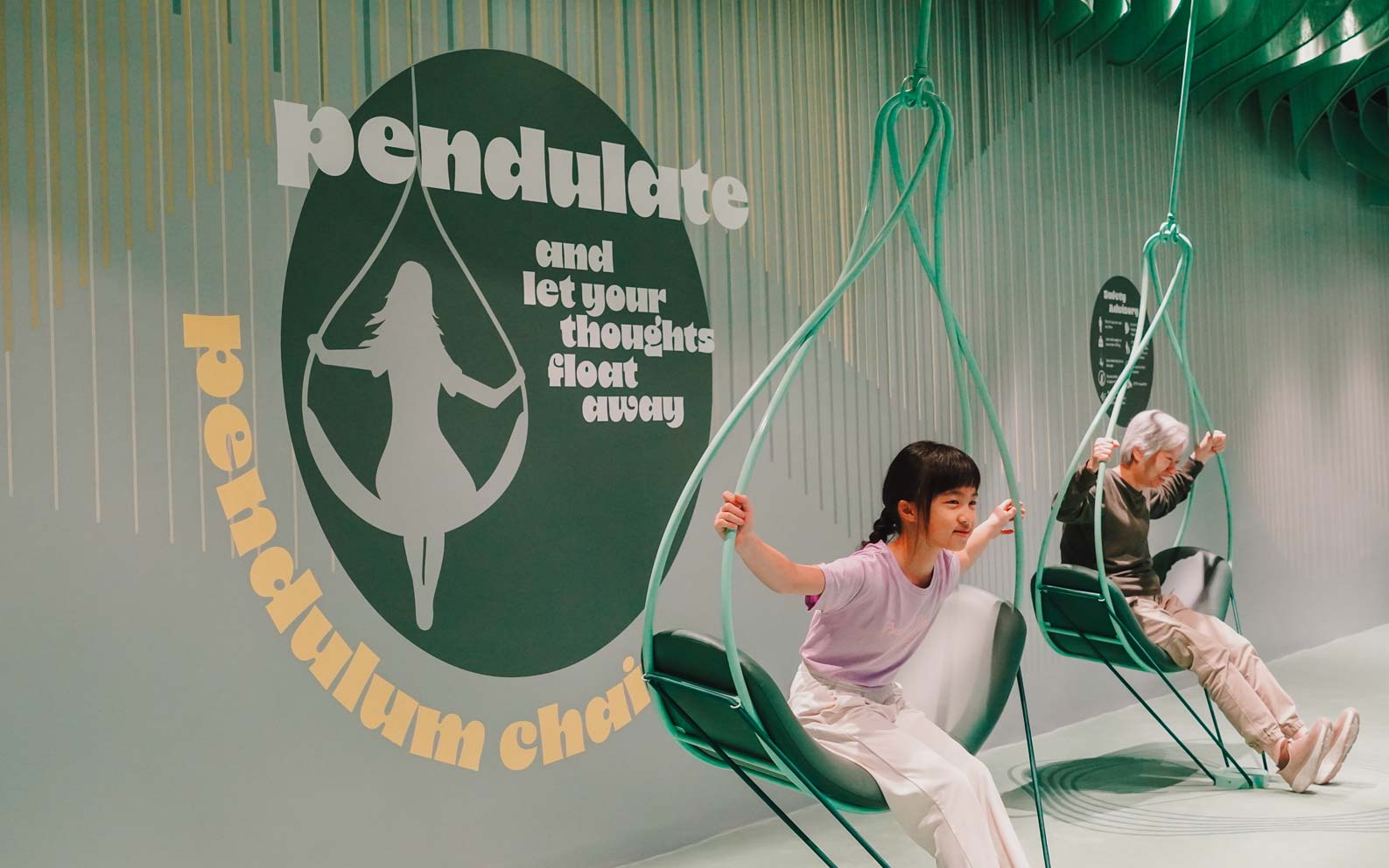
In the Green Zone, travellers can unwind and relax on six pendulum chairs overlooking the soothing ambiance of Dreamscape. The tranquil zone offers a perfect respite for those seeking peace from the bustling airport environment.
The Orange Zone features Spar Pods – elevated soft punching bags hinged by thin ropes – for travellers to release pent-up energy. In addition, the three-dimensional petals structures on the walls can also be jabbed, providing a fun and safe way to destress before their next flight.
For travellers seeking a strength workout, the Pink Zone is the place to be. Four pull down levers, connected to weights ranging from 2kg to 8kg, are linked to a light ball that changes colour when pulled, adding a dynamic visual element to the exercise.
The Yellow Zone features five trampoline pods that are equipped with sensors that play music when travellers step inside. Energetic travellers are welcomed to bounce, dance, and move to the catchy tunes, adding to the lively and joyful atmosphere.
The Blue Zone is ideal for travellers looking for a touch of adventure. The nature inspired, organically shaped cave comes with a rope maze that is designed to spark curiosity and encourage exploration.
Seven per cent of study participants reported their roles being made redundant in 2024
Fourteen per cent of all respondents reported a decline in their salary
Fifty-nine per cent of all respondents intend to move away from their current employment in 2025
Job redundancies have increased while salary progress has slowed for personnel in travel, tourism, hospitality, and lifestyle businesses last year, found a salary and employment trend study conducted by ACI HR Solutions, a recruitment, executive search and professional training firm.
The 2025 ACI Salary & Employment Trends Report, which drew inputs from a sample of 718 travel, tourism, hospitality, and lifestyle personnel across Asia-Pacific and surrounding regions through a survey conducted in December 2024, found a seven per cent job redundancy among respondents in 2024, up from three per cent in 2023.
Results captured in the 2025 ACI Salary & Employment Trends Report, 2024 do not reflect the positivity in travel and tourism recovery
Fourteen per cent of respondents also reported a decline in their salary. Of those who took home a smaller pay packet in 2024, six per cent of respondents had a one to five per cent decrease, and another six per cent of respondents had six to 10 per cent taken off. A majority of 44 per cent of respondents had their salary cut by more than 10 per cent.
On the other hand, 62 per cent of respondents enjoyed a raise in 2024, down from 68 per cent in 2023. The most common wage increment ranged one to five per cent. Eighteen per cent of respondents received a six to 10 per cent hike in their salary, while only six per cent of respondents were given more than 10 per cent.
Some 57 per cent of respondents received a bonus in 2024 – down from 62 per cent seen in 2023. Most of them received a bonus worth up to two months of their monthly wages – 35 per cent received a bonus of less than a month’s salary while 38 per cent received one to two months’ of their salary.
Further analysis conducted by the 2025 ACI Salary & Employment Trends Report noted that job instability is expected to continue into 2025, as 10 per cent of hiring managers said jobs would be eliminated this year (this was six per cent in 2024) while 32 per cent said recruitment in 2025 would only be for replacements. Another 20 per cent were unsure if new hires would be brought into their company in the next 12 months.
While 38 per cent of hiring managers expected new headcounts in 2025 – down from 41 per cent in 2024, they admitted that recruitment would not be easy. Their top concerns included the lack of qualified candidates/shortage of talents; high salary, unrealistic expectations, and budget constraints; hiring quotas; language barriers; and high turnover.
To gauge sticking power among employees, the report queried respondents on their intentions to move. Forty-one per cent of respondents do not intend to change employment from their present employer and/or the industry within the next 12 months. However, slightly more – 47 per cent – have intentions to move within the industry and 12 per cent are looking for opportunities in other industries.
Among respondents with intentions to change their employers in 2025, most desire a higher salary and a different company brand/culture.
Business normalising, impacts 2023 quick hires These findings come amid recovered international travel and tourism business in 2024, when most destinations had exceeded 2019’s international arrival numbers.
Andrew Chan, founder and CEO of ACI HR Solutions, told TTG Asia: “We have virtually recovered to pre-pandemic levels across the industry in 2024 and the tourism wheel is undoubtably spinning again with great velocity. However, from the results captured in this year’s ACI Salary & Employment Trends Report, 2024 may not have delivered the positivity we had expected, and it perhaps leaves us with more questions than answers in the coming year.”
As to why employment conditions in 2024 had not reflected the improving travel and tourism business, Chan said strong gains in 2023 had “started tapering off” in 2024.
“We’re now getting back to some form of normality,” he added.
While the study did not delve into roles that hiring managers had indicated retrenchments for, Chan saw that “new hire demands are higher for sales and operations positions”.
He added: “The uptick in redundancies could also be a spillover from when employers took the opportunity in 2023 to make quick hires to capitalise on the tourism recovery, and now we’re seeing some sort of recalibration.”
He warned that “redundancies are now very much a part of corporate and HR strategies, so each year we are going to see some form of deviation from previous year’s results”.










 What would you say is the AIA Carnival’s biggest achievement across its 10 years of existence?


 Further analysis conducted by the 2025 ACI Salary & Employment Trends Report noted that job instability is expected to continue into 2025, as 10 per cent of hiring managers said jobs would be eliminated this year (this was six per cent in 2024) while 32 per cent said recruitment in 2025 would only be for replacements. Another 20 per cent were unsure if new hires would be brought into their company in the next 12 months.