The ‘City’ he built turned 50 last year – richer, greener and peppered with hotels. At 72, the Singapore tycoon has more indefatigable energy than ever
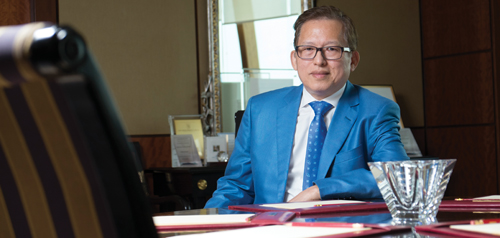
Kwek Leng Beng, Executive chairman, City Developments Limited
You’ve just hired the first CEO for City Developments Limited (CDL), Grant Kelley. What would you like him to do?
He is a private equity man who knows how to invest in real estate, from Japan, China, Australia to the UK and the US. He also has experience with hotels, which will help, as CDL has a big subsidiary hotel group. We have not yet extracted the full potential (of Millennium & Copthorne [M&C]) in terms of earnings, assets and value creation. Private equity people are good in controlling costs and improving the value of a property.
How would you like to see M&C grow and strengthen?
We have been growing. We’ve just acquired the Wyndham (Grand London) Chelsea Harbour (and at press time, the Novotel New York Times Square).
But there aren’t many assets coming into the market. In any case, hotel capital values worldwide, Singapore including, have gone up a lot, but earnings have not caught up. In Singapore, a three-star hotel was recently sold at S$900,000 (US$710,000) per key, which was unheard of before. Grand Park Orchard fetched S$1.4 to S$1.5 million per key, even though the rooms are small. Construction and land costs have gone up.
The New York Palace was sold in 2010 for only US$400,000 per key. Today, anything less than US$2 million (per key) will not buy you a five-star deluxe hotel in New York.
What about emerging markets or buying another chain, like the Copthorne Hotels that you bought?
We are looking at emerging markets, but there’s always a priority. We also looked at buying another chain over a year ago, but there were few opportunities in that chain that we could work upon and the financials didn’t work. Today one also competes with many private equity firms, all flushed with funds. So the whole dynamics have changed. I tried to repeat what I did in the early days when I first started to buy hotels – it’s too late now, unless you’re willing to pay blindly.
Don’t you wish you had bought more?
Of course, but don’t forget, at the time, that kind of money was big, also I didn’t want to put all my eggs in one basket. I had a policy to diversify, into global markets and into different sectors, so if one sector goes bad, it will be balanced by another. Look at SARS, when occupancies dropped to zero in Singapore and East Asia hotels. But in Europe and America, business was strong.
So what to do, if there isn’t a lot to buy?
You continue to have the vision to buy, search. Meanwhile, you add value to your existing hotels. With the right concept and proper renovation, you might be able to increase your rates by 30-50 per cent. That’s as good as buying or building another hotel, where you have a gestation period of two to three years (for hotel construction) in which there is no income. Then, when the cycle is up, you can sell it if you like.
Do you see yourself as a hotelier or a real estate player?
You can say both, and add being a financial man too. Hoteliers might not be real estate people; they are also generally not financial people. They don’t necessarily see things the way I do. I have come across GMs or even more senior management staff who say, ‘We must give good service.’ But what’s the use of giving six-star service and charging four-star rates?
Hoteliers can be dreamers. They are polite and articulate. Even if their hotel occupancy is low, they will give a long speech on how good the occupancy is.
This is why if things don’t work out (with people), I have a policy that we must be brave enough to change them. People try to advise me, ‘Don’t change or else no one would dare to join you.’ When I interview senior people, some of them have asked me, ‘I hear you have a revolving door practice?’ I reply, ‘If you are suffering from cancer, should you not seek treatment?’
You are in the hotel industry, you should know how good they are. In fact though, at M&C, we have had only one CEO who was with us for six months only. (The others served an average of five years, the longest serving being Richard Hartman). In the US today, if you’re no good, you get chucked out pretty quickly.
So it’s not that you’re tough, but they are weak?
Exactly. Business is business. If you are frightened, don’t join me. If you’re a (weakling), I will find out.
It is hard to find a good CEO and it’s getting harder, isn’t it?
Yes, the world is seeing a lot of hotels being built. The greatest problem facing the industry is talent. You have a lot of people who are willing to work, but they are not up to the mark. And the good ones get poached frequently.
International chains earn big money through management/franchise fees. Why is this a small part of your business?
To a large extent, it’s because of a shortage of talent. It is true one’s brand will be enhanced with more management contracts/franchises, so it is something we should do more. But it’s not a priority.
I’m big in management contracts/franchises in the Middle East (including 25 contracts), with 40 more in the pipeline. We have a good partner there who’s aggressive and hands-on. But overall, we prefer not to be too involved (in this area). I use the rule of thumb that, in terms of income, one hotel you own equals 20 management contracts. The fee is based on percentage of turnover and GOP, but do you realise how many people and how much infrastructure you must have? If you have 10 good hotels, why would you want to manage other people’s hotels and earn so little? So, our priority is our own hotels.
So why do the other chains want to be asset light?
They get better returns because they have critical mass. But they don’t appreciate there’s a lot of capital value to be harnessed (from owned hotels). My Orchid Inn (Singapore) used to make less than S$10 million a year. At the right time, I pulled down the aged building, had planning approval to build a condo and sold the units I developed. I announced a profit that would take me 30-40 years to make if it were a management contract.
How much of your success is luck?
Luck plays a part, especially these days, when the world is so uncertain. But some calculated risk and foresight are necessary. My strengths are, I can analyse and I have some foresight. I always go with one fundamental pro and con and not with the whole host of pros and cons that can make me unable to make a good decision in the end. I always believe, if you can solve that one fundamental issue, the rest will in turn be solved.
This is why I have bought hotels within 24 hours of being offered. I made quick decisions because I was confident they were good buys.
While hotel operations contribute nearly half of City’s revenues, at the end of it, the profit contribution is not even 20 per cent.
Hotels don’t make as much as property development. Also if one does not control costs one will not make much money. But we are making strong progress. We now have training programmes and are raising the standards of certain services and giving new amenities. Over time, these costs will be absorbed.
But yes, even my son once commented to me, that with hotels, one faces management issues every day in every department. But in property, there are only three chapters, so to speak: you buy land, get planning approvals then sell. Yet even he feels that the property business is not challenging enough and prefers to be in biotech. In biotech he can make a lot of money if he identifies the right biotech. He said, ’I don’t want to work so hard like you!’
If you ask me, if I were to be reborn would I go into hotels? I would say no. Too much work for too little profit and by the time you make a profit, you need to channel it back to keep up with the trends.
But you have fun with it.
Yes, but up to a certain point. You travel so much that you suffer from jet lag. Everywhere I go, I don’t see the country’s sights, but I try to see the latest trends at places I travel to. I check what are people doing there that is so good? Can we think of something better or modify what they’ve done?
Are you a connoisseur of luxury hotels?
I once asked my late father, ‘Why don’t we position ourselves as a deluxe developer?’ He said, ‘Why be so silly? You should do whatever that can make money – deluxe, middle, lower end – cast your net wider.’
This is the right strategy. Some people focus on luxury only because they want to create a statement for themselves. But the trick is, a three-star makes more money than a four-star, a four-star more than a five-star. Pick your choice. I choose to cast my net wider so I have better profits and spread my risk.
So you’re not keen to build your own luxury brand, even with your South Beach project in Singapore?
What’s the objective? To make money or to create a statement? I don’t need to create a statement. I think I’m already known in the hotel world, maybe better known in the hotel world than in the real estate world. When I bought The Plaza New York, people said, ‘Who’s this Singaporean in New York buying The Plaza?’
Why did you tender for South Beach about five years ago?
Initially, I was not interested. One day, I went to the DTZ office at Shaw Towers along Beach Road, from where I could see the new developments in the city’s financial district. I had unobstructed views. Location and the priceless views were the deciding factors. South Beach is just across the road from the convention centre, Suntec Singapore. That’s why several international chains have knocked on our doors to manage South Beach. But we haven’t made a decision on who will manage South Beach.
Are you inclined to outsource or self-manage?
Sometimes, after calculating management fees, I feel you can be better off managing the hotel yourself. One can’t assume that international management will perform better. They may get you a higher rate (because of the brand), but if the hotel management group has five hotels in Singapore and each day they have 500 rooms to fill, how much is your share of the business?
What is the one thing international management companies have not learnt through all these years?
Some are living on past glory or the perception that their brands can drive a lot of business. It was true perhaps in the early days.
After the (former) Westin (Plaza & Stamford), which had 1,500 rooms, left Singapore, we brought in The St Regis brand for our hotel. How many Westin customers shifted to St Regis? Not many. (Both brands are owned by Starwood Hotels & Resorts.)
Also, even though chains love to talk about consistency, and try their best to achieve it, their products are not always consistent. I can assure you that many a four-star hotel in London is only as good as a three-star here.
What’s your vision for South Beach? And why Philippe Starck?
I want to create a hotel that is not a cookie cutter. Something that is both lifestyle and luxurious, that will make you go ‘waaah’ when you see the lobby and, by the time you reach your room, your mind is no longer so jumpy; you just want to relax.
So we thought of Philippe Starck. His design is more down-to-earth now. Previously, his concepts at times were edgy, like Alice in Wonderland (jokes).
People don’t like cookie-cutter products. When I built my Studio M, the first loft hotel in Singapore, people loved it. Singaporeans do staycations at the hotel. It attracts the hip crowd, who party there over the weekends. The occupancy and rates have been high from day one.
I understand you’re creating another M – M Social.
I’m trying to create another lifestyle category, this time for young people who want to socialise and interact with one another, use technology, want to see and be seen.
Is there any other gap left?
One day I would like to build a two-star hotel, but one that will have a strong talking point.
Growing up, did you tell yourself, ‘I’m going to be the second richest man in Singapore?’
(Laughs) First, I want to make a correction. Nobody actually knows how rich a person is. One can only speculate. Do you think Forbes is accurate? Forbes gives you a rough idea of the wealth of a person in its publications. Most times, they take into account the market capitalisation in the person’s equities portfolio, which may not be the true or full figure.
A lot of Asians are private people. Why should they want to reveal their assets? It’s not like we want to be subjected to probity checks.
Do you like such rankings?
It’s fun to read.
What does ‘rich’ mean to you?
I’ve always said, someone worth $100 million may have a higher standard of living than a person worth $1 billion.
I do not spend money carelessly. I used to enjoy super cars. I like to stay in nice hotels, not necessary six-star but ones that make me feel good, comfortable and, most importantly, happy.
What motivates you now?
It has always been, and still is, about being passionate about what I do. If you’re not, at best you will be a mediocre performer. And what a waste, if you have the knowledge and experience, not to contribute or pass that on to others. I learnt years ago that by working, you keep your mind active. It’s like driving a car – you don’t want to apply the brakes, which make the car falter, you keep going till it’s over.
So retirement is not on the cards?
I don’t think about it. I feel young at heart. I feel I can contribute to the business and society. I’ve seen friends retire at 35 and are bored after two years of going round the world.
When your late father handed the reins to you and your brother, he said: “I hope the young will emulate the older generation in their indefatigable energy for hard work, spirit and tenacity.” What would you say when it’s time to hand over?
That philosophy is correct. But it’s up to the individual – some accede to that philosophy, for others, it matters not.
I would say, at end of the day, you must ask, have I done anything useful to my business? How much more can I contribute to my business? Am I happy to do so?
Don’t you wish to see your legacy continue?
Every father wishes that. But one can only try.

This article was first published in TTG Asia, February 21, 2014 on page 6. To read more, please view our digital edition or click here to subscribe.