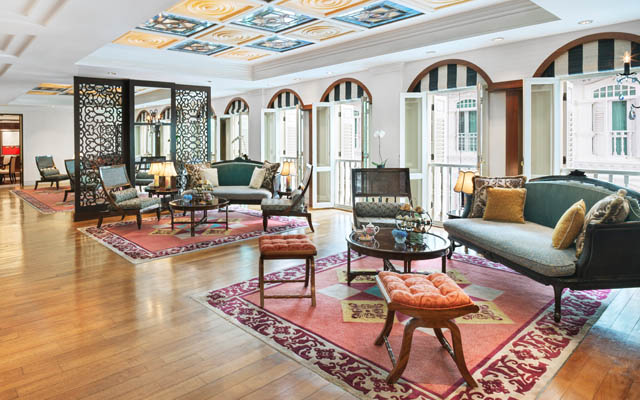
MELIÁ Hotels International will roll out its first Innside by Meliá hotel in Asia when the 258-room Innside Yogyakarta opens in early 2015, expanding the brand’s presence beyond its current European stronghold.
The Indonesian hotel will also mark the biggest property to launch under the Innside by Meliá brand, which is so far only operating in major cities in Spain and Germany, with Denmark and the UK soon to be added into the portfolio.
Comprising a mix of four- and five-star properties with “their own character, unique architecture and avant-garde design”, Innside by Meliá properties are conceived as technology-driven urban hotels, with facilities such as multi-functional events rooms and a lobby bar that is the “centre of energy”.
Apart from six hotels in the pipeline for China – which also includes a Innside by Meliá in Zhengzhou (TTG Asia e-Daily, January 13, 2014) – the Spanish hospitality chain has other properties launching in Indonesia and Vietnam later this year, according to a company spokeswoman.
The 300-room Meliá Surabaya will form part of a large leisure complex that includes a golf course and shopping mall.
The 150-room Meliá Danang, which will include 10 villas and a spa, is located on Non Nuoc beach near Hue and Hoi An.
COME March, Phuket will welcome Baan Teelanka, an inverted attraction that will mark the first of its kind in Thailand.
Baan Teelanka – which means upside-down house in Thai – is founded and managed by Alex Riva and Wah Yodying, a husband-and-wife team that has invested 25 million baht (US$760,000) into constructing the gravity-defying structure.
Located on Phuket’s Chalermprakiat Ror 9 Road between Premium Outlet and Siam Niramit, the 13m-high, three-storey house is fully furnished with staircases, a garage, bedroom, kitchen and bathroom – but with the furniture and household fixtures all hanging downwards from the ceiling.
Adjacent to the topsy-turvy house is the A-Maze-in-Phuket, a 950m2 hedgerow garden maze designed by Adrian Fisher and filled with some 2,200 plants and 12 different gates for the creation of alternate routes.
“This fully furnished upside-down house is fantastic light-hearted entertainment for families and is the perfect attraction for those looking for an alternative to the beach,” said Riva, who is currently taking a sabbatical from his 20-year hospitality career to resettle in Phuket with his family to launch the new attraction.
“In the evenings after opening hours, the house is also available for rental for private parties or corporate groups to organise their own fun-themed events,” he added.
The attraction is open daily from 10.00 to 18.00, with tickets priced at 120-200 baht and 100-150 baht for Baan Teelanka and A-Maze-in-Phuket respectively. The attraction also boasts a café and a souvenir shop on site.
MYANMAR’S airspace will see competition intensify as three domestic airlines commence or expand operations over the next few months.
Brand new carriers Apex Airlines and Mann Yatanarpon Airlines are due to take flight soon, while FMI Air Charter will start more scheduled flights.
A source from Apex told TTGAsia e-Daily that the company’s management is still looking for aircraft and expects to launch operations in April or May out of Nay Pyi Taw International Airport.
On Mann Yatanarpon, Win Swe Tun, deputy director of Myanmar’s Department of Civil Aviation, could not say when the airline would begin services officially but revealed: “Mann Yatanarpon Airlines will operate regular scheduled flights to all major tourist destinations in Myanmar out of Mandalay and Yangon airports.”
However, TTG Asia e-Daily understands the airline intends to take delivery of 70-seat ATR72-600 aircraft by end-January and start flights between late February and early March.
FMI, which currently runs scheduled Yangon-Naypyidaw flights and charter flights, will introduce new scheduled services to other major tourist destinations in April, according to Win Swe Tun.
JET Airways will commence a daily service from Mumbai to Paris’ Charles de Gaulle airport on May 14, pitting it directly against Air France.
The carrier will deploy an Airbus A330-200 for the route, offering 235 economy and 18 premium flatbed seats. It is also the only evening departure from continental Europe to Mumbai.
Gaurang Shetty, vice president commercial of Jet Airways, said that the airline would now be able to offer seamless travel between Europe and India with onward connections to Colombo, Dhaka and Kathmandu.
Sonal Swamy, director of Mumbai-based Syrisa Travel, pointed out that the “convenient departure and arrival times and short-transit connections beyond Paris will ensure that (the flight) will succeed”.
“It will benefit inbound visitors as they can connect to any destination within India after arriving in Mumbai in the morning. It will improve both oubound departures and inbound arrivals at Mumbai and Tier Two and Tier Three cities that use Mumbai as gateway,” she added.
Jet Airways has launched special fares to mark the new route, priced from Rs45,291 (US$729) for economy class and Rs153,315 for premiere class, taxes included. Tickets are available for purchase until February 10.
SILVERNEEDLE Hospitality will add Riva Arun Bangkok to its SilverNeedle Collection of independently owned boutique hotels when the property is completed in 2015.
Riva Arun Bangkok will offer 25 rooms across two buildings built in Sino-Portuguese colonial style, located opposite Wat Arun along Chao Phraya River. It will come with a rooftop bar with 360º views of its surroundings.
Iqbal Jumabhoy, managing director and CEO of SilverNeedle Hospitality, commented: “As the area where international tourist arrivals grew the most in 2012 and 2013, we are optimistic that South-east Asia’s long-term fundamentals remain robust and will pursue opportunities here as well as in the broader Asia-Pacific region.”
The SilverNeedle Collection currently comprises Riva Surya, Bangkok; 137 Pillars House, Chiang Mai; and Kiridara, Luang Prabang.
MANDARIN Oriental Hotel Group (MOHG) has yesterday announced the launch of a luxury resort in Bali come 2016.
The Mandarin Oriental, Bali is located on Bali’s southern Bukit peninsula and is part of the upscale Bukit Pandawa development. Bali’s Ngurah Rai International Airport is 25 minutes from the resort and popular tourist destinations Seminyak and Sanur are 30 minutes away.
Owned and developed by Bali Ragawisata, the resort is designed by acclaimed achitect and interior designer Jean Michel Gathy of Denniston International.
The property offers 97 villas, each with a private pool, as well as 24 guestrooms. F&B options on the resort premises include a signature cliff-top restaurant, a three-meal restaurant and a beach grill and bar.
Multi-purpose function rooms, such as a cliff-top ceremony platform boasting sweeping ocean views and ideal for weddings, are also on offer.
Other amenities include a 1,725m2 spa at Mandarin Oriental with eight treatment rooms, heat and water therapies, a 100m outdoor swimming pool surrounded by lifestyle cabanas, fitness centre, a beach club and a kids’ club.
An 18-hole golf course is also located adjacent to the resort.
SINGAPORE Changi Airport has sealed its status as a major aviation hub in Asia-Pacific with record-breaking passenger traffic and more destinations added to its network in 2013.
The airport yesterday released official figures for 2013 that showed a total of 53.7 million passengers and 343,800 landings and take-offs, registering five per cent and 5.9 per cent growth respectively.
Besides breaking new ground for the number of passengers handled annually, the airport also smashed its monthly and daily records. It handled 5.1 million passengers in December – the first time the figure has surpassed five million since the airport’s opening – and 191,800 passengers and 1,100 flights on December 21.
Changi’s strong performance is fuelled by exponential growth in travel demand within the Asia-Pacific region. Travel to South-east and North-east Asia, which make up almost 70 per cent of the facility’s traffic, rose 8.2 per cent and seven per cent respectively.
Airside view of Singapore Changi Airport — Credit: Changi Airport Group
Indonesia is the biggest market (over 7.4 million passengers or 8.8 per cent growth year-on-year) and Jakarta is again the busiest route for Changi, followed by Kuala Lumpur, Hong Kong and Manila. Bali (Denpasar) attracted 17 per cent year-on-year growth through Changi, making it the fastest growing of Changi’s top 10 routes.
Changi welcomed a host of new links and airports in 2013. Seven new Chinese destinations were added to its network namely Guilin, Jinan, Lijiang, Nanchang, Nanning, Ningbo and Wuxi, while Mandalay (Myanmar), Kalibo (the Philippines) and Addis Ababa (Ethiopia) are also now accessible from Singapore.
As a flood of passengers begins to descend on the region’s shores, there is a greater urgency to address operational challenges. How robust is Asia’s cruise ecosystem? Paige Lee Pei Qi, Mimi Hudoyo, S Puvaneswary, Rosa Ocampo, Prudence Lui and Greg Lowe report
Singapore Cruise Centre
As a destination, Asia is rising in fame among cruise lines. Just in the first three months of this year, the region will welcome 247 cruises, marking a 22 per cent increase, according to the Asia Cruise Association’s (ACA) recent White Paper.
The same study found that some 1.5 million passengers cruised in Asia last year, representing passenger revenue of roughly US$2 billion. This is a result of 21 international cruise lines operating a total of 43 ships, logging 762 cruises (within Asia) and 58 voyages (starting or ending outside of Asia).
ACA general manager, Kevin Leong, said: “With the projected growth in deployment, berth capacity may soon become constrained and the infrastructure is unlikely to keep pace with industry needs.
Bob Guy, managing director of Destination Asia (Singapore & Malaysia), agreed that the growing cruise business could lead to a bottleneck situation in countries like Singapore, which is one of the region’s key hubs for large ships.
“When cruise liners come and put 2,000 passengers at the terminals and out into Singapore, it can be a big problem logistically if not managed well,” he explained.
Recognising this, Singapore Tourism Board’s (STB) deputy director, cruise, Annie Chang, said: “It is essential for Singapore to build up ancillary services to be well-equipped for the business expansion that may come in the following years.”
She pointed out that each player in the ecosystem – comprising cruise lines, terminal operators, cruise suppliers, travel consultants, attractions, airlines, groundhandlers, hoteliers as well as the dining and retail sectors – would have to play a part.
World Express Singapore’s managing director, Darren Tan, added: “We do see that the destination is top priority, especially for the longhaul market. The destination is the product as they will explore the country when the ship calls here.”
In April 2013, STB launched the Passenger Experience Committee (PEC), a platform for cruise-related stakeholders to address service and experience-related issues across the value chain, from disembarkation at the cruise terminals to land tours in Singapore.
According to Chang, one area that the PEC is currently looking into is increasing transport connectivity near the cruise terminals.
To this end, some improvements have been made at Marina Bay Cruise Centre Singapore (MBCCS) since its opening in 2012. For example, it released a mobile phone app that provides cab drivers with a cruise arrival and departure schedule and a push-notification service to alert them when there are a significant number of passengers who need a taxi.
“We have also changed the location of the cab stand and pick-up bays to improve accessibility for both passengers and cab drivers alike,” an MBCCS spokesman added.
Accessibility is also a key concern in other ports across Asia.
Commenting on Thailand, Royal Caribbean Cruises (Asia), Singapore and South-east Asia, managing director, Jennifer Yap, said: “Ports such as Laem Chabang are located too far away from the main city attractions in Bangkok, for instance, and the inadequate road and transport infrastructure at these ports also add to the challenge.”
The heavy traffic in some cities such as Manila is also making shore excursions in an already very tight window longer than necessary.
Pearl Brion, travel specialist at Rajah Travel Corp, said that to beat congestion, authorities are informed even before a ship docks, so that roads can be unclogged.
Over in Hong Kong, the new Kai Tak Cruise Terminal is continuing to grow its transportation options. In addition to regular minibus and Sunday/holiday double-decker bus services, free shuttle bus rides to nearby MTR stations are also offered.
Meanwhile, in Malaysia’s Langkawi port, Panorama Tours Malaysia managing director, Richard Vuilleumier, said: “There is a huge shortage of vehicles, so we have to sub-hire vehicles way in advance as it is not cost effective to drive the vehicles from Kuala Lumpur.
“The solution is for Langkawi to develop its tourism, so it becomes justifiable for tourism players to invest and have their coaches stationed there.”
Finding the necessary manpower on the ground is also a problem.
Laura Vlad, regional director Asia, Intercruises Shoreside & Port Services, said: “There is a shortage of guides when multiple or larger ships are in port or during peak season. It is also difficult to source for guides to work on weekends or public holidays.”
She added that local guides in Asia often lack the required language proficiency to communicate with foreign guests, especially for those of Spanish, Italian and German descent.
Port quality – a crucial factor
Despite the efforts made to ensure passengers get a great experience in the city, the biggest pain point in many destinations is the port itself.
Criticised for its substandard facilities for international cruise ships, travel consultants said that the Port of Manila’s sorry state may be one of the reasons why cruise ships stick around for only a short period in the Philippine capital.
“At the passenger terminal, there are not enough seats and F&B outlets, and sometimes the lights are turned off, lending a gloomy rather than a welcoming feel,” said one interviewee who wanted to remain anonymous.
Likewise, Imam Syafii, director of Costa Cruises’ preferred sales agent in Indonesia, said the missing link in the country’s cruise ecosystem is port infrastructure and services.
“Ports of call need to upgrade their facilities and infrastructure to meet international standards, and their staff needs to be well-trained to handle cruise passengers,” he explained.
The Travel Advisers Hong Kong, director of outbound department, Kitty Lee, added: “The immigration procedure at the new Kai Tak Cruise Terminal is supposed to be simple, but its design has complicated the flow.”
Royal Caribbean Cruises’ Yap, hoped for more CIQ and terminal operator support, especially for ships that carry a higher proportion of international guests.
She said: “More manpower and flexibility are needed for faster and seamless immigration clearance, especially for the port-of-call guests to avoid diminishing the quality of guest experience.”
Dickson Chin, managing director Indo-China, Wallem Ship Agencies, added: “Immigration procedures do form a very integral part of the entire cruise experience, which vary across countries and often causes delay.
“In transit calls, when we have passengers that are already sailing, they already have pre-arrival manifests so a brief clearance will be ideal in order to maximise the shore time.
“We must understand that immigration formalities are often the first and last touch point for passengers, and therefore largely impact how they remember the cruise experience.”
ACA’s Leong went as far as to suggest a single, transit-style visa for Asian cruises.
Swettenham Pier Cruise Terminal in Penang
Change is in the winds
Most hearteningly, steps are being taken to spruce up ports in the region.
In Indonesia, a new terminal is being built at Tanjung Perak Harbour, Surabaya, which will boast modern touches, including cafés and Wi-Fi service, while Benoa’s passenger terminal is seeing improvements made to immigration, security and recreation facilities, among others.
A recent update given by Indonesia’s Directorate General of Sea Transportation showed dredging work in 14 locations in 2013, including Belawan and Benoa in Bali and Tanjung Emas in Semarang, which will continue this year.
Over in the Philippines, the Department of Tourism recently commissioned a cruise study with the aim of further improvement to “infrastructure like cruise terminals, navigation systems, port-of-call jetties, and waste management and land-based facilities”.
Since 2012, Singapore’s MBCCS has increased the number of immigration counters and cut immigration time to an average of 15 minutes. Singapore Cruise Centre (SCC) also underwent a renovation in 2012, emerging with a 26 per cent increase in passenger operations space.
Hardware aside, SCC CEO, Christina Siaw, has also sent staff for Bahasa Indonesia language courses to accommodate the growing number of Indonesian cruise passengers. They have also attended hospitality and tourism courses.
Meanwhile, Malaysia’s six primary ports have set up sub-task force committees to efficiently address port-specific issues. They report to the Malaysia Cruise Council, also formed in 2012 to chart the direction for the country’s cruise industry.
However, ACA’s White Paper notes that there still remains too few transit ports of call in Asia.
It said: “There is still much that can be done in establishing new ports of call especially in South-east Asia where ships are well-served by homeports, but where there are few destinations within range of them on short cruises.
“Just as the markets in Asia are as yet largely unfamiliar with cruising, so too are many of their governments and authorities. Until the benefits of cruising to local and national economies are demonstrated and understood, and until the practicalities of the global cruise business are appreciated and taken on board, support for the industry is likely to be half-hearted.”
New ports, new sights
Puerto Princesa
Some countries in Asia have heeded the call to establish new ports of call or make existing ones more attractive to keep a steady flow of cruises.
Indonesia’s Ministry of Tourism and Creative Economy, for example, is identifying potential ports of call in the country and encouraging stakeholders to come up with new land excursions.
Rizki Handayani, the ministry’s director of MICE and special interest marketing, said: “We are working on developing Madura as a new point for cruise calls to add to Surabaya and Bali in eastern Indonesia, as well as Padang for western Indonesia…The idea is to connect cruise ships from Langkawi with Sabang, Nias and Padang.”
In Madura, Karapan Sapi, or its traditional bull race, will be the highlight. And in Semarang, Central Java, excursions now feature not only the Borobudur Temple but also the old town, handicraft centres and cottage industries.
Last year, Malaysia’s Port Klang Cruise Centre (PKCC) also created excursion programmes to Carey Island. In addition, souvenir stalls selling handicraft items made by the Mah Meri tribe have been set up at PKCC.
Operations manager, Syed Jaffar Mohamed, said: “Cruise visitors want to see Malaysia, not the port. Through this tour, we wish to give them a glimpse of the lifestyle of the indigenous people of Carey Island and surrounding areas.”
In the Philippines, Jenica Ferrer, sales and operations officer of groundhandler Travel People, said her company has also received a lot of support from upcoming destinations such as Puerto Princesa in Palawan, where the local government has come forward to assist with entertainment, security and F&B, among others. “They are very active and welcoming because they want tourists,” she explained.
Meanwhile, the Hong Kong Tourism Board (HKTB) has successfully encouraged the development of many new tours in Hong Kong, which includes visits to walled villages and beaches as well as country park hikes.
Tailor-made programmes have also been created by traditional attractions. Vivian Lee, executive director, sales & marketing, Ocean Park, said: “We understand that most cruise passengers are in town on tight schedules therefore we have designed a range of packages to cater to the interests and preferences of different target segments to maximise their time.” Examples include a family-friendly animal lover programme and another for those who love thrilling rides.
Even as countries are rallying resources at home, greater cooperation among Asian ports of call has also been urged.
HKTB general manager, MICE and cruise, Kenneth Wong said: “As the cruise market in Asia is still at a developing stage, it is crucial that destinations in the region work together to grow Asia’s cruise market as a whole. The HKTB is actively exploring cooperation/partnership with destinations such as Taiwan, Hainan, Japan, Vietnam to develop regional cruise itineraries and products.”
With the upcoming Hong Kong-Zhuhai-Macau bridge and West Kowloon’s high speed train station connecting the SAR to China, Worldwide Cruise Terminals
(Hong Kong) managing director, Jeff Bent, said Kai Tak Cruise Terminal would facilitate shore excursions to Macau and even Kaiping’s Cannon Towers in Guangdong province.
Chattaphat Boonyawon, inbound manager of SEA Tours Thailand, was also optimistic about the development of the Dawei deep sea port in Myanmar, which would be a boost to cruising in the region.
“New (cruise liners) like SeaDream, The World, MSC, TUI, among others, will call on Thai ports during their maiden voyages (to Asia),” he said. “In terms of their regional series, they are repositioning cruises by using Thailand as their way and turnaround ports for their vessels’ calls en route to Australia, Singapore, Hong Kong.”
Summing up the need of the hour, Asia Cruise Association’s recent White Paper said: “Unlike other leisure travel where nearby destinations and nations compete for the tourist dollar, in cruise they must work together for mutual benefit.”
820The number of cruises in Asia last year, including those that start and end outside of Asia, providing the opportunity for 1.5 million passengers to cruise. Passenger revenue is roughly US$2 billion. This was made possible by 21 international cruise lines serving the region, operating 43 ships.
117The number of separate destinations in Asia that received or hosted cruise ships in 2013. Of these, 19 ports handled 589 turnarounds, with six having more than 20 turnarounds each. Some 114 ports saw 1,947 transit calls, of which 11 had over 50 transits and 16 had 20 or more.
22The percentage increase in the number of cruises in Asia in the first three months of the year, rising to 247 cruises. This represents a 14 per cent increase in passenger days. More capacity additions are expected through the year.
1.3 million The 12 primary Asian source markets are estimated to have delivered this number of passengers in 2012, amounting to 0.4 per cent of their combined populations. China is estimated to be the largest at 471,000, with a penetration of 0.04 per cent.
3.8 million Future projections suggest a potential Asian source market of this size by 2020, representing a compound annual growth of 14.3 per cent and a total penetration of 0.1 per cent. China is forecast to reach 1.6 million and Japan at 766,000, becoming the top two. To carry that many passengers would require 15 Voyager of the Seas-size ships deployed year-round on short cruises.
Additional reporting from Mimi Hudoyo, S Puvaneswary, Rosa Ocampo, Prudence Lui and Greg Lowe
This article was first published in TTG Asia, January 17, 2014 on page 14. To read more, please view our digital edition or click here to subscribe.
THE 30-year-old Hilton Petaling Jaya has reported a rise in forward bookings for corporate groups and business events since the completion of its renovations in mid-January.
General manager, Charles Marshall, told TTGmice e-Weekly in an interview that prior to the facelift, which cost in excess of RM50 million (US$15 million), the hotel drew mostly group leisure business.
“Now, the business mix is 40 per cent corporate/ FIT, 45 per cent events and association meetings, and 25 per cent leisure,” said Marshall.
He added that the 546-key property, located in the heart of Petaling Jaya, is benefiting from its strategic location along the Federal Highway to tap residential conferences, multinational training events and corporate business from both Petaling Jaya and the larger Klang Valley.
It also enjoys spillover business from Kuala Lumpur whenever major events and conferences flood the city and rooms are fully booked.
Marshall is optimistic about the business outlook for this year. He said: “We are getting more enquiries from the US, Europe and the Middle East especially from the United Arab Emirates, Qatar, Oman and Saudi Arabia.”
STUDENTS aspiring for a career in the meetings and events industry will get to rub shoulders with industry professionals at IT&CM China in Shanghai this April.
The programme, put together by IMEX Group, Meeting Professionals International (MPI) and MCI, will see 50 students from Shanghai-based universities attending a day of presentations led by leading meetings industry professionals and participating in a guided tour of the show grounds.
IT&CM China’s IMEX-MPI-MCI Future Leaders Forum (FLF) will kick off a year-round series of similar forums slated to take place in destinations such as Turkey, Africa, Slovenia and North America, including MPI’s World Education Congress in Minneapolis and IMEX America in Las Vegas.
IT&CM China, a dedicated trade show for business events specialists, has supported FLF for several years now. Organised by TTG Asia Media, this year’s edition will run from April 15 to 17 at the Shanghai World Expo Exhibition & Convention Center.
FLF in Shanghai will also host the semi-finals of the University Challenge, where the winner will be sponsored to attend the finals at IMEX Frankfurt in May.
Some 6,000 students have taken part in FLF since its launch in 2003, and an overwhelming 90 per cent of them have stated that they are “likely to enter the industry as a result of attending (the event)”.