TTG Asia
Asia/Singapore Sunday, 21st December 2025
Page 2260

AirAsia to up capacity on China routes

0

AIRASIA is aiming to double its revenue from Chinese routes within the next two to three years by increasing frequencies on existing services between Malaysia and China.

Aireen Omar, CEO of Malaysian operations, AirAsia, said at a press conference in Tianjin last week that China contributed more than 10 per cent of revenue for the Malaysia-based LCC.

“China is also an important market for the whole AirAsia group. All routes connecting with China are very profitable. We hope to strengthen the market further by improving connectivity into China from more destinations,” she commented.

Aireen added: “Currently, AirAsia is the biggest foreign airline flying into China.”

She declined to reveal which routes will have their frequencies increased.

AirAsia flies from Malaysia to eight points in China and Hong Kong: Guangzhou, Guilin, Shenzhen, Kunming, Nanning, Hangzhou, Macau and Hong Kong.  Flights from Chiang Mai in Thailand to Hangzhou were inaugurated last Friday.

The group’s Malaysian operations will take delivery of three new Airbus A320 aircraft this year to boost fleet size to 75.

Aireen said the primary focus of the airline’s network expansion plans for 2014 will be to introduce new international routes, but details were not disclosed.

The LCC’s latest route will commence on April 18 between Kuala Lumpur and Kalibo, running four times weekly.

Tokyo announces mega tourism complex in Toyosu

0

THE Tokyo metropolitan government last week showcased plans for a new shopping and entertainment complex in the Toyosu district of Koto Ward, which will also be the new home of the iconic Tsukiji fish market.

Expected to open in March 2016, the 1.7 hectare Senkyaku Banrai complex will consist of four buildings, according to Japanese newspaper The Asahi Shimbun.

The buildings will house the Toyosu outer market featuring 120 stores from Tsukiji fish market and 20 new stores, a food court for 1,000 customers, cooking schools, a multilingual tourist information centre, one of Japan’s largest hot-bath facilities, food-related stores, and a market dedicated to traditional Japanese handicrafts such as pottery.

The designated site is within walking distance of venues for the Tokyo Olympics and directly linked to Shijo-mae Station on the New Transit Yurikamome, reported The Asahi Shimbun.

Tokyo’s government said it expects Senkyaku Banrai to attract some 4.2 million visitors, both local and foreign.

Taipei’s Taoyuan gets nod for aviation hub plans

0

THE Taiwanese government has given the green light to transform Taoyuan International Airport into a regional aviation centre as the facility struggles to cope with increased passenger traffic in recent years.

International news agency AFP reported that the new ‘aerotropolis’ will span almost 7,000 hectares, and feature a free trade zone, a third terminal at the airport and an industrial park for goods distribution and aviation-related industries.

The head of Taoyuan county government, Wu Chih-yang, was quoted by the agency as estimating that up to NT$500 billion (US$16.5 billion) will go into the development, creating some 260,000 jobs.

Plans to turn Taoyuan airport into a regional hub were first raised in the 1990s by the Kuomintang party but progress halted after the party lost power, returning to the table only with the Kuomintang’s rise in recent times.

Taipei’s main airport now faces difficulties in managing increased passenger traffic as tourist numbers from China surge, with 2.9 million Chinese making their way to Taiwan last year, a 10 per cent increase from the previous year.

AFP stated that a third runway for the airport has been scheduled to open in 2020, 10 years ahead of the original date planned.

Passenger capacity is expected to reach 60 million annually by 2030, said the same report.

Suntec Singapore nabs 3-year deal with JEC Composites

0

SUNTEC Singapore Convention & Exhibition Centre (Suntec Singapore) has announced it will be the “venue of choice” for JEC Group’s major global CONFEX events for the next three years.

Convened by the world’s largest organisation dedicated to the promotion of the composites industry JEC Group, JEC Asia Composites Show & Conferences is one of its CONFEX events that provides a platform for composites designers, manufacturers and suppliers to showcase their technologies and will take place in Singapore between November 17 and 19, 2014.

In 2014, JEC Asia is targeting 5,000 delegates and visitors, and 300 exhibiting companies from 50 countries.

According to Arun Madhok, CEO of Suntec Singapore, the convention centre’s ability to offer flexible customisable space attracted the JEC group most.

“The extreme flexibility of Suntec Singapore’s space allows us to easily accommodate multiple room configurations…we are able to switch room configurations in a very short time and resize meeting rooms and conference halls from one day to the next,” he said.

“Whether an event grows 10 per cent, 50 per cent or 100 per cent from year to year, Suntec Singapore’s flexible space will fit the need without wasting any resources,” Madhok added.

According to the press statement from Suntec Singapore, the growing interest in Asia is driven by the region’s key strategic position for the composites industry, having overtaken the Americas and Europe in terms of production.

Asia represents 41 per cent in production volume compared to 32 per cent in the Americas and 20 per cent in Europe and is expected to reach 50 per cent by 2015.

The making of halal travel experts

0

21feb-halal-travel1b

It’s a market waiting to be served. Many are bothering to, seeing how halal travel demand is growing and how real value add is required.

Kuoni Group Travel Experts (GTE) now moves as many as 150 Muslim-only tour groups a year from key Asian markets to European destinations and, increasingly, destinations in the Middle East and the US. These are small families, government groups or large MICE movements with up to 1,000 travellers. Kuoni GTE’s head of MICE Sales Asia, Reto Kaufmann, estimates that annual growth could be as high as 30 per cent, with the MICE market increasing fastest.

Last year, the company saw double-digit increases in room nights booked by group travellers from Indonesia and India, while those from Bangladesh quadrupled. China, Malaysia, the Philippines and Thailand also offer significant numbers of potential Muslim travellers. China, with a Muslim population of 23 million, recorded a six per cent rise in room nights booked with Kuoni GTE last year.

According to a Pew Research Centre forum, 72 countries today have a million or more Muslim inhabitants and 60 per cent of them live in Asia-Pacific. Catering to Muslim travellers beyond haj and umrah pilgrims seems a no-brainer, with rising disposable income and a younger demographic among them. But the fact that it’s still a novelty shows how fraught it is with challenges.

Agencies that have already dipped their toes in the water know that pork-free is not necessarily halal. Try explaining that to a restaurant tucked in the alps of, say, Switzerland. Finding halal restaurants and Muslim-friendly facilities remain the fundamental challenge – even in countries such as India, South Korea, Japan, Taiwan, Hong Kong and China, which have recognised the importance of Muslim travellers, “only parts of the programme comply with Islamic rules”, said Dannie Soesilo, commissioner of an Indonesian agency, Sakinah Nurhidayah.

Not all countries have halal certification bodies and in fact rely on travel consultants to develop halal products, added Garuda Indonesia Holidays’ COO, Widjaya Hadinukerto. Accreditation is therefore becoming important, Widjaya said.

But being halal, like eating organic, can be expensive, and agency heads like Adam Kamal, general manager of Rakyat Travel Malaysia, expressed angst over operators who keep costs down by taking clients to pork-free restaurants whereas his agency uses only halal-certified ones. “Meals at these restaurants are more expensive and may be out of the popular tourist spots. Thus there is additional transportation cost incurred,” Adam said.

For agencies handling MICE groups, finding halal restaurants that can cater to big groups is a struggle. Cooper Huang, CEO, Harmony Tours & Travel, Malaysia, sometimes works with hotel ballrooms but outsources the cooking to chefs from halal restaurants. For FITs, he provides his clients with maps where they can find halal restaurants.

21feb_halal-tavel2
A halal partnership. Left, Bolduc aims to create a TripAdvisor-like halal travel portal. Right, Kaufmann aims to educate European travel trade about Muslim travel market and needs.

Wide open space
The field to dig the halal travel goldmine is therefore wide open. Last December Kuoni GTE tied up with Crescentrating, a Singapore-based company barely five years old, whose primary business is to help the travel industry cater to Muslims through consulting, workshops and market research. It also rates hotels’ halal-friendliness and is now moving to accredit more than 100 travel agencies over the next 12 months. Most of these agencies will be from South-east Asia, the initial target market for the first eight curated Muslim tour packages which the partnership is launching this month. The tours cover five European cities – Paris, London, Rome,  Berlin and Geneva – and are aimed at Muslim MICE and family groups from Asia and Europe.

“Our rating enables travellers to understand clearly to what degree their needs will be met with respect to availability of halal food, prayer facilities, service during Ramadan and level of non-halal activities and amenities in the hotel (for example, alcohol served in the hotel, separate pool and spa facilities, etc),” said COO, Dany Bolduc.

Asked what criteria it uses to accredit travel agencies, Bolduc said: “Three main criteria: They are an accredited agency with the local authority, preferably with IATA membership; have staff who have participated in our training workshop; and sell Muslim travellers only packages that comply with Crescentrating criteria.”

Although Crescentrating has its own portal with a booking engine, halaltrip.com, Bolduc said this until now serves only individual and small group travel. Over 50 per cent of Muslims travel in family and/or multi-generational groups, which is why it needs Kuoni.

“Offering tour packages requires expertise in the logistics of transporting and managing large groups of people; a channel of DMCs who are experts in local sights and attractions, and have deep relationships with hotels and restaurants that can offer great quality at an affordable price. Kuoni is a world leader in tour packages,” Bolduc explained.

Kuoni in turn needs Crescentrating’s expertise on and commitment to halal travel to further bolster its credibility and value-add among Muslim clients. Added Kaufmann: “Part of it is helping to educate Europe’s travel trade about halal food expectations, family-friendly environments, making allowances for religious practices and gender-related nuances, and that an increasing demand exists.

“We are sourcing those hotels and restaurants that can meet not only the needs of large groups of people, but also are willing to go the extra mile and offer added value. European suppliers know that if Kuoni is investing in Muslim-specific tours, we’ve done our homework and there’s a definite market here.”

Going the extra mile
Kuoni itself goes the extra mile by ensuring, say, itineraries allow for the regular prayer times daily. It arranges joint prayer sessions or exchanges that can enhance the destination experience with the local communities.

Asked what he’d wish destinations, airports and other tourism providers would do for halal travel, Bolduc said: “The availability of halal food is critical. Airports need to have halal-certified concessions. Restaurants and food suppliers in destinations would also be well-advised to offer more halal food choices in their establishments.

“Prayer facilities are also important while travelling. Governments have a role to play by raising the awareness of this untapped market to the tourism service sector and encouraging local business to cater to the unique requirements of Muslim travellers.”

In its rankings, Malaysia has consistently ranked as the most Muslim-friendly travel destination under the OIC (Organisation of Islamic Co-operation) category. Kuala Lumpur International Airport was also ranked as the top airport in 2013. For non-OIC countries, Singapore and Thailand’s Suvarnabhumi International Airport were ranked as the top destination and airport respectively, in 2013.

“This year’s ranking of destinations should be very interesting as a number of countries are making significant inroads in developing infrastructure and services to attract Muslim travellers,” said Bolduc.

Japan, for instance, is seeking to create more user-friendly airports for Muslims, with prayer rooms, ablution facilities, halal food, etc, in the lead up to the 2020 Summer Olympics.

Meanwhile, a US$170 million resort built on Islamic principles will open in the Maldives in October. A joint venture between Maldives’ ADK Group and Turkey’s Capris Gold Group, it will offer Muslim-friendly services such as a separate beach for ladies only, certified halal buffet in all restaurants, family-friendly facilities.

Needless to say, no alcohol or pork is sold in this resort.

“We have our own brochures with halal-certified restaurants. I think Malaysian consumers will trust us more than they trust Kuoni.”
Adam Kamal, GM, Rakyat Travel Malaysia

We built the City

0

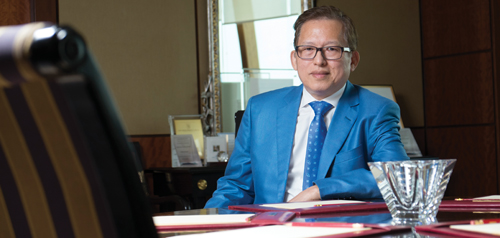
The ‘City’ he built turned 50 last year – richer, greener and peppered with hotels. At 72, the Singapore tycoon has more indefatigable energy than ever
21feb_kwek-leng-beng-dscf8850_72dpi
Kwek Leng Beng, Executive chairman, City Developments Limited

You’ve just hired the first CEO for City Developments Limited (CDL), Grant Kelley. What would you like him to do?
He is a private equity man who knows how to invest in real estate, from Japan, China, Australia to the UK and the US. He also has experience with hotels, which will help, as CDL has a big subsidiary hotel group. We have not yet extracted the full potential (of Millennium & Copthorne [M&C]) in terms of earnings, assets and value creation. Private equity people are good in controlling costs and improving the value of a property.

How would you like to see M&C grow and strengthen?
We have been growing. We’ve just acquired the Wyndham (Grand London) Chelsea Harbour (and at press time, the Novotel New York Times Square).

But there aren’t many assets coming into the market. In any case, hotel capital values worldwide, Singapore including, have gone up a lot, but earnings have not caught up. In Singapore, a three-star hotel was recently sold at S$900,000 (US$710,000) per key, which was unheard of before. Grand Park Orchard fetched S$1.4 to S$1.5 million per key, even though the rooms are small. Construction and land costs have gone up.

The New York Palace was sold in 2010 for only US$400,000 per key. Today, anything less than US$2 million (per key) will not buy you a five-star deluxe hotel in New York.

What about emerging markets or buying another chain, like the Copthorne Hotels that you bought?
We are looking at emerging markets, but there’s always a priority. We also looked at buying another chain over a year ago, but there were few opportunities in that chain that we could work upon and the financials didn’t work. Today one also competes with many private equity firms, all flushed with funds. So the whole dynamics have changed. I tried to repeat what I did in the early days when I first started to buy hotels – it’s too late now, unless you’re willing to pay blindly.

Don’t you wish you had bought more?
Of course, but don’t forget, at the time, that kind of money was big, also I didn’t want to put all my eggs in one basket. I had a policy to diversify, into global markets and into different sectors, so if one sector goes bad, it will be balanced by another. Look at SARS, when occupancies dropped to zero in Singapore and East Asia hotels. But in Europe and America, business was strong.

So what to do, if there isn’t a lot to buy?
You continue to have the vision to buy, search. Meanwhile, you add value to your existing hotels. With the right concept and proper renovation, you might be able to increase your rates by 30-50 per cent. That’s as good as buying or building another hotel, where you have a gestation period of two to three years (for hotel construction) in which there is no income. Then, when the cycle is up, you can sell it if you like.

Do you see yourself as a hotelier or a real estate player?
You can say both, and add being a financial man too. Hoteliers might not be real estate people; they are also generally not financial people. They don’t necessarily see things the way I do. I have come across GMs or even more senior management staff who say, ‘We must give good service.’ But what’s the use of giving six-star service and charging four-star rates?

Hoteliers can be dreamers. They are polite and articulate. Even if their hotel occupancy is low, they will give a long speech on how good the occupancy is.

This is why if things don’t work out (with people), I have a policy that we must be brave enough to change them. People try to advise me, ‘Don’t change or else no one would dare to join you.’ When I interview senior people, some of them have asked me, ‘I hear you have a revolving door practice?’ I reply, ‘If you are suffering from cancer, should you not seek treatment?’

You are in the hotel industry, you should know how good they are. In fact though, at M&C, we have had only one CEO who was with us for six months only. (The others served an average of five years, the longest serving being Richard Hartman). In the US today, if you’re no good, you get chucked out pretty quickly.

So it’s not that you’re tough, but they are weak?
Exactly. Business is business. If you are frightened, don’t join me. If you’re a (weakling), I will find out.

It is hard to find a good CEO and it’s getting harder, isn’t it?
Yes, the world is seeing a lot of hotels being built. The greatest problem facing the industry is talent. You have a lot of people who are willing to work, but they are not up to the mark. And the good ones get poached frequently.

International chains earn big money through management/franchise fees. Why is this a small part of your business?
To a large extent, it’s because of a shortage of talent. It is true one’s brand will be enhanced with more management contracts/franchises, so it is something we should do more. But it’s not a priority.

I’m big in management contracts/franchises in the Middle East (including 25 contracts), with 40 more in the pipeline. We have a good partner there who’s aggressive and hands-on. But overall, we prefer not to be too involved (in this area). I use the rule of thumb that, in terms of income, one hotel you own equals 20 management contracts. The fee is based on percentage of turnover and GOP, but do you realise how many people and how much infrastructure you must have? If you have 10 good hotels, why would you want to manage other people’s hotels and earn so little? So, our priority is our own hotels.

So why do the other chains want to be asset light?
They get better returns because they have critical mass. But they don’t appreciate there’s a lot of capital value to be harnessed (from owned hotels). My Orchid Inn (Singapore) used to make less than S$10 million a year. At the right time, I pulled down the aged building, had planning approval to build a condo and sold the units I developed. I announced a profit that would take me 30-40 years to make if it were a management contract.

How much of your success is luck?
Luck plays a part, especially these days, when the world is so uncertain. But some calculated risk and foresight are necessary. My strengths are, I can analyse and I have some foresight. I always go with one fundamental pro and con and not with the whole host of pros and cons that can make me unable to make a good decision in the end. I always believe, if you can solve that one fundamental issue, the rest will in turn be solved.

This is why I have bought hotels within 24 hours of being offered. I made quick decisions because I was confident they were good buys.

While hotel operations contribute nearly half of City’s revenues, at the end of it, the profit contribution is not even 20 per cent.
Hotels don’t make as much as property development. Also if one does not control costs one will not make much money. But we are making strong progress. We now have training programmes and are raising the standards of certain services and giving new amenities. Over time, these costs will be absorbed.

But yes, even my son once commented to me, that with hotels, one faces management issues every day in every department. But in property, there are only three chapters, so to speak: you buy land, get planning approvals then sell. Yet even he feels that the property business is not challenging enough and prefers to be in biotech. In biotech he can make a lot of money if he identifies the right biotech. He said, ’I don’t want to work so hard like you!’

If you ask me, if I were to be reborn would I go into hotels? I would say no. Too much work for too little profit and by the time you make a profit, you need to channel it back to keep up with the trends.

But you have fun with it.
Yes, but up to a certain point. You travel so much that you suffer from jet lag. Everywhere I go, I don’t see the country’s sights, but I try to see the latest trends at places I travel to. I check what are people doing there that is so good? Can we think of something better or modify what they’ve done?

Are you a connoisseur of luxury hotels?
I once asked my late father, ‘Why don’t we position ourselves as a deluxe developer?’ He said, ‘Why be so silly? You should do whatever that can make money – deluxe, middle, lower end – cast your net wider.’

This is the right strategy. Some people focus on luxury only because they want to create a statement for themselves. But the trick is, a three-star makes more money than a four-star, a four-star more than a five-star. Pick your choice. I choose to cast my net wider so I have better profits and spread my risk.

So you’re not keen to build your own luxury brand, even with your South Beach project in Singapore?
What’s the objective? To make money or to create a statement? I don’t need to create a statement. I think I’m already known in the hotel world, maybe better known in the hotel world than in the real estate world. When I bought The Plaza New York, people said, ‘Who’s this Singaporean in New York buying The Plaza?’

Why did you tender for South Beach about five years ago?
Initially, I was not interested. One day, I went to the DTZ office at Shaw Towers along Beach Road, from where I could see the new developments in the city’s financial district. I had unobstructed views. Location and the priceless views were the deciding factors. South Beach is just across the road from the convention centre, Suntec Singapore. That’s why several international chains have knocked on our doors to manage South Beach. But we haven’t made a decision on who will manage South Beach.

Are you inclined to outsource or self-manage?
Sometimes, after calculating management fees, I feel you can be better off managing the hotel yourself. One can’t assume that international management will perform better. They may get you a higher rate (because of the brand), but if the hotel management group has five hotels in Singapore and each day they have 500 rooms to fill, how much is your share of the business?

What is the one thing international management companies have not learnt through all these years?
Some are living on past glory or the perception that their brands can drive a lot of business. It was true perhaps in the early days.

After the (former) Westin (Plaza & Stamford), which had 1,500 rooms, left Singapore, we brought in The St Regis brand for our hotel. How many Westin customers shifted to St Regis? Not many. (Both brands are owned by Starwood Hotels & Resorts.)

Also, even though chains love to talk about consistency, and try their best to achieve it, their products are not always consistent. I can assure you that many a four-star hotel in London is only as good as a three-star here.

What’s your vision for South Beach? And why Philippe Starck?
I want to create a hotel that is not a cookie cutter. Something that is both lifestyle and luxurious, that will make you go ‘waaah’ when you see the lobby and, by the time you reach your room, your mind is no longer so jumpy; you just want to relax.

So we thought of Philippe Starck. His design is more down-to-earth now. Previously, his concepts at times were edgy, like Alice in Wonderland (jokes).

People don’t like cookie-cutter products. When I built my Studio M, the first loft hotel in Singapore, people loved it. Singaporeans do staycations at the hotel. It attracts the hip crowd, who party there over the weekends. The occupancy and rates have been high from day one.

I understand you’re creating another M – M Social.
I’m trying to create another lifestyle category, this time for young people who want to socialise and interact with one another, use technology, want to see and be seen.

Is there any other gap left?
One day I would like to build a two-star hotel, but one that will have a strong talking point.

Growing up, did you tell yourself, ‘I’m going to be the second richest man in Singapore?’
(Laughs) First, I want to make a correction. Nobody actually knows how rich a person is. One can only speculate. Do you think Forbes is accurate? Forbes gives you a rough idea of the wealth of a person in its publications. Most times, they take into account the market capitalisation in the person’s equities portfolio, which may not be the true or full figure.

A lot of Asians are private people. Why should they want to reveal their assets? It’s not like we want to be subjected to probity checks.

Do you like such rankings?
It’s fun to read.

What does ‘rich’ mean to you?
I’ve always said, someone worth $100 million may have a higher standard of living than a person worth $1 billion.

I do not spend money carelessly. I used to enjoy super cars. I like to stay in nice hotels, not necessary six-star but ones that make me feel good, comfortable and, most importantly, happy.

What motivates you now?
It has always been, and still is, about being passionate about what I do. If you’re not, at best you will be a mediocre performer. And what a waste, if you have the knowledge and experience, not to contribute or pass that on to others. I learnt years ago that by working, you keep your mind active. It’s like driving a car – you don’t want to apply the brakes, which make the car falter, you keep going till it’s over.

So retirement is not on the cards?
I don’t think about it. I feel young at heart. I feel I can contribute to the business and society. I’ve seen friends retire at 35 and are bored after two years of going round the world.

When your late father handed the reins to you and your brother, he said: “I hope the young will emulate the older generation in their indefatigable energy for hard work, spirit and tenacity.” What would you say when it’s time to hand over?
That philosophy is correct. But it’s up to the individual – some accede to that philosophy, for others, it matters not.

I would say, at end of the day, you must ask, have I done anything useful to my business? How much more can I contribute to my business? Am I happy to do so?

Don’t you wish to see your legacy continue?
Every father wishes that. But one can only try.

21feb-view2

This article was first published in TTG Asia, February 21, 2014 on page 6. To read more, please view our digital edition or click here to subscribe.

Room rates slide in Asia: HRG

0

ROOM rates in Asia registered a year-on-year decrease in Asia although “supercities” such as Singapore and Shanghai exhibited gains in average room rates (ARR) in the face of negative foreign exchange rate growth.

Hong Kong still tops the charts in Asia with the priciest rooms at 193.20 pounds (US$322), a 0.6 per cent year-on-year increase, according to the latest survey from Hogg Robinson Group (HRG).

Likewise, Singapore bucked the overall trend of declining room rates in Asia with a 2.5 per cent increase in ARR to 175.10 pounds.Shanghai and Beijing posted a 0.8 per cent and 8.2 per cent growth to 130.90 pounds and 141.34 pounds respectively, while Seoul saw a 9.0 per cent rise in ARR to 170 pounds.

On the other hand, Tokyo, New Delhi, Mumbai, Bengaluru and Hyderabad were all found to have decreases in ARR in line with regional performance.

Margaret Bowler, director global hotel relations, HRG, commented: “Some of the fastest growing economic regions in the world are in this group and we expect to see some stopping and starting in forthcoming years as they reach maturity ­– currently, the stop-start nature of supply and demand, with one catching up with the other, means it will take a little time for these destinations to even out.”

The HRG study found that supercities – destinations popular both for leisure and business travel – such as Singapore, Barcelona or Beijing are now leading the rise and fall in room rates rather than external trends as was previously the case.

Said Bowler: “Despite the declines across given regions, we see clear evidence of the ‘supercities’ forging their own path, contradicting their national trend. Nairobi, Beijing and others each have their own story to tell which differs from other destinations in those regions.”

Germany upbeat about growth from India

0

GERMANY welcomed more Indian arrivals in 2013 despite the severe devaluation of the Indian rupee and economic downturn, with arrivals growing five per cent year-on-year to 628,544.

Speaking at the German National Tourist Board’s (GNTB) India Pool roadshow last week, Romit Theophilus, director-marketing & sales, German National Tourist Office in India, said: “We are optimistic for 2014, and expect the growth rate to be back in double digits (since 2011) and to have 1.5 million Indian visitor overnights by 2020.”

To do that, GNTB will promote Germany’s UNESCO World Heritage sites and the Berlin Wall, as 2014 marks the 25th anniversary of the Fall of the Wall, said Theophilus.

Wolfgang Gärtner, head of international marketing, Tourism Marketing Company of Saxony, said his company had customised three itineraries for the Indian market. “We have the only Dresden-based Indian tour guide who’s certified. The automobile-making tradition of our region is an added bonus for Indian car aficionados.”

Sanjay Maniar, managing director, Travelaid, said: “Germany is usually a two- to three-night destination for Indians but interest is rising with GNTB’s promotions. Indians are looking beyond Black Forest and Oktoberfest, and Berlin is very high on the must-do list.”

ExecuJet fires up presence in Asia

0

EXECUJET Aviation Group is expanding its footprint in Asia to meet the growing appetite for travel on business jets in the region.

Zurich-headquartered ExecutJet currently has bases in Indonesia, China, Malaysia, Australia and New Zealand, offering fixed-based operations, aircraft maintenance and charter operations.

It made its maiden showing at the Singapore Airshow last week, where it announced that it will open a Singapore office.

Graeme Duckworth, managing director of ExecuJet Asia, said: “The Chinese are still looking for natural resources and doing business around the world. In Malaysia, we are seeing demand for travel to Russia, South America and Africa.

“ExecuJet currently manages aircraft that are based in Singapore and Malaysia, but in order to grow the business we are intending to invest in resources on the ground by establishing a Singapore office and hiring an aircraft management director.”

ExecuJet Australasia is also boosting the company’s charter fleet of eight aircraft with the addition of its first Gulfstream G650 to be based in Wellington. The G650 can fly non-stop from Auckland to cities including Los Angeles, Beijing and Hong Kong.

The rest of ExecuJet’s fleet are based in Sydney, Melbourne, Perth, Wellington and Kuala Lumpur, and charters cost about US$9,000 an hour for a business jet that seats between eight and 19 passengers.

Meanwhile, ExecuJet Indonesia is preparing in the next two months to move from the temporary general aviation terminal at Bali airport to a new facility, which is designed to handle all general aviation and business aircraft up to narrow-body aircraft, and provide VIP lounge access, ground handling services and aircraft management.

Hilton says no to shark fin in Asia-Pacific

0

HILTON Worldwide will no longer serve shark fin or take orders for shark fin dishes at all 96 of its Asia-Pacific properties from April 1.

The company announced today that it was on track to ban shark fin in all its restaurants and F&B facilties around the world.

“We made a decisive commitment to influence consumer demand and ensure operational compliance across our portfolio of hotels by taking a measured country-by-country approach,” said Martin Rinck, president, Asia-Pacific, Hilton Worldwide.

“In placing a global ban on shark fin, we take action in suport of environmental conservation efforts worldwide, and progress our efforts in responsible business operations.”

Hilton took shark fin off the menus at its properties within China and South-east Asia in December 2012, serving it only on request. It subsequently rolled out a complete ban in South-east Asia in September last year, in Greater China on February 1 this year and will completely halt the serving of shark fin from April 1, when the ban takes effect in Japan.

Elaine Tan, CEO of World Wide Fund for Nature-Singapore, lauded the move, saying: “The demand for shark fin in Asia-Pacific has been identified as a major cause of decline in global shark populations. Hilton Worldwide’s ban on shark fin will go a long way in this region towards protecting valuable shark species, which are in turn crucial for maintaining the health of our marine ecosystems.”

Several Asia-Pacific airlines including Korean Air and Asiana Airlines last year stopped the transport of shark products in order to support shark conservation efforts.