TTG Asia
Asia/Singapore Monday, 27th April 2026
Page 2196

Air ancillaries take off

0

With more legacy airlines unbundling their products and LCCs distributing through B2B, booking of ancillaries through the GDS has become more seamless


12-september-gds1

12-september-abacus
Ho Hoong Mau Vice president, airline distribution

How different are ancillaries booked on LCCs vs full-service carriers (FSCs)?
Today, most FSCs are just selling baggage and pre-reserved seats, while LCCs offer the full suite like meals, comfort kits, in-flight entertainment and early boarding. The main difference is fulfilment. For FSCs, the issuance of EMD-A is needed by the agencies for fulfilment. EMD-A is clearly not needed for the LCCs.

Why have airlines been slow in making ancillaries available to agencies?
For FSCs, unbundling to itemise ancillaries and charge for them separately is retrospective, and so, much more costly and involved. In many respects, their response has therefore been pretty fast.

The defence from some quarters is that Asians like all-in packages and that ancillary strategy and full-service brand strategy don’t mix: in a recent poll we conducted with Asia-Pacific carriers, almost eight in 10 still experience resistance

from travellers in paying for services that used to be included in the fare. Asian carriers are also hesitant as they don’t see a net revenue gain on ancillaries yet, once the operational adjustments have been costed in.

But ancillaries are now gaining momentum, given the strong competition from LCCs with their more flexible fare structures; ancillary-friendly industry standards being developed by ATPCO and IATA; GDSs’ ability to support the ancillary-friendly industry standards via evolving technology as well as sale of ancillaries via XML connectivity; and ease of fulfilment of ancillary sales via EMDs.

Around half the LCCs based in Asia-Pacific are now integrated with Abacus to access the B2B channel for ancillaries.

Why have agencies been slow in booking ancillaries through the GDS?
They have not been slow. They are responding to customer demand for ancillaries and are providing them as a value-add to their offering, within the ancillary provision of the GDS. They are selling these ancillaries without any incentive or commission from the carriers.

Where we need to move faster, however, is in integrating the ancillaries into the more complex workflows, as with the managed travellers gaining pre-ticket approval and then adding ancillaries post-ticketing. We are working on it.

The alternative for some full-service airlines – the introduction of premium economy class, has gained immediate traction. Currently, up to seven per cent of Abacus bookings are premium economy.

How are you encouraging bookings?
With Abacus Air Extras, ancillary options are visible to agencies during the shopping and pricing workflow. Agencies are able to offer the specific product attributes customers want using Abacus point-of-sale technology, without having to check other sources like the airline’s website. The graphical interface allows easy sale of excess baggage, pre-reserved seats, lounge access, Wi-Fi and more. These ancillaries can then be fulfilled easily with the Abacus EMD-A document.

Many carriers have chosen to bundle ancillaries into fare families, presenting them to Abacus agencies as branded fares. It’s a tactical marketing tool for the
carriers to compete more effectively. Travellers are given more packages to choose from, priced accordingly. Our research shows that the majority of carriers are choosing to package ancillaries rather than present them in an à la carte menu, so branded fares have their place.

How many airlines do you have selling ancillaries?
So far, we are working with nine carriers on Abacus Air Extras, with many more offering fare families.

What is the most-booked ancillary by agencies?
Pre-reserved seats.

What is the most profitable ancillary for agencies?
Agencies are not making any profit from ancillary products at present. There’s no commission given by the carriers for ancillary sales. In one respect, they are profiting from the confusion among consumers over what is included or excluded online. Travellers are more inclined to use a travel consultant when it begins to look complicated and they want advice.

How can agencies make money from ancillaries?
Either add a mark-up or service fee.


Leon Herce Vice president, distribution commercial, Asia-Pacific
Leon Herce
Vice president,
distribution commercial,
Asia-Pacific

How different are ancillaries booked on LCCs vs full-service carriers (FSCs)?
LCCs have been ‘creative practitioners’ of the ancillary revenue art, while FSCs are still catching up.
LCCs typically rely upon a mix of à la carte fees to generate good levels of ancillary revenue. FSCs’ ancillary activity, on the other hand, may consist of fees associated with excess or heavy baggage, and limited partner activity for frequent flier progammes.
However, we have also noticed that FSCs are also moving towards adopting à la carte fees. All Nippon Airways, for example, is testing the sale of upgrading meals to economy class passengers on longhaul routes.

Why have airlines been slow in making ancillaries available to agencies?
Airlines are facing some of the most challenging times in the history of aviation. With increasing fuel prices, cut-throat competition and rising traveller expectations, airlines are looking to opportunities like ancillary services to drive new revenue.

Travellers’ appetite for ancillary services is growing as well. The IATA’s 2013 Global Passenger Survey found that nearly half (48 per cent) of passengers bought ancillary products in the last 12 months, compared to 34 per cent in 2012.  In the beginning, ancillaries were primarily offered via an airline.com website, but today, airline sales strategies have evolved to include B2B channels like the GDS. Technology advancement has been crucial to enable the successful sale of ancillary services via a B2B channel.

Why have agencies been slow in booking ancillaries through the GDS?
Ease of booking, system reliability, cost efficiency and content aggregation are top concerns for travel agencies. Historically, booking ancillary services could mean learning new commands, more time investment without necessarily any financial gains.

However, as travellers today expect a more personalised service, travel agencies must be able to advise quickly and efficiently while being able to book a completely customisable ticket. This often means being able to offer clear value-added services from the airline, such as extra leg room, advanced seat selection or a comfort kit, and depending on the travel agency’s preference, being able to charge for this value-added service via service fees.

How are you encouraging bookings?
Amadeus believes that the ability to advise and book a completely personalised  fare allows travel consultants to deliver far greater value to their customers. Our role is to make this process as seamless as possible.

The Amadeus Selling Platform is a fully integrated solution that completely incorporates ancillary services into the booking flow, ensuring that the booking and pricing of ancillary services is as simple as booking airfares.

Additionally, we are also integrating ancillary services into Amadeus Web Services and our online corporate travel booking tool, AeTM, to enable ancillary sales via the online travel agency channel. We have also invested heavily to evolve our solutions to ensure they are built in the same way that travel agencies think.

How many airlines do you have selling ancillaries?
To date, 56 airlines are using Amadeus to power their ancillary service sales, including Tigerair, Qantas and AirAsia, with 25 already selling ancillaries across 108 markets.

What is the most-booked ancillary by agencies?

Advanced seat selection. This is largely because airlines have not only started to unbundle seat reservations from their lowest booking fare, but also because travellers have come to appreciate seat reservation as an ancillary option.

How can agencies make money from ancillaries?
Travel agencies will be able to provide an enhanced level of customer service through the personalised ancillary offering – differentiating them in a highly competitive travel landscape while also providing them with an opportunity to enhance their service fee strategy.


Damian Hickey Vice president, global sales & distribution, Asia-Pacific
Damian Hickey
Vice president,
global sales & distribution,
Asia-Pacific

How different are ancillaries booked on LCCs vs full-service carriers (FSCs)?
Traditionally, LCCs have opted for a more unbundled product offering and hence, ancillaries are booked more often and played a bigger part in an LCC revenue stream.

However, we are now seeing hybrid and FSCs unbundling their ancillary products. An example are those airlines that distribute fares on industry standard (like ATPCO) while distributing ancillaries via a more flexible direct API connect.

Why have airlines been slow in making their ancillaries available to agencies?
Airlines have been slow due to the lack of flexibility in distributing ancillaries. Previously, airlines were limited to distributing ancillaries through industry standard such as ATPCO.
According to a study by SITA, 87 per cent of airline ancillary revenues come from direct channels although indirect channels account for nearly half of the ticket sales. This presents great opportunity for the airline to capture additional ancillary revenue by making their offering more available through the B2B channel.

This is changing with the Travelport Merchandising Platform, which enables airlines to distribute and differentiate all of their content and products via the agency channel, connecting to Travelport exactly how they choose to – whether it be industry standard, direct API connect, or a hybrid of both.

Why have agencies been slow in booking ancillaries through the GDS?
Traditionally, agencies have to go outside of their normal booking flow to the airline’s website to book ancillaries for their customers. Not only is this extra process time-consuming, it also makes the accounting, payment and fulfilment process more complicated.

However, this does not mean that agencies don’t want to sell ancillaries. In a series of interviews conducted by Travelport in November 2012 with 33 global corporations – 88 per cent of agencies want to offer baggage allowance, 87 per cent want to offer seat upgrades.

This has again changed with Travelport Merchandising Platform, which enables agencies to fully understand and compare products and offers from those airlines within the agencies’ existing desktop environment.

How are you encouraging bookings?

Travelport Merchandising Platform has three core components, which are accessible from our Smartpoint desktop:

  • Travelport Aggregated Shopping – aggregates LCC content alongside those of traditional carriers, all on the same screen.
  • Travelport Ancillary Services – allows agencies to sell airline ancillaries or ‘optional extras’, such as lounge passes, seats and bags, within their existing workflow rather than via an airline website.
  • Travelport Rich Content – enables airlines to fully differentiate themselves with graphical content and product descriptions to help agencies become more informed about their offering to increase upsell and cross-sell opportunities. This component is currently in alpha testing.

How many airlines do you have selling ancillaries?
FSCs like Air Canada, KLM, Qantas, Air France, Alitalia, Air New Zealand, Aegean and Air Berlin, as well as LCCs like EasyJet, Jet2.com, Transavia.com, Tigerair and AirAsia.

What is the most-booked ancillary by agencies?
Checked baggage and seats with extra leg room.

What is the most profitable ancillary for agencies?
The key is not to focus on ancillary profit, but the overall service they can offer to customers, who expect a one-stop-shop from the agencies.

To be profitable, agencies need to satisfy the increasing demands of today’s consumers within the same workflow; upsell through easy access to detailed product and fare information; and improve customer loyalty.

How can agencies make money from ancillaries?
By providing a high-value service. The opportunity always exists for mark-ups for value-added services. Some airlines do pay commission on ancillaries.


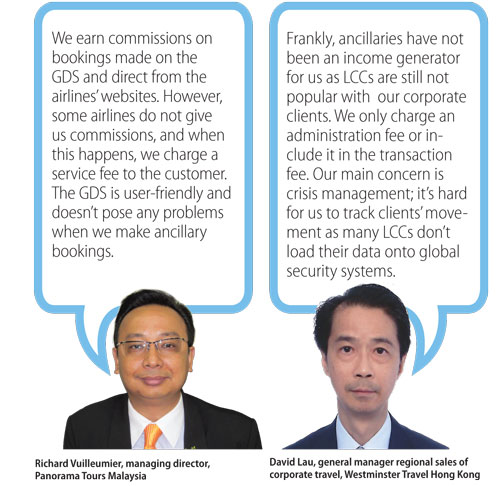
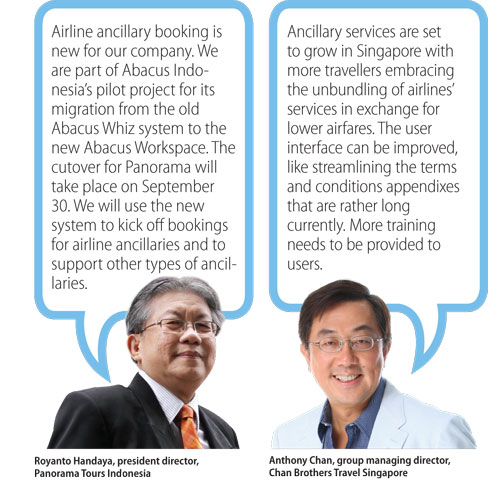
Travel agencies weigh in…
12-september-comment1

12-september-comment2

Additional reporting from Paige Lee Pei Qi and Kathy Neo

This article was first published in TTG Asia, September 12, 2014 issue, on page 18. To read more, please view our digital edition or click here to subscribe.

Stamford, IMPACT join hands to groom future MICE experts

0

A MEMORANDUM of Understanding on academic collaboration has been inked between Stamford International University and Thailand’s IMPACT Exhibition Management.

The collaboration will see opportunities being created for students to develop skills and perspectives that will lead them to successful careers in the MICE industry, and enable Stamford International University to be a source of young MICE talents.

Loy Joon How, general manager of IMPACT Exhibition Management, said: “This agreement…is intended to produce young people who will be a major force in driving the future of the MICE industry in Thailand. We expect the new generation, through innovative education and real-world training offered by Stamford, to specifically answer demands of the employment market.”

Reed China grows show portfolio, invests in online prowess

0

FOLLOWING the launch of seven industry events focusing on the auto, energy and publishing sectors last year, Reed Exhibitions Greater China is maintaining its growth momentum with the debut of FIBO China fitness event in Shanghai this month, the China Wuhan Daily-Use Articles Trade Fair in November and the China Bakery Show in Shanghai next May.

Nat Wong, president of Reed China, told TTGmice e-Weekly in an interview that the China Bakery Show was created through a joint venture with the China Association of Bakery & Confectionery Industry.

“Reed China brings in (event) knowledge and experience, while the local partner (contributes) local (industry) know-how and entrepreneurship. We expect this segment (bakery and confectionery) will grow very fast,” Wong commented.

Reed China is also leveraging the recent boom in the country’s gift industry by expanding its stable of related events to 10 in a single calendar year. These gift shows will be held in major cities like Beijing, Shenzhen, Shanghai, Chengdu and Wuhan.

“This segment accounts for a quarter of Reed China’s business and targets the domestic market,” said Mike Jiang, general manager of Reed Huabo Exhibitions (Shenzhen) Co. “Reed China holds about 90 per cent of the marketshare in China’s gift and homeware event sector.”

While acknowledging that the company’s growth in China is “fast”, chairman and CEO of Reed Exhibitions, Mike Rusbridge, said “it still represents a small fraction, given the group’s growing portfolio of over 500 events”.

“We now manage more than 50 events a year in China (and want to) continue to explore and develop new sectors. Our strategy is three-fold – we look for acquisitions, standalone launches and new show concepts,” revealed Rusbridge.

Noting that “customers are changing generationally” and “Generation Y and Millennials are (familiar with) going online or using mobile”, Rusbridge said: “That is changing the way we organise the services we provide. (Knowing) how to market on social media is vital.”

The company has invested US$30 million in a web hosting platform that will support all its events within the next few years.

“The new platform will kick-start in 2015 and be rolled out in phases and by country through 2017. This will enable the China office to plug into data systems, marketing tools, etc and access (Reed’s services) in any part of the world,” he said.

Pro-Health China takes 4,000-pax incentive to Sydney

0

PRO-HEALTH China kicks off its five-day incentive in Sydney today, bringing more than 4,000 of its top performing distributors in seven waves to the Australian city.

The event, said to be worth A$20.4 million (US$18.3 million) in estimated economic impact for the New South Wales economy, will see delegates participating in a Corporate Social Responsibility walk in the iconic Blue Mountains, a teambuilding session on Bondi Beach, and a gala dinner in Luna Park.

The Chinese health and skincare company last took a smaller VIP incentive to Sydney in 2009, and has been keen to return. This is the first time that Pro-Health China has held its annual conference outside of Asia, according to a press release issued by Business Events Sydney.

Pro-Health China’s annual conference comes in a busy year for Sydney, which has experienced a steady flow of Asian business events. The destination will welcome a total of 28 incentive events from Asia this year, attracting 60,328 delegate days and generating an economic impact of A$60.2 million for the state.

With the short-lead nature of this market, the bureau is expecting this number to rise by year’s end.

Johor to establish CVB

0

JOHOR is on the hunt for hotel investors, as it prepares to set up a state convention bureau in 2016 to bring more business events to the southern-most state of Peninsular Malaysia.

Backed by the Johor state government, Iskandar Regional Development Authority (IRDA) and Johor Department of Tourism, a working committee was recently formed, comprising members from the private and public sector, to hammer out the details of the new CVB.

Ismail Ibrahim, chief executive, IRDA, said the state is concurrently developing hardware in order to attract more business events. Hotel inventory in Iskandar Malaysia, which is being developed as a metropolis three times the size of Singapore, is expected to increase to 6,600 rooms by end-2015, from around 5,000 rooms now. The state of Johor has about 17,000 rooms.

Ismail added: “Currently, we have a main convention centre known as Persada Johor International Convention Centre in Johor Bahru (capital of Johor) that can accommodate a maximum of 4,000 delegates. We have projected that we will need another three to four convention centres – in Nusajaya, Pasir Gudang and Senai.”

Ismail and his team from IRDA are at PATA Travel Mart to network and attract private investors. Current incentives for the development of three- to five-star hotels are 10-year tax holidays, but additional incentives can be considered on a case-to-case basis.

Ganneesh Ramaa, manager, Luxury Tours Malaysia, said the new set-up would help attract more MICE visitors to the state, which in turn would create business opportunities for suppliers. He added: “To attract more business events, there must also be convention centres that can accommodate group sizes of 5,000 to 6,000 pax and are professionally run.”

Johor will be the third secondary destination in Malaysia to have a CVB, after Sarawak in East Malaysia and Penang in the north, which is in the midst of setting up the Penang International Convention and Exhibition Bureau (PICEB). PICEB is likely to be up and running in early 2015.

Hemophilia congress picks Kuala Lumpur for 2020

0

THE Malaysian capital has won the bid to host the World Federation of Hemophilia (WFH) World Congress in 2020, an event that will draw 4,300 delegates from around the world and generate an estimated RM55 million (US$17 million) in economic impact for the country.

The biennial congress is dedicated to the advancement of treatments to improve the lives of people with genetic bleeding disorders including hemophilia, von Willebrand disease, rare factor deficiencies, and inherited platelet disorders, and is regarded the most significant international forum for the global bleeding disorders community.

Commenting on the win, Zulkefli Haji Sharif, CEO of the Malaysia Convention & Exhibition Bureau (MyCEB), said: “One of MyCEB’s goals is to make Malaysia the choice destination in business events and meetings for healthcare professionals. As such, we are proud that Kuala Lumpur is given the nod by the WFH as the venue for its 2020 congress.

“The bidding process was a long and exciting journey for our team who worked closely with the Hemophilia Society of Malaysia to produce the winning submission.”

Faraizah Dato’ Abd Karim, president of the Hemophilia Society of Malaysia, said the WFH members were impressed by Malaysia’s comprehensive bid to host the event and look forward to bringing the congress to Kuala Lumpur in 2020.

Asia-Pacific leads in travel booking via mobile devices

0

TRAVELLERS from Asia-Pacific use mobile devices most compared to travellers from other regions when planning and purchasing travel, according to the Travel Flash Report released by Criteo.

The report examined the share and value of bookings generated from mobile devices for more than 1,000 travel websites worldwide including airlines, hotels, car rentals, cruises and apartments in 1H2014.

One of the key regional findings include Asia-Pacific being the leader with more than 20 per cent of travel bookings made on a mobile device. Brazil and Germany turned in less than 10 per cent.

Globally, smartphones and tablets accounted for 21 per cent of hotel bookings, while peer-to-peer apartment rentals saw the highest mobile penetration of 34 per cent.

Additionally, the value of mobile bookings increased in every area except accommodation – average booking value was 21 per cent higher for air travel and 13 per cent higher for car rentals, but 30 per cent lower for hotel bookings on mobile devices than desktop.

Jason Morse, vice president for mobile products at Criteo, said: “Mobile is the driving force behind the exponential growth in online travel booking and sales, and that’s only set to continue in the second half of this year and beyond.

“Travel marketers need to think strategically about developing a highly effective omni-channel marketing experience, ensuring the entire consumer experience – from the ads to shopping carts – is mobile optimised.

“Determining budget across desktop and mobile must be completely fluid because consumers are making decisions in real-time, requiring that the booking experience be streamlined and integrated with mobile-friendly payment systems to ease the all-important path to purchase.”

Criteo’s complete report can be downloaded at http://www.criteo.com/resources/travel-flash-report-online-travel-never-looked-so-mobile/

Johor to establish CVB

0

JOHOR is on the hunt for hotel investors, as it prepares to set up a state convention bureau in 2016 to bring more business events to the southern-most state of Peninsular Malaysia.

Backed by the Johor state government, Iskandar Regional Development Authority (IRDA) and Johor Department of Tourism, a working committee was recently formed, comprising members from the private and public sector, to hammer out the details of the new CVB.

Ismail Ibrahim, chief executive, IRDA, said the state is concurrently developing hardware in order to attract more business events. Hotel inventory in Iskandar Malaysia, which is being developed as a metropolis three times the size of Singapore, is expected to increase to 6,600 rooms by end-2015, from around 5,000 rooms now. The state of Johor has about 17,000 rooms.

Ismail added: “Currently, we have a main convention centre known as Persada Johor International Convention Centre in Johor Bahru (capital of Johor) that can accommodate a maximum of 4,000 delegates. We have projected that we will need another three to four convention centres – in Nusajaya, Pasir Gudang and Senai.”

Ismail and his team from IRDA are at PATA Travel Mart to network and attract private investors. Current incentives for the development of three- to five-star hotels are 10-year tax holidays, but additional incentives can be considered on a case-to-case basis.

Ganneesh Ramaa, manager, Luxury Tours Malaysia, said the new set-up would help attract more MICE visitors to the state, which in turn would create business opportunities for suppliers. He added: “To attract more business events, there must also be convention centres that can accommodate group sizes of 5,000 to 6,000 pax and are professionally run.”

Johor will be the third secondary destination in Malaysia to have a CVB, after Sarawak in East Malaysia and Penang in the north, which is in the midst of setting up the Penang International Convention and Exhibition Bureau (PICEB). PICEB is likely to be up and running in early 2015.

Lowcostbeds finds new home in Asia

0

SOON to open a third office in Asia-Pacific and making its debut appearance at PATA Travel Mart this year, Lowcostbeds is scaling up its presence in Asia to move away from being solely a UK brand towards becoming a global entity.

The bed bank planted its flag in the region through its office in Bangkok, where it is headquartered, and Sydney within the last one year.

Said Adam Alford, managing director Asia Pacific, Lowcostbeds, on the new direction: “We have opened two offices this year and plan to open a third in a few months. Our business is heavily geared towards our international expansion as we become less known as a UK bed bank (but) more a global business.”

He noted that the company’s UK business now constitutes less than 30 per cent of total business, compared to more than 80 per cent 18 months ago. Lowcostbeds has forecasted its growth rate to triple for 2015.

“We are committed to opening up Asia-Pacific and the Middle East. From a distribution point we are not identifying a single target market but rather expanding to markets where our products are welcome. For example, we have increased our total inventory by over 200 per cent since August last year. We have buyers in Asia now targeting individual contracts for best pricing to sell to more than 40,000 of our travel partners worldwide.”

But how does this bed bank ensure it stands out from the competition, amid a proliferation of other B2B websites and even peer-to-peer vacation rental channels each out for a bite of the accommodation market?

Read more in TTG-PATA Travel Mart Show Daily

Tourists advised to stay away from fake orphanages

0

WITH voluntourism becoming a hot topic, travel consultants and visitors are urged to steer clear from orphanage tourism as it exposes children to exploitation.

Amy McLoughlin, responsible tourism awards manager & associate specialist, Wild Asia, said: “Orphanage tourism is most common in Cambodia, where tourists may be approached by children, asking them to make a visit to their orphanage (and make) a small donation towards the upkeep of their home.

“Most commonly the children in question are exposed to exploitation, and the begging culture does not equate to a sustainable future for the centre or its inhabitants.

“Shockingly, there have also been reports of some establishments where children have been bought from families to be placed in fake orphanages to work in heartstring-tugging roles to generate money,” she added.

While the number of orphans in Cambodia has declined over the past 10 years, orphanages have more than doubled, and almost three-quarters of “orphans” still have at least one living parent, according to UNICEF.

As a result of the controversy surrounding orphanage tourism in Cambodia, several tour operators are now adopting a no-go stance.

Despite receiving a handful of such requests each month, Cambodia-based A Touch Of Asia refuses to take any tours or individuals to orphanages or schools, revealed general manager, Steve Lidgey. “There is considerable evidence from international specialists that visiting an orphanage can do more harm than good,” he said.

Read more in TTG-PATA Travel Mart Show Daily