TTG Asia
Asia/Singapore Saturday, 27th December 2025
Page 2157

One Farrer dangles ‘attractive’ rates

0

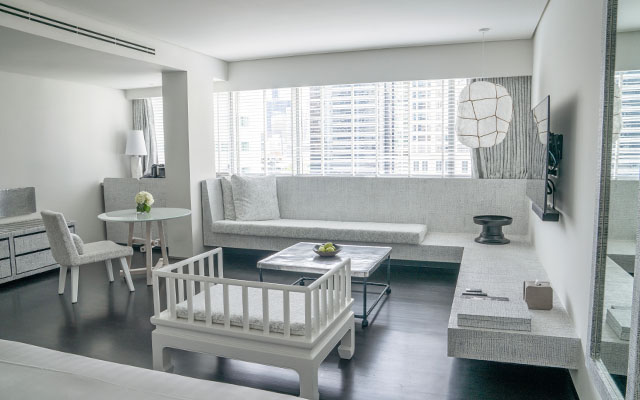
ONE Farrer Hotel & Spa Singapore is putting the final touches to its opening on September 3 and, though the hotel is pitched at the luxury level, rates will not be luxurious at the start in a bid to draw the well-heeled to a new location and product concept.

For the first three to six months, the opening rates for the three-in-one hotel concept will range from S$280 (US$224) for rooms at the Urban Hotel, to S$400 for suites and S$1,000 for villas at the Skyline Hotel, said general manager and vice president hotel operations, Gilbert Madhavan.

Chairman, Richard Helfer, said: “The rates at One Farrer Hotel & Spa for a while would be more attractive than some other areas of the city, as it’s in a new location and we are a new independent hotel. This plus our superior facilities are good reasons for people to come as they know we’re a five-star hotel and they can try it out at a lower rate for now.”

The 243-room hotel has a three-in-one concept: Urban Hotel, levels 11-15, targeted at business and leisure travellers; Loft Apartments, levels 16-17, targeted at the extended stay market; and the Skyline Hotel, levels 18-20, targeted at the luxury segment.

It is part of a mixed-use development called Connexion at Farrer Park, which also boasts The Farrer Park Medical Centre, home to more than 200 medical specialists, and The Farrer Hospital, one of the first private hospitals to be built ground-up in Singapore after 30 years.

But only 25 per cent of the hotel’s business mix will be medical tourism. The rest will be leisure (15 per cent), corporates (30-35 per cent) and the remainder, meetings and incentives.

Helfer, former founding chairman and CEO of Raffles International Hotels & Resorts, said One Farrer Hotel & Spa would “drive” the leisure and corporate market with its concept and service standards.

– Richard Helfer on making a Connexion, View From the Top, TTG Asia, September 12 issue

SIA’s Indian airline is Vistara

0

TATA-SIA Airlines Limited (TSAL), the joint venture between Tata Sons and Singapore Airlines, yesterday announced the brand name of its full-service airline, which is expected to commence flying from October.

Vistara, derived from the Sanskrit word ‘Vistaar’ meaning limitless expanse. It will begin operations in October subject to approvals from India’s Directorate General of Civil Aviation.

Headquartered in New Delhi, Vistara will take delivery of its first plane, an Airbus A320-200 in September and plans to increase its fleet to 20 aircraft, including A320neos by the end of the fifth year of operations.

While the airline’s route network in India is unannounced, TSAL’s CEO, Phee Teik Yeoh, said: “We will operate in cities where there is a clear demand for a full-service carrier be it metro or non-metro cities.”

Queried whether it is the right time to commence operations in India considering the majority of domestic airlines are making losses, Yeoh said TSAL remains positive as the new Indian government is investor-friendly and has announced measures for the sector, like opening new airports in the country (TTG Asia e-Daily, July 29, 2014).

Mukund Rajan, member of the Group Executive Council at Tata Sons and director at TSAL, added: “The time is rights for us to commence operations as Indian travellers are looking for fresh options. India is expected to become the third-largest aviation market in the world by 2020, which clearly means there is a potential that needs to be tapped.”

Tata Sons had partnered Singapore Airlines in September 2013 for the joint venture, holding 51 per cent stake in TSAL (TTG Asia e-Daily, September 20, 2013).

PATA peeks into the Rise of the Young Asian Traveller

0

PATA today released The Rise of the Young Asian Traveller report, revealing the key travel habits and attitudes of Asia’s future travellers in order to help tourism professionals understand the need to engage young people as consumers and employees of the industry.

Crucial information covered in the report include: their dream destinations (France, the US, Australia, Japan, and Italy); why youth travel does not always mean ‘budget travel’ in Asia; what the leap to mobile technology will mean for travel providers across the region; how low cost carriers have capitalised so successfully on the youth market; why the most sophisticated tourism boards look to attract students as well as leisure travellers; who exerts the biggest influence on young Asians’ travel decisions; and why it is important to start reaching the next generation of your brand’s consumers today.

PATA CEO Martin Craigs said: “This report highlights very effectively why Asia’s top destinations and tourism brands need to sit up and take notice of young consumers and their travel tastes. Today’s young travellers will very quickly become business and family travellers, so it is important to show them your trust and loyalty from a very early stage.”

The Rise of the Young Asian Traveller can be purchased at the PATA Online Store.

The report is based on participation from almost 3,000 travellers between the ages of 15 and 34 in an online survey distributed across 13 countries in North-east and South-east Asia, including China, South Korea, Japan, the Philippines, Thailand, Vietnam, Indonesia and Malaysia (TTG Asia e-Daily, February 20, 2014).

E-visas scheduled to launch in Myanmar next month

0

MYANMAR will introduce an e-visa system beginning September 1, a move that could finally streamline visa processes for travellers.

Tourists are required to file their visa application online at www.myanmarevisa.gov.mm at least one week before their trip. The online visa is priced at US$50, though the same visa obtained through an embassy abroad costs US$30, according to the Ministry of Hotels and Tourism. Only credit card payment is accepted.

Once the application has been processed by the Ministry of Immigration and Population, applicants will receive an email confirmation letter that they must present to the airline and to immigration authorities at Yangon International Airport, along with their passports.

Business visas are not yet available online, though this may change in the future.

Mika Itavaara, managing director, Discovery DMC in Yangon, said: “This is great news that we have been looking forward to for quite some time. It will make visa application handling faster and more convenient to tourists from all countries. This is especially welcome news to those nationals who don’t have Myanmar embassies and consulates in their country or nearby.”

With the halt of pre-arranged visa-on-arrival several months ago, tourists from countries without a Myanmar consulate or embassy have had to stop in Bangkok to obtain the visa before going to Myanmar, taking one full day out of their itineraries.

Myanmar first announced it would implement an e-visa system two years ago (TTG Asia e-Daily, February 15, 2012).

By Tobias Esche.

HKDL works its magic in South-east Asia

0

HONG Kong Disneyland (HKDL) is casting a spell on the regional market to get more travellers from South-east Asia, which will see it stepping up trade engagement.

Larry Leung, director – travel trade sales, HKDL, said: “We realise that visitors from South-east Asia stay an average of four to five days in Hong Kong, and when they visit HKDL, they want the full experience. Thus, it is not just about selling theme park tickets, but also rooms in our two hotel properties and promoting our F&B offerings.”

He added that HKDL and its hotels have several halal-certified food outlets to endear them to Muslim travellers as well.

Said Leung: “Since the opening of the theme park, we’ve seen stable growth from our key markets in South-east Asia, so we see the need to further step up efforts. Our liaison representatives in key markets will also intensify training, educational and marketing support to travel consultants.”

HKDL participated in a Malaysian consumer travel fair for the first time over the weekend, bringing interactive activities and performances such as Disney character-drawing, storytelling sessions and making of towel animals.

The theme park welcomed three new themed areas – Grizzly Gulch, Toy Story Land, and Mystic Point last year (TTG Asia e-Daily, March 26, 2013).

The resort appointed its first South-east Asian liaison representative in Thailand in 2007, then further extended its network by appointing local representatives in other South-east Asian markets such as Malaysia, Indonesia and the Philippines.

“We will also leverage the synergy with our parent company, The Walt Disney Company, next year with the ultimate goal of strengthening the Disney affinity and making HKDL a top-of-mind destination and driving traffic there.”

Jetstar opens 4th Indonesian retail outlet in Medan

0

JETSTAR Group is solidifying its presence in Indonesia with the introduction of another travel shop and its Straight-to-Gate service.

The budget airline group opened its fourth Jetstar Travel Shop in Indonesia in Medan. The first in the city, the retail outlet is located on Jalan Juanda Baru and will begin selling hotels and travel insurance in the coming months, besides air tickets.

Jetstar Asia CEO, Barathan Pasupathi, said customers have the option of transacting in cash at the shop, catering to the needs of Indonesian customers.

“The Jetstar Travel Shop in Medan is another customer initiative that we believe will help our customers to have even easier access to our everyday low fares,” said Pasupathi. “Customers in Medan prefer to book and purchase their tickets through offline booking options as credit card penetration is still relatively low in the city.”

Jetstar Asia operates daily flights between Medan and Singapore.

In the meantime, Jetstar Asia started rolling out its Straight-to-Gate service in Indonesia on August 8.

Following a soft-launch of the service in Jakarta last month, passengers without check-in baggage and visas departing from Surabaya, Medan and Bali can now check-in online, proceed directly to the gate and pay airport tax there.

Straight-to-Gate was launched in Singapore last year followed by Hong Kong, Thailand and Malaysia. Pasupathi said some 45 per cent of Jetstar Asia’s passengers with only carry-on baggage have been eligible for the service since it was first launched.

The Jetstar Group operates 114 weekly flights between the Indonesian ports of Jakarta, Bali (Denpasar), Medan, and Surabaya, as well as international destinations, including Singapore, Perth, Sydney and Melbourne.

Japan baits incentives with free add-ons

0

JAPANESE CVBs are dangling freebies to increase the appeal of their cities as attractive incentive destinations and counter the image of Japan as an expensive travel option.

Speaking to TTG Asia e-Daily during the Japan Incentive Travel Seminar in Singapore last Thursday, Momoko Maeda, incentive coordinator from Sapporo Convention Bureau, said: “In order to bring more guests into our city, we must be able to attract them first with a value proposition and position ourselves at the top of their minds.”

According to Maeda, incentive groups will be able to enjoy a list of benefits if they spend more than 200 nights in the city, e.g. 50 pax for four nights.

The bureau will sponsor the group’s gala dinner and throw in a performance, or arrange a special welcome ceremony by a “kimono lady” for the group.

Said Maeda: “Our unique cultural dance items will be popular for the guests because it is something only we have that will leave them with a memorable experience.”

Likewise, the Okinawa Convention & Visitors Bureau’s (OCVB) Welcome Project created for incentive tours, which are valid until March 30, 2015, includes an airport greeting fronted by Miss Okinawa.

Shuhei Kohagura, OCVB’s MICE marketing specialist, added: “As attractions at receptions, we can provide displays of Okinawan performing arts including Ryukyu, Eisa, and lion dances (as part of the Welcome Project).”

Tourism arrival figures from Singapore to Japan between January and June are at 97,900, up from 83,304 over the same period last year, said Susan Maria Ong, deputy director of Japan National Tourism Organization (JNTO) Singapore office.

Maggie Tay, director, Singapore-based Euro-Asia Holidays, said while Singapore travellers are always interested in Japan, budget is still an issue. “Travelling to Japan is already more expensive than other destinations in the region, and the expenses there are also quite high.

“However for the groups who want to really reward their staff, they will be willing to spend a bit, so these are the ones that will still go to Japan,” she said.

Similarly, Jenny Ho, managing director, Classic Travel, who usually arranges for incentive tours in Tokyo and Osaka, said: “It is useful that the other CVBs are coming up with attractive offers so we can explore these cities instead of the typical major ones.”

JNTO also brought its incentives showcase to Kuala Lumpur on Friday, the second and final leg of the travel seminar.

Malaysian trade backs restructuring of national carrier

0

THE Malaysian Association of Tour and Travel Agents (MATTA) and Malaysian Inbound Tourism Association (MITA) have rallied behind prime minister Najib Razak’s call for a complete overhaul of Malaysia Airlines (MAS) in order to return it to profitability and improve its public image.

The airline’s largest shareholder, Khazanah Nasional, last Friday proposed to take full ownership of the airline through an offer to purchase the remaining 30.6 per cent stake it does not already own, which would lead to MAS’ effective delisting from Bursa Malaysia (TTG Asia e-Daily, August 8, 2014).

Meanwhile, MAS will continue to operate all current flights, schedules and reservations.

Speaking to TTG Asia e-Daily, MATTA president, Hamzah Rahmat, believes restructuring would have a higher chance of success if carried out without interference from airline unions or politics.

He said: “Sacrifices will have to be made, but it will be for the good of the airline and its sustainability in the long term. MAS used to be a renowned airline in the past, so close to Singapore Airlines. But now, it is behind Garuda Indonesia. Since Garuda’s restructuring, its inflight services and international image has improved. MAS, too, can climb back and become one of the top Asian airlines, and one of the top 10 airlines in the world.

“As far as MATTA is concerned, we strongly back our national carrier for national interest. Where there is a choice of airlines, we urge the travelling consumer to choose MAS.”

Adam Kamal, deputy president 2, MITA, said: “The restructuring is timely in light of MAS’ image after the twin tragedies this year involving two of its aircraft and the airlines’ poor financial performance over the last few years. What is important is for Khazanah Nasional to ensure that this time, the restructuring will be effective.”

MAS’ image took a drubbing in the wake of two major incidents, the mysterious disappearance of MH370 and the downing of MH17 over Ukrainian airspace, both within the short span of a few months.

Over the last 12 years, MAS underwent six restructuring exercises, and details of this latest planned exercise is expected to be announced at the end of this month.

High-tech passenger journeys on the rise

0

PEEK INTO THE FUTURE: In this section, Raini Hamdi asks industry leaders to pen their thoughts on what the future will bring. Here is Francesco Violante, CEO, SITA on the future passenger journey

08-august-franscesco-violante-selfservice

As technology becomes a normal part of people’s travel experience, it is continuing to uproot the traditional passenger journey.

One major area is the rise of the connected aircraft. By 2016, more than three-quarters of airlines will deploy tablets, onto which information such as passenger name lists, passenger bag load status and connecting flight information is loaded, thereby improving the passenger experience.

Passengers are beginning to expect to use their mobile devices onboard for calls, Internet, emails and entertainment, with those signing up for inflight connectivity through SITA’s subsidiary OnAir increasing year on year.

Most airlines and airports are also investing in business intelligence, which will furnish passengers with information they say they want – flight times and bag status, for instance, or waiting times at check-in, security and checkpoints.

A third trend is m-commerce, enabling passengers to purchase travel services on the move. According to our surveys, once passengers have bought their tickets, nearly 40 per cent would purchase ancillary services while en route – such as paying for parking or buying a lounge pass. Most airports plan to offer m-commerce in the next two years, while airlines see it as a new frontier in retailing.

SITA is also involved in some exciting collaborative innovations and developments at airports that promise significant change. At check-in, SITA’s trial with Virgin Atlantic of wearable technology, including Google Glass and Sony Smart watches, demonstrates great potential to enhance passengers’ travel experiences.

The trial enabled concierge staff to meet and greet VIP passengers with a personalised check-in service. But we are only at the beginning of a learning curve that could see wearable technology impacting other areas across the airport and aircraft maintenance.

Also at the airport, we are starting to pilot beacon technology that could open up a range of low-cost possibilities for interacting with passengers, such as determining passenger location, navigating the airport and much more. Developments in passenger flow monitoring are another great example of IT benefiting the passenger experience and increasing airport efficiency.

The next major technology-led trend at airports is self bag-drop. We are seeing the rise of bag-drop areas at airports, although our surveys find that passengers are still cautious. Our work includes self bag-drop at Melbourne and Brisbane airports in Australia.

With IATA’s and Airports Council International (ACI)’s SmartSecurity, the industry is working on the next generation of checkpoint. IT is the enabler, helping to optimise processes. New biometrics kiosks are a prime example of change to come, as they fast track international arrivals, enabling a ‘land, touch and go’ procedure.

Our work involves the introduction of Automated Passport Control self-service kiosks at Orlando Airport as well as new self-service passport control kiosks at Miami International Airport.

If we are going to create this new journey then continued investment in IT is essential, along with infrastructure based on global standards and interoperability between technologies, sharing data securely and using common processes and approaches. That means backing IATA’s and ACI’s programmes to deliver a better passenger experience.

We see common-use technologies as vital to the new journey. Passengers do not want to learn how to use different technologies every time they use a different airline or go to a different airport.

Finally, we need to decide who owns the passenger, and work together to share the benefits of business intelligence and analytics because these have great potential to improve our industry’s processes and the passenger experience.

By Francesco Violante, CEO, SITA 

This article was first published in TTG Asia, August 8, 2014 issue, on page 10. To read more, please view our digital edition or click here to subscribe.

Ship shape future of cruising

0

PEEK INTO THE FUTURE: In this section, Raini Hamdi asks industry leaders to pen their thoughts on what the future will bring. Here is Adam M Goldstein, president & chief operating officer, Royal Caribbean Cruises on the future shape of cruise ships

08-august-adammgoldstein-ship

People sometimes ask me if there will ever be a cruise ship larger than our Oasis-class ships. My answer is yes. It’s clear from history that ships get larger over time. There may be a longer-than-usual hiatus as Oasis-class represents a significant increase in guest occupancy (5,400) and GRT (225,282), but it is highly unlikely that there will never be a bigger ship.

The only certainty is that cruise ship size and design will respond to consumer preferences. Over the last 15 years the average size of cruise ships has expanded rapidly. While economies of scale result from increases in size, at least to a point, this efficiency goal has not been our focus. The primary driver has been the desire of customers for ever more options, choices and variety. The proliferation of specialty restaurants, entertainment venues, themed bars and action-oriented experiences is the visible manifestation of this insistent pressure.

I’m comfortable forecasting that this consumer-led desire for diversity of experiences will continue. I’m considerably less comfortable predicting what these experiences will be. After all, when Royal Caribbean began in 1970 with the first purpose-built ships for warm weather cruising, no one could have imagined rock climbing walls, ice skating rinks, surfing, sky diving, digital signage or pervasive Wi-Fi, not to mention the elimination of the main dining room as on the forthcoming Quantum of the Seas with its Dynamic Dining concept.

I’m also comfortable forecasting that four critical elements of ship design and construction will continue to play a crucial role in the cruise industry’s development.

First, technology will be ubiquitous. In less than 20 years we have transitioned from marketing the benefits of disconnecting from daily life to calling out improvements to online connectivity. This is the beginning of a revolution in the guest and crew experience with unforeseeable developments ahead.

Second, safety and environmental sensitivity will continue to be front and centre. We take responsibility for our guests and crew every time a cruise ship leaves port and this will not change.  Nor will our need to protect the oceans on which we sail. Continuous improvement in this domain must be unceasing.

Third, fuel efficiency will only grow in importance but how this quest will manifest itself in terms of types of fuels, propulsion and power generation is unpredictable.

Finally, destinations will continue to emerge around the world, especially in Asia, over the upcoming decades. These new ports-of-call will often lack the ability to handle the largest cruise ships early in a port’s maturity curve. So it’s highly likely there will continue to be a variety of ship sizes and a need for appropriate tendering services as well as permanent docks, regardless of the size of the source markets that produce the customers.

Taking all of the above into account, it’s clear Royal Caribbean and the cruise industry will continue to push the boundaries of cruising as we have known them. It will be exciting to see the innovations unfold.

By Adam M Goldstein, president & chief operating officer, Royal Caribbean Cruises

This article was first published in TTG Asia, August 8, 2014 issue, on page 10. To read more, please view our digital edition or click here to subscribe.