TTG Asia
Asia/Singapore Friday, 24th April 2026
Page 1897

Singapore’s suburban appeal

0

Offering a more immersive local experience and lower hotel rates than its counterparts in the city, suburban hotels are gradually growing in popularity among foreign visitors, discovers Paige Lee Pei Qi

march18_sg

The emergence of suburban hotels into Singapore’s hotel landscape over the past few years has drawn foreign travellers with their offer of a different experience away from the tourist belt.

According to the latest statistics from the Singapore Tourism Board (STB), there were about 14 million room nights available as of November 2015, a seven per cent year-on-year increase, with hotels in suburban areas contributing most to the increase.

The April 2015 launch of Genting Hotel Jurong, sister property to Resorts World Sentosa (RWS), marks the first major hotel in the growing Jurong Lake District. The 557-room hotel is a 15-minute drive from Tuas Checkpoint, which connects Singapore to Johor Bahru in Malaysia.

“We hope (the hotel) will infuse new energy and vibrancy into this thriving business and lifestyle hub,” said Chow Keng Hai, vice president of rooms at RWS.

Genting Hotel Jurong has enjoyed a “very healthy occupancy rate” driven by both leisure and business travellers since its opening, with a strong demand from Malaysia and Indonesia, added Chow.

Likewise, the new 443-key Park Hotel Alexandra has been enjoying an average occupancy rate of 70 per cent since its soft opening in June 2015, according to its general manager Angeline Tan.

“Many travellers are increasingly looking for immersive experiences be it on business or leisure travel, and there is more to shopping and sightseeing in Singapore,” observed Tan, who counts Europe, Australia, Hong Kong, China and Malaysia as the hotel’s key target markets.

Tan believes that the historical flavour of the Alexandra-Bukit Merah area lends to the property’s unique selling points.  “The hotel overlooks the lush verdant green belt of the Southern Ridges on one front and the heritage enclave of Queenstown on the other. The area itself is full of history,” she added.

Katong’s Peranakan heritage, on the other hand, is a stronger drawcard for Grand Mecure Singapore Roxy located on East Coast Road. Said Jennifer Narcis, the hotel’s director of sales & marketing: “We are located within the rich cultural district of Katong where traces of Peranakan history are found. The hotel is also a short walk away to the scenic East Coast Park.”

Meanwhile, Capri by Fraser, Changi City’s location in the far eastern corner of Singapore will enable travellers to seek out “Changi’s rich history and its great historical sites”, opined Choe Peng Sum,  CEO of Frasers Hospitality, which launched the 313-key hotel residence in 2012.

For example, Choe highlighted how the hotel’s new cycling expedition in East Coast Park on complimentary bicycles, led by the hotel’s general manager, is a hot favourite among the guests.

Commenting on Village Hotel Changi Singapore, Arthur Kiong, CEO of Far East Hospitality, said: “The hotel offers guests a breath of fresh air that is unlike the densely populated urban city centre. It provides guests off-the-beaten-track experiences that enables them to experience the best of Singapore and live like a local.”

For visitors interested to see a slice of rustic Singapore, the hotel offers the Ubin Adventure package that provides complimentary bikes to explore Pulau Ubin, an island located a short ferry ride away.

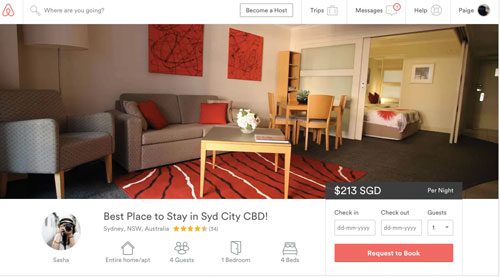
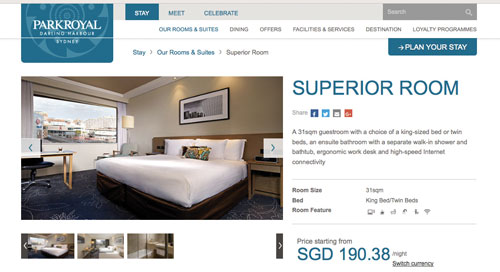
Apart from the immersive experience, the strongest pull towards these suburban hotels is their competitive hotel rates, which can be 10 to 15 per cent lower than city hotels, inbound travel agents told TTG Asia.

Hardeep Singh, director of sales and operation in Chariot Travels, said: “These (suburban) hotels are attractive because city hotel rates are high in Singapore, and the good thing about them that they usually provide shuttles to the city so (location) is not a problem at all.”

On the other hand, Siam Express’ manager Daniel Goh has not received special requests for suburban hotels as they are perceived to be “inconvenient” by his clients.

This article was first published in TTG Asia, March 4, 2016 issue, on page 28. To read more, please view our digital edition or click here to subscribe.

Photo of the Day: Cebu Pacific flies to Guam

0

cebuCebu Pacific long haul division general manager Alex Reyes pose with cabin crew during the launch of the airline’s inaugural Manila-Guam service on March 15. The four-times weekly flight is the carrier’s first US destination.

New portal connects Muslim travellers with halal products

0

tripfez_founder__ceo_faeez_fadhlillah

Tripfez founder and CEO, Faeez Fadhlillah

TRIPFEZ, a new B2C travel booking engine dedicated to the Muslim travel market, was launched last week at ITB Berlin.

“Tripfez is a virtual shop window showcasing halal-friendly travel solutions to a captive but underserved audience of 108 million Muslim travellers,” explained founder & CEO, Faeez Fadhlillah.

“These travellers already represent at least 10 per cent of the entire travel economy and are increasingly making travel purchasing decisions based on their religious beliefs.”

The portal allows suppliers to register their Muslim-friendly tours and manage their allocations, inventory and pricing.

At present, Tripfez features more than 200,000 halal-friendly hotels globally, at least 10,000 of which are certified by Salam Standard – a hotel reference system for Muslim travellers launched by Fadhlillah last year.

Similarly, agents who register their Muslim-focused tours with Tripfez will be asked to meet certain criteria before they are distributed through the website.

Tripfez will also be showcased at the upcoming Arabian Travel Market (ATM), held in Dubai from April 25 to 28.

TAT to open office in Prague

0

tat-governor-dr_-yuthasak-supasorn

Yuthasak Supasorn, Tourism Authority of Thailand governor

THE Tourism Authority of Thailand (TAT) is scheduled to open an office in the Czech Republic capital of Prague in August, adding to the current network of 35 offices in Thailand and 27 offices overseas.

TAT governor Yuthasak Supasorn first announced the plan to open the TAT Prague Office at ITB Berlin 2016, which concluded last week.

“The German and European markets remain very important to us because they have the highest length of stay, more than twice the overall average,” said Yuthasak Supasorn.

“We have seen the prospective sign and a strong growth in Eastern Europe. So, the office in Prague has been established to specifically oversee this growing market in order to uphold Thailand as a quality getaway to tourists in this region,” he added, referring to plans to better reach the markets of Bulgaria, Hungary, Poland, Romania, Slovakia, and Ukraine through the Prague outpost.

Last year, visitor arrivals from Eastern Europe totalled more than 364 thousand. This amounted to more than 636 million euros (US$705 million) in tourism receipts, a year-on-year increase of 9.7 per cent.


Extra public holidays to spur Thai domestic travel

0

kobkarn-wattanavrangkul_ride-to-khong-500x300

Kobkarn Wattanavrangkul, Minister of Tourim & Sports of Thailand

PLANS by the Thai government to introduce extra public holidays in May and July this year have been welcomed enthusiastically by the travel trade.

According to tourism minister Kobkarn Wattanavrangkul, the additional holidays will fall on May 6, a Friday, the day after Thailand’s Coronation Day, and July 18, a Monday, the day before the Asarnha Bucha festival.

This will place two new long weekends in Thailand’s calendar and is designed in part to promote domestic tourism.

“Whenever we have more long weekends, there will surely be more travelling, both domestic and outbound,” said Surapong Techaruvichit, president of the Thai Hotels Association, adding that he expects more than 90 per cent of tourists to be travelling domestically.

“It will be very good for hotels and destinations all over Thailand. I do not have any figures to support this, but hotel occupancies over long weekends are always higher than normal weekends,” he added.

Massive expansion enroute for Boracay Airport

0

interior-of-airplane-with-passengers-on-seats-credit-dundanim-_-123rf-stock-photo-7342042_xl

Boracay Airport can only handle low-capacity aircrafts at present

INCREASED capacity, better accessibility and reduced airfares to some of the world’s most popular beaches are expected when an expanded Boracay Airport debuts in the Caticlan region in 1Q2017.

According to Cesar Chiong, general manager, Boracay Airport, the airport is currently capable of handling 72-seater turboprop aircrafts only, but will be getting an extended runway that can handle bigger aircraft. It will also boast increased passenger capacity, from the current one million to five million.

Paul So, managing director, Great Sights Travel and Tours, said the opening of the expanded Boracay Airport will also reduce airfares as more airlines operate routes there and compete for market share.

With greater connectivity and improved safety features, the upgraded airport will be a boon for corporates and MICE travellers as well, says Kat Cruz, team leader, meetings and events, American Express Transnational.

Cruz noted that when she brought an incentive group of 340 to Boracay last month, they had to take several flights because Caticlan airport can only handle small, low capacity planes.

Paris sends largest sales mission to SE Asia to date

0

picture2

THE Paris Convention & Visitors Bureau (PCVB) is on its fourth sales mission to South-east Asia with 18 participating exhibitors, the largest delegation to date, a sign of the potential that the region’s markets hold despite a global economic slowdown.

This is also the first time the roadshow was extended to Singapore, besides the traditional cities of Kuala Lumpur, Jakarta and Bangkok.

Clement Laloux, director of marketing, PCVB, who was in Kuala Lumpur on March 14, said: “Singapore is an (airline) hub in South-east Asia. With a small population base, it may not have the volume, but there are quality tourists whom we want to reach out to, people who will spend a lot.”

Laloux described 2015 as a “good year” with a 5 to 10 per cent visitor growth from South-east Asia compared to the previous year, a majority of whom travelled for leisure.

He further characterised incentive travel from Asia to Paris as “developing quickly”, especially from China. Laloux cited Amway China as an example, who had recently sent 1,400 delegates on a seven-night programme to Paris.

Even though incentive groups from South-east Asia are far smaller than from China, with an average of 50 to 200 people per group, they are just as important, said Laloux.

He added that the South-east Asian markets have evolved over the last five years with a growing number of FIT visitors staying in Paris to feel the pulse of the city, rather than be in the outskirts to save on accommodation costs.

Asked for his forecast in 2016, he said: “I hope we will see the same growth, but it is too early in the year to tell.”

Travel start-ups get plenty of love from GDSs

0

42884860_l_1

GDSs are increasingly investing into start-ups with an aim to groom a new generation of travel technology innovators and to diversify their business spectrum.

Last June, Travelport announced the development of a seed-stage investment and mentorship programme.

Participants in the programme, named Travelport Labs, which run in four-month cycles with up to four start-ups accepted in each cycle, have access to Travelport’s experienced staff of product managers, designers, developers and coaches across the world as well as to its APIs, software development kits and data feeds.

At the end of each cycle, the start-ups will be given the chance to pitch their innovations to senior Travelport executives, investors and other potential business development partners in the travel industry.

Explaining their move, Jason Nash, head of marketing and product incubation, Travelport, said: “In the business environment today, innovation is a matter of survival. It takes diverse perspectives to develop game-changing ideas. By engaging entrepreneurially-minded individuals, we can explore new product ideas, validate their fit in the industry, and create value for the entire travel value chain.”

As well, Amadeus launched Amadeus Next last December to “mentor, nurture, and partner” with travel technology start-ups in the Asia-Pacific region.

Explaining their rationale behind the programme, Simon Akeroyd, vice president, corporate strategy at Amadeus APAC, said: “We realised that there was a lack of start-ups in Asia-Pacific really focusing on travel, despite the overall surge of start-ups in today’s day and age. There was also limited knowledge on travel technology available.

“Knowing what you want from the travel experience is not the same as understanding the nuances of the industry, and that is a big challenge for the start-ups we have met, as they often only see the consumer perspective,” he said.

Amadeus Next offers start-ups access to technology and solutions to build and validate their minimum viable product, expertise in the form of mentoring and guidance, as well as reach via its customers and industry players, added Akeroyd.

In terms of funding, Amadeus would help start-ups connect to investors and venture capital. Globally, Amadeus also has a dedicated Amadeus Venture Fund which offers early-stage micro-investments.

To date, six travel technology startups are on board with them, including Klook, Orahi, Triposo, and TopDocs, a platform for medical tourism.

Additionally, JungleVentures, CyberAgent Ventures Techsauce and Hubba, Thailand’s startup leader in terms of co-working spaces, technology events, technology media and startup education, have also joined up with Amadeus Next.

As for Travelport Labs, Nash shared that from the previous incubation cycle, they have since invested in a US-based start-up called Unboundly, a company focused on optimising flight search and fares in Asia. He added: “Unboundly is now completing a follow-on funding round – you can expect to see good things from them in the future.”

Nash said: “The labs encourage breakthrough thinking to hone in on big, dynamic, and disruptive ideas that will revolutionise how people think about travel. Ultimately, we aim for at least 50 per cent of the ideas from Travelport Labs to be disruptive to the traditional travel distribution model.”

Sharing similar sentiments, Akeroyd said: “Start-ups disrupt the status quo by pushing technology to new frontiers and this is especially true in the travel space…so it only makes sense to foster and support the travel tech community in Asia-Pacific.”

Elaborating on where they expect new ideas to come from, he said: “Booking used to be one of the most important phases of the travel process, but now travellers expect more at every phase of the travel journey – from payment to ground transportation to destination content.

“Amadeus wants to make every part better for the traveller, and we are in a unique position sitting across the entire industry to do so. But we will be naive to think we can do it all ourselves. Collaboration with industry players, of all sizes, is key to the future success of the travel industry,” he added.

Photo of the Day: Queen Elizabeth docks in Manila

0

the_queen-cruise
The maiden call of the MS Queen Elizabeth in Manila last week, with a warm welcome thrown by the Philippine Department of Tourism (DoT). The ship’s estimated 2,500 guests from the US, EU, and Australia have toured parts of Manila and Tagaytay before docking. More cruise calls are expected in the Philippines this year, as part of the DoT’s plan to push cruise tourism in the country.

Shangri-La debuts in Hambantota, Sri Lanka

0

image_1_20160310150924

Hambantota Resort & Spa by Shangri-La, Sri Lanka

SHANGRI-LA’s Hambantota Resort & Spa, opening on June 1, will be the first internationally-branded luxury resort to be built in developing Hambantota, located on Sri Lanka’s southern coastline.

With the town of Hambantota a distance away from Colombo International Airport, Shangri-La provides a 25-seater private luxury coach transfer. Guests can also choose to arrive at the closer Mattala Rajapaksa International Airport – located 35km from the resort – via Fly Dubai, and Rotana Jet, as well as domestically via Cinnamon Air and Sri Lankan Airlines.

Spanning over 18ha, the 300-key beachfront Hambantota Resort & Spa, inclusive of 26 suites, features lush tropical gardens, an 18-hole golf course, an artisan village and a variety of adventure options.

F&B outlets include all-day diner Bojun Hala, hawker-style eateries Sera, oceanfront Beach Grill restaurant, as well as lounge spots Giman Hala, 19th Hole Bar and the Lobby Lounge.

For facilities, Shangri-La’s signature CHI Spa is available, highlighting the region’s famed Ayurvedic treatments, as well as a gym, dive centre, 30-metre lap pool, freeform pool, tennis court and retail offerings.

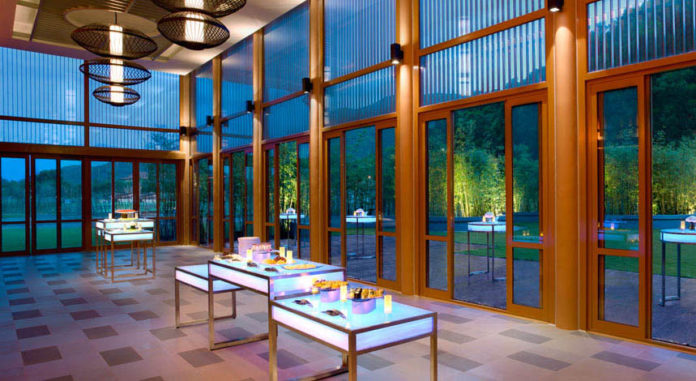
Also on site is a multi-purpose events space spanning over 2,525m2, designed for hosting conferences, meetings, and weddings, while a variety of smaller function rooms and outdoor pavilions cater to a range of events requirements.

Hambantota Resort & Spa is the first of two Shangri-La hotels under development in Sri Lanka and the group’s third resort in the Indian Ocean. The second hotel – Shangri-La Hotel, Colombo – is slated to open in 2017.