Royal Caribbean’s Anthem of the Seas is finally in Singapore and has rolled out a line-up of vacations onboard to destinations across South-east Asia, including special sailings for Christmas and the New Year.
Anthem of the Seas brings to the table 30 holidays to choose from. For those seeking a short getaway, there are the three- to four-night trips to Malaysia and Thailand; or the five-night Spice of Southeast Asia vacation to destinations like Penang, Phuket, Phi Phi Islands and more.
Enjoy a range of sailings on the Anthem Of The Seas departing from Singapore
Those with more time to spare can join the eight-night Bali Adventure that takes travellers on a journey to Bali’s coastline, where they can visit iconic temples like Tanah Lot and Uluwatu, enjoy traditional Balinese dance performances and discover the cultural hub of Ubud.
Holidaymakers looking for an immersive journey to Vietnam and Thailand can enjoy a 10-night South-east Asia adventure, where they can explore Ho Chi Minh City’s History Museum, Vietnam’s Reunification Hall, Thailand’s Grand Palace and Wat Arun, or shop at the Ben Thanh Market in Vietnam.
For the festive sailings, there is the four-night Christmas getaway on December 24 to Penang and Phuket, as well as the five-night voyage departing on December 28, which will journey to cities across Malaysia and Thailand.
KTO organised a fam trip for Singapore travel agents and media earlier this month to spotlight destinations beyond Busan; photo by KTO
In an effort to bring more travellers’ attention to destinations beyond popular Busan in the country’s south-east region, the Korea Tourism Organization (KTO) organised a fam trip for Singapore travel agents and media earlier this month.
The activity was part of KTO’s strategy to actively promote the cities of Busan and Ulsan, and Gyeongnam province, or BuUlGyeong, as a combined destination.
KTO organised a fam trip for Singapore travel agents and media earlier this month to spotlight destinations beyond Busan; photo by KTO
The fam trip highlighted a blend of cultural heritage, natural scenery, arts and creativity, local cuisine and outdoor leisure activities across Sancheong, Hapcheon, Hadong, and Gimhae in Gyeongnam province, as well as Ulsan and Busan.
Park Chul-ho, senior director of regional tourism promotion, KTO, said: “The BuUlGyeong region’s blend of urban excitement, natural beauty, and cultural richness creates an ideal destination for Singapore travellers seeking diverse experiences beyond Seoul.”
Lee Kyung Jin, deputy director of KTO (Singapore Office), added: “Singapore travellers are very well-travelled and they have been to South Korea many times. It is about showing them new places and attractions so they want to revisit South Korea.”
Park shared that the top inbound tourist markets to South Korea for 2023 were Japan, China and the US.
“While Singapore ranks behind these top markets, it remains a key focus for us. We will focus on targeted promotions to foster further growth,” remarked Park.
Exploring the south-east region is made possible with Busan’s Gimhae International Airport as a natural jumping point. To further facilitate tourism, a new international airport is being built on Busan’s Gadeok Island, which is expected to open in December 2029.
At present, Singapore Airlines flies to Busan four times a week, while Jeju Air does so seven times a week. In addition, Busan is developing the north port and expanding high-speed rail connections, which will boost access for international visitors, added Park.
When asked how the BuUlGyeong region would appeal to Singapore travellers, travel agents told TTG Asia that they could include certain destinations into their future itineraries.
Syaza Anwar, director, Azza Travel & Tours, which specialises in tours for Muslim travellers, said she usually uses the main cities of Seoul and Busan as a draw to invite travellers to explore other parts of South Korea that are new to them. Attractions such as the Jangsaengpo Whale Culture Village and Sancheong Donguibogam Village would appeal to her customers. With regards to food, she noted that “while there are not many halal restaurants, there are more vegetarian and vegan restaurants these days, so we can still find alternative places for our customers”.
Meanwhile, Busan is stepping up its promotional efforts. Inbound tourism for 2024 is expected to exceed the record set in 2019, indicating that Busan has nearly overcome the effects of the pandemic on tourism, shared Lee Jung-sil, president of Busan Tourism Organization (BTO).
BTO plans to enhance the port city’s branding as an “international tourism city”, further develop its tourism industry through corporate collaboration, and implement market-specific strategies targeting South-east Asia, including Singapore, as well as China, Taiwan, Japan, and the Americas.
“According to a survey of visitors planning to visit Busan, over 60 per cent of both domestic and international respondents listed food as the number one reason for their trip. Moving forward, we plan to strengthen experiential content that combines unique Busan experiences with local cuisine,” Lee added.
In today’s digitally connected world, travellers are no longer confined to one source for inspiration, with Sarah Mathews, managing director of eTourism Frontiers, noting the end of the “mono-searching” era.
“The disruptors of discovery (are drawing us) away from mono-searching. For those of you who still reach out to your High Street travel agent, you’re one of the very few,” said Mathews during her speech at the PATA Destination Marketing Forum 2024 (PDMF) in Phetchaburi, Thailand.
Sarah Mathews emphasises the interconnected, non-linear nature of modern consumer journeys at the PDMF 2024 hosted at Dusit Thani Hua Hin on November 14; photo by PATA/PDMF
Mathews emphasised that platforms like Netflix, social media, and even gaming have become key sources of travel inspiration. “For some of us, the way we access travel information isn’t even through search anymore. It’s often from (indirect sources) – watching a Netflix programme, a cooking show, or engaging with social media,” she explained.
Such nonlinear discovery paths reflect how consumers have evolved into what she calls “digital omnivores”.
“We’re consuming content on multiple devices daily. This makes it harder to track users, but also broadens opportunities to reach audiences in unexpected places,” she noted.
AI has become central to this evolution. “AI-driven personalisation is everywhere – from Amazon recommendations to OTAs tailoring travel options,” said Mathews.
She urged destinations to leverage AI, warning that “destinations that don’t embrace AI to personalise experiences are already falling behind”.
However, Mathews reminded marketers that storytelling remains at the heart of destination marketing.
“It’s about the people, the culture, and the products. Technology is just a tool to share these stories,” she said, adding that video content is particularly crucial.
“The most time we spend online is on video. If you’re building an audience, focus on creating snackable, shareable video content,” she suggested.
Mathews also called for a shift from outdated success metrics, such as arrival numbers, to focusing on economic reinvestment. “You can’t champion sustainability while aiming for 10 million extra visitors annually,” she stated. Instead, she advocated for measuring economic output, empowering local ownership and ensuring economic benefit – especially in developing nations – as key to long-term sustainability.
This year’s PDMF spotlighted an immersive user-generated content contest, inviting participants to uncover content gems from the technical tours, highlighting the forum’s focus on innovative marketing strategies.
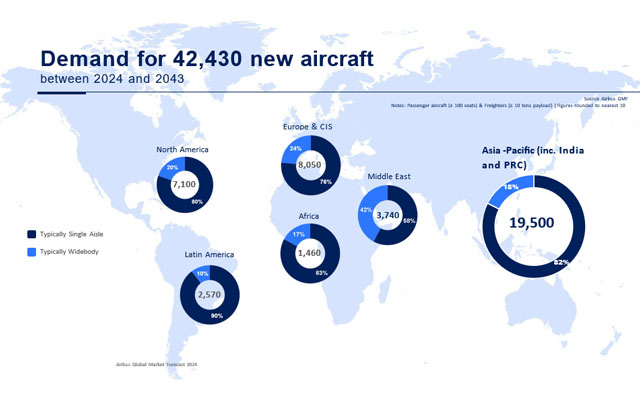
Airbus has released its latest regional market forecast, forecasting that the Asia-Pacific aviation sector will require 19,500 new aircraft over the next 20 years.
This demand represents 46 per cent of the global requirement, which is expected to reach around 42,430 new aircraft by 2043.
Airbus forecasts that the Asia-Pacific region will require 19,500 new aircraft by 2043, driven by strong growth in passenger demand and sustainability efforts
Anand Stanley, president of Airbus Asia-Pacific, presented these findings during the Association of Asia-Pacific Airlines’ Annual Assembly of Presidents in Brunei, underscoring the region’s continued growth and importance in the global aviation market.
The Asia-Pacific forecast, which includes China and India, reflects a year-on-year growth of three per cent in terms of new aircraft needed. With this surge in demand, the region’s fleet will continue to expand, driven by both growth and replacement needs, with sustainability initiatives becoming more prevalent.
Airbus anticipates the need for 16,000 single-aisle aircraft, such as the A220 and A320neo Family, to support the region’s short- and medium-haul routes. At the same time, demand for medium- and large-sized long-range aircraft, like the A330neo and A350, will total approximately 3,500 aircraft. Key recent widebody aircraft orders in the region include Cathay Pacific (A330neo), as well as EVA Air, Japan Airlines and Korean Air (A350), with several other ongoing campaigns expected to fuel growth.
Airbus estimates that nearly 71 per cent of the aircraft deliveries will support fleet expansion, while 29 per cent will replace older models, significantly contributing to decarbonisation efforts. The next generation of Airbus widebody aircraft offers an immediate 25 per cent improvement in fuel efficiency and a corresponding reduction in carbon emissions. These advancements reflect Airbus’ commitment to supporting the aviation industry’s goal of minimising its environmental footprint.
The Asia-Pacific region is projected to have an annual growth rate of 4.8 per cent, outpacing the global growth rate of 3.6 per cent, with widebody aircraft playing a pivotal role in enhancing passenger connectivity.
The A350 has established itself as the leader in longhaul travel, with nearly 300 A350s already in service in Asia-Pacific and another 230 on order.
At the same time, the A330ceo replacement cycle is underway, with some 540 A330ceos currently operating in the region. The A330neo is positioned as the optimal replacement, offering a seamless transition for airlines, with commonality in pilot training and technical operations between the two models.
Stanley stated: “As one of the fastest-growing aviation markets in the world, the Asia-Pacific region is poised for significant growth over the next two decades. With rising demand for both passenger and cargo operations, we are well-positioned to help our airline partners meet their long-term goals with the most efficient, sustainable, and advanced aircraft available, while contributing to decarbonisation efforts across the industry.”
According to a new report from Rocket Travel by Agoda, travel-based loyalty programmes continue to climb in popularity thanks to the sector’s ability to build loyalty through highly personalised customer experiences.
Rocket Travel by Agoda’s 2025 Trend Report reveals that the top five airline loyalty programmes alone saw a 7.75 per cent average growth in valuation from 2020 to 2023 while some travel loyalty programmes in the financial services sector have tripled in value since 2019.
The new report outlines how travel drives high levels of loyalty in commoditised marketplaces
“Unlike other industries, travel is something that people are emotionally invested in,” said Damien Pfirsch, head of Rocket Travel by Agoda, the strategic partnerships arm of Agoda. “By offering real-world experiences that customers really care about, it’s easier for brands to turn transactional relationships into long-term partnerships with their customers.”
While the report noted a dip in levels of customer satisfaction for many customer loyalty programmes post-Covid because of reductions in benefits, there was now an opportunity to reignite customer enthusiasm through more engaging online experiences. For brands using Rocket Travel by Agoda solutions, some partners have seen 40 per cent of loyalty users book more than once.
“Digital travel platforms are uniquely engineered to let customers design their own, highly personalised experience thanks to great search capabilities and a wide selection of destinations and accommodations – all at value-driven prices,” he said. “The technology is also highly customisable, so brands are able to offer their loyalty customers an enjoyable experience with all the look and feel of their main site.”
Other benefits include the ability to search based on distance to key points of interest, find refundable or flexible travel options, filters based on pricing data and localised languages. Meanwhile interactive tools proactively recommend options to the customer based on their preferences – like deep discounts for price-sensitive travel planners or options with high earning potential for points-hungry members – drive increased repeat rate and added long-term value from each customer.
“And these personalisation capabilities are only going to get stronger as the industry embraces AI,” Pfirsch noted.
The report highlighted that travel-based loyalty programmes tend to appeal to higher spending customers, presenting businesses with the opportunity to not only boost levels of customer engagement but also benefit from higher customer lifetime values.
Elsewhere the report explores how travel-based loyalty programmes offer partners the opportunity to tap into ancillary revenue streams.
“Travel loyalty programmes also offer businesses the flexibility to drive ancillary revenue through expansion into adjacent verticals such as hotels, car hire and ground transportation,” he shared. “For example, we worked closely with one of our partners to estimate that if they looked to offer trip insurance as an add on, they could boost incremental revenue by around US$1.2 million and the early results are indeed looking promising.”
Rocket Travel by Agoda leverages its extensive industry expertise to guide partners in crafting loyalty programmes that resonate with their audiences, build loyalty and support sustainable growth. With a clear focus on personalised and flexible offerings, brands can build lasting customer relationships and elevate their market presence in 2025 and beyond.
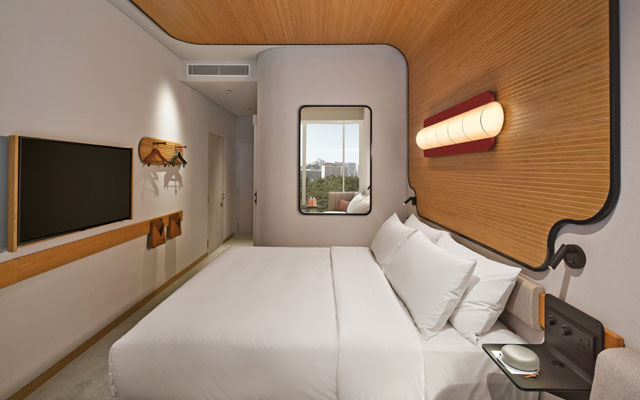
The Standard, Singapore, Singapore The Standard, Singapore is situated just steps away from both the 150-year-old UNESCO Botanic Gardens and the Orchard Road shopping district.
Situated on Orange Grove Road, the property features 143 rooms across eight floors each with floor-to-ceiling windows, boasting views of the pool, and the lush greenery of the district.
For F&B, the hotel offers an Izakaya experience and an inventive cocktail programme, as well as a café serving an all-day menu.
Soul Boutique Hotel
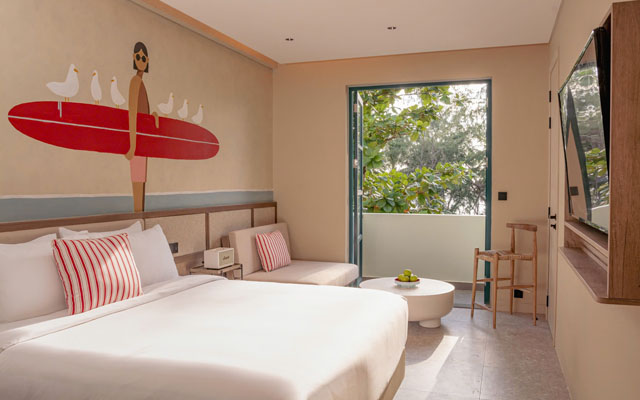
Soul Boutique Hotel, Vietnam
Located just 15 minutes from Phu Quoc International Airport within the Marina Phu Quoc complex, Soul Boutique Hotel provides guests a choice of 58 beachfront rooms.
The hotel offers shared access to amenities with Sailing Club Phu Quoc, where guests can indulge in an array of activities or unwind by the beachfront.
Mandarin Bay Resort and Spa
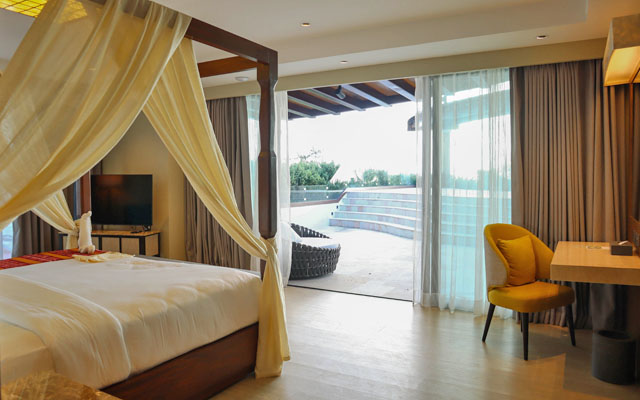
Mandarin Bay Resort and Spa, the Philippines Mandarin Bay Resort and Spa at Station 2 in Boracay has soft opened, featuring 365 guestrooms ranging from 38m² to 55m².
Most of its nine F&B outlets are already serving a variety of cuisines, and guests can enjoy a dip at the resort’s 220m² long pool.
Its Spa Village will soon open, followed by the convention centre.
Hotel Nikko Kaohsiung
Hotel Nikko Kaohsiung, Taiwan The 260-key Hotel Nikko Kaohsiung is the first Nikko-branded hotel in southern Taiwan, and is located in the Asia New Bay Area of Kaohsiung City.
The hotel is easily accessible with the nearby MRT and Light Rail stations, and is just a 25-minute drive from Kaohsiung International Airport and a 1.5- hour journey from Taipei via high-speed rail.
Onsite are five restaurants, a swimming pool, gym, sauna, club lounge, and event venues.
The PATA Destination Marketing Forum 2024 (PDMF 2024), held from November 12 to 14 at the Dusit Thani Hua Hin in Phetchaburi Province, Thailand, has showcased the province as an ideal international conference destination, highlighted its status as a UNESCO Creative City of Gastronomy, and strengthened collaboration between local stakeholders and major tourism organisations.
Under the theme Authentic Prosperous Journeys: Nurturing Culture, Culinary Delights, and Community Wisdom, PDMF 2024 explored the impact of tourism beyond economic growth. The forum spotlighted community-based tourism and examined its positive effects on local communities, job creation, cultural preservation, and the collaboration between national and provincial authorities to promote tourism.
From left: Tourism Authority of Thailand’s Siripakorn Cheawsamoot, PATA’s Peter Semone, Phetchaburi Province’s Wanpen Mungsri, Thailand Convention and Exhibition Bureau’s Chiruit Isarangkun Na Ayuthaya, and DASTA’s Athikun Kongmee
The event was organised by PATA in partnership with Phetchaburi Province, Thailand Convention and Exhibition Bureau, and the Designated Areas for Sustainable Tourism Administration (DASTA), with the support of the Tourism Authority of Thailand.
On November 13, delegates joined one of three different tour routes arranged by DASTA and its partners, which showcased Phetchaburi’s community-driven tourism. Highlights of the tours included hands-on experiences in cooking local dishes, seasonal salt-making, traditional Thai shadow puppet-making, and visits to iconic landmarks. Delegates were encouraged to post about their experiences on social media as part of the Phetchaburi in Focus: Social Media Contest, with winners announced during the conference.
On the following day, attendees participated in conference sessions led by tourism professionals, community leaders, and specialists from diverse fields, including digital marketing, marine biology, culinary arts, and renewable energy. Representing the public sector were organisations such as the Ministry of Tourism of Cambodia, the National Food Institute, the Nepal Tourism Board, the Palau Visitors Authority, the Sabah Tourism Board, the Sarawak Tourism Board, and the Sri Lanka Tourism Development Authority. Representatives from the private sector included e-Tourism Frontiers, Intrepid Travel, and OAG, to name a few.
The event welcomed over 370 delegates from 26 destinations across Asia-Pacific and beyond, including Australia, Bangladesh, Bhutan, Cambodia, China, Taipei, Gibraltar, Hong Kong, India, Indonesia, Japan, Lao, Macau, Malaysia, Nepal, New Zealand, Oman, Palau, the Philippines, Singapore, South Africa, Spain, Sri Lanka, the UK and the US.
PATA chair Peter Semone remarked during his opening speech: “Tourism today must extend beyond mere economic growth to embrace the environmental and sociocultural aspects of tourism, creating a positive ripple effect in the communities that host us. The value of tourism lies not only in the revenue it generates but in its power to create jobs, protect culture, support environmental preservation, and foster a shared economy that lifts all members of a community.”
Wanpen Mungsri, deputy governor, acting governor of Phetchaburi Province, said: “The theme aligns with global tourism trends that prioritise community involvement, sustainable growth, and eco-friendly practices, as well as addressing climate change. Most importantly, Thailand and the Asia-Pacific region will strive toward stable, prosperous, and sustainable growth, leaving no one behind.”
Ayana Hospitality has launched Ayana Bali’s newly redesigned website that provides an immersive and intuitive experience for its guests.
Ayana Bali’s new digital presence features the four properties – Ayana Resort, Ayana Segara, Ayana Villas, and Rimba by Ayana Bali – seamlessly connected within the 90-hectare estate, and showcases Ayana Bali’s facilities, experiences, landscapes, and guest offerings.
With a reimagined digital presence, guests can now explore Ayana Bali’s four integrated resorts with ease; Rimba by Ayana Bali, pictured
Through the new website, users can explore dining options and activities available throughout the destination, such as its 14 pools, secluded beach picnics, farm-to-bar workshops, peaceful walks in the six-hectare Tevana Garden, and much more.
The redesigned website introduces interactive features and a convenient direct booking experience that guarantees the best rates, exclusive offers, and added benefits. Highlights include activity showcases that allow guests to visualise and personalise their stay by combining an array of spa, dining, cultural, and leisure experiences across the four resorts.
An interactive property map invites visitors to explore Ayana Bali in detail, zooming in on dining outlets, facilities, photo spots, and hidden corners. Additionally, eight detailed itinerary ideas offer solutions for holiday planning, ranging from Romantic Getaways and Family Fun Adventures to Rejuvenation Retreats and Creative Family Escapes, ensuring a curated itinerary across the resorts for every type of traveller.
Giordano Faggioli, general manager of Ayana Bali, commented: “Our goal was to create a digital experience that reflects the elegance and beauty of Ayana’s world-class offerings while expressing our unique integrated resort concept. We’re excited to invite visitors to explore a website that showcases the beauty of our four connected properties and the freedom guests have to envision and plan every aspect of their stay.”
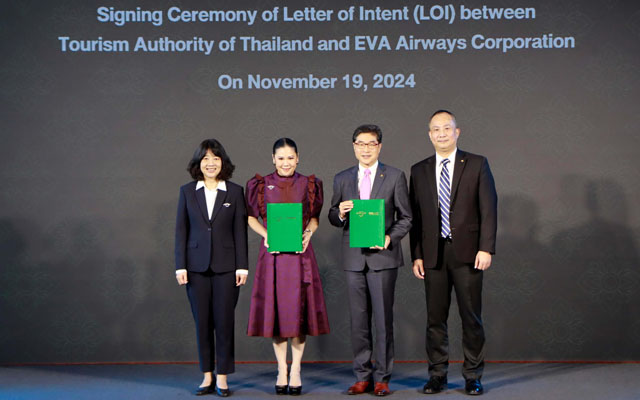
The Tourism Authority of Thailand (TAT) and EVA Air have renewed their strategic partnership with a four-year Letter of Intent (LOI) to further boost tourism to Thailand from key international markets.
The LOI was signed by TAT deputy governor for international marketing – Asia and South Pacific Pattaraanong Na Chiangmai, and EVA Air vice president Tang Tseng, and witnessed by TAT governor Thapanee Kiatphaibool, and EVA Air executive vice president Albert Liao along with senior executives from both organisations.
The four-year extension builds on past success to enhance Thailand tourism via EVA Air’s global network
The renewed partnership focuses on joint marketing campaigns, familiarisation trips for media and travel agents, attractive travel deals with tour operators, and participation in tradeshows and roadshows to maximise visibility.
These efforts build on past collaborative initiatives, such as the 2023 tram campaign in Amsterdam promoting Thailand and EVA Air’s Bangkok-Amsterdam flights, which ran earlier in September and reached 21 million impressions. Other successful activities include Thai tourism promotions at the 2024 Bookizcon in South Korea and a networking event in Sendai, Japan, involving 11 tourism partners.
Headquartered in Taipei, EVA Air is a Star Alliance member and operates 28 weekly flights between Bangkok and Taipei and daily flights between Taipei and Chiang Mai. Its Bangkok-Taipei route will increase to 32 weekly flights from January 15 to March 29, 2025.
In addition to regional connectivity, the airline links Bangkok with Japan, South Korea, China, Hong Kong, and Macau via Taipei. It also offers direct flights from Bangkok to key European cities such as London, Vienna, and Amsterdam, with connections via Taipei to Paris, Milan, and Munich. For longhaul routes, EVA Air operates 87 weekly flights connecting Thailand to major North American cities, including Los Angeles, San Francisco, New York, and Toronto.
Liao stated: “Our partnership with TAT strengthens Thailand’s appeal as a premier destination. Through joint marketing and tailored packages, we aim to introduce Thailand’s attractions to more travellers across our network.”
“This renewed alliance will inspire more travellers and reinforce Thailand’s position as a must-visit destination,” added Thapanee.
Universal Studios Japan is expanding Super Nintendo World with the world’s first Donkey Kong Country area, following its popular opening in March 2021.
Based on the video game series created by Nintendo, Donkey Kong, Donkey Kong Country will make its grand opening on December 11 and provide new experiences such as The Golden Temple, a shining structure located in the deepest part of the jungle that has actually appeared as a level in Donkey Kong games. Inside, guests will enter the world of Donkey Kong and feel the atmosphere of the mysterious ruins as well as discover the mural inside.
The new Donkey Kong Country area will officially launch on December 11
There will also be a new ride attraction, Mine Cart Madness, which utilises an innovative ride system and a unique coaster design, sending riders on an unpredictable adventure where they will experience jaw-dropping manoeuvres.
In addition, the theme park will offer new Play Wild! merchandise, including a ticket holder featuring designs of Donkey Kong’s trademark red tie and barrels as well as straps that match the tropical image of the area.
Information about the new area and the experiences that await guests will be announced prior to the grand opening.